A federal grand jury in Minnesota has indicted 10 green card holders for illegally voting or falsely claiming citizenship to vote, one as recently as the August 11 primary. Minnesota's top election official says the case proves noncitizen voting is "vanishingly rare." The Justice Department's own case list says something else: every alleged false citizenship claim was made in person during a voting window, the moment when Minnesota's only check on citizenship is a checkbox and a signature.
Ten Indictments, One HSI Investigation
Attorney General Todd Blanche, Homeland Security Secretary Markwayne Mullin and U.S. Attorney Daniel N. Rosen announced the charges Wednesday. The grand jury returned ten separate indictments on September 24, and the release credits an investigation by Homeland Security Investigations. All ten defendants are lawful permanent residents, from Liberia, Lithuania, Ghana, Germany, Bosnia, Brazil, Canada and South Africa.
"The law is clear, only American citizens may vote in American elections, and enforcing this law is fundamental to our democracy. That should not be a partisan concept," Blanche said. Rosen put it more bluntly: "When, in order to obtain a ballot, a non-citizen swears he or she is a citizen, we will prosecute."
The counts carry real weight. False claim of citizenship in order to vote, under 18 U.S.C. 1015(f), is a felony with up to five years in prison. Voting by an alien under 18 U.S.C. 611 is a misdemeanor with up to one year. Nine defendants face the voting count and eight face at least one felony count. Every defendant is presumed innocent, and an indictment is only an allegation.
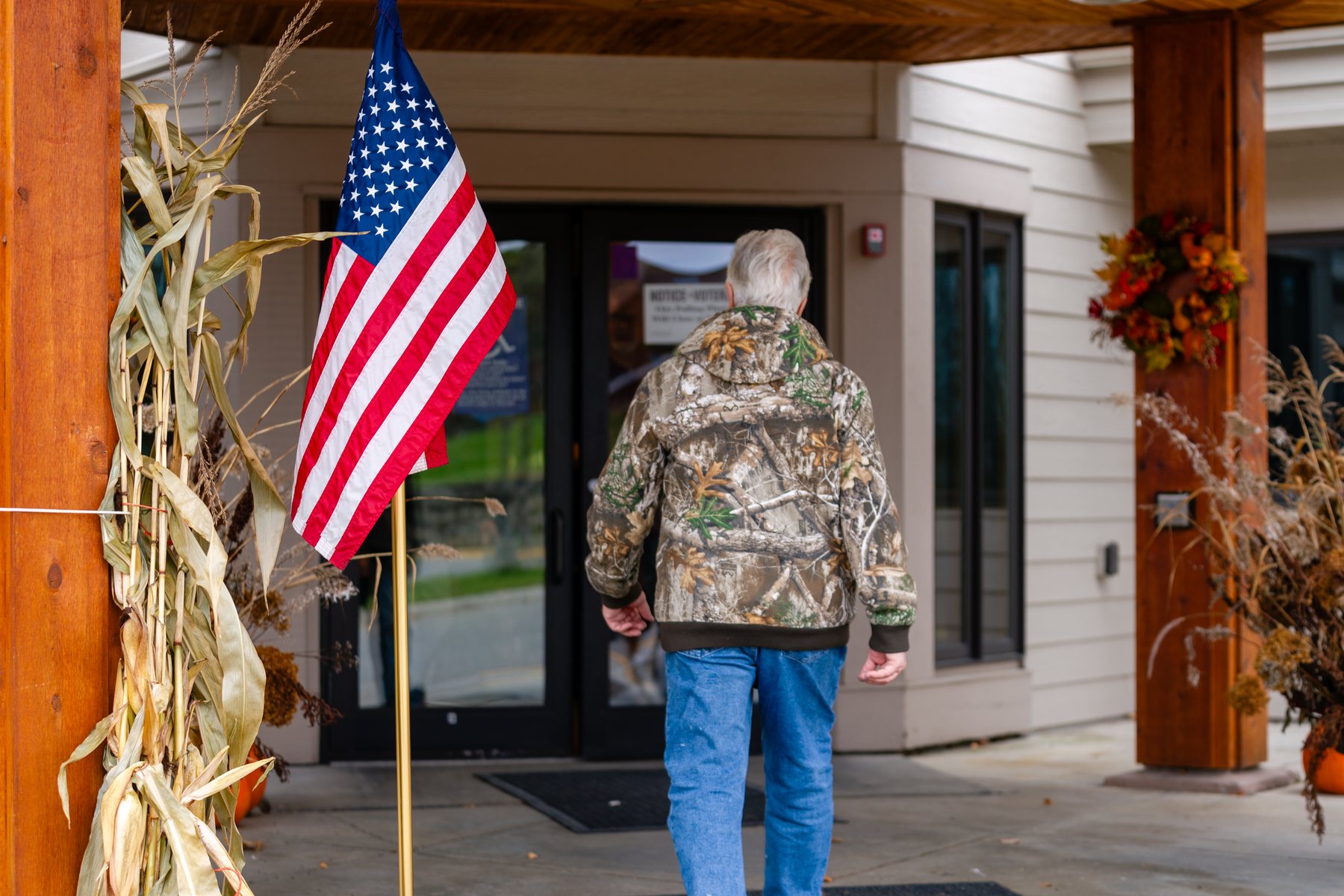
A voter heads into the combined polling place at Zion Lutheran Church in Grand Rapids, Minnesota, on Election Day, Nov. 7, 2023. (Photo: Lorie Shaull, CC BY 2.0, via Wikimedia Commons)
Read the Dates and a Pattern Jumps Out
Coverage has listed the defendants. What it has not done is line up the dates DOJ attached to each charge. There are nine alleged false citizenship claims across the ten cases, and not one of them is dated to the ordinary advance registration season.
Six of the nine were allegedly made on November 5, 2024, which was Election Day. Joshua Frederick Kofi Edzie's newest one is dated August 11, 2026, primary day. The remaining two are dated October 18, 2024 (Bhator Konah Bryant, "when registering to vote") and October 23, 2024 (Edzie again). Minnesota's deadline to pre-register for that election was October 15, according to MinnPost's 2024 election calendar, which explains that after that date Minnesotans could "still register to vote" only "while voting in-person absentee or at their polling place on Election Day."
So both October claims fell in the window when the only way onto the rolls was to show up in person and register at the same time you vote. The other seven fell on an election day itself. Seven of the nine voting counts are also dated November 5, 2024.
On Election Day, Citizenship Is a Signature
Minnesota asks about citizenship at two points on Election Day, and both are sworn statements. Under Minn. Stat. 204C.10, the version in force for the 2024 election, every voter must sign a polling place roster stating that he or she "is a citizen of the United States." The roster warns that "deliberately providing false information is a felony."
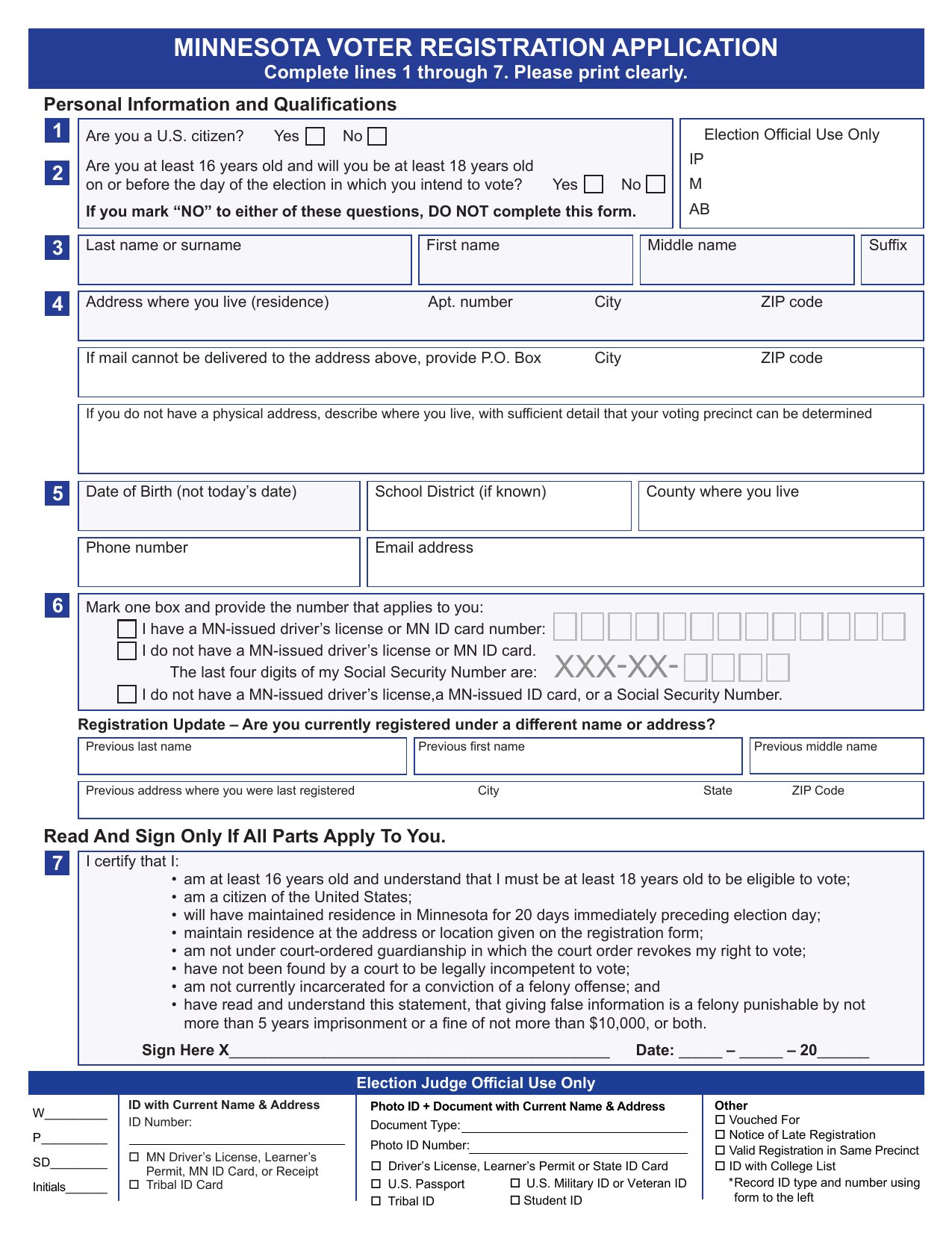
A voter who registers on the spot fills out the state's Election Day registration application. Its first line asks, "Are you a U.S. citizen?" with a Yes box and a No box. Line 7 is a signed certification that the applicant is "a citizen of the United States."
Official record
Minnesota Secretary of State, Election Day Voter Registration Application (2 pages), as posted on sos.mn.gov. The PDF's own metadata describes it as the form "with space for vouching information that is only used when registering at the same time as voting."
"Are you a U.S. citizen? Yes / No"
Line 1, Minnesota Voter Registration Application
Read or download the full 2-page application (PDF) · DOJ release 26-1119
Now look at the bottom of that page, the "Election Judge Official Use Only" strip. It has boxes for an ID with a current address, a photo ID plus a document with a current address, a student ID, a college housing list and "Vouched For." Every box is about proving where you live. None of them asks for proof of citizenship. A green card holder can legally hold a Minnesota driver's license, and that is the first ID listed.
The ID number on the form does not settle the question either. The form's own confidentiality notice says election officials use the birth date and ID number "to confirm your identity with the Minnesota Department of Public Safety or Social Security Administration." Identity is what gets checked. On Election Day, citizenship rests on the voter's word.
Simon's "Vanishingly Rare" Uses the Wrong Denominator
Secretary of State Steve Simon, a Democrat, answered the charges with a statement quoted by the Associated Press. "These indictments affirm the fact that noncitizen voting is a vanishingly rare crime," it said. "If these indictments result in convictions, that will amount to ten individuals over a period in which around 8.5 million votes were cast in Minnesota."
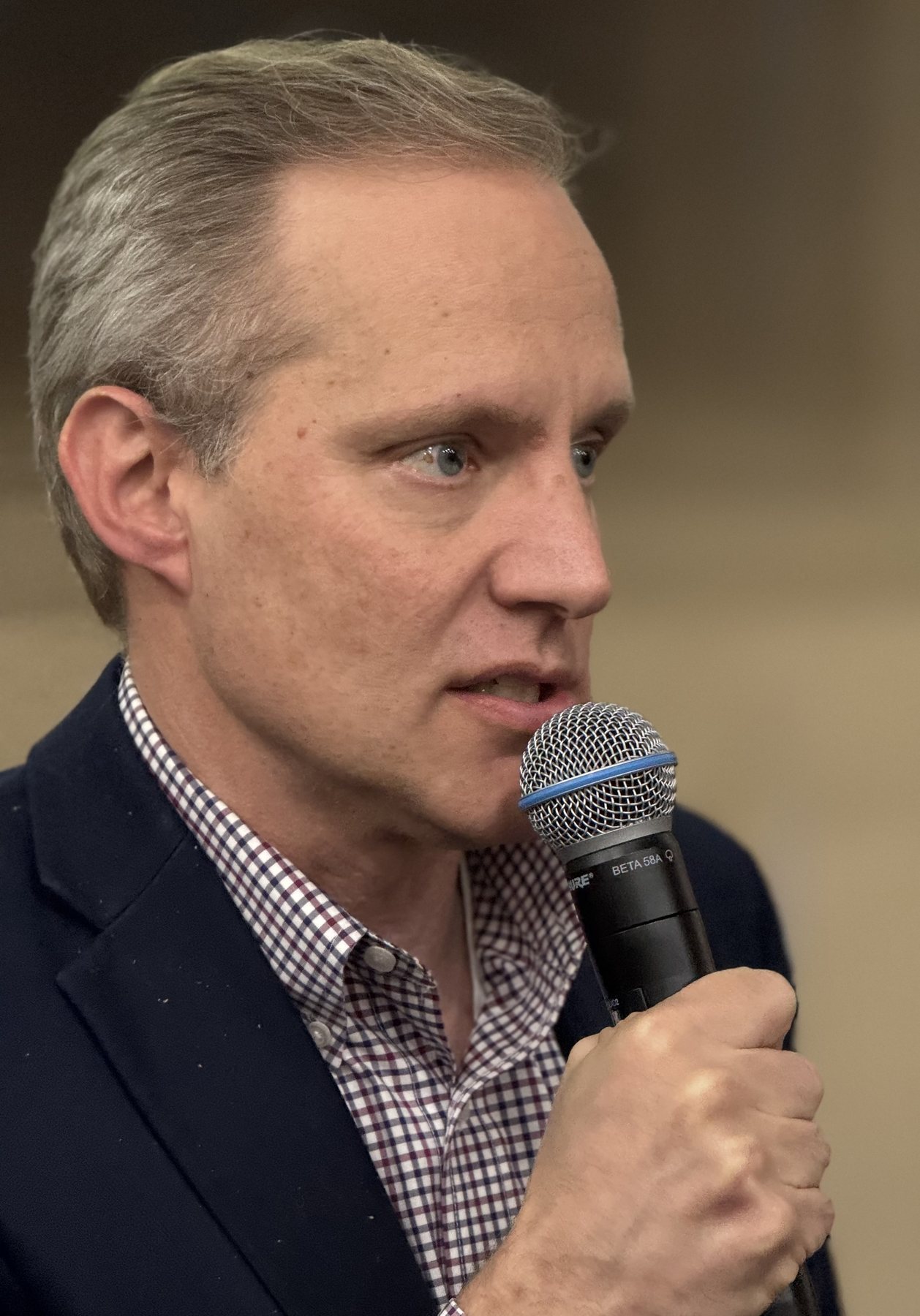
Minnesota Secretary of State Steve Simon speaking at Century Middle School in Lakeville, Minnesota, March 2026. (Photo: Travellers and Tinkers, CC BY-SA 4.0, via Wikimedia Commons)
Ten cases over 8.5 million votes measures how many people federal agents caught, not how many people voted illegally. Those are different numbers whenever the front-line check is an honor system. Nothing in DOJ's release or in Simon's statement says Minnesota's own election system flagged any of these ten. The cases came from HSI.
The calendar makes the point sharper. Edzie allegedly claimed citizenship in October 2024 and then, according to DOJ, did it again and voted on August 11, 2026. That was well into a year of national fights over noncitizen voting, the SAVE database and voter rolls. If the allegation holds up, the safeguard at his polling place did not stop him.
What the Skeptics Get Right
The AP's Nicholas Riccardi and Gary Fields made the other side's case in a piece published early Thursday, and some of it is fair. They reported that a Trump claim of 1,500 noncitizen voters in Nevada turned out to be zero once the names reached the state. In Arizona's Maricopa County, the federal database flagged 60 possible noncitizen voters and county prosecutors charged eight.
Blanche himself told reporters, "I don't think we can say there's a pattern we've identified," adding that "every case is different." He was answering whether the cases are connected, and nothing in the Minnesota indictments suggests a coordinated scheme. Ten votes would not have flipped a statewide race in 2022 or 2024.
None of that answers the question the dates raise. These ten are not people caught in a database mismatch. DOJ alleges that most of them signed a sworn statement saying they were citizens. Every one of them is a lawful permanent resident, carrying a green card that identifies the holder as a permanent resident, not a citizen.
The National Count Keeps Climbing
Minnesota is the biggest single batch so far, but not the only one. On Monday, DOJ announced charges and guilty pleas involving 12 more people in Florida, Kansas, New Jersey, Pennsylvania, Texas, Hawaii and Utah. That list includes the Utah postal carrier accused of dumping about 300 ballots. It also includes a New Jersey green card holder accused of voting in four straight presidential elections, from 2012 through 2024.
At Wednesday's press conference, Blanche said the department has charged 90 people with election offenses since President Trump returned to office, CBS Minnesota reported, 50 of them in the last five weeks. Mullin said DHS is investigating 1,600 voter fraud cases, and the AP quoted him adding "300,000 more that we're getting to." Rosen went further, telling reporters that Minnesota itself has created an environment that, in his words quoted by the AP, "seems to encourage non-citizens to break the law and vote."
With the Midterm Five Weeks Out, the Checkbox Is Still There
Minnesota voters go to the polls November 3. Same-day registration remains open, and the current form on the Secretary of State's website still asks citizenship as a yes-or-no question. The penalty for lying on it is a felony, which the state points to as the deterrent. These indictments are what it looks like when that deterrent fails and someone outside the election system goes looking.
Help from Washington will not arrive in time. The House-passed voter ID bill, H.R. 7008, takes effect 90 days after enactment, too late for November 3 even if it were signed today. So the question in Minnesota on Election Day will be the one it was in 2024. A voter checks a box, signs a line, and the state takes his word for it.
Top photo: Todd Blanche takes the oath of office as U.S. Attorney General in the Oval Office, Aug. 10, 2026. (Official White House photo by Daniel Torok, public domain, via Wikimedia Commons)