A Utah letter carrier has been federally indicted for throwing about 300 mail-in ballots into a church-parking-lot dumpster, and his excuse was that he wanted to "lighten his workload." The Justice Department's own detention filing lays out his day minute by minute. It shows he dumped the ballots 83 minutes into his route and then stayed out on the road for roughly three more hours anyway.
A Substitute Carrier, 300 Ballots and a Church Dumpster
The defendant is Damon Matai Seei, 34, of Payson, Utah. A federal grand jury indicted him on September 16, and the indictment was unsealed September 22 when U.S. Marshals arrested him and he appeared at the Orrin G. Hatch U.S. Courthouse in Salt Lake City, according to the Justice Department's announcement and KSL. He is a former carrier; prosecutors say he no longer works for the Postal Service.
On Wednesday, June 3, Seei was covering another carrier's route in Eagle Mountain, in Utah County. His bag held advertisements and hundreds of ballots mailed out for the state's June 23 primary. Prosecutors say he threw some of that mail, including roughly 300 ballots, into a dumpster at a local church.
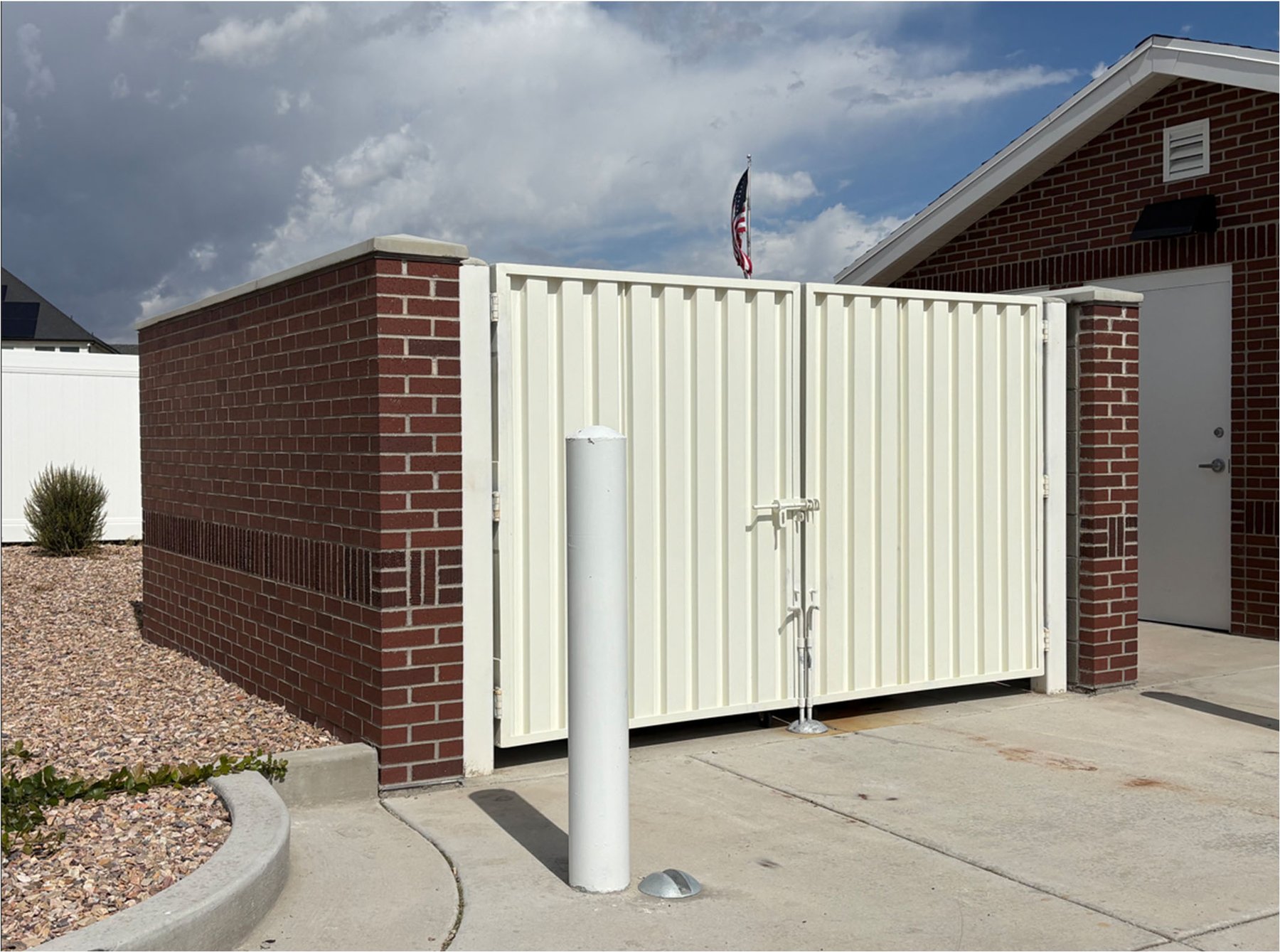
The dumpster enclosure in the church parking lot where prosecutors say the ballots were thrown away. Exhibit 2 to the United States' detention filing in United States v. Seei, No. 2:26-cr-00361 (D. Utah). (U.S. Attorney's Office court exhibit, public record)
"When American voters lawfully cast their vote, they should feel confident that it is counted," Acting Deputy Attorney General Trent McCotter said in the release. "Ballot integrity is not a partisan issue." The release pairs the case with a same-day Justice Department video announcing election-integrity enforcement actions.
DOJ's Own Timeline Blows Up the "Lighten His Workload" Excuse
The headlines ran with Seei's explanation. Almost nobody ran the clock. The United States' position regarding detention, filed September 17, cites Postal Service records for his entire shift.
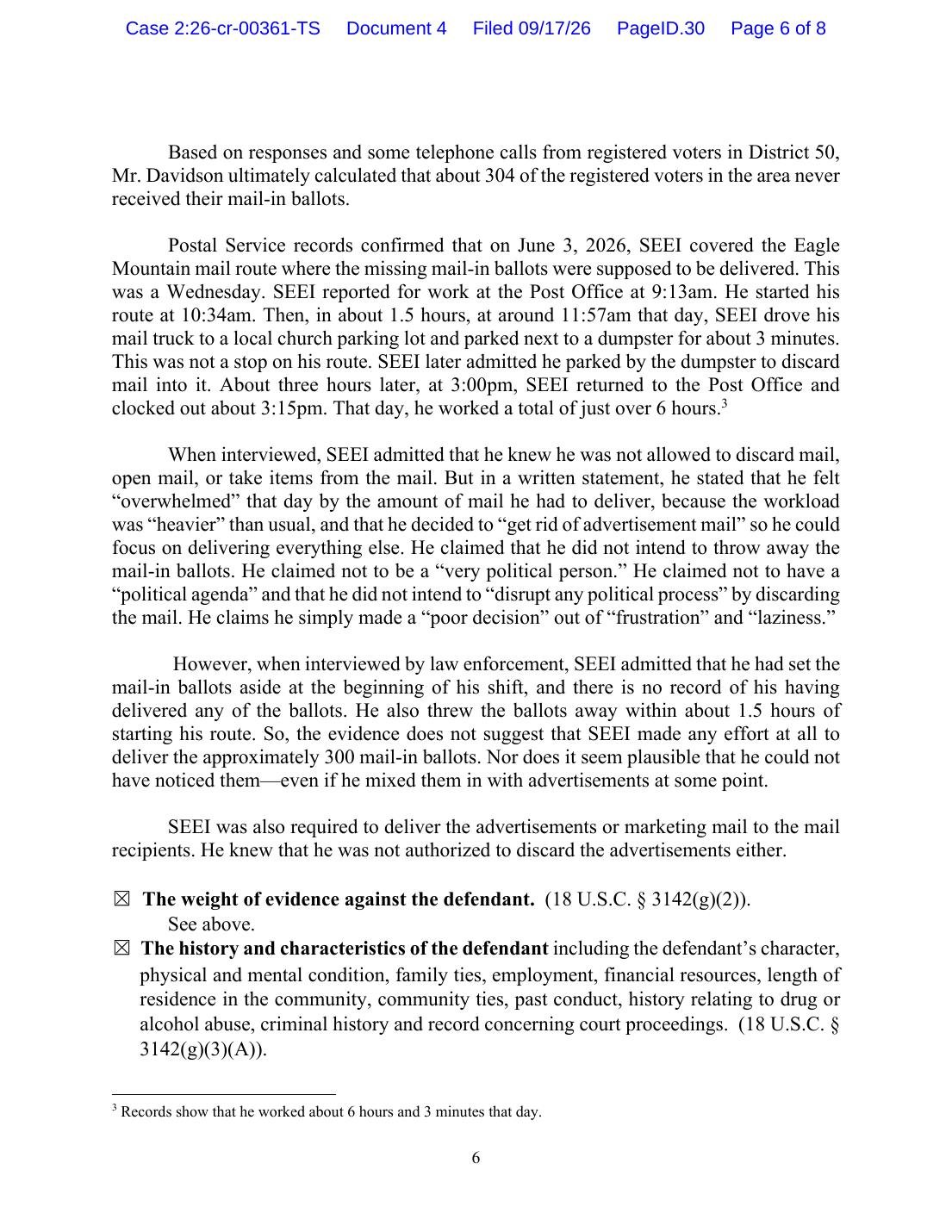
He reported to the post office at 9:13 a.m. and started his route at 10:34 a.m. At about 11:57 a.m. he drove his mail truck to the church lot, which was not a stop on his route, and parked beside the dumpster for about three minutes. Then he kept going. He did not return to the post office until 3:00 p.m. and clocked out around 3:15 p.m., for a workday of just over six hours.
So the ballots went into the trash 83 minutes into the route, and Seei still spent about three more hours out on it. Prosecutors wrote that he tossed the mail "presumably so he could go home earlier." If that was the plan, the records suggest it did not buy him much. Whatever he did with those three hours, the filing says there is "no record of his having delivered any of the ballots."
Official record
United States v. Damon Matai Seei, Case No. 2:26-cr-00361-TS (D. Utah), United States' Position Regarding Detention, Document 4, filed September 17, 2026, before District Judge Ted M. Stewart. Official copy at justice.gov.
"When interviewed by law enforcement, SEEI admitted that he had set the mail-in ballots aside at the beginning of his shift, and there is no record of his having delivered any of the ballots."
Detention filing, page 6
Read or download the full filing with exhibits (PDF, 15 pages) · Read the two-page indictment
He Says He Meant to Toss Junk Mail. Prosecutors Aren't Buying It.
In a written statement, Seei said he felt "overwhelmed" because the load was "heavier" than usual and decided to "get rid of advertisement mail" so he could focus on everything else. He said he did not mean to throw away ballots and claimed he is not a "very political person." He chalked it up to a "poor decision" made out of "frustration" and "laziness."
His own interview cuts against that. The filing says he admitted setting the ballots aside at the start of his shift. Prosecutors wrote that the evidence "does not suggest that SEEI made any effort at all to deliver" them, and that it does not "seem plausible that he could not have noticed them." U.S. Attorney Melissa Holyoak put it more bluntly at the press conference, telling reporters, "He did not deliver a single one," according to KSL.

U.S. Attorney Melissa Holyoak of the District of Utah, whose office is prosecuting the case. (U.S. Department of Justice official portrait, public domain, via Wikimedia Commons)
No one has charged or alleged a political motive, and the Justice Department's own filing notes that Seei denies one. What the record does show is that a single carrier could pull an entire neighborhood's ballots out of the mail stream and nobody inside the Postal Service noticed.
The Post Office Told Voters Their Ballots Were Coming
This is the detail that should bother every mail voter in America. According to the filing, many of the affected Eagle Mountain voters had email confirmations from the Postal Service saying their ballots were scheduled to arrive on June 3. The ballots never came.
The Postal Service did not catch it. A resident did. Utah County Clerk Aaron Davidson told KUTV his office was first alerted when an Eagle Mountain resident brought in a list of 27 neighbors who never got ballots. The filing says Davidson then ran the county's own databases, found turnout "remarkably low" in Utah House District 50, emailed voters there and mapped the replies. He counted about 304 registered voters who never received their ballots.
"There is no chain of custody when it goes through the U.S. Postal Service," Davidson told KUTV. He also said he still supports mailing ballots out, and is more worried about completed ballots making it back to clerks on time.
About 30 of Roughly 300 Voters Made It to the Polls
Davidson told KUTV that of the roughly 300 voters he confirmed, about 30 ended up voting in person. One Eagle Mountain couple who did told the station they expected long lines because so many neighbors were missing ballots. Instead, they said, "there was hardly anyone there."
That leaves roughly 270 voters who, by the clerk's count, did not show up to vote in person. Holyoak said investigators are still reaching out to find out whether any of them voted some other way. As of September 17, the filing says, the government had "not yet been able to notify" the roughly 300 victims at all, more than three months after the ballots went into the dumpster.
The ballots themselves are gone. Holyoak told KSL investigators never recovered them because the crime was not discovered until much later.
One Count, Five Years Max, and No Request to Hold Him
The two-page indictment charges a single count under 18 U.S.C. section 1703(a), the general law against a postal employee who "unlawfully secretes, destroys, detains, delays, or opens" mail. It lists "advertisements and mail-in ballots" side by side. The statute caps the penalty at five years in prison. There is no separate election-crime count.

The Orrin G. Hatch U.S. Courthouse in Salt Lake City, where Seei made his first appearance on September 22. (Photo: Swilsonmc, CC BY-SA 3.0, via Wikimedia Commons)
Prosecutors also did not ask the court to jail him before trial. The filing notes Seei has no identified criminal history and checks the box stating the government "is not seeking detention." It asked instead for release conditions, including one tailored to this case: that he "not interfere with any other delivery of mail, including, especially, the delivery of mail-in ballots."
The reason given was the calendar. "Given that a national election will take place on November 3, 2026," the filing says, the court should impose conditions to stop him from interfering with more ballots. His next court date is November 30, four weeks after that election.
Utah Already Voted to End Automatic Mail Ballots
Utah votes overwhelmingly by mail. Holyoak said more than 95 percent of Utah voters rely on mail ballots. That is changing slowly. In 2025 the Republican Legislature passed HB300, which phases out automatic mail ballots by 2029 and requires voters to opt in every eight years, according to Utah News Dispatch.
Lt. Gov. Deidre Henderson, the state's top election official, told KSL she was "grateful that the department takes cases of denying lawful voting just as seriously as alleged illegal voting." She urged Utahns to sign up at trackmyballot.utah.gov. That is good advice for anyone voting by mail this fall. In Eagle Mountain, the Postal Service's own emails said the ballots were on the way, and 300 voters only learned otherwise because a neighbor started making a list.
Top photo: A U.S. Postal Service Grumman LLV mail truck. (Photo: Famartin, CC BY-SA 4.0, via Wikimedia Commons)