An Oregon school district that hands homeschool families $2,000 per child refused to reimburse a Marine veteran mother one cent for her Christian phonics books. According to her new federal lawsuit, the same program pays for a kindergarten book that teaches "water has its own spirit" and ends with a pledge to "honor Mother Earth."
A Mother of Five Just Sued Hillsboro Over Her Kids' Schoolbooks
The case is Bulzan v. Hillsboro School District, No. 3:26-cv-01965, filed September 22 in the Portland Division of the U.S. District Court for Oregon. Tessa Bulzan homeschools her children in Hillsboro, a Portland suburb, and is represented by Alliance Defending Freedom. The 49-page complaint says the district violated her rights under the First and Fourteenth Amendments.
Her background is not what critics of homeschooling usually picture. The complaint says she did not learn to read until age ten because of undiagnosed dyslexia, got diagnosed only after joining the Marines, then earned an MBA from Duke and managed marketplace orders for Nike. She left that job to teach her kids at home on her husband's government salary. Her husband built her a classroom in the house.
"Religious families who choose to homeschool aren't second-class citizens, yet Oregon treats them as such by denying them a public benefit available to other families," ADF Senior Counsel Kate Anderson said in the group's announcement.
The District Pays for Curriculum, Just Not Christian Curriculum
Hillsboro runs a Homeschool Partnership out of its Hillsboro Online Academy, with on-site classes at Groner Elementary. The district's own curriculum allowance page says families can be reimbursed for "secular (non-religious) homeschool curriculum, extracurricular activities, and school supplies," and sets the 2026-2027 allowance at $2,000 per enrolled student. The program's home page repeats the "non-religious" rule.
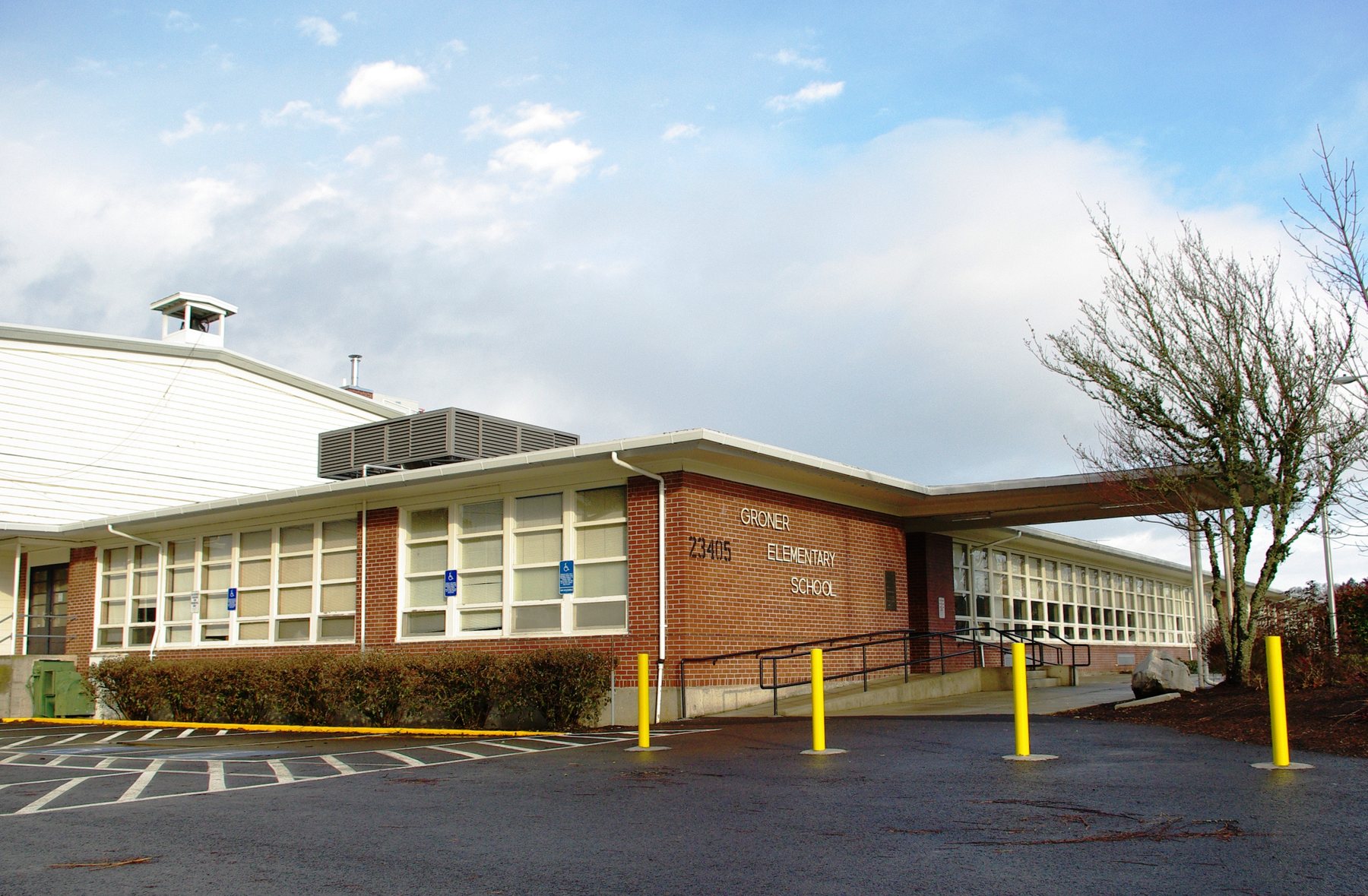
Groner Elementary School in Scholls, Oregon, where Hillsboro's Homeschool Partnership holds its on-site classes. (Photo: Aboutmovies, CC BY-SA 3.0, via Wikimedia Commons)
Bulzan enrolled two children in July 2025, using Abeka and Classical Conversations curricula plus classes at a Christian co-op called Firmly Planted Hillsboro. When she turned in receipts after the first semester, the district paid for her Math-U-See books and her son's swim-team dues. It refused everything else "due to the Christian and biblical worldview that is taught," according to district emails quoted in the complaint.
The rejection was total. The complaint says one Abeka second-grade worksheet asked the child to pick the right word in six sentences, and one of the six was "The Bible is the Word of God." Another read "Sarah will bake cookies for her family." The district would not reimburse any portion of the curriculum, including pages that never mention God, and it did pay for a similar secular reading series from Evan-Moor.
What the District Does Reimburse
This is the part of the lawsuit that ADF's own press release left out, and it is buried on page 12. The complaint says the Homeschool Partnership reimburses a kindergarten book titled We Are Water Protectors. In that book, the complaint says, a young girl explains that "water is sacred," declares that "water has its own spirit," and talks about a prophecy of her ancestors.
The book ends, according to the complaint, with an "earth steward and water protector pledge" to "honor Mother Earth." The author's and illustrator's notes describe "the sacred relationship between humanity and all living things." We Are Water Protectors, written by Carole Lindstrom and illustrated by Michaela Goade, won the 2021 Caldecott Medal. It is a picture book inspired by the Standing Rock protests against the Dakota Access Pipeline.
Official record
Tessa Bulzan v. Hillsboro School District and Hillsboro School District's Board of Education, Case 3:26-cv-01965-AR (D. Or., Portland Division), Complaint, filed September 22, 2026. Copy posted by Alliance Defending Freedom.
"Through HSDHP, the District reimburses materials and experiences that promote a wide range of worldviews, including instruction that contradicts Christian beliefs and instruction with other spiritual themes."
Complaint, paragraph 83
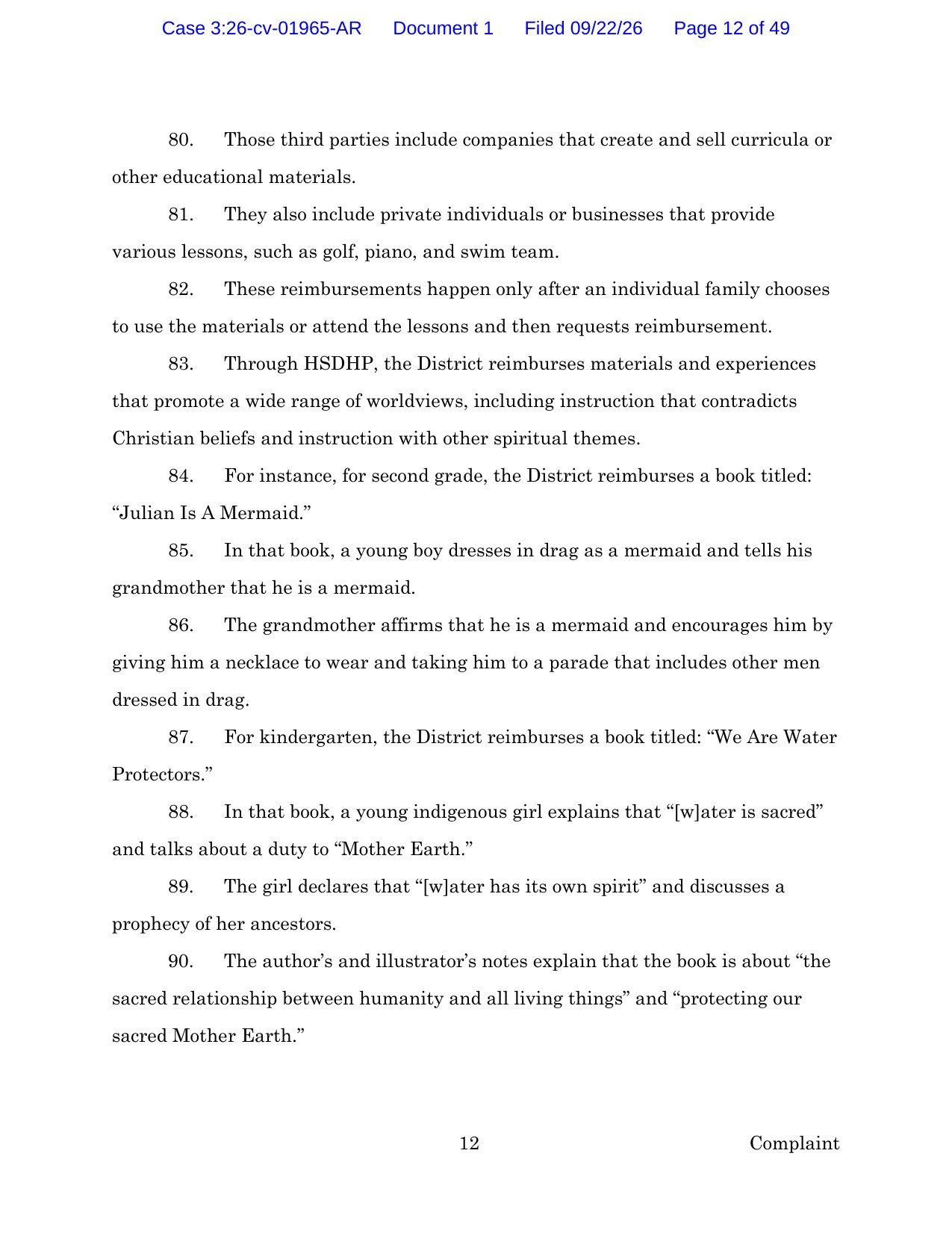
Page 12 of the complaint. Read or download the full 49-page complaint (PDF) · view the docket
The same page says the district reimburses Julian Is a Mermaid for second grade, a book the complaint describes as a boy who dresses as a mermaid and is taken by his grandmother to a parade that includes men in drag. Put the two lists side by side and the rule is plain. A book about sacred water spirits counts as secular. A phonics workbook with one Bible sentence does not.
Officials Kept Pointing to Salem
Every district official in the email trail blamed the Oregon Department of Education. The program administrator wrote that ODE was "very clear" that any school receiving state funds, charter or public, "cannot pay for religious curriculum," and that her "hands [were] truly tied." The Hillsboro Online Academy principal said reimbursing Abeka would "violate the Establishment Clause" and the Oregon Constitution.
That state provision is Article I, section 5, which says no money "shall be drawn from the Treasury for the benefit of any religeous [sic], or theological institution." A homeschooling mother buying phonics books is not a theological institution, and the U.S. Supreme Court has already said state no-aid clauses cannot be used to shut religious families out of a benefit everyone else gets.
The emails show something more pointed. The complaint says Assistant Superintendent Andrea Neville wrote to ODE that she did "not see this particular complaint as meeting the threshold for a full process," scolded an ODE specialist for sending Bulzan "detailed steps to launch a discrimination complaint," and asked the state to back the district "rather than expect [the District] to move through multiple steps." ODE told her the process was "required."
Neville also raised a rumor that another district was "reimbursing religious curriculum and materials." She wrote that she "truly hoped" it was not true and that, if it was, "it warrant[ed] a conversation of use of state funds in their program." In other words, the concern was not only Bulzan. It was any Oregon family getting Christian books reimbursed anywhere.
The New Contract Names Christian Curricula by Name
The district then put the policy in writing. At tech pickup for the 2026-2027 year, the complaint says, parents were handed a two-page "agreement" that had not been mentioned at enrollment. It says curriculum funds "may not be used to purchase or reimburse any materials, curriculum, classes, or activities that are religious in nature."
The agreement listed five curricula as ineligible, and the complaint says all five are grounded in Christianity. The first two were Abeka and Classical Conversations, the exact programs the district knew Bulzan used. A third was The Good and the Beautiful, which she had already bought for this year. The form warns that breaking program rules "may result in removal" at the discretion of staff. Bulzan and her husband have not signed it.
The Supreme Court Has Ruled on This Question Three Times
The complaint leans on a line of cases that runs straight at Hillsboro's rule. In Trinity Lutheran (2017), the Court said a state could not bar a church preschool from a playground-resurfacing grant because it was a church. In Espinoza (2020), it struck down Montana's use of its no-aid clause to exclude religious schools from a scholarship program.
Then came Carson v. Makin in 2022. Maine paid tuition for rural students at private schools but refused to pay if the school taught religion. The Court said a state that chooses to subsidize private education "cannot disqualify some private schools solely because they are religious." The complaint swaps homeschool materials into that sentence and quotes it back to the district.
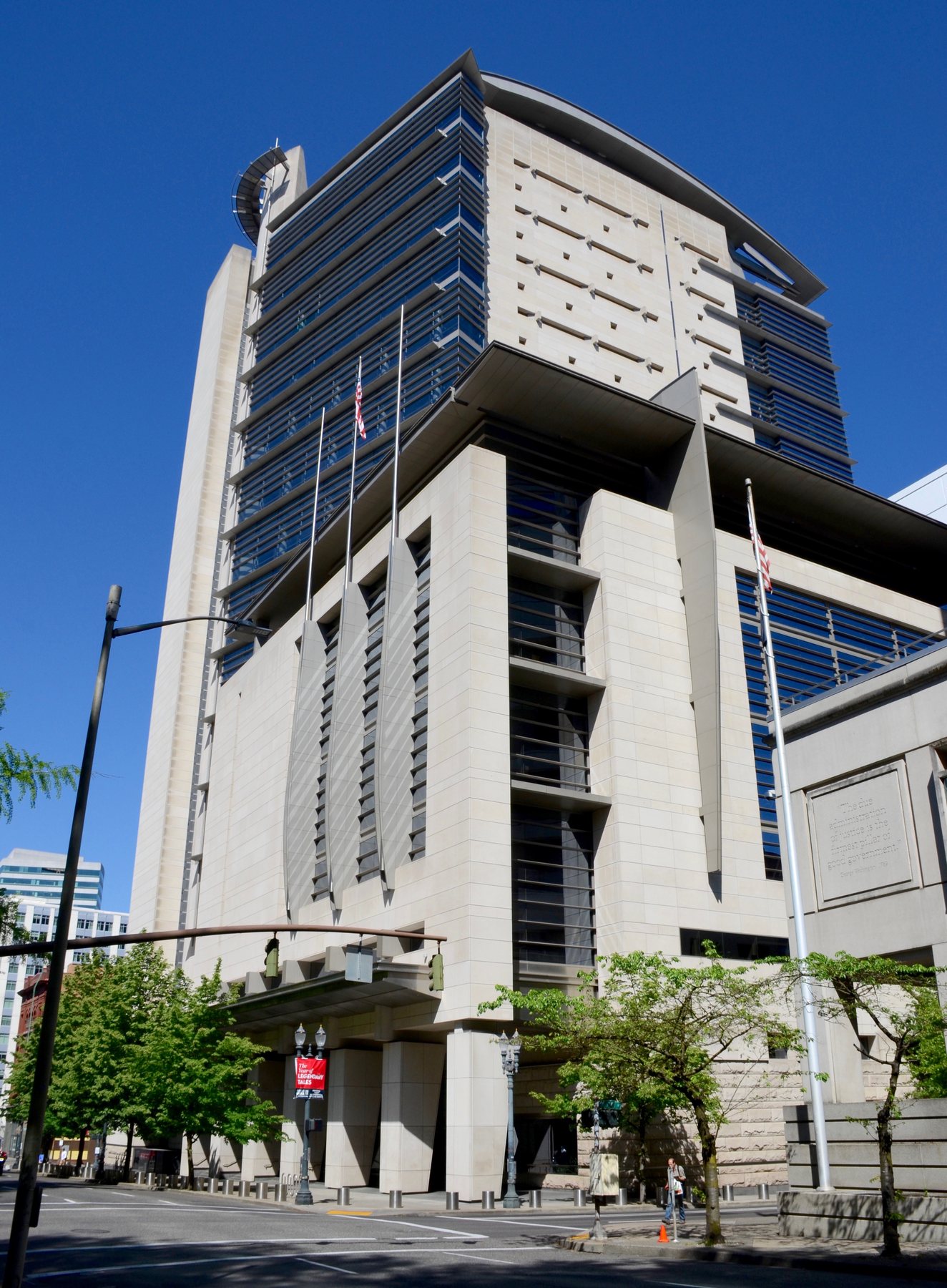
The Mark O. Hatfield U.S. Courthouse in Portland, home of the federal court's Portland Division, where Bulzan's lawsuit was filed. (Photo: Steve Morgan, CC BY-SA 4.0, via Wikimedia Commons)
Carson turned on the exact distinction Hillsboro is drawing. Maine argued it was only refusing to fund religious use of the money, not religious status. The Court rejected that. Hillsboro's principal said much the same thing in writing, telling Bulzan the district could approve a version of the curriculum with the religious instruction removed. The complaint also cites Mahmoud v. Taylor (2025), the Maryland opt-out ruling, for the point that homeschooling "comes with a hefty price" for religious families who already pay school taxes.
Oregon's Education Department Is Not a Defendant, Yet
One detail stands out in the caption. The only defendants are the Hillsboro School District and its board. The Oregon Department of Education, the agency every district official said was calling the shots, is not named. The prayer for relief still asks the court to declare that "the District's and ODE's policy" is unconstitutional.
That matters beyond one family. If a federal judge agrees that the policy came from Salem, other Oregon districts running similar homeschool allowances would have a hard time applying the same "non-religious" rule. Nothing has been decided. The allegations are Bulzan's, the district has not yet answered in court, and the case will be heard under Ninth Circuit precedent.
Bulzan is asking for an injunction requiring the district to reimburse materials that otherwise meet program rules regardless of religious content, plus damages and attorneys' fees. Her kids are enrolled again this year. Until a judge rules, a book about sacred water spirits stays reimbursable in Hillsboro, and a worksheet that says "The Bible is the Word of God" does not.
Top photo: Hillsboro School District's administration building in Hillsboro, Oregon. (Photo: Aboutmovies, released into the public domain, via Wikimedia Commons)