President Trump said Saturday he has approved new fuel economy standards that end the Biden-era push to force electric vehicles onto American car buyers, and Transportation Secretary Sean Duffy says the formal announcement comes Monday. The government's own cost tables show who gains the most: the three automakers Trump named, General Motors, Ford and Stellantis, save a combined $19.3 billion in compliance costs over five model years.
Trump Says the "EV Mandate" Is Terminated
Trump made the announcement on Truth Social Saturday afternoon. "BIG DAY FOR AMERICAN AUTO WORKERS AND CAR BUYERS!" he wrote, saying he had approved standards that "TERMINATE" what he called the Biden and Buttigieg "EV Mandate," according to the full post reproduced by Mediaite.
He promised "LOWER PRICES, saving families thousands on a new, beautiful, and safe car," and said "Every Manufacturer, from General Motors to Ford to Stellantis, has called me wanting to build here, and now they can!" He thanked Duffy and Commerce Secretary Howard Lutnick, per Fox Business.
Duffy followed on X: "a major victory for America's auto workers is COMING MONDAY," Newsweek reported. As of Sunday no final rule text has been released, so the only official numbers anyone can check are in the proposal NHTSA published last December.
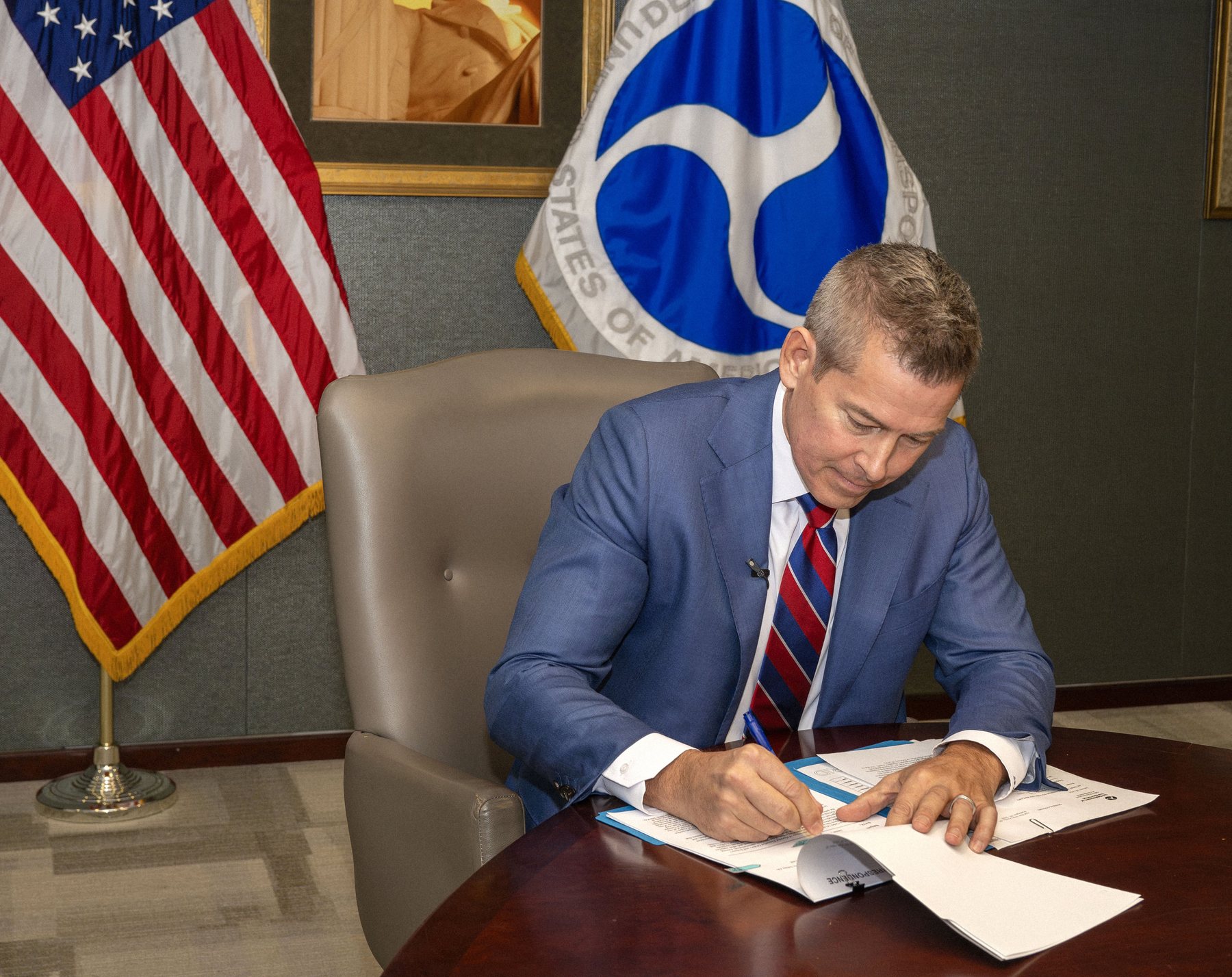
Transportation Secretary Sean Duffy signs a 2025 memorandum, his first action as secretary, directing staff to reset fuel economy standards. (U.S. Department of Transportation, public domain, via Wikimedia Commons)
What the Proposal on the Table Actually Does
The document is the SAFE Vehicles Rule III proposal, published December 5, 2025 at 90 FR 56438. It runs 219 pages. NHTSA's preferred option sets a combined requirement of roughly 34.5 miles per gallon for model year 2031. The Biden-era standards it replaces were aimed at about 50.4 mpg by that same year, per Newsweek.
The legal pivot is about electric cars. The proposal says federal law directs NHTSA to set standards that are feasible for gasoline and diesel vehicles "without regard to any reliance" on electric alternatives. EVs still count toward compliance if automakers choose to build them. They just no longer set the bar for everyone else. NHTSA laid that groundwork in a June 2025 interpretive rule that said the prior administration "illegally used CAFE standards as an electric vehicle mandate."
There is one more fact most coverage skips. Congress already set the CAFE civil penalty to zero in the July 2025 tax and spending law, Public Law 119-21, and the proposal says NHTSA updated its model to "set the value of civil penalties at zero." Monday's rule resets the target. The fine for missing the old target is already gone.
The Detroit Three Get 44 Percent of the Savings
Here is what the headlines missed. Table IV-22 of the proposal breaks out each automaker's cumulative technology costs for model years 2027 through 2031. Under the Biden standards, the industry total is $117.4 billion. Under Trump's preferred option, it is $73.9 billion. That is $43.5 billion in avoided costs.
We added up the rows for the three companies Trump named. General Motors drops from $32.8 billion to $24.2 billion, a savings of $8.6 billion. Ford drops from $12.1 billion to $6.6 billion, saving $5.5 billion. Stellantis, the parent of Jeep, Ram and Dodge, is cut in half, from $10.4 billion to $5.2 billion.
Together that is $19.3 billion, or 44 percent of all savings across 18 automakers. Toyota saves $2.3 billion. Honda saves $3.0 billion. The rule Trump pitched as a win for American auto plants puts most of its money where those plants are.
Official record
National Highway Traffic Safety Administration, "The Safer Affordable Fuel-Efficient (SAFE) Vehicles Rule III for Model Years 2022 to 2031 Passenger Cars and Light Trucks," Notice of Proposed Rulemaking, 90 FR 56438 (Dec. 5, 2025), Docket NHTSA-2025-0491. Official copy at govinfo.gov.
"NHTSA estimates that this proposed rule would reduce the average up-front vehicle costs due to CAFE standards by approximately $900, cutting in half what consumers might expect to pay as a result of increased requirements under the No-Action Alternative."
NHTSA, 90 FR 56449
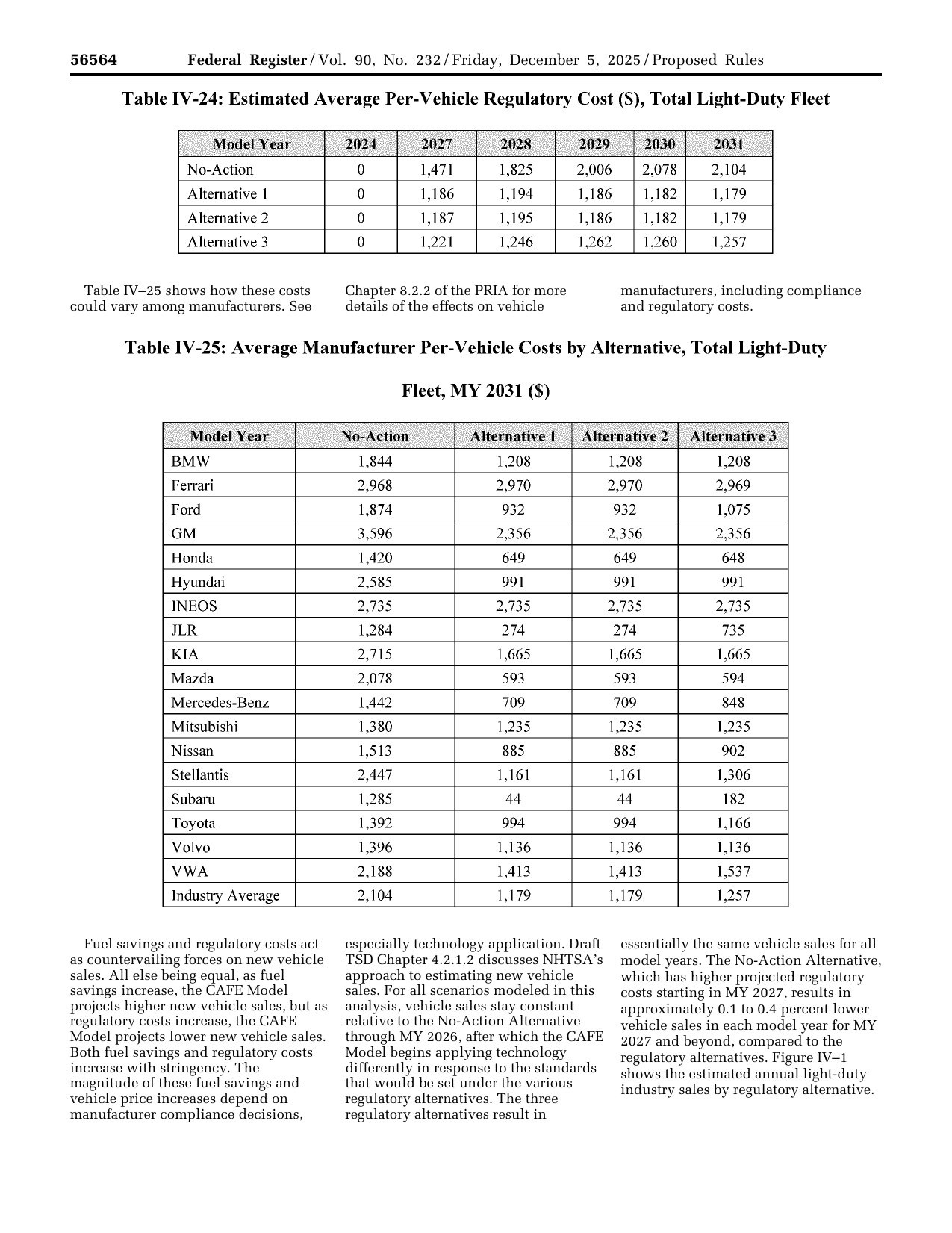
Page 56564, carrying the per-vehicle cost tables, including each automaker's 2031 figures. Read or download the full 219-page proposal (PDF) · view the docket
Per Car, Stellantis Buyers Come Out Furthest Ahead
Table IV-25 does the same math per vehicle for model year 2031. Across the whole industry, the regulatory cost baked into an average new vehicle falls from $2,104 to $1,179, a cut of $925. NHTSA assumes those savings pass straight through to buyers as lower prices.
For the Detroit brands the cut is deeper. A Stellantis vehicle sheds $1,286 in regulatory cost, from $2,447 to $1,161. A GM vehicle sheds $1,240, from $3,596 to $2,356. Ford's falls $942, from $1,874 to $932. GM's per-car compliance bill under the Biden rules, at $3,596, was the highest of any mass-market automaker in the table.
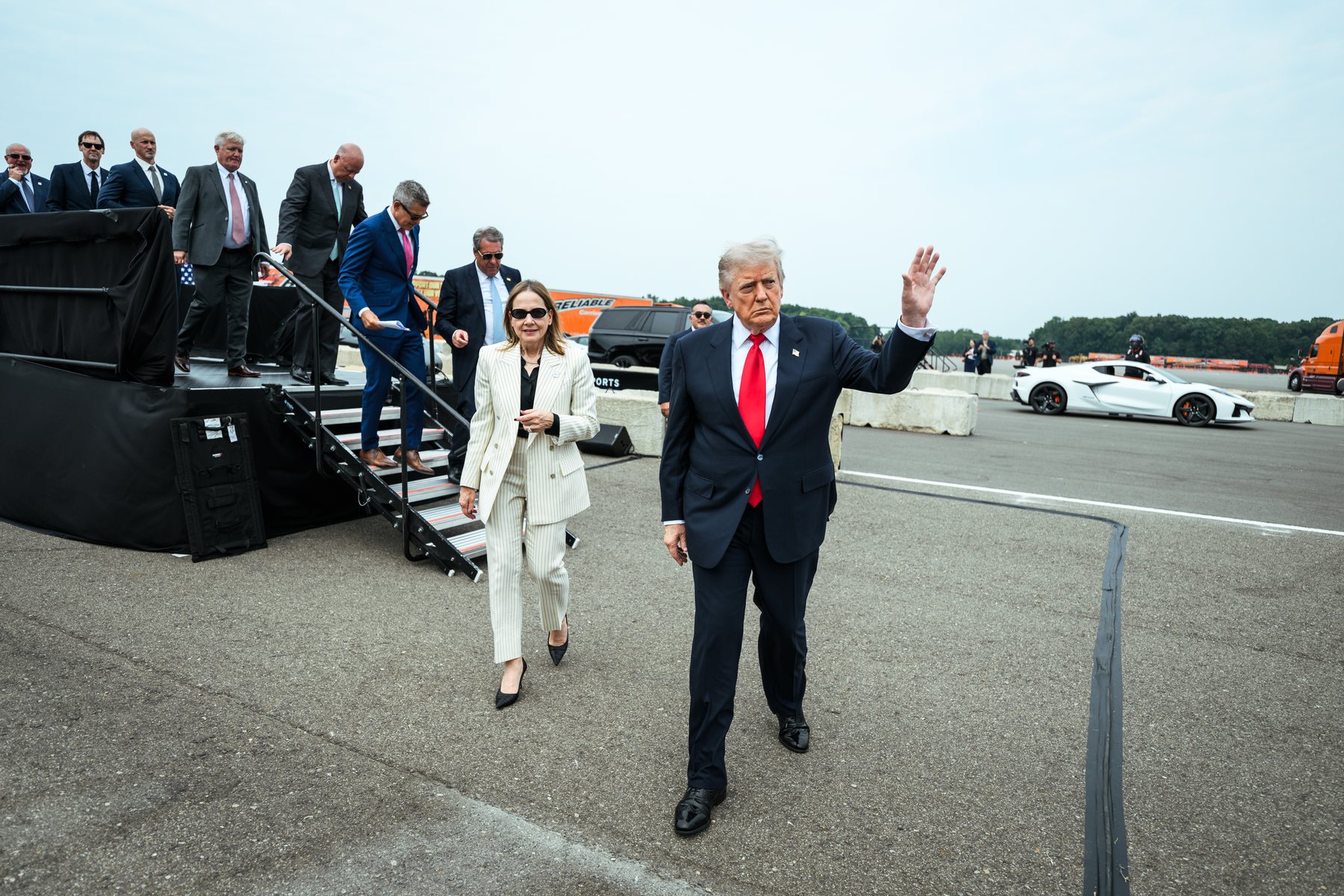
President Trump walks with GM CEO Mary Barra at the General Motors Proving Ground in Milford, Michigan, on July 27, 2026. (Official White House Photo by Daniel Torok, public domain, via Wikimedia Commons)
Does "Thousands" Hold Up?
Not on the proposal's numbers, at least not per car. NHTSA's own estimate is about $900 to $1,300 per vehicle depending on the brand, not several thousand. Trump could be counting something the tables leave out, such as models automakers would have dropped or repriced to hit the old targets. The proposal itself says its analysis "does not account for changes in the fleet mix offered by manufacturers," including "eliminating some models entirely."
The final rule could also change the figures. NHTSA said in the proposal it was exploring a new way to present fuel savings in the final version. Until the text posts Monday, the $925 average is the only official number there is.
Critics Say You Will Pay It Back at the Pump
Opponents are already swinging. Electrek published a piece Saturday headlined "Trump plans to raise" gas costs Monday, arguing that dropping from 50.4 to 34.5 mpg means burning 45 percent more fuel. NHTSA's own tables do show a trade: over the lifetime of vehicles built through 2031, the proposal avoids $37.1 billion in technology costs and gives up $53.9 billion in fuel savings, at a 3 percent discount rate.
The 45 percent math assumes cars get built right down to the new minimum. NHTSA projects they won't. Table I-2 has the fleet actually averaging 41.3 mpg in 2031 against the 34.5 requirement, and 42.2 mpg in 2027 against 30.4. Automakers keep improving efficiency because buyers pay for gas. The rule stops Washington from dictating how fast, and how many of those cars must be electric.
NHTSA still scores the proposal as a net gain of $24.0 billion for the country, counting vehicle features buyers get to keep and safety costs they avoid by buying newer cars sooner.
What to Watch on Monday
Start with the target: does the 34.5 mpg target survive, or did NHTSA move it after the comment period? Then check whether the per-vehicle savings for GM, Ford and Stellantis grow or shrink in the final tables? Last, watch whether the rule keeps reaching back to model year 2022, which the zeroed-out penalty made possible?
For car buyers, the proposal's answer is clear enough. About $925 comes off the average new vehicle's regulatory price tag, and more than that on the Jeeps, Chevys and Fords built in Michigan and Ohio. Trump says that is only the start. Monday's paperwork will show whether his own agency agrees.
Top photo: President Donald Trump at the General Motors Proving Ground in Milford, Michigan, July 27, 2026. (Official White House Photo by Daniel Torok, public domain)