Three ICE charter flights dropped more than 100 deportees in eight African countries over roughly 10 days in late August, and not one of the people on board was a citizen of the country where the plane landed. Internal U.S. government documents obtained by CBS News name Burundi, Cameroon, the Central African Republic, Equatorial Guinea, Eswatini, Liberia, Rwanda and Sierra Leone.
The manifests carried Afghans, Cubans, Iranians, Nepalis, Nicaraguans, Turks and Venezuelans, plus African detainees sent to countries that were not their own. DHS told CBS that when someone goes to court to refuse removal to his home country, "we are required by law to find a safe and secure nation for them to go to," while anyone who leaves voluntarily gets a free flight and a $3,000 check. "The choice is theirs," the department said.
The last plane landed in Bangui carrying 12 Afghans and eight Iranians
The flight that touched down Saturday in Bangui, capital of the Central African Republic, carried 12 Afghans and eight Iranians along with several Nepalis and Nicaraguans, according to Savi Arvey of Human Rights First, quoted by the Associated Press in Sam Mednick's report from Dakar. It was the second removal flight into the country since June.
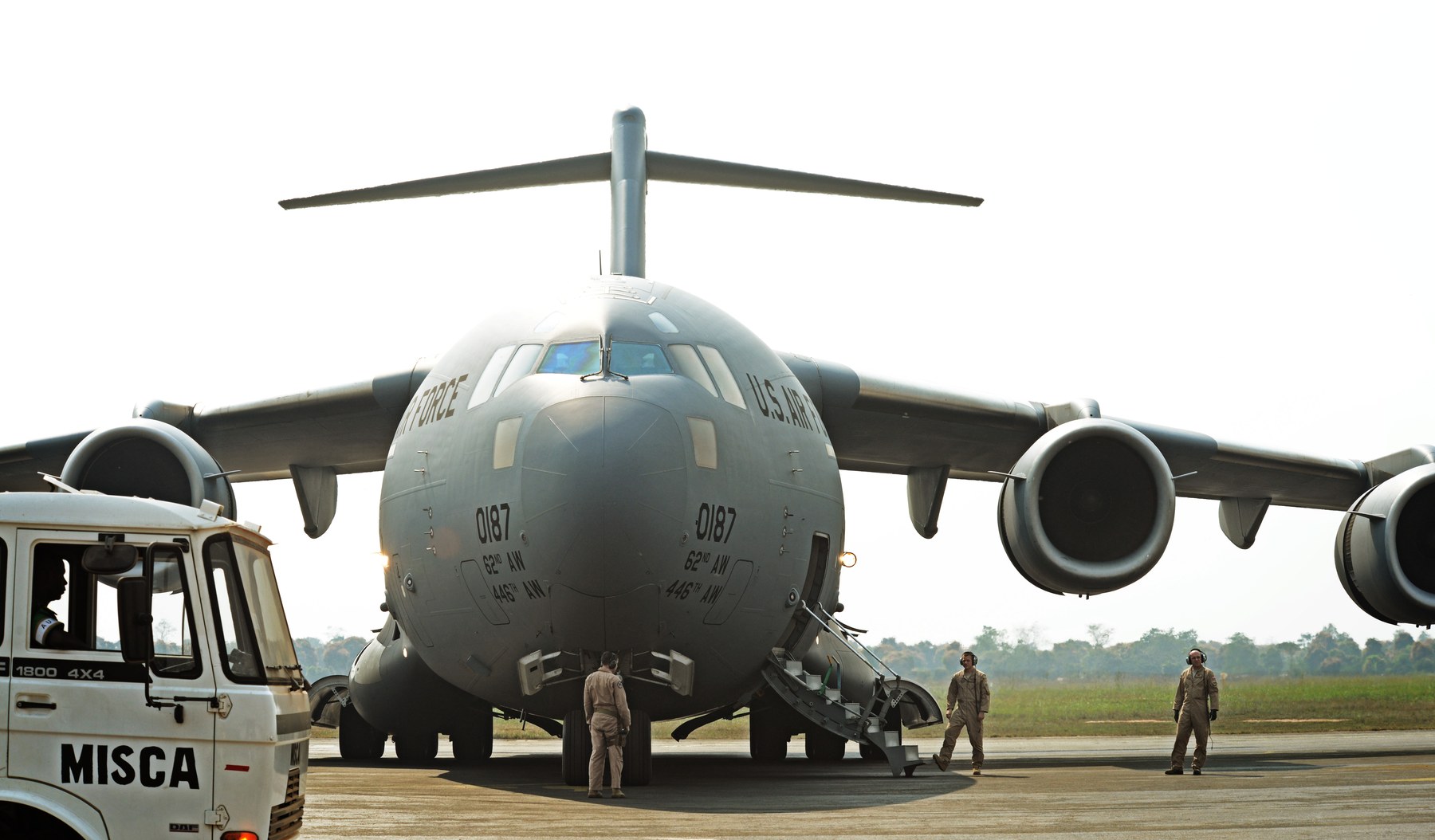
Bangui M'Poko International Airport, the Central African Republic, where Saturday's ICE charter landed. A U.S. Air Force C-17 sits on the ramp during a 2014 African Union airlift mission. File photo, unrelated to any deportation flight. (U.S. Air Force photo by Staff Sgt. Ryan Crane, via Wikimedia Commons, public domain)
The statute allows this, and it puts it dead last
Congress wrote the sequence into 8 U.S.C. 1231(b). An immigration judge designates a country of removal, usually the person's home country, sometimes an alternate. If that route fails, the statute steps through options tied to citizenship, birth and prior residence. Only when all of them are "impracticable, inadvisable, or impossible" may the government fall back on any "country with a government that will accept the alien."
Third-country removal is the last rung on that ladder, and the sequencing is the legal fight. Nobody serious argues the government lacks the authority. The argument is whether DHS works the earlier steps first, and how much warning a person gets. ICE's July 9, 2025 guidance set that at 24 hours, six in exigent circumstances, and none at all where the receiving country has given assurances against torture, per JURIST.
Official record
Department of Homeland Security v. D.V.D., No. 24A1153, order on application for stay, June 23, 2025. Cited as 606 U.S. ____ (2025).
"The application for stay presented to JUSTICE JACKSON and by her referred to the Court is granted. The April 18, 2025, preliminary injunction of the United States District Court for the District of Massachusetts, case No. 25–cv–10676, is stayed pending the disposition of the appeal in the United States Court of Appeals for the First Circuit and disposition of a petition for a writ of certiorari, if such writ is timely sought." — Order of the Court, page 1
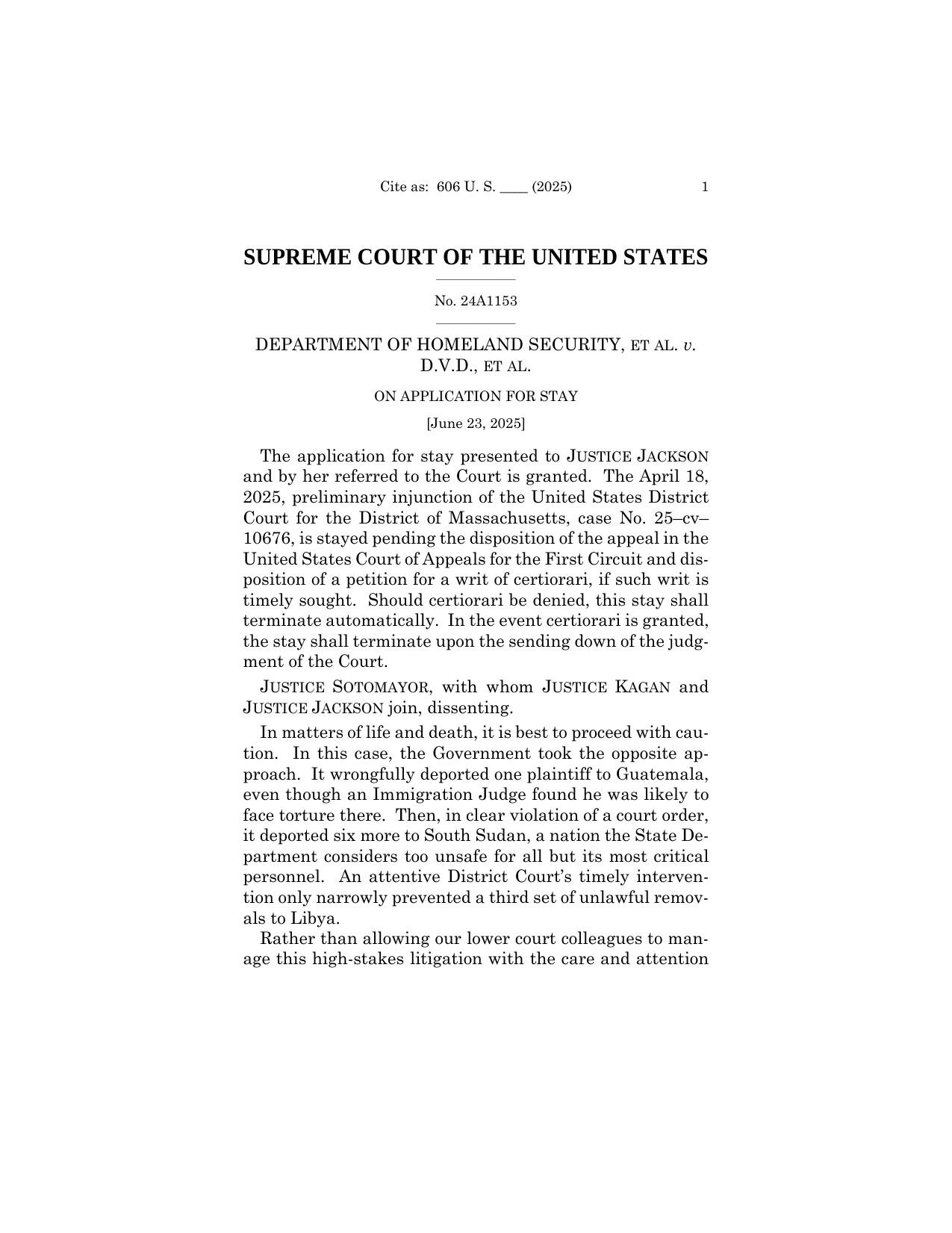
Read or download the full 19-page document (PDF) · official Supreme Court copy
A federal judge threw the policy out in February. The planes kept flying.
On February 25, 2026, Judge Brian E. Murphy of the District of Massachusetts set the third-country removal policy aside as "not in accordance with law." He wrote that DHS had adopted a policy of dropping people "in parts unknown" and that "It is not fine, nor is it legal," per the announcement from Human Rights First, one of three groups representing the nationwide class.
The ruling has never taken effect. The First Circuit stayed it on March 16, 2026 by a 2-1 vote and expedited the appeal, as JURIST reported. Class counsel put it in one line in their March practice alert: the decision is stayed, so it is persuasive authority and nothing more. That is why an August flight to Bangui was lawful.
Why this tool exists at all
ICE explains the underlying problem on its own website. Under Zadvydas v. Davis, 533 U.S. 678 (2001), a person with a final removal order generally cannot be held past six months when removal is not likely in the foreseeable future. When a foreign government stalls on travel documents, the clock runs out, and ICE says it "has been legally required to release thousands of noncitizens, including those with serious criminal convictions."
Two of the eight destination countries once sat on the other side of that fight. The State Department ordered visa sanctions against Sierra Leone in 2017 and Burundi in 2020 for refusing or unreasonably delaying the return of their own nationals, per that same ICE page. Burundi's were later lifted, Sierra Leone's reduced. Both now take other countries' deportees.
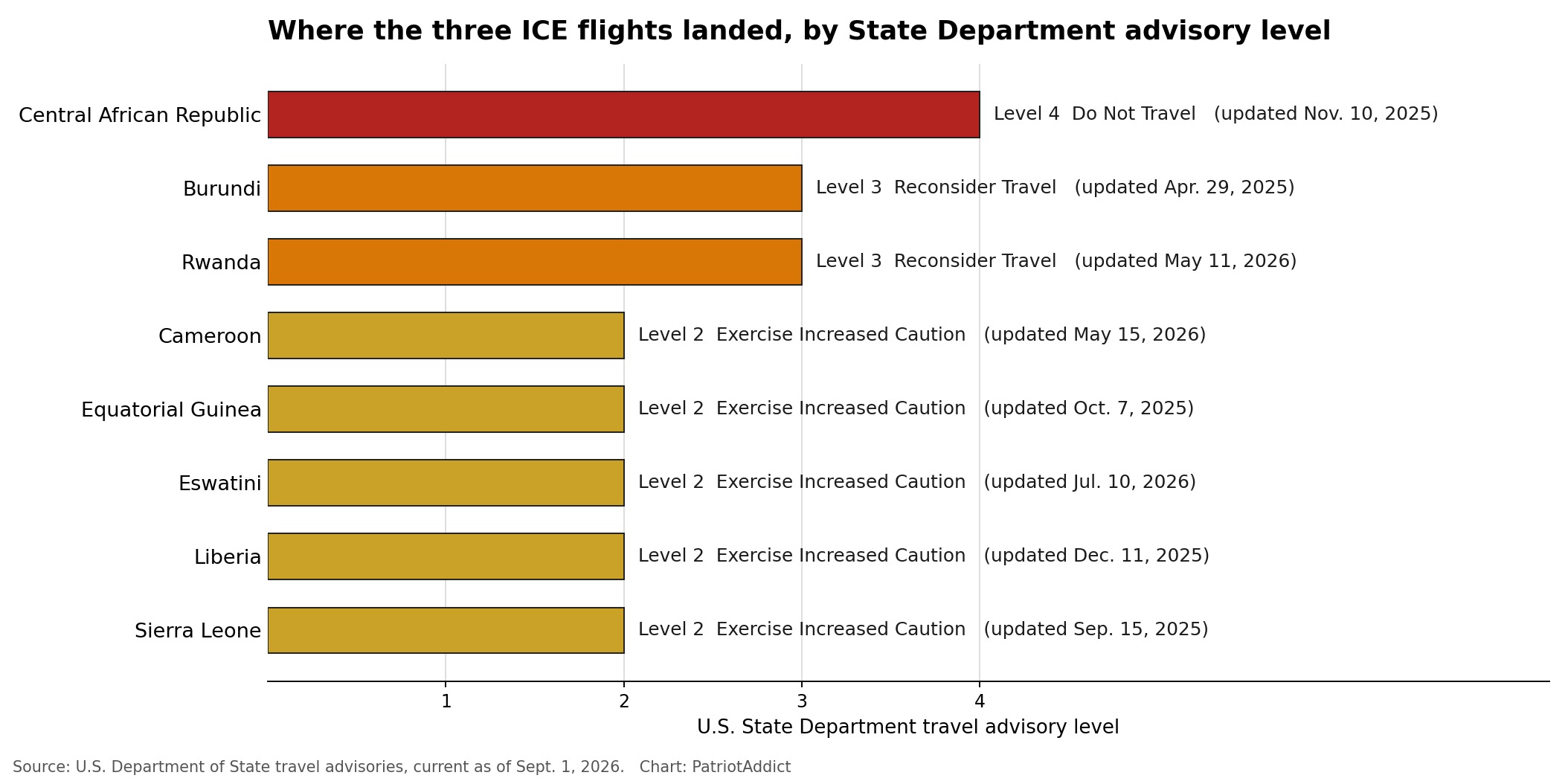
The eight destinations, ranked by the State Department's own travel advisory level. Only the Central African Republic is Level 4, Do Not Travel. (Chart by PatriotAddict, built from current U.S. Department of State travel advisories)
Only one of the eight is a country Americans are told to avoid
The Central African Republic is Level 4, Do Not Travel, last updated November 10, 2025 and flagged for unrest, crime, kidnapping, landmines and terrorism. Burundi and Rwanda are Level 3. Cameroon, Equatorial Guinea, Eswatini, Liberia and Sierra Leone are Level 2, the same rating the department currently gives France, Italy and the United Kingdom.
That undercuts the loudest version of the criticism. Flying a Venezuelan with a final order to Liberia under a signed, published agreement is not banishment to a war zone, and we read that agreement line by line when the first flight landed outside Monrovia. The problem here is not the category. It is which plane went where.
The Afghans are where this argument stops working
Among the people put off the plane in Bangui was a 24-year-old Afghan whom CBS and the AP identify only as Khalil. He crossed the southern border illegally in 2024 and spent his entire time in the country in ICE custody. In August 2025 an immigration judge granted him withholding of removal after finding he would likely face persecution in Afghanistan. Asylum was denied under a Biden-era rule disqualifying people who had not sought protection along the way.
Withholding is country-specific. It barred ICE from putting him on a plane to Kabul and did nothing to stop a plane to Bangui. One of his brothers was brought to the United States in 2014 for his work alongside American forces in the Afghan National Army. Another was a U.S.-trained pilot the Taliban killed during the war.
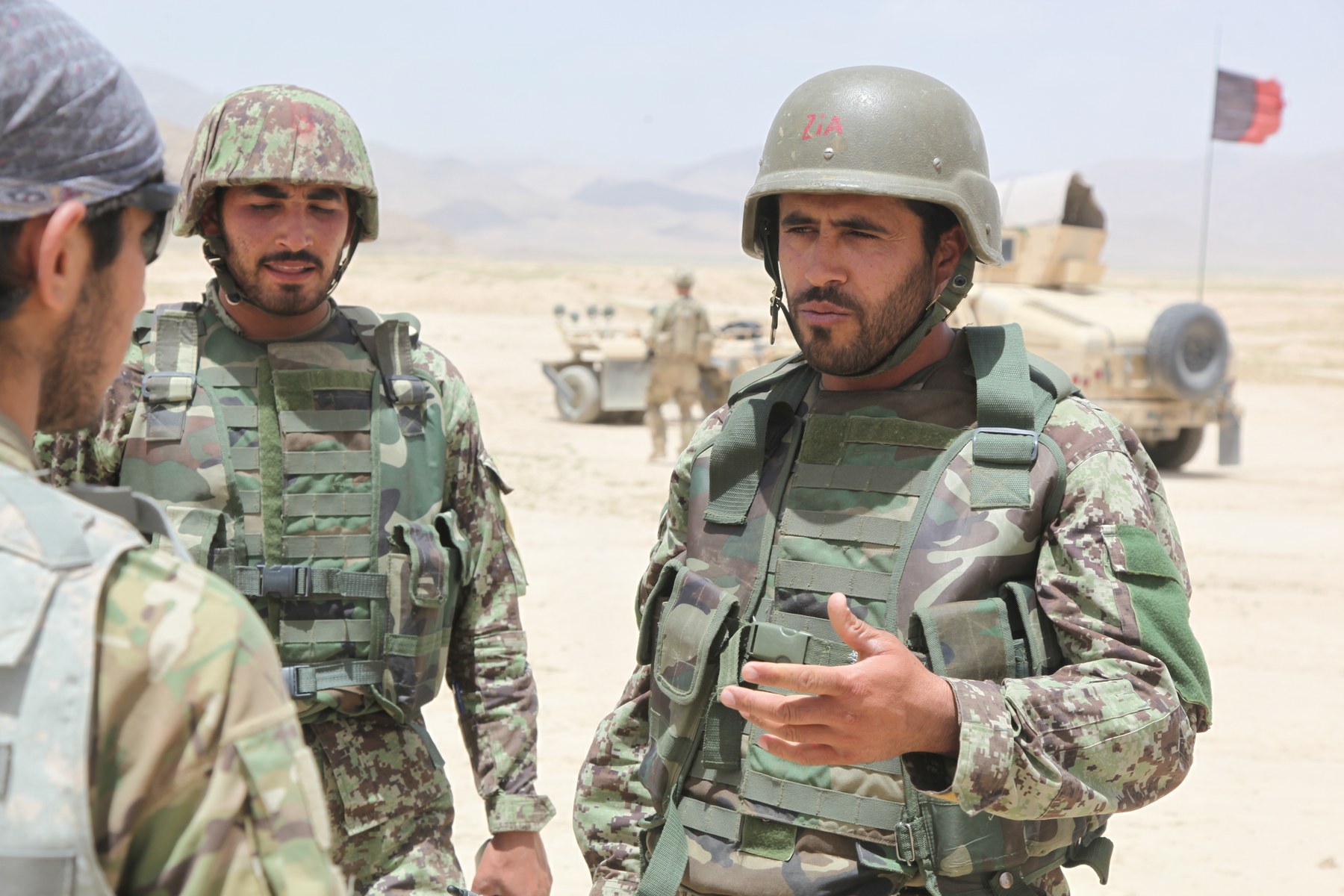
Afghan National Army soldiers talk with coalition forces through an interpreter in Ghazni province, May 29, 2012. About 178,110 Afghans hold U.S. Chief of Mission approval for a Special Immigrant Visa and no visa. (U.S. Army photo by Spc. Andrew Baker, via Wikimedia Commons, public domain)
Marine Col. Zachary Schmidt supervised Khalil's brother in Afghanistan and testified in the immigration case. He told CBS he has seen Taliban threats against the family, and that "if Khalil gets sent back to Afghanistan, that he will be killed." Speaking in his personal capacity, he added: "The deal is that if you help us, and help rebuild your country, we will look out for you. We have to keep that promise."
The pipeline built to keep that promise has stopped. #AfghanEvac counts three Afghan Special Immigrant Visas issued since January 1, 2026, one principal applicant and two family members, against 178,110 people who held Chief of Mission approval and no visa as of August 2025.
What the deals cost, and where the people ended up
Senate Foreign Relations Committee Democrats put numbers on the program in a February 2026 minority report, "At What Cost?", covering agreements through January 31, 2026. It found the United States sent more than $32 million directly to foreign governments in connection with these deals.
The finding that should bother enforcement hawks is a different one. More than 80 percent of the migrants sent to third countries the U.S. paid "have already returned to their country of origin or are in the process of doing so," per the report's executive summary. If four in five wind up home anyway, the premise that home would not take them was wrong, and the taxpayer bought two flights instead of one.
None of this is the engine of mass deportation. ICE logged 356,389 removals in the first nine and a half months of fiscal 2026, per ABC News, while the new weekly Haiti charters would need decades to clear the 334,891 Haitians who lost TPS. A hundred people on three African flights is a rounding error. The tool exists to break one narrow stalemate, where a foreign government says no and a federal judge says release him, and it should survive.
Saturday is not an argument against that power. It is an argument about a manifest, and a manifest is a list of names somebody in the government chose. Twelve Afghans went to the one destination on the list our own State Department tells Americans to stay out of, and at least one is there because his family fought on our side. Fixing that costs nothing. It means reading the list before the plane leaves.