The Commerce Department's scientific integrity policy lost its ban on political interference in a quiet revision dated August 19, 2026. We pulled both versions of the document, the superseded one from the Internet Archive and the live one from commerce.gov, and read them against each other line by line.
NPR's Hansi Lo Wang reported the change on August 31. The policy is Department Administrative Order 216-23, and it governs every agency under Commerce, including the Census Bureau, the Bureau of Economic Analysis and the National Oceanic and Atmospheric Administration. Rather than take anyone's word for what got cut, here is the actual text.
What the January 2025 policy actually said
The superseded order carried the anti-interference language in more than one place. Section 8.02 stated it as a flat command. Section 8.07(a) turned it into a prohibition on "political interference or inappropriate influence in the funding, design, proposal, conduct, review, evaluation, or reporting of scientific activities." Section 8.08(b) is the sentence NPR quoted, and it appears exactly as reported.
Official record
U.S. Department of Commerce, Department Administrative Order 216-23, "Scientific Integrity." Effective January 15, 2025. Superseded.
"Ensure that scientific findings and products are not suppressed, delayed, or altered for political purposes and are not subjected to inappropriate influence." — DAO 216-23 (2025), Section 8.08(b)
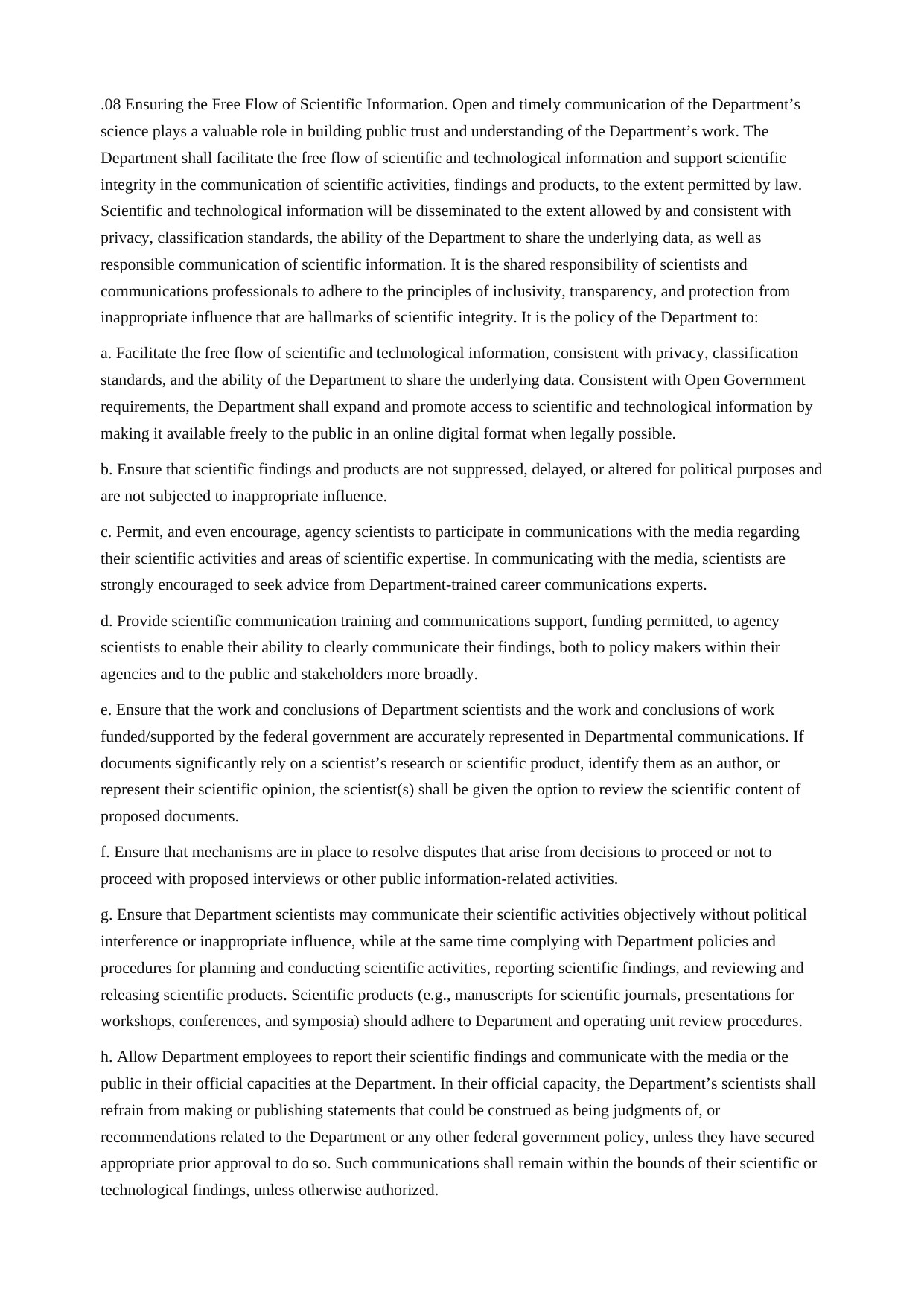
Section 8.08 of the superseded 2025 order. Subparagraph (b) carries the deleted anti-interference language. Commerce publishes this order as a web page and not as a PDF, so this image is our own typeset rendering of the verbatim text. Text: U.S. Department of Commerce, a U.S. Government work in the public domain.
Read or download our 21-page rendering of the full 2025 text (PDF) · archived official source
That version also defined the term itself differently. Its Section 3.01 said scientific integrity means "the adherence to professional practices, ethical behavior, and the principles of honesty and objectivity," then added a second sentence: "Inclusivity, transparency, and protection from inappropriate influence are hallmarks of scientific integrity."
What the August 2026 revision says instead
The current order keeps a definition that reads similarly at a glance. Look at the end of it and the second sentence is simply not there. The revision does promote transparency from hallmark to core principle and adds peer review to the covered activities. Those are real changes in the other direction. Protection from inappropriate influence is not among them.
Official record
U.S. Department of Commerce, Department Administrative Order 216-23, "Scientific Integrity." Effective August 19, 2026. Current.
"'Scientific Integrity' is defined as the adherence to professional practice, ethical behavior, and the principles of honesty, objectivity, and transparency when conducting, managing, peer reviewing, using the results of, and communicating about Scientific Activities and Scientific Information." — DAO 216-23 (2026), Section 3.07
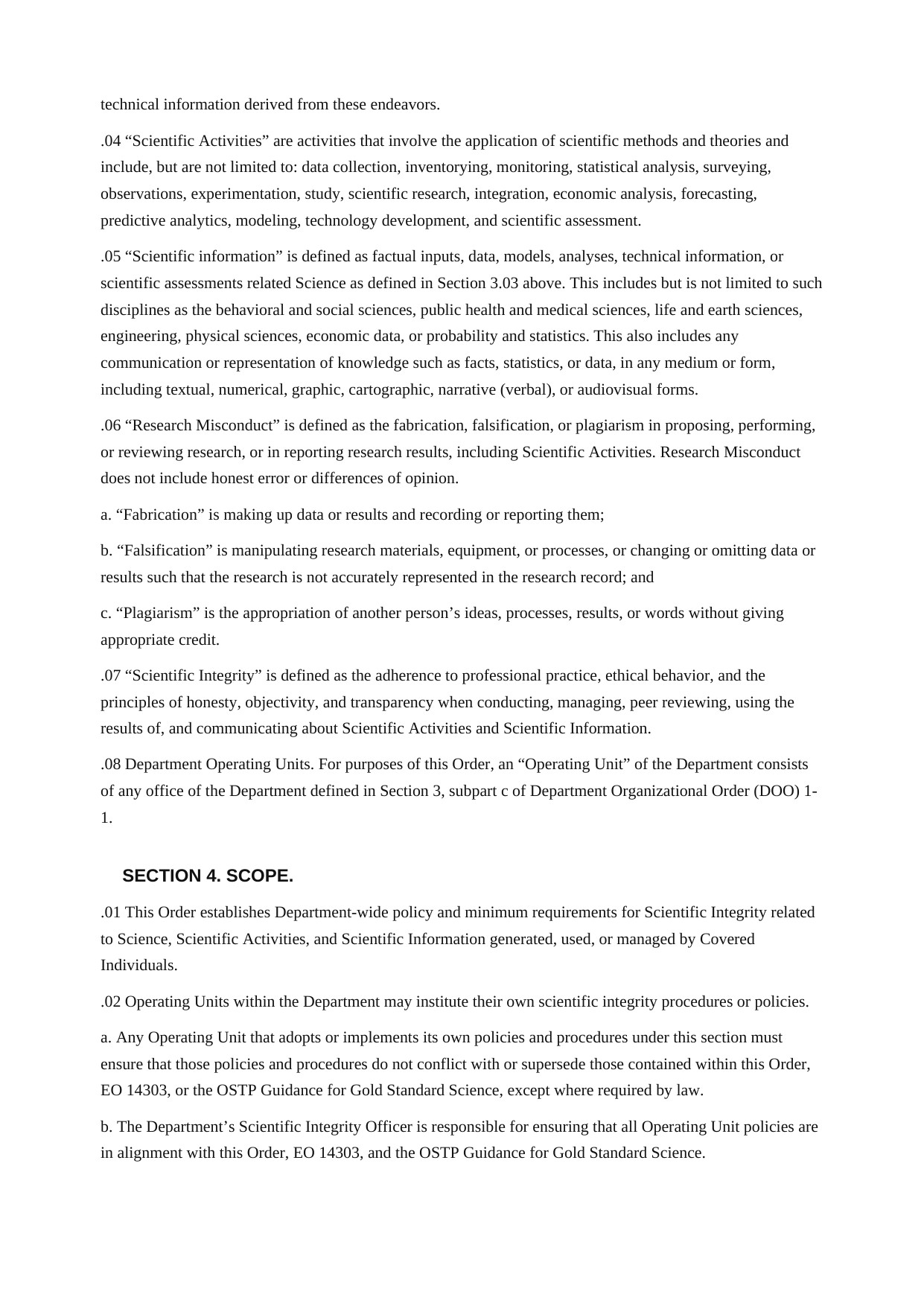
Section 3.07 of the current order. The definition ends at "Scientific Information," with no hallmarks sentence following it. As above, this image is our own typeset rendering of the verbatim text, not a Commerce-issued PDF. Text: U.S. Department of Commerce, a U.S. Government work in the public domain.
Read or download our 8-page rendering of the full 2026 text (PDF) · official source

Census Bureau headquarters in Suitland, Maryland. The bureau is one of the Commerce agencies covered by DAO 216-23. Photo: U.S. Census Bureau, public domain.
The phrases that went to zero
Word counts settle the argument faster than adjectives do. The 2025 order runs about 9,200 words. The revision runs about 3,300. We counted every occurrence of the relevant terms in both.
"Inappropriate influence" appears nine times in the old policy and zero times in the new one. "Political interference" goes from four to zero, "political purposes" from three to zero, "reprisal" from three to zero. "Whistleblower" drops from eight mentions to one, surviving only as a closing clause saying the order cannot override the Whistleblower Protection Act. The words "free flow" and "media" vanish entirely, which is what happens when you delete a whole section on scientific communication.
Beth Jarosz of the Association of Public Data Users told NPR the new structure leaves "lots of opportunities to put pressure on staff." The documents back her up on the mechanism. The 2025 policy required the department to act "in consultation with the Office of the General Counsel" three separate times and named that office nine times overall. The 2026 order mentions it once, as one of five seats on an ad hoc committee.
Now the part the coverage skipped
Close to 6,000 words were cut, and anti-interference language is not most of them. A large share of the deleted text is diversity and equity material. "Diversity, equity" appears five times in the old order and zero times in the new one. "Equitable" goes from six to zero. Gone with it are passages requiring the department to hire scientists "with consideration for diversity, equity, inclusion and accessibility," to include "Indigenous Knowledge" as a form of evidence, and to act on violations shown to have "a disproportional impact on underrepresented groups."
Anyone who wanted that language out of federal science policy got what they wanted, and that position was campaigned on openly. Whether the interference ban had to go out the door in the same edit is a separate question, and nobody separated the two.
The rewrite added teeth the old policy never had
Read the new order on its own terms and it is not toothless. It sets deadlines the 2025 version never contained: 14 days for the Scientific Integrity Officer to assess an allegation, 120 days for an investigation, 30 days for a report, seven days for a final determination. It spells out a disciplinary ladder ending in "termination of employment or appointment." Section 7.03 says information containing "falsifications, fabrications or plagiarism must be corrected." Section 5.02(c) sends any allegation against someone under the Secretary or Deputy Secretary straight to the Inspector General.
The drafting was rushed, though. Section 5.01(c) tells the reader that "The Section is designed to mirror that contained within DAO 216-23," and that its passages survive "should that DAO be revised or rescinded." The order is DAO 216-23. That is a copy-paste artifact left in a signed departmental directive.
Does the executive order behind the rewrite cover the gap?
Section 2.02 says the revision was issued under Executive Order 14303, "Restoring Gold Standard Science", signed May 23, 2025. If the protection moved up a level, the executive order would carry it. We searched the full text at 90 FR 22601. The words "political," "suppress," "influence" and "interference" do not appear in it once.
The executive order does tell agencies rewriting their policies to "protect employees from efforts to prevent or deter consideration of alternative scientific opinions." Commerce did not do that. The 2025 order had a mechanism for staff to file written dissent from conclusions used in policy decisions. The phrase "differing scientific opinion" appears three times in the old policy and nowhere in the new one, so on this point the revision falls short of the very order it cites as authority.
The real backstop is a regulation, not a departmental order
Here is what did not change, and it probably matters most for census numbers. A departmental administrative order can be rewritten by the department any Wednesday. The rule at 5 CFR Part 1321, issued under the 2018 Evidence Act, cannot. Section 1321.7 requires recognized statistical agencies to "produce statistical products that are impartial and free from undue influence and the appearance of undue influence."
Nancy Potok, a former Census Bureau deputy director, made that point to NPR, calling the removal "a major change that eliminates the guardrails against political interference in the statistical and scientific data products of the department" and adding that the failure to bring the department's orders in line with that rule "is definitely troubling and needs some explanation." Commerce and Census spokespeople did not respond to NPR's requests for comment.
The verdict
NPR got this one right. Every phrase in that story matches the source documents word for word, and the removals are broader than the story had room to describe. The timing is real too: the revision is dated the day after the Census Bureau posted an unauthored report on noncitizen voting, which we covered on August 24. Timing is not proof of motive, and nobody has produced a document connecting the two.
A department that wanted diversity language out of its science policy could have done that in an afternoon and left the interference ban standing. It cut both. Until someone at Commerce explains why, the guardrail is gone from the policy and rests entirely on a regulation the department did not write.