President Trump meets executives from at least 10 U.S. fuel refiners and distributors Tuesday afternoon to press for more refining capacity and lower pump prices before the November midterms. The problem with that ask sits on the government's own scoreboard: American refineries ran at 97.4 percent of operable capacity in the week ending August 21, a rate they have hit only 15 times since 2000.
Interior Secretary Doug Burgum, Energy Secretary Chris Wright and National Energy Dominance Council Executive Director Jarrod Agen are in the room, according to a White House official who briefed CNBC. Spokeswoman Taylor Rogers said the president "is laser-focused on ensuring his successful energy dominance agenda translates into the most cost savings possible at the pump for consumers." AAA's national average read $4.0954 a gallon Tuesday, after the first August on record with the average above $4 every single day.
97.4 percent is the whole story
EIA publishes refinery utilization every Wednesday as series WPULEUS3. We pulled the full history. Out of 1,390 weekly readings since January 2000, exactly 15 have printed at or above 97 percent. The August 21 week is one of them, and the last time the country matched it was September 7, 2018.
Refiners are not sandbagging. The 2026 average to date is 93.2 percent, against 90.8 percent for all of 2025 and 89.9 percent in 2024. No year since 1998 has averaged higher. These plants are being pushed about as hard as American refining has ever been pushed.
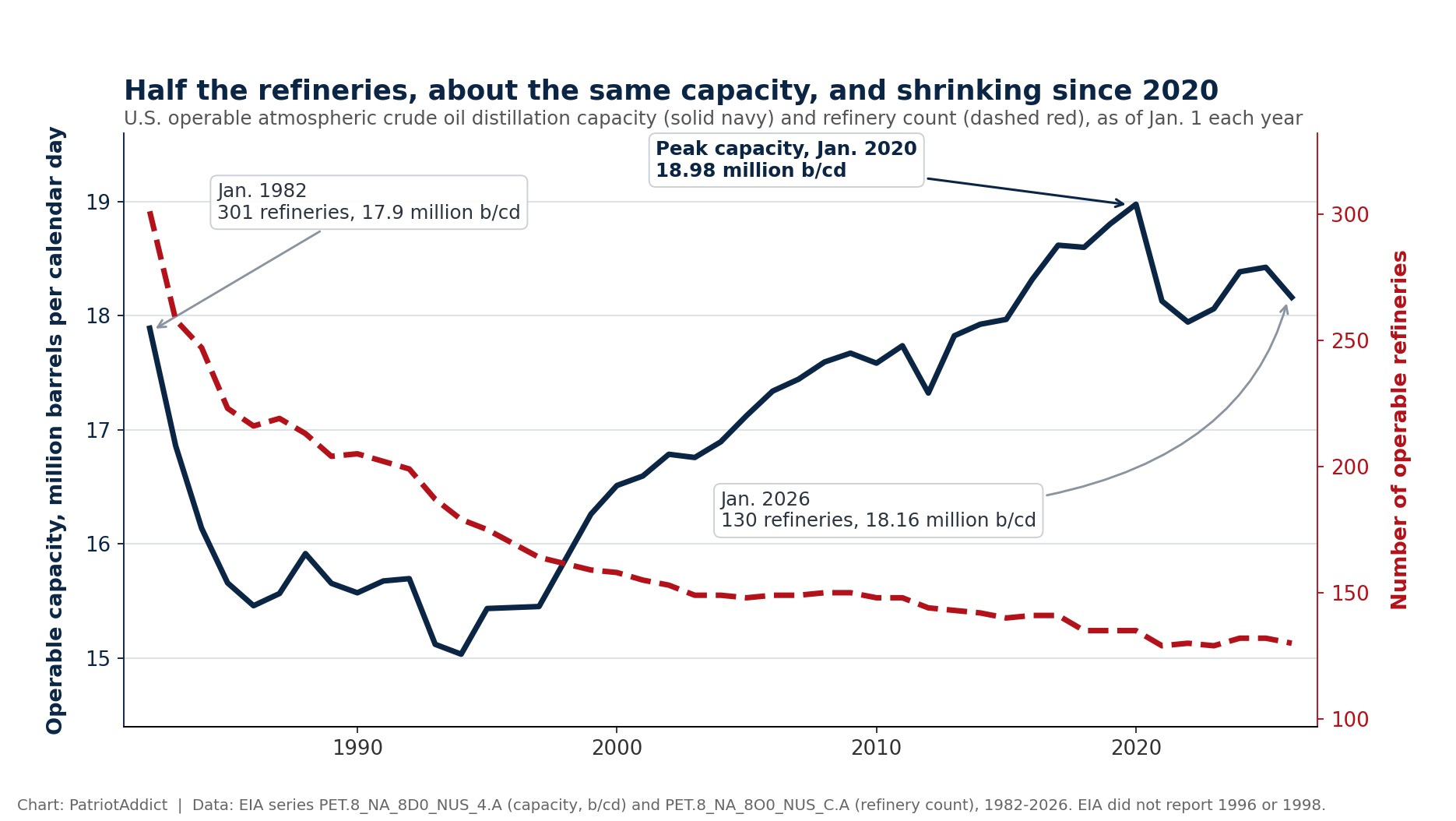
Chart built by PatriotAddict from EIA's annual Refinery Capacity Report series PET.8_NA_8D0_NUS_4.A (operable atmospheric crude oil distillation capacity, barrels per calendar day) and PET.8_NA_8O0_NUS_C.A (number of operable refineries), as of January 1 each year, 1982 through 2026. EIA did not publish figures for 1996 or 1998.
What a refiner can physically add by November 3
Run the arithmetic the meeting will not. Operable capacity stood at 18,027 thousand barrels per calendar day in the August 21 week, so 2.6 points of headroom is about 469,000 barrels a day of extra crude, and only if every plant in America hits a number nobody has sustained. Gasoline came out at 56.2 percent of crude runs that week, which turns that headroom into roughly 263,000 barrels a day of additional gasoline.
Americans burned 9,043 thousand barrels a day of finished motor gasoline in the same week. The absolute physical ceiling on new domestic supply, with zero maintenance and no unplanned outages anywhere, is under 3 percent of demand. Election Day is 63 days out, and September and October are when refiners normally take units down for fall turnarounds.
Inventories say the same thing. Gasoline stocks fell 2.536 million barrels in the August 21 week, to 206.842 million. We computed the five-year average for the comparable week from EIA's history and got 219.985 million, putting stocks 5.97 percent low. Closing that 13.1 million barrel gap at the theoretical maximum rate would take about 50 days.
Official record
EPA, "National Fuel Waiver to Bring Forward Wintertime Gasoline Beginning September 1, 2026," letter to the Governors, signed by Administrator Lee Zeldin, August 20, 2026.
"As of the week ending August 7, 2026, refinery utilization was 96.2 percent. Given this high utilization rate, refineries have minimal ability to produce more refined product, such as gasoline, in the event of a supply disruption." — EPA, page 3
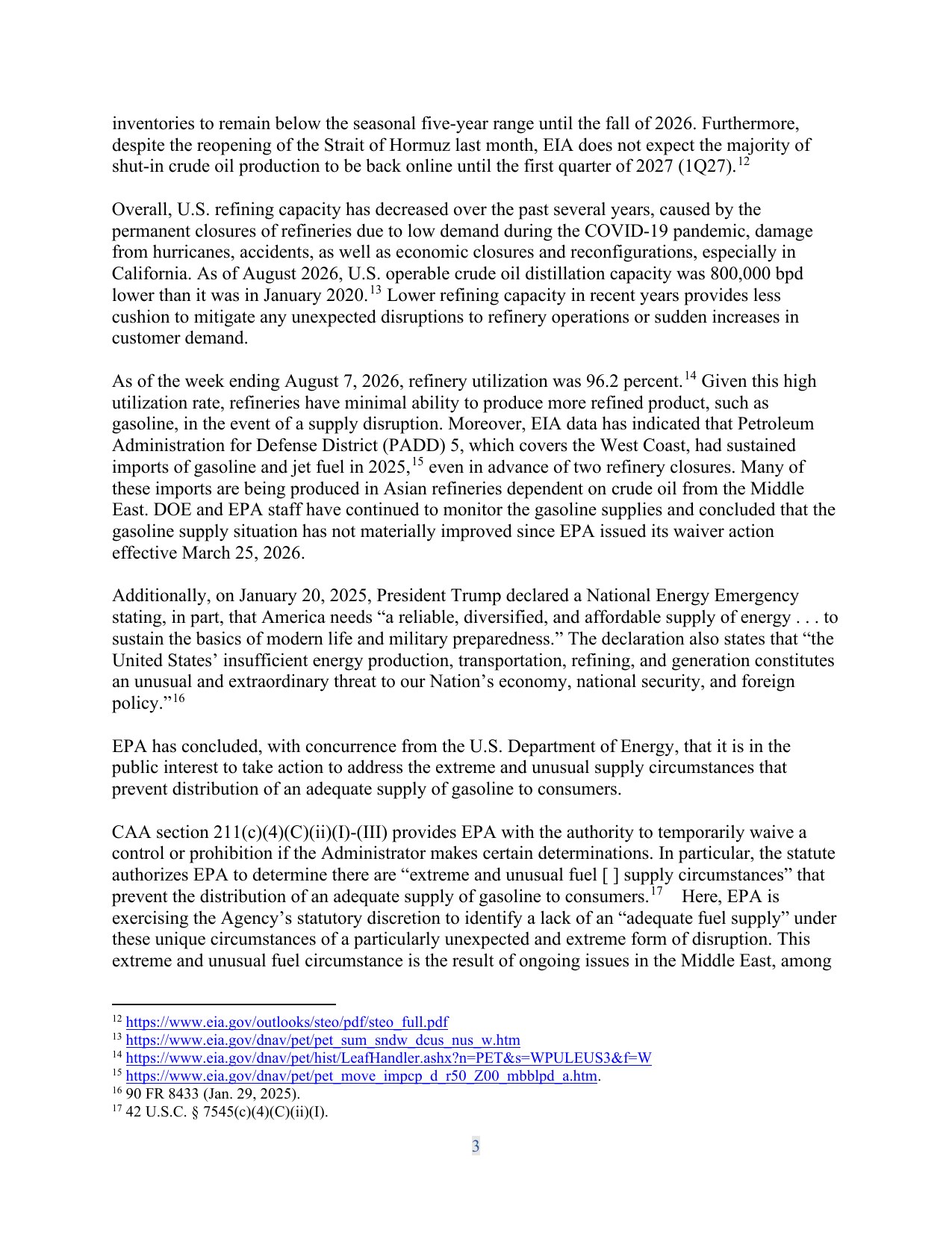
Read or download the full 5-page waiver letter (PDF) · EPA fuel waivers index
The administration wrote that sentence itself, 12 days before this meeting was set. The same page says capacity is "800,000 bpd lower than it was in January 2020." We checked that against EIA's weekly capacity series and got 781,000, against 18,808 thousand barrels a day on January 3, 2020. EPA rounded. The number is real.
America had 301 refineries in 1982. It has 130 now.
EIA counted 301 operable refineries on January 1, 1982, running 17.9 million barrels per calendar day. On January 1, 2026, it counted 130 refineries running 18.16 million. Four decades of consolidation into a smaller number of very large Gulf Coast complexes means one unplanned outage now moves the national number in a way it never could in 1982.
The direction changed in 2020. Capacity peaked at 18.98 million b/cd that January and has not recovered. EIA reported on June 29 that capacity fell over 250,000 b/cd during 2025 alone, after LyondellBasell ended refining at its 263,776-b/cd Houston plant that March and Phillips 66 shut its 138,700-b/cd Los Angeles refinery in October. Valero's 145,000-b/d Benicia refinery has since stopped too.
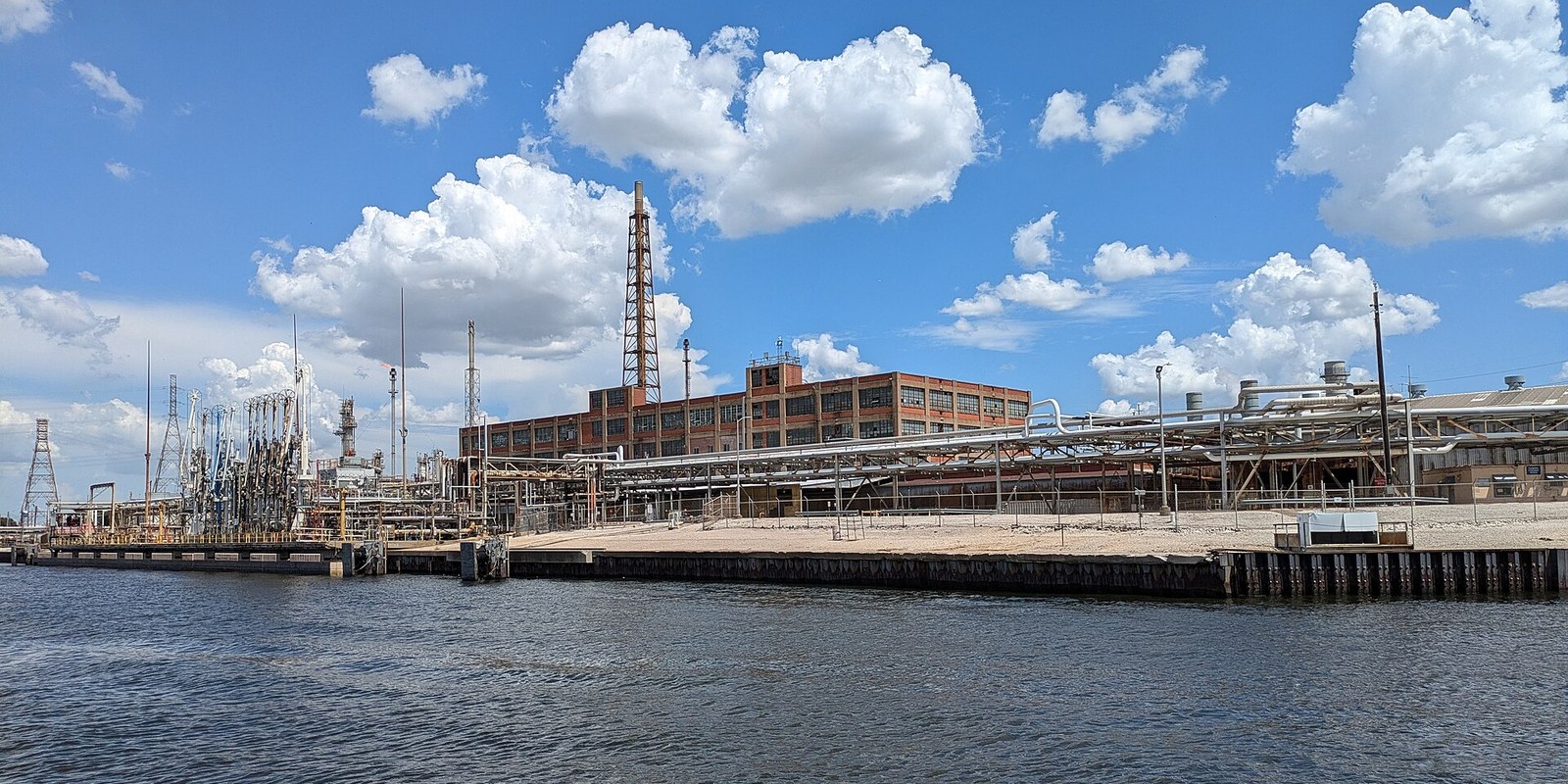
The LyondellBasell Houston refinery, viewed from the Houston Ship Channel on August 16, 2024. It ran 263,776 barrels a day of crude distillation capacity and stopped refining in March 2025, the largest single piece of the capacity America lost last year. Photo by Rifleman 82 via Wikimedia Commons, CC BY-SA 4.0.
Replacing it is not a two-month project. EIA's own reference desk puts it plainly: the newest U.S. refinery with significant downstream unit capacity is Marathon's Garyville, Louisiana plant, online since 1977 and now the third largest in the country at 617,000 b/cd. That was 49 years ago. Everything built since is small, topping out at a 45,000-b/cd plant in Galveston that started up in 2022.
Sixty-one cents a gallon says the bottleneck is real
Here is the cleanest measure of how tight refining actually is, computed here rather than taken on anyone's word. Subtract crude, at West Texas Intermediate spot divided by 42 gallons, from EIA's daily U.S. Gulf Coast conventional gasoline spot price. What is left is the refining margin on a gallon.
Across August 2026 that spread averaged $1.246 a gallon, and on August 25 it hit $1.431. Across the five previous Augusts it averaged 63.3 cents. The refining step is taking 61.3 cents a gallon more than its recent norm for this month. Crude is not what is doing this: WTI averaged $83.65 in August against $64.86 a year earlier, worth about 45 cents a gallon, while the margin widened 70.1 cents over the same span.
CNBC reported that Valero estimated earlier this month that the wars in Iran and Ukraine have knocked roughly 5 million barrels a day of global refining capacity offline, and that ExxonMobil CEO Darren Woods told the network in late July that refining constraints have opened a "disconnect" between crude prices and pump prices. That disconnect is the 61 cents.
The one fast lever already got pulled
There is a real short-term tool here, and the administration used it 12 days ago. Cheaper, more volatile winter-grade gasoline stretches the same barrel further, and Clean Air Act section 211(c)(4)(C) lets EPA waive the summer volatility rules early. Administrator Lee Zeldin signed that waiver on August 20, starting the winter transition September 1 instead of September 16 and adding what EPA called "hundreds of thousands of barrels per day."
Two things cap what is left. The waiver runs only through September 15, because the winter standard applies by law after that anyway. And EPA has had emergency fuel waivers running continuously since May 1, including a single national gasoline pool at a common 10 psi. The regulatory shelf is close to bare, which is why Tuesday's agenda is about steel and units instead.
What to watch
Executive Order 14213, signed February 14, 2025, made the Interior Secretary chairman of the National Energy Dominance Council and the Energy Secretary its vice chairman, with a mandate to advise the president on improving permitting and production across American energy. Burgum and Wright sit in Tuesday's room in exactly those roles. Anything durable that comes of it will be permitting relief for expansions at existing Gulf Coast plants, and the place it becomes visible is EIA's January 2027 capacity report.
The crude side is already being worked hard, including Friday's Venezuela reserve deal, and Orinoco crude still has to reach a plant built to process it. The refining side is where the shortage lives, and it is measured in units that take years to build. Two EIA prints settle this before Election Day. Weekly utilization says whether the plants found any room at all. The Gulf Coast crack says whether the squeeze is easing, and if it narrows back toward 63 cents, the number on the sign follows it down. If refiners keep running above 97 percent and the crack holds near $1.25, Tuesday was a photo opportunity.