President Trump announced Friday night that the United States has secured majority control of more than 65 billion barrels of proven oil reserves in Venezuela, a deal he says "MORE THAN DOUBLES American Oil Reserves" and will "substantially lower" gas prices long into the future. On the reserve arithmetic, he is right. On the pump price, the number that settles it is not 65 billion. It is 972,600.
What Trump announced, and what Caracas actually put in writing
The announcement came in a Truth Social post at 6:47 p.m. Eastern Friday. Trump credited Secretary of State Marco Rubio and "Secretary of War Pete Hegseth," working with the "Highly Respected Interim President of Venezuela, Delcy Rodriguez," and said the deal came "at no cost to the American Taxpayer."
The specifics came from Caracas. Rodríguez's government said the deal covers 17 fields with "a proven potential of 65 billion barrels," could draw $100 billion of investment, and would yield more than $209 billion in tax revenue, which goes to Venezuela rather than the U.S. Treasury. A U.S. official who briefed ABC News and the Associated Press anonymously said Washington gets 55 percent of the effective output of a new private company formed with an unnamed Venezuelan operator, under a 100-year grant. No text of the agreement has been released.
Rubio posted on X that the deal means "securing stable reserves and low-cost oil in our Hemisphere and lowering gas prices here at home."
Official record
Treasury's Office of Foreign Assets Control rewrote the Venezuela sanctions plumbing the day before the announcement. On August 27, 2026, OFAC issued General License No. 46D, "Authorizing Certain Activities Involving Venezuelan-Origin Oil or Petrochemical Products," superseding General License 46C of June 10.
"all transactions prohibited by the Venezuela Sanctions Regulations, 31 CFR part 591 ... that are ordinarily incident and necessary to the lifting, exportation, reexportation, sale, resale, supply, storage, marketing, purchase, delivery, or transportation of Venezuelan-origin oil, including the refining of such oil ... for importation into the United States, by an established U.S. entity are authorized" — General License No. 46D, paragraph (a)
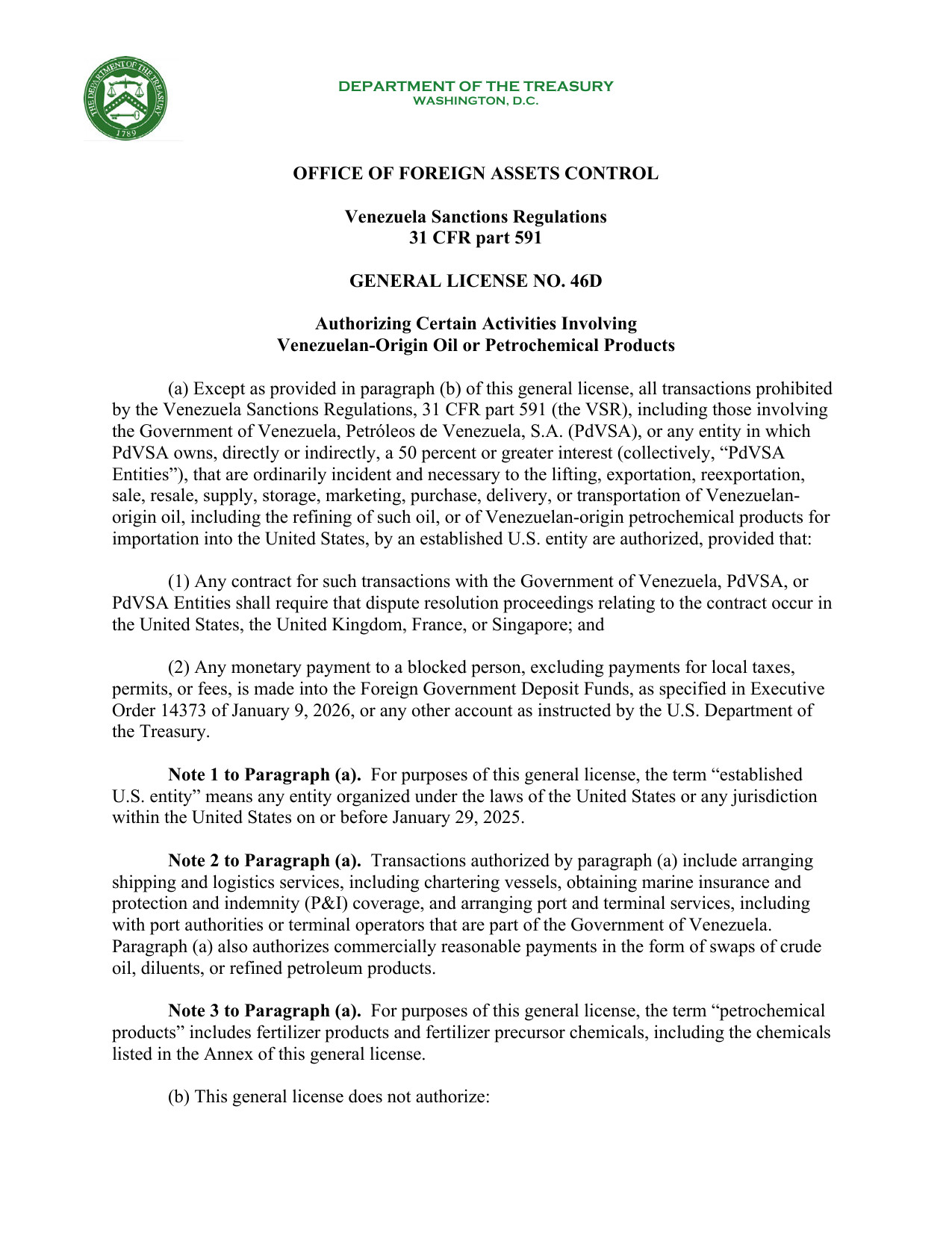
Read or download the full 5-page general license (PDF) · OFAC general licenses index
The reserve claim holds up, and it is bigger than the coverage let on
The Energy Information Administration released its annual proved reserves report on April 7. It puts U.S. crude oil and lease condensate proved reserves at 46.0 billion barrels at year-end 2024. Sixty-five billion is more than the entire American reserve base. Stack them and you get 111 billion, about 2.4 times today's figure. "More than doubles" is not spin. It is addition.
The catch is what a reserve is. Proved reserves are an inventory estimate, volumes that geology and engineering say can be recovered at existing prices. They are not a valve. America produced 13.59 million barrels of crude a day in 2025, about 4.96 billion for the year, so the 46 billion on EIA's books is a little over nine years of output. Reserves are a balance sheet item. Gas prices come off the income statement.
Venezuela pumped 972,600 barrels a day last year
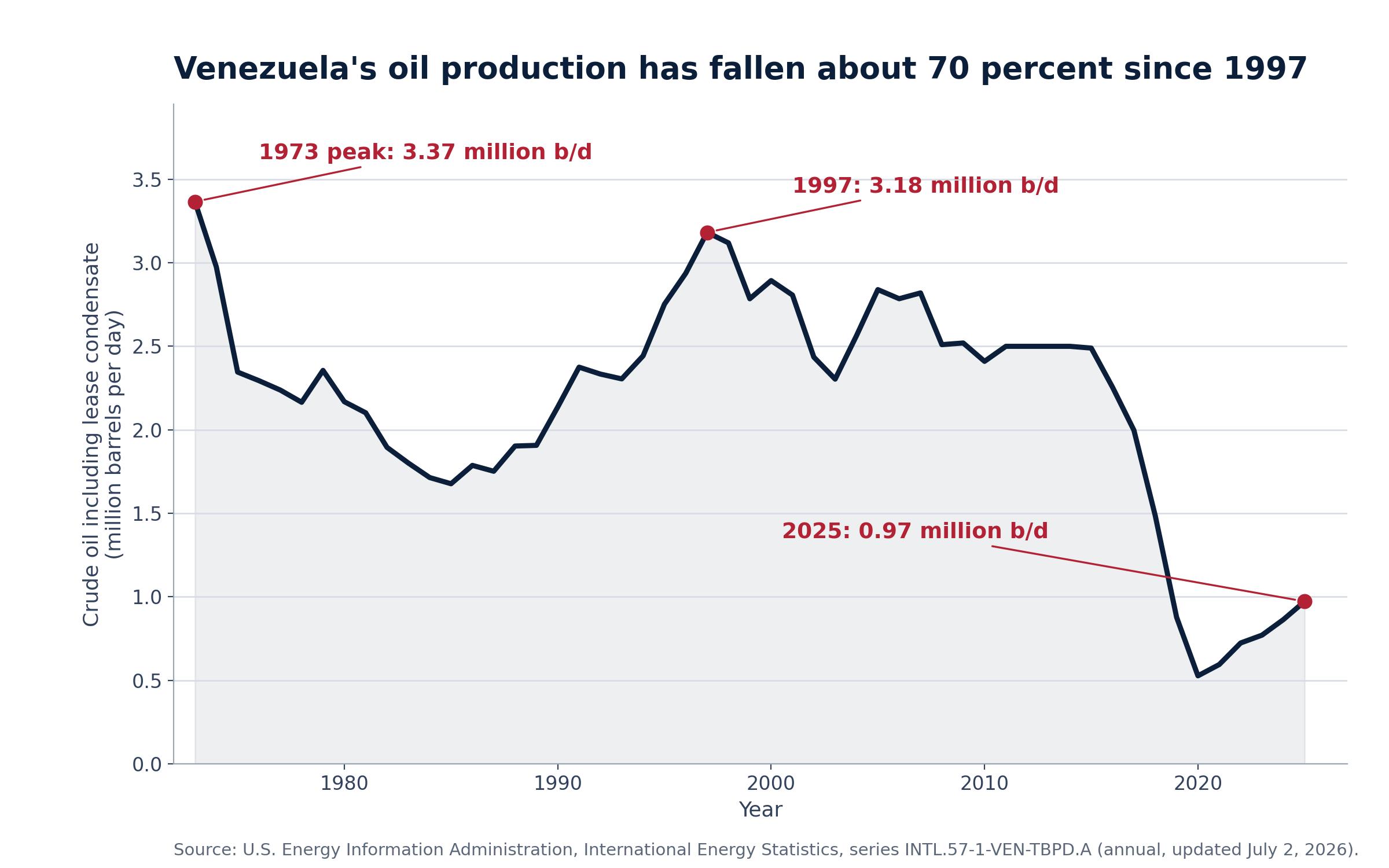
Chart built by PatriotAddict from U.S. Energy Information Administration International Energy Statistics, series INTL.57-1-VEN-TBPD.A, annual crude oil including lease condensate, updated July 2, 2026.
That is the number the gas-price claim has to get past. EIA's international series puts Venezuelan crude output at 972,600 barrels a day in 2025, against 3.18 million in 1997. The country holds an estimated 303 billion barrels of proved reserves, the largest pile on earth, and produces about 1.15 percent of the world's crude. The 65 billion in this deal is roughly a fifth of that pile. The constraint there has never been geology.
Run the timeline out. Producing 65 billion barrels at an incremental one million a day takes 178 years. At two million it takes 89. Even at three million a day, more than Venezuela has managed nationally in any year since 1973, you are at 59 years. This is a multi-decade asset and should be sold as one.
What it would take to move the number on the sign
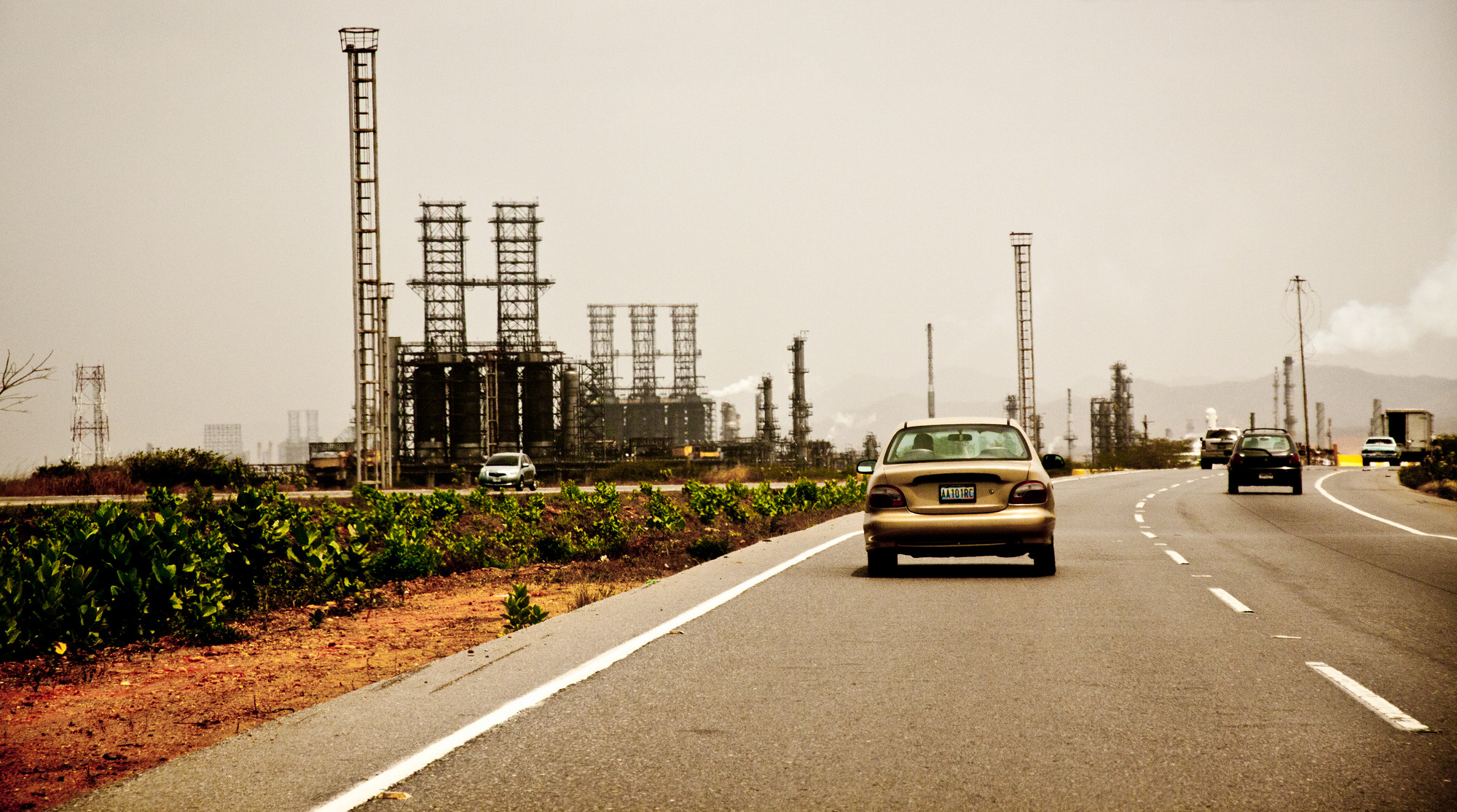
File photo of the Puerto La Cruz refinery in Anzoátegui state, one of Venezuela's largest. Photo by Daniel Zambrano via Wikimedia Commons, CC BY-SA 3.0.
EIA's breakdown of a gallon of regular for May 2026 puts crude oil at 52 percent of the $4.48 retail price, refining at 22, distribution and marketing at 15, taxes at 12. A barrel is 42 gallons, so every $1 move in crude is worth about 2.4 cents at the pump if it passes through in full. Cutting 50 cents off a gallon means taking $21 off a barrel.
Size the deal against that. If the new company reached one million barrels a day, more than quadruple what all of Venezuela produces now, the American 55 percent share is 550,000 barrels a day. World crude production ran 84.36 million a day in 2025. That share is 0.65 percent of global supply.
Amy Myers Jaffe of New York University told the AP the deal could be "helpful in the long run, but it's not going to do anything to change the price of gasoline at the retail station for Labor Day weekend." Kevin Book of ClearView Energy Partners told the same reporters that deploying capital on that scale takes "many years."
The White House is not pretending otherwise. Trump meets Tuesday with large and small refiners about expanding American capacity to turn crude into gasoline. The administration says it needs more refineries specifically to process Venezuelan oil. Orinoco crude is extra heavy and sour, and somebody has to build for it.
The first barrels are not earmarked for your tank
Here is the detail that drew the least attention. The U.S. official who briefed reporters said the at-cost oil goes to the Strategic Petroleum Reserve and the military. That is a defensible use for it. It is also not gasoline.
The SPR held 413.5 million barrels on January 2 and 289.7 million on August 21, a draw of 123.7 million in under eight months as Washington leaned on the stockpile to blunt the Iran war. Refilling that hole is the first claim on anything the government buys at cost.
The thing setting your price this month is the war
Brent settled at $71.32 on February 27, before the Iran conflict escalated, hit $138.21 in the week of April 6, and was $88.24 on August 25, the latest day in EIA's daily series. Regular gasoline ran $2.937 the week of February 23, peaked at $4.500 on May 11, and sat at $4.085 on August 24, up 93.8 cents in a year. AAA says the national average stayed above $4 every day of August for the first time on record, and as we wrote Friday, this is the most expensive August at the pump in EIA's data going back to 1990.
None of that runs through Venezuela. It runs through the Strait of Hormuz.
Washington split, and so did Caracas
Sen. Bernie Moreno, Republican of Ohio, wrote that "if it were up to DC Democrats, Maduro would still be in power, Venezuelan oil would be going to China at half price." Sen. Tim Kaine, Democrat of Virginia, called it "corruption at epic scale." Ricardo Hausmann, the Harvard economist and former Venezuelan planning minister, said Rodríguez "has no legitimacy or constitutional power to commit Venezuela to any such deal." Darren Woods of ExxonMobil called the country "un-investable" in January. Exxon and Chevron both declined to comment Friday.
What to watch
Locking down a fifth of the largest proved reserve base on earth, in this hemisphere, at no upfront cost to taxpayers, is a real strategic win if it survives lawyers, elections and the next Venezuelan government. What is missing is everything needed to price it: no published text, no named operator, no capital commitment from any major American oil company, no schedule.
Voters will judge this by the number on the sign at the corner. That number is $4.085, it is set in the Persian Gulf, and nothing in this agreement changes it before Election Day.
Header photo: President Donald Trump speaks at a roundtable with energy officials and oil industry executives in the East Room of the White House on January 9, 2026, flanked by Vice President JD Vance and Secretary of State Marco Rubio. Official White House photo, public domain, via Wikimedia Commons.