A three-judge panel of the Eleventh Circuit has wiped out the 2023 ruling that found Georgia's political maps illegally diluted Black voting strength, sending the entire case back to the district judge who decided it. The order runs 11 pages, it is unanimous, and it never says Georgia's maps are lawful. It says the test those maps were measured against no longer exists.
What the panel actually did on Aug. 25
The consolidated appeals are Nos. 23-13914, 23-13916 and 23-13921, out of three cases tried before U.S. District Judge Steve C. Jones in the Northern District of Georgia. In an October 2023 order, Jones struck the state's 2021 congressional and legislative plans and permanently barred Georgia from using them, holding that they violated Section 2 of the Voting Rights Act.
The panel that undid that judgment was Robin Rosenbaum, appointed by Barack Obama in 2014, Barbara Lagoa, appointed by Donald Trump in 2019, and Charles R. Wilson, appointed by Bill Clinton in 1999. They ruled per curiam. Two Democratic appointees signed on with no dissent and no separate opinion. The order is also marked "NOT FOR PUBLICATION," which means it binds these parties and sets no circuit precedent for anyone else.
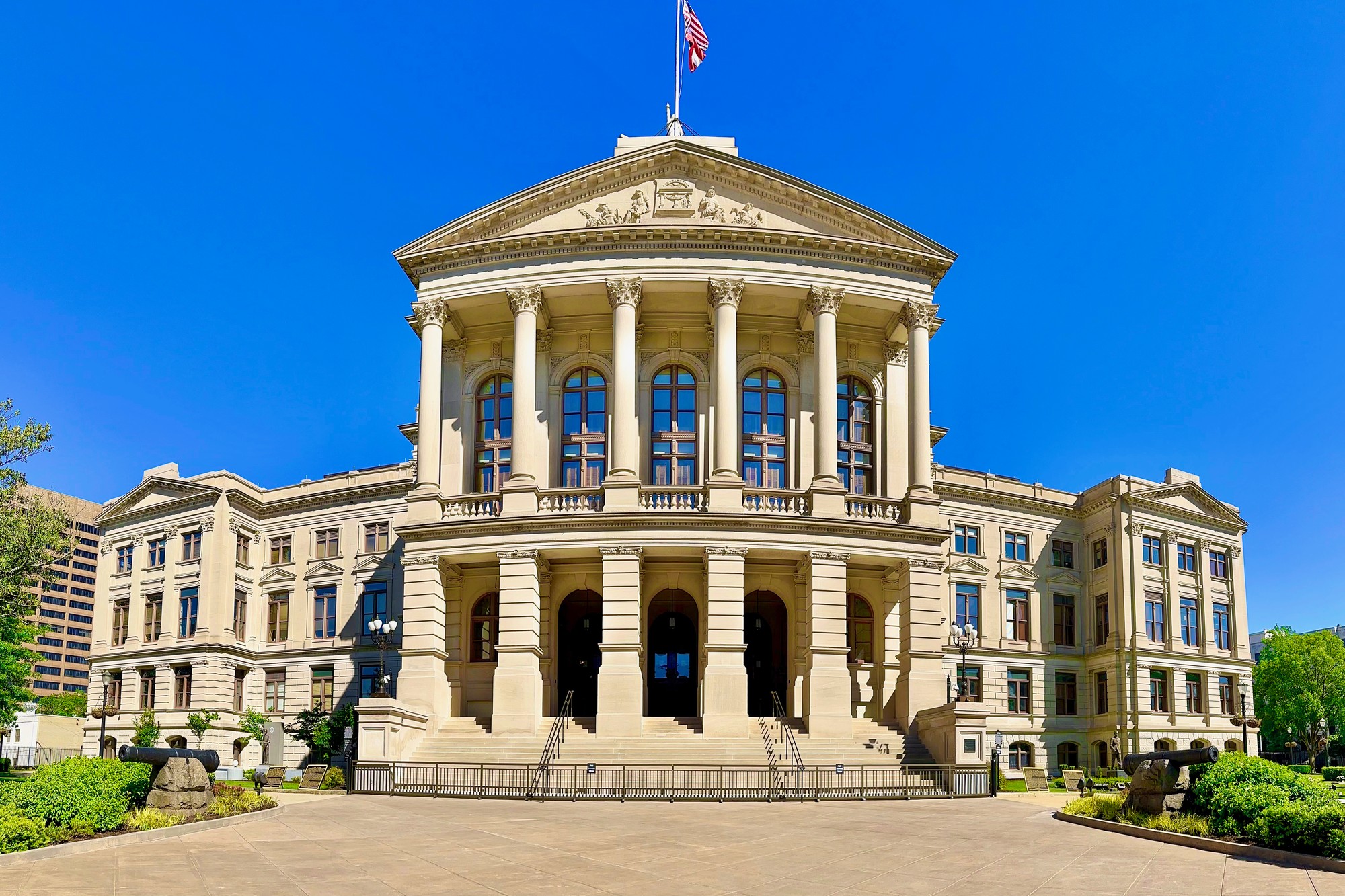
The Georgia State Capitol in Atlanta, where the 2021 maps at issue in the case were passed in special session and where the 2023 replacement maps were drawn after Judge Jones struck them. (Photo by Harrison Keely, via Wikimedia Commons, CC BY 4.0)
Callais changed the test. It did not repeal Section 2.
Section 2 is still on the books at 52 U.S.C. 10301. What moved was the proof burden. In Louisiana v. Callais, No. 24-109, decided April 29 by a 6-3 vote with Justice Samuel Alito writing and Justice Elena Kagan dissenting for herself, Justice Sonia Sotomayor and Justice Ketanji Brown Jackson, the Court held that Section 2 fits inside Congress's Fifteenth Amendment power only as an enforcement of that Amendment's ban on intentional racial discrimination.
Read that carefully, because it is being oversold in both directions. Alito wrote that the interpretation "does not demand a finding of intentional discrimination," but "imposes liability only when the circumstances give rise to a strong inference that intentional discrimination occurred." Plaintiffs do not have to prove a legislator's racist intent. They do have to produce circumstances that strongly imply it, which is a long way from the effects-based standard that governed vote-dilution cases for four decades.
The Eleventh Circuit spent several of its 11 pages spelling out what else changed. Plaintiffs drawing illustrative maps "cannot use race as a districting criterion," and any map they offer "must meet all the State's legitimate districting objectives," including stated partisan goals. Analysis of racially polarized voting now has to control for party affiliation, and the totality-of-circumstances review has to center on "present-day intentional racial discrimination regarding voting." Gingles survives. It was rewritten around the edges until the middle gave way.
Official record
Alpha Phi Alpha Fraternity, Inc., et al. v. Secretary, State of Georgia, Nos. 23-13914, 23-13916 and 23-13921 (11th Cir.), decided Aug. 25, 2026, on appeal from D.C. Docket Nos. 1:21-cv-05337-SCJ, 1:21-cv-05339-SCJ and 1:22-cv-00122-SCJ. Full docket history is collected on Loyola Law School's All About Redistricting.
"The appropriate response to such a significant change of law is to vacate and remand, so the district court may reconsider, in the first instance, whether Georgia's redistricting plans violate Section 2 of the Voting Rights Act under the updated Callais framework. We do so here." — Per curiam, p. 5
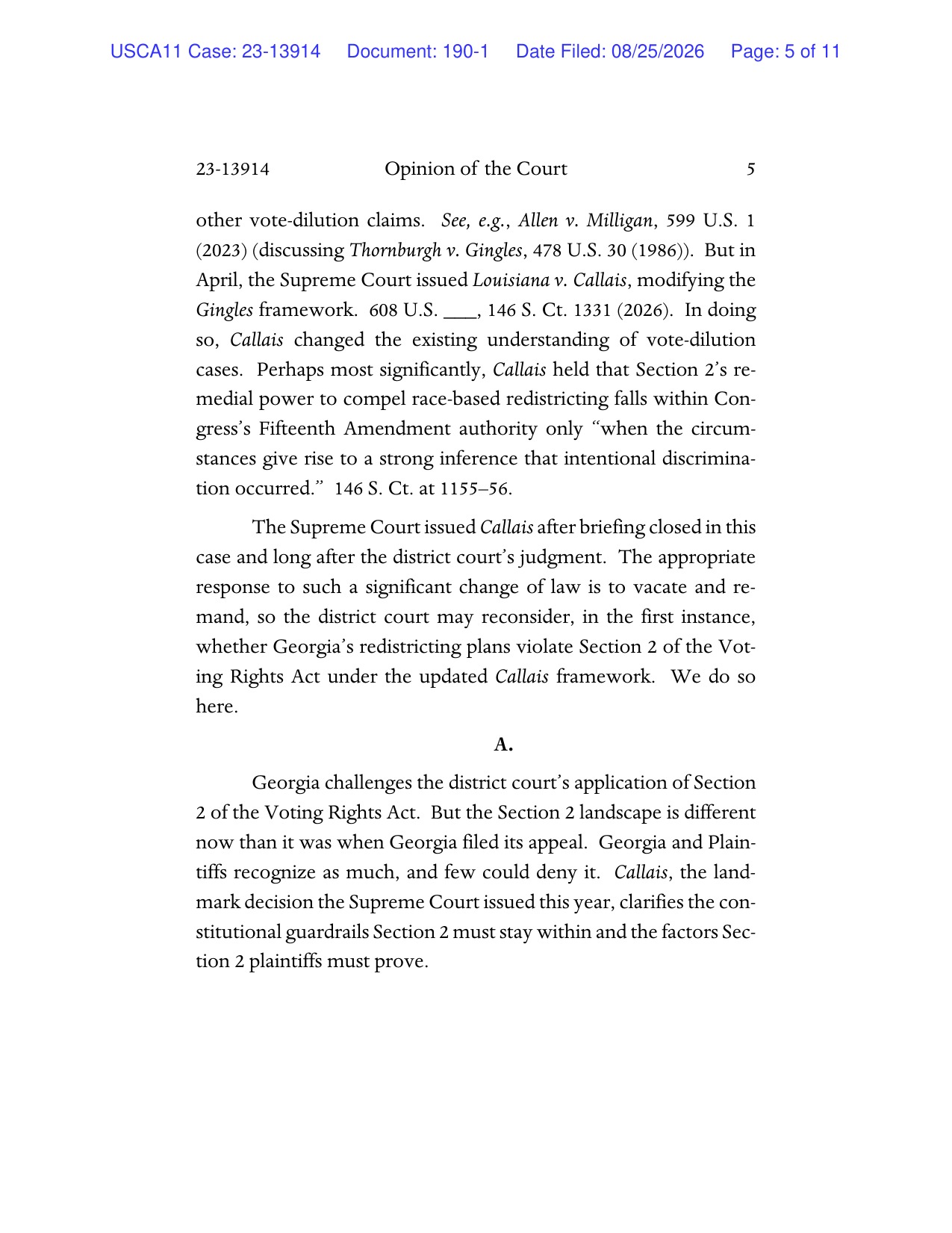
Page 5, where the panel states the Callais holding and announces the vacatur. Read or download the full 11-page opinion (PDF).
Nobody won a map this week
Georgia's plaintiffs asked the panel for a narrower result, arguing it should vacate only what Callais actually disturbed and leave the rest of Jones's findings intact. The panel declined: "By its nature, the Gingles analysis is fact-intensive, and those facts may take new shapes under the scrutiny of the new Gingles framework."
That cuts the other way too. Nothing in the order restores the 2021 maps or blesses the ones Georgia is using now. Ken Lawler, chairman of Fair Districts Georgia, put it plainly to the Georgia Recorder: "The decision does not invalidate Georgia's maps. It does not declare they have to be changed." Michon Lindstrom, communications director for Secretary of State Brad Raffensperger, said the ruling will not affect the maps used in November.
Gov. Brian Kemp read Callais in May as requiring new maps before the 2028 cycle and put redistricting on the agenda for a June special session. Republican legislators dropped it on June 17, saying they would wait for the courts. House Speaker Jon Burns has not closed the door, telling the Recorder his caucus is "reviewing the implications of the court's ruling." Kemp had already broken with other Southern Republican states this spring by declining to redraw for the midterms.

The North Carolina State Legislative Building in Raleigh. Lawmakers adjourned weeks ago and are not scheduled back until after Election Day, which is what stalls the state's new ballot rules. (Photo by P. Hughes, via Wikimedia Commons, CC BY 4.0)
North Carolina's new ballot rules ran into a paperwork wall
On Aug. 27 the North Carolina Rules Review Commission, an all-Republican body of political appointees, signed off on election rules that WRAL reports would create new mail-ballot procedures, tighten the process for voters lacking photo ID, and let poll workers remove people from polling places. The State Board of Elections had passed them in July on 3-2 party-line votes.
Approval was not the last step. Under N.C. Gen. Stat. 150B-21.3(b2), written objections from 10 or more people asking for legislative review push a rule's effective date out to the subsection (b1) timeline, which is tied to the next regular session of the General Assembly. Gov. Josh Stein was among the objectors and the elections board says the threshold was met. Republicans control both chambers and will very likely approve the rules eventually, but they adjourned weeks ago with no plans to return before Nov. 3. Absentee ballots start going out next week.
The lesson there is procedural, not partisan. Election rules written close to an election tend to die on a calendar, whoever writes them. Vermont showed the quieter version of the same week: Gov. Phil Scott and Secretary of State Sarah Copeland Hanzas announced on Aug. 25 that just under 900 people had been cut from the rolls after an audit found DMV staff had registered them over 25 years despite their having declined. None of them had ever voted.
The part that actually decides seats
Georgia is the bigger story because Georgia is where the new rules get their first real workout. Judge Jones now has to decide, on a record built for a legal test that has since been replaced, whether Black voters in Georgia can show a strong inference of intentional discrimination once race is pulled apart from party. Callais made that a much harder question to answer, which is exactly what its authors intended. Whatever Jones concludes lands after November and shapes the maps Georgia runs in 2028.