Bethany Hall was collecting a $5,000-a-year Virginia tuition grant at Liberty University until she changed her major to Music and Worship. The state took the money back, and on August 11 her lawyers asked the U.S. Supreme Court to throw out the 2004 decision that let Virginia do it.
The filing was docketed on August 14 as Hall v. Fleming, No. 26-193. It runs 96 pages and asks the justices to do one thing: overrule Locke v. Davey, 540 U.S. 712 (2004).
Virginia will pay for her to take religion classes. It will not pay for her to major in one.
The Virginia Tuition Assistance Grant is an ordinary state benefit. It gives $5,000 a year to Virginia residents attending accredited private nonprofit colleges inside the state. Hall qualified as a Music Education major at Liberty. She switched to Youth Ministries, then to Music and Worship, and the State Council of Higher Education for Virginia ruled her ineligible.
The catch sits in the statute. Virginia limits the grant to private institutions whose purpose is collegiate, graduate or professional education and "not to provide religious training or theological education," under Va. Code § 23.1-628. A student can take religious coursework at a religious school with state money in hand. What she cannot do is point the degree itself at ministry.
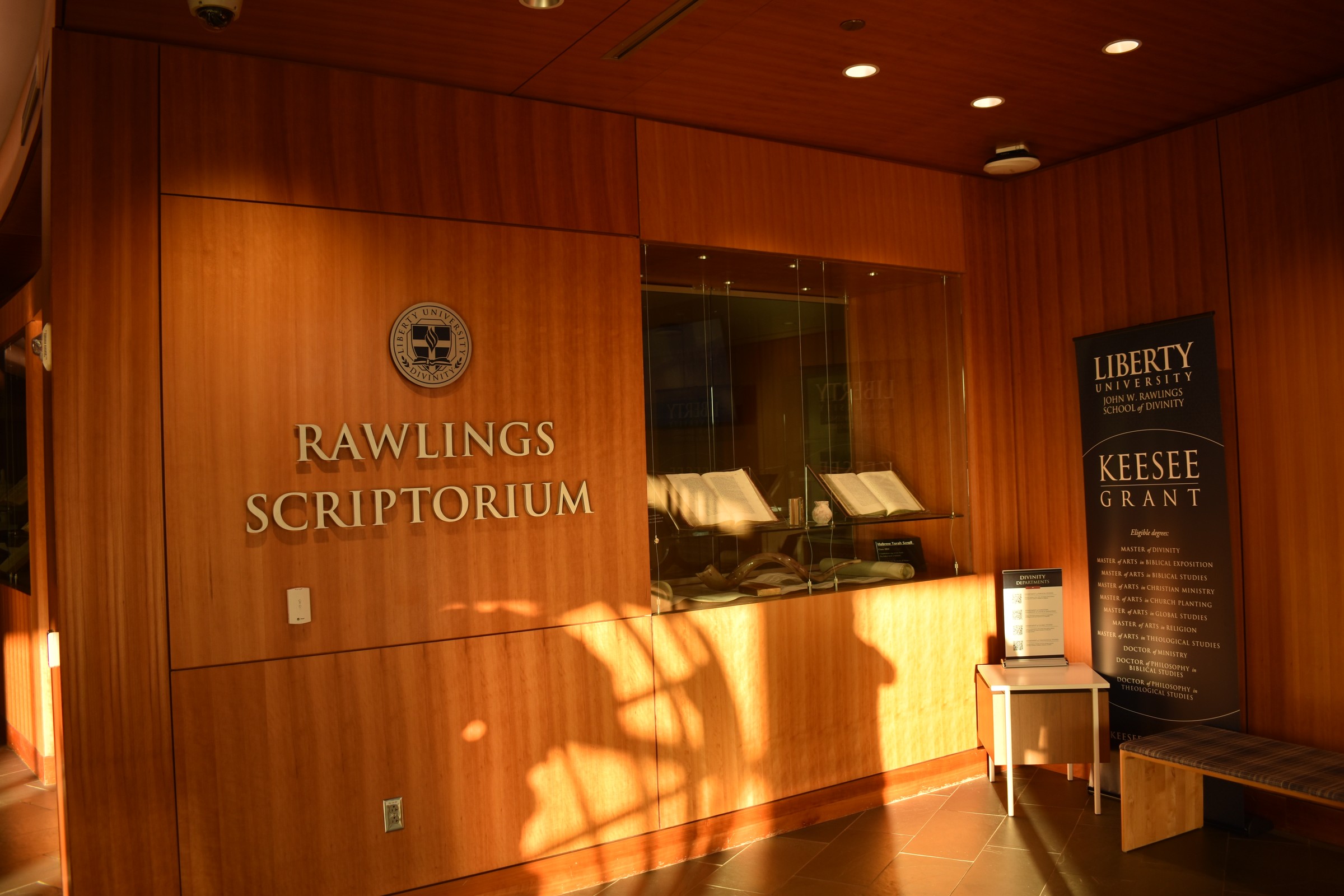
The Rawlings Scriptorium at Liberty University's John W. Rawlings School of Divinity in Lynchburg, Virginia. Hall's Music and Worship major is the kind of degree Virginia's grant program will not fund. Photo: Northern-Virginia-Photographer via Wikimedia Commons (CC0).
The judge who ruled against her called the precedent a "stain"
Hall lost in the Eastern District of Virginia before Judge David J. Novak in May 2025. She lost again on May 13, 2026, at the Fourth Circuit, in a published opinion reported at 175 F.4th 510, by Judge DeAndrea Gist Benjamin joined by Judges Steven Agee and Julius Richardson. The panel found her case "directly analogous" to Locke, and that settled it.
Richardson, confirmed to the Fourth Circuit in 2018 after President Trump nominated him, joined that opinion and then wrote separately to say he thought it was wrong. He also clerked for Chief Justice William Rehnquist, who wrote the majority opinion in Locke. "Locke v. Davey is a stain on our Free Exercise jurisprudence," Richardson wrote. "And the Supreme Court has all but confined it to its facts. But until the Court formally buries Locke, we lower-court judges must keep applying it." Earlier in the concurrence he called Locke binding "even as a moth-eaten shell of its former self," and wrote that without it, the Court's recent cases "would require us to hold that Virginia's program violates the Free Exercise Clause."
That is what separates this petition from the pile of religion cases already sitting at the Court. Hall is not asking the justices to fix a split between circuits. She is carrying up a unanimous ruling against her in which one of the judges spelled out, on the record, that he ruled against her only because he had to.
Official record
Bethany M. Hall v. A. Scott Fleming, No. 26-193, petition for a writ of certiorari filed August 11, 2026, docketed August 14, 2026. Steven W. Fitschen of the National Legal Foundation is counsel of record.
"The Question Presented is whether this Court should overrule Locke." — Petition for a writ of certiorari, page i
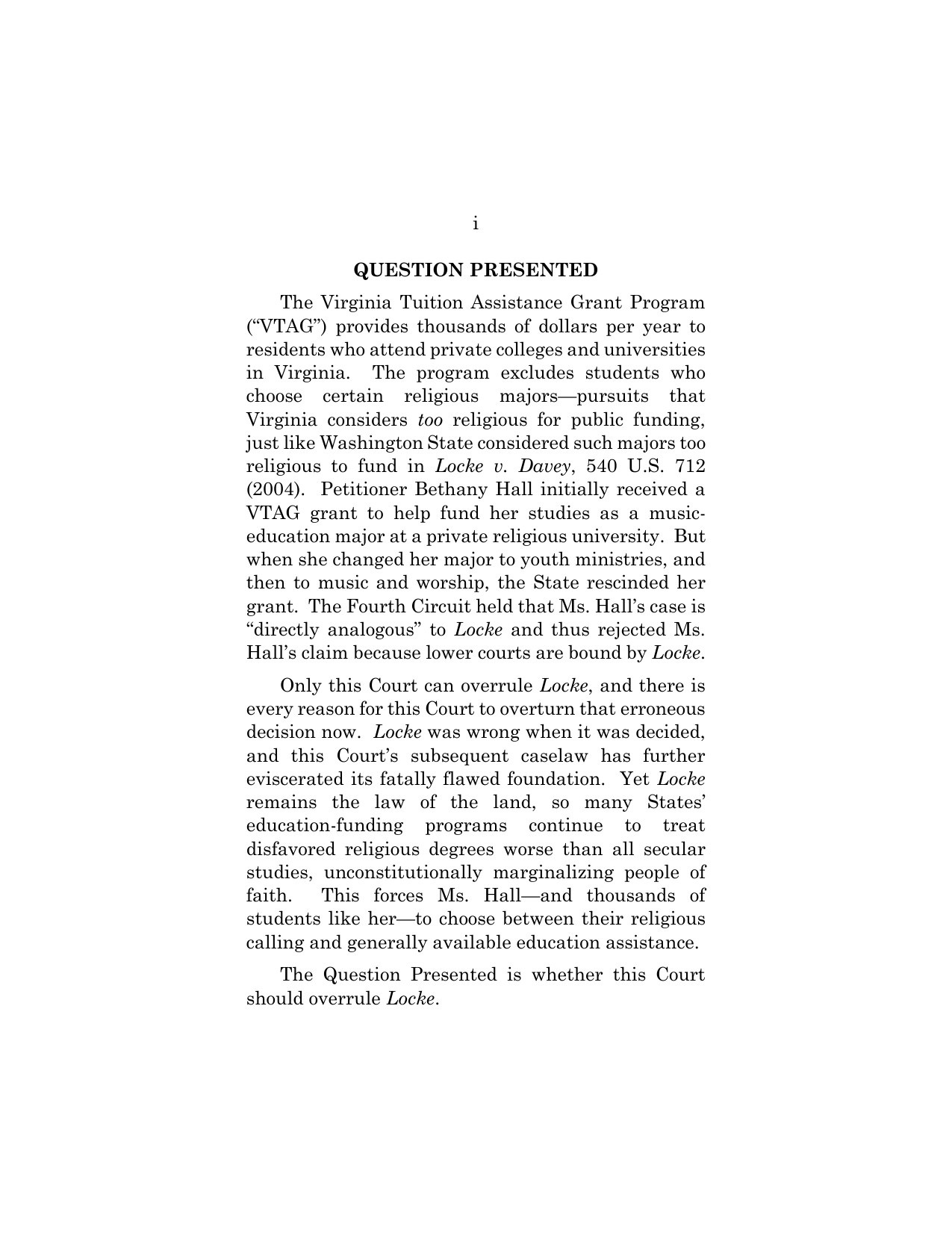
Read or download the full 96-page petition (PDF), or view the Supreme Court docket.
Locke has been shrinking for nine years
In Locke, the Court let Washington State refuse to fund a devotional theology degree under its Promise Scholarship. Justice Antonin Scalia dissented, writing that the program discriminated against "those whose belief in their religion is so strong that they dedicate their study and their lives to its ministry."
Since then the Court has moved steadily in Scalia's direction. Trinity Lutheran v. Comer (2017) held Missouri could not shut a church preschool out of a playground resurfacing grant. Espinoza v. Montana Department of Revenue (2020) struck down a state constitutional bar on aid reaching religious schools. Carson v. Makin (2022) held that discriminating on religious use offends the Free Exercise Clause just as much as discriminating on religious status, and said flatly that "Locke cannot be read beyond its narrow focus on vocational religious degrees."
So Locke survives inside a fence the Court built around it. Hall's argument is that the fence has gotten so tight there is nothing left inside worth protecting, and that leaving the case on the books hands states a template for treating a ministry calling as the one major taxpayers may refuse to fund.
Ten other states run the same exclusion
The petition catalogs statutes in Alabama, Florida, Illinois, Michigan, Minnesota, New Jersey, New Mexico, Ohio, Oregon and South Carolina that cut students out of state grants for majoring in theology, divinity or religious education, most of them worded almost identically. Citing Data USA, the petition counts 6,724 Divinity and Ministry degrees earned in 2024 alone.
One detail on the signature page is hard to miss. Joshua D. Davey, the student who lost his scholarship in Locke v. Davey, is now a lawyer at Troutman Pepper Locke and co-counsel for Hall. "Twenty-two years ago, the Supreme Court's decision allowed states to single out students like me because our course of study related to our religious calling," Davey said in the announcement of the filing. "I am hopeful that the Court will correct that decision and treat students like Bethany equally." Jeremy Dys of First Liberty Institute put the ask more bluntly: "The Supreme Court should formally overrule it."
What happens next
Filing a petition is a request, not a result. The Court turns away the overwhelming majority of what reaches it, and it can deny this one without explanation. Virginia's response was due September 14. On August 25 the Clerk extended that to October 14, with Tillman J. Breckenridge of the Virginia Attorney General's office as counsel of record for Fleming. Nothing gets decided before then.
What is already decided is the cost to Hall. She is out $5,000 a year, and she is out that money for one reason: she pointed her degree at the church instead of the concert hall. A federal appeals judge agreed with her about the Constitution and ruled against her anyway. If the justices take the case, they will finally answer a question they have circled for nine years. If they pass, the rule for students like her stays what it has been since 2004: study whatever you want and the state will help, unless you mean to give your life to it.