The Second Amendment Foundation and the Firearms Policy Coalition filed their opening merits brief at the Supreme Court on Friday, asking the justices to rule that AR-15-platform rifles are protected arms no government may ban outright. The 68-page filing in the consolidated cases Viramontes v. Cook County and Grant v. Higgins does not ask the Court to write new law. It argues the Court already answered this in 2008 and now has to say so out loud.
A brief is an argument, not a ruling
Worth stating plainly before anything else: nothing was decided last week. This is the petitioners' opening brief, filed on the August 28 deadline the Court set when it granted an extension in July. Cook County and Connecticut have not answered yet. David H. Thompson of Cooper and Kirk is counsel of record. Cutberto Viramontes, the named Illinois plaintiff, wants an AR-platform rifle made by Smith and Wesson, and his co-plaintiff Christopher Khaya wants an IMI Galil, built on the AK-47 platform.
Official record
Cutberto Viramontes, et al. v. Cook County, Illinois, et al., No. 25-238, and Eddie Grant, Jr., et al. v. Ronnell Higgins, No. 25-566, Brief of the Petitioners, filed August 28, 2026, on writs of certiorari to the Seventh and Second Circuits. Available on the Court's own public docket.
"Reversing the decisions below requires breaking no new ground; this Court need only apply its holding in Heller. But affirming the decisions below is impossible without effectively overruling Heller and severely limiting the Second Amendment's protection." (Brief of the Petitioners, pp. 3-4)
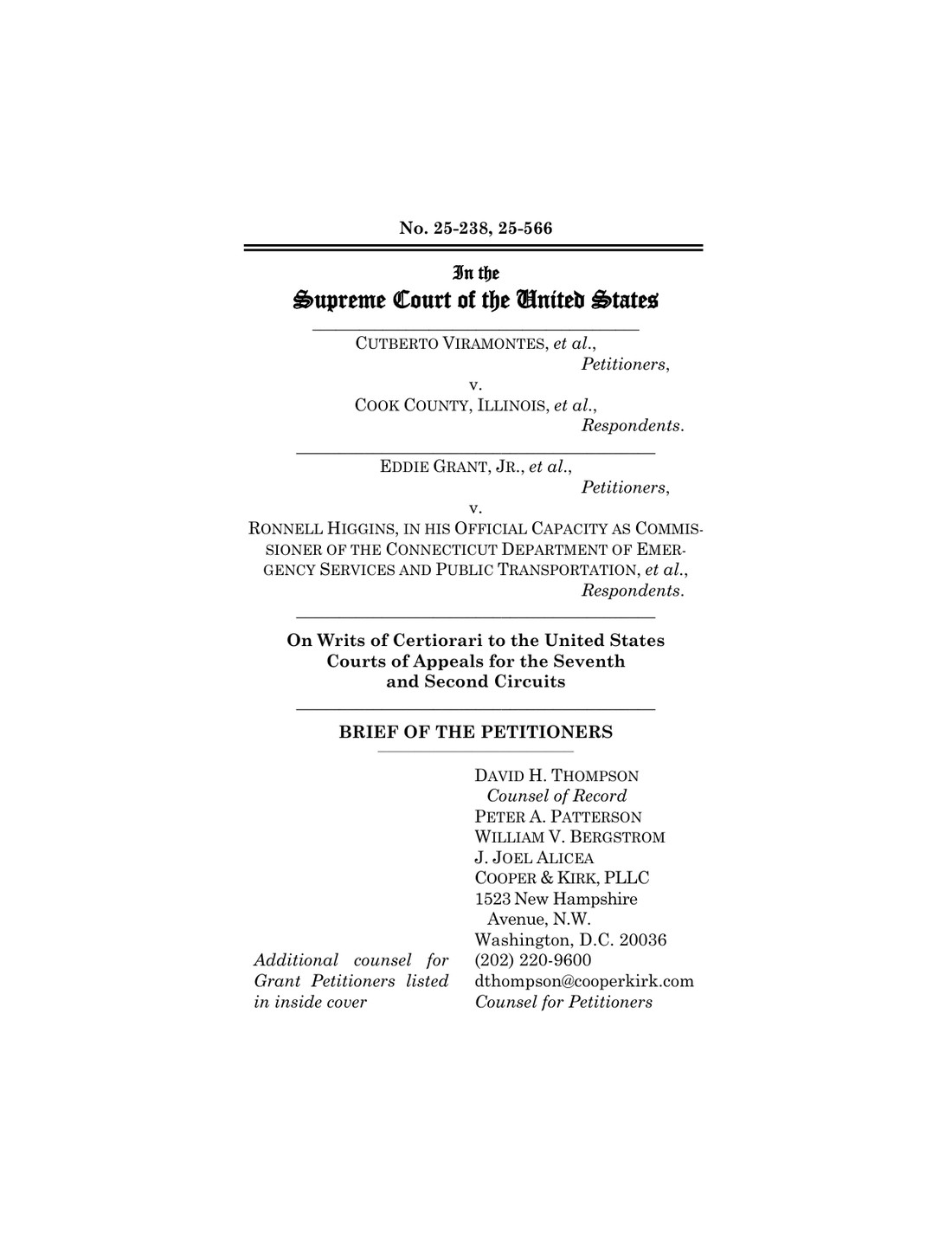
Read or download the full 68-page brief (PDF)
The question the Court actually granted
The question presented reads, verbatim: "Whether the Second and Fourteenth Amendments guarantee the right to possess AR-15 platform and similar semiautomatic rifles." That is the whole thing. When the Court granted review on June 30, it took the Grant petition only "as to the question presented by the petition in No. 25-238," consolidated the two cases and allotted a single hour of argument.
The magazine bans in both jurisdictions survive untouched. Connecticut and Cook County each cap magazines at ten rounds, and the brief says so on page 16: "Those bans are not challenged and are not at issue in these cases." Anyone reading a headline about the Supreme Court and magazine limits is reading about a different case.
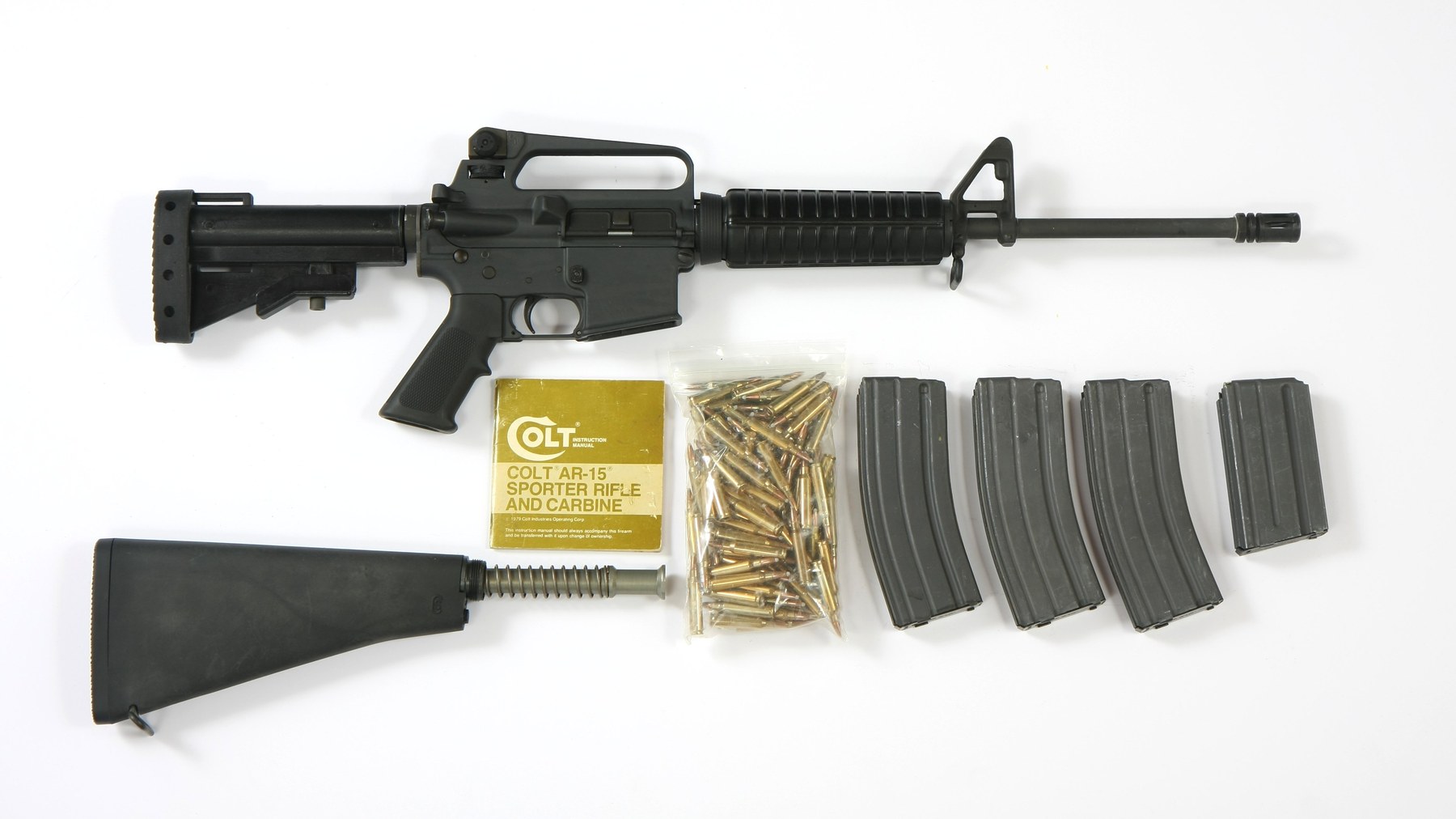
A pre-ban Colt AR-15 Sporter Lightweight rifle with its original manual, 5.56mm ammunition and magazines. The telescoping stock and pistol grip visible here appear on both the Connecticut and Cook County feature lists that define a banned "assault weapon." The muzzle device is a flash suppressor, which Connecticut lists by name. Photo by Steve Rainwater, January 2013, via Wikimedia Commons, CC BY-SA 2.0.
Both laws ban features, and the brief attacks them one at a time
Cook County's ordinance and Connecticut General Statutes section 53-202a work the same way. Each names specific rifles, the AR-15 among them, then sweeps in anything carrying a listed feature: folding or telescoping stocks, pistol grips, thumbhole stocks, flash suppressors, barrel shrouds, muzzle brakes.
Roughly six pages then compare an AR-15 feature by feature against a Winchester 1873, the rifle marketed as "The Gun that Won the West." The point is mechanical rather than sentimental. A pistol grip exists because the AR's straight-line barrel-and-stock geometry leaves the trigger hand nowhere else to go. The brief's conclusion on page 20: "none of these features make the rifle mechanically fire faster or with greater power."
Nobody is arguing this case in October
This is where most coverage has it wrong, including the Daily Caller's writeup of the filing, which says the cases were consolidated "prior to hearing oral arguments once the next term of the Supreme Court begins in October." They will not be heard in October. The Court has already published its October calendar and its November calendar, and Nos. 25-238 and 25-566 appear on neither. The granted and noted list shows argument dates for other cases and a blank for this one. Respondents' briefs are not due until October 21, so December is the earliest realistic sitting and January is likelier.
The docket also shows how hard this grant was to get. Viramontes was distributed for conference 22 separate times between December 2025 and June 2026 before the justices took it. And the Seventh Circuit decision under review is not even a published opinion. It is an unpublished summary order affirming under Bevis v. City of Naperville, holding the petitioners had not shown the banned rifles are "arms" at all.
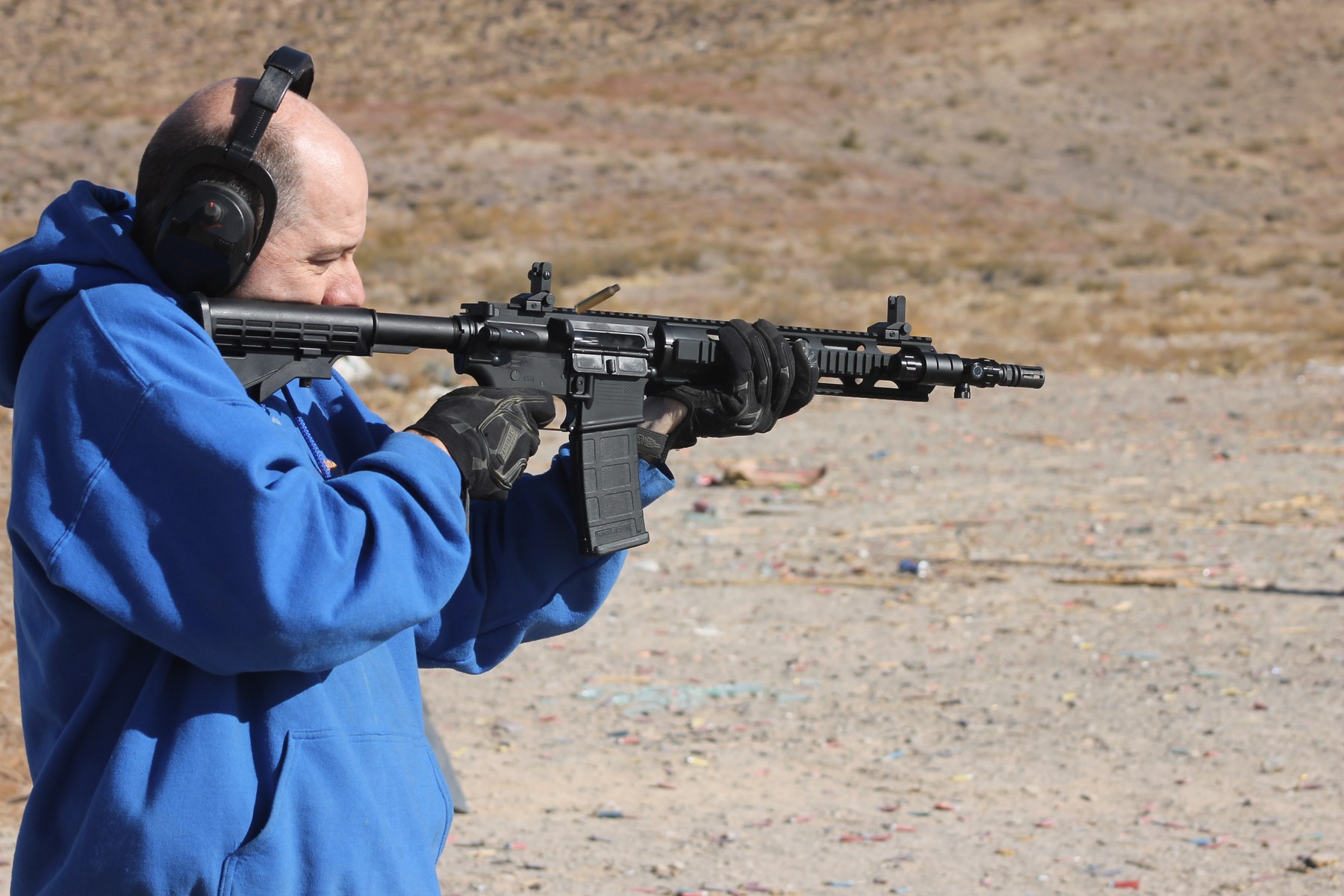
A shooter firing an AR-15-platform rifle, an ABC Rifle Company ABC-15, at an outdoor range in Nevada. The brief's core claim is that lawful use on this scale is what puts a firearm beyond a legislature's reach. Photo by Noah Wulf, September 2019, via Wikimedia Commons, CC BY-SA 4.0.
The numbers the brief leans on
Common use is the whole ballgame under Heller, so the brief spends its evidentiary weight there. Survey data it cites puts roughly 26 million Americans owning at least one such rifle, about 22 million of them an AR-15 specifically. Dealers report these rifles account for roughly 20 percent of firearm sales, second only to semiautomatic handguns.
Then the comparison the brief wants the justices to sit with: even if every one of the 425 rifle murders committed annually in the United States involved an AR-15, that would touch a fraction of a percent of the ones in circulation. Handguns account for an average of 7,087 homicides a year, more than sixteen times the rifle figure. Knives account for 1,604.
Konstadinos Moros, SAF's director of legal research and education, gave the Daily Caller News Foundation the strategic read: "Anti-gun states, relying on circuit courts that are hostile to the Second Amendment, have long gotten away with unserious arguments in AWB cases. That tactic was always only going to work until the Supreme Court finally decided to take on the issue itself."
A separate fight over magazines is still waiting on the Court
The Third Circuit, sitting en banc, struck down both New Jersey's assault firearm ban and its ten-round magazine limit on July 17 in a 192-page set of opinions written by Judge Arianna Freeman, an appointee of Joe Biden. The reported caption is Association of New Jersey Rifle and Pistol Clubs v. Attorney General New Jersey, also called Cheeseman v. Davenport after the consolidated FPC challenge. It split the court badly, drawing separate dissents from Judges Shwartz, Krause and Smith. The court then stayed its own mandate on August 4, so New Jersey's ban stays enforceable for now.
That ruling collides with the Ninth Circuit decision under review in Duncan v. Bonta, No. 25-198, the challenge to California's ten-round limit, and with the Seventh Circuit's July 9 decision upholding Illinois' law in Barnett v. Raoul. Duncan has been held over rather than granted, per the SAF-affiliated judicial report published August 26, which also says summer order lists are due Friday, September 4 and that such lists ordinarily handle motions and rehearing petitions rather than cert grants. The Court's own case distribution schedule shows the real date to watch: every summer-list petition, Duncan included, is set for the long conference on Monday, September 28.
What is actually on the table
A ruling for the petitioners would not repeal any statute by itself. It would resolve the plain-text question the Seventh Circuit ducked, reject the Second Circuit's "unusually dangerous weapons" test, and send both cases back with instructions to enter judgment for the plaintiffs. The dozen or so state bans the brief catalogs, from California to Maryland, would then face the new rule one lawsuit at a time.
A ruling the other way is the outcome to think hardest about. The brief's own framing is that affirming these decisions is "impossible without effectively overruling Heller." Cook County and Connecticut get until October 21 to argue that it is not. Everything after that turns on nine people and a calendar the Court has not printed yet.