Federal prosecutors in Minneapolis were prepared to charge ICE officer Christian Castro over the January shooting of Julio Sosa-Celis, then decided not to put the case in front of a grand jury. The decision landed in the final week of August, days before Castro walked out of a Texas jail a free man, and nobody at the Justice Department has said a word about it publicly.
MPR News reporter Matt Sepic broke the story Sunday, citing two people with knowledge of the case who are not authorized to speak publicly. The charge under consideration was deprivation of rights under color of law, 18 U.S.C. 242, which carries up to ten years when bodily injury results. It is the same offense Derek Chauvin pleaded guilty to after a Hennepin County jury convicted him of murdering George Floyd.
Six days earlier, the Justice Department was telling reporters it might charge him
On August 25, CNN reported that DOJ was weighing charges and that prosecutors could move "as soon as Tuesday." Emily Covington, the department's director of public affairs, confirmed in writing that the U.S. attorney's office was consulting the Civil Rights Division, as department policy requires, and that division lawyers had talked with prosecutors in Minnesota. She would not say what the outcome would be.
The outcome was nothing. No indictment, no declination letter, no statement. When MPR asked both the Minnesota U.S. attorney's office and Justice Department headquarters for comment, it got neither. DHS did answer, and its answer was narrow. Castro is suspended from ICE without pay, and a senior Homeland Security official told WCCO that "lying under oath is a serious federal offense" and that the U.S. attorney's office is "actively investigating these statements." On the shooting itself, DHS said nothing.
Official record
Complaint and Warrant, State of Minnesota v. Christian J. Castro, No. 27-CR-26-12537 (Hennepin County District Court, 4th Judicial District), filed May 18, 2026. Page 4 describes what happened when Minnesota investigators tried to interview the federal agents at the scene.
"Soon after conducting the interview of ICE Agent 1, FBI agents at the scene informed the BCA that they had been directed to cease working with the BCA and that no further interviews would be conducted at the scene. At that point, federal authorities stymied all further efforts by the BCA to interview additional ICE agents or Defendant himself. To date, federal authorities have prevented any further interviews of involved federal agents." — Complaint, at 4
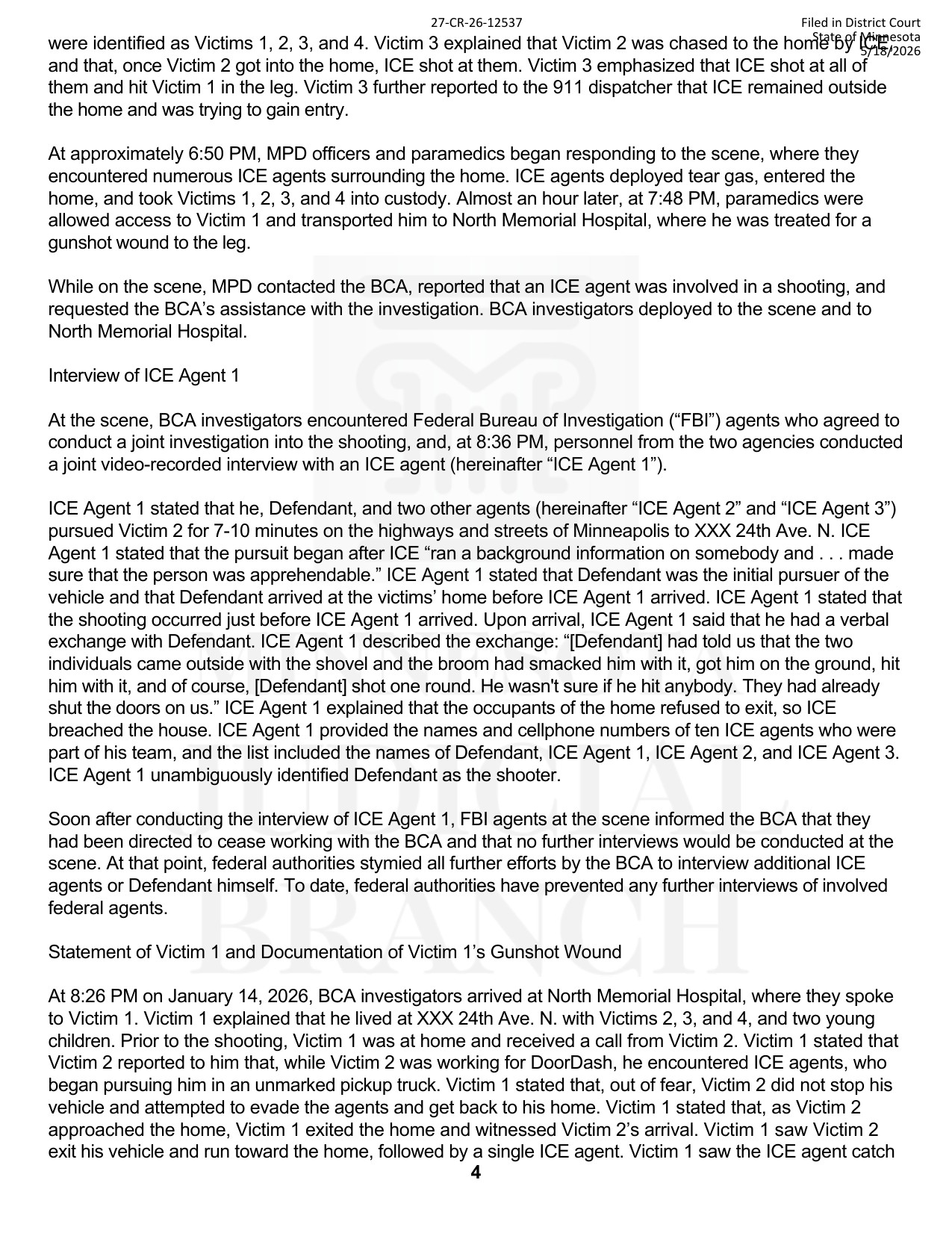
Read or download the full 11-page complaint and warrant (PDF), as e-filed in Hennepin County District Court and announced by the Hennepin County Attorney's Office on May 18
This is the office that already prosecuted the man Castro shot
Two days after the January 14 shooting, the same U.S. attorney's office charged Julio Sosa-Celis and Alfredo Aljorna with assaulting a federal officer, on the strength of an FBI affidavit summarizing Castro's account that they beat him with a broom and a snow shovel. A Minneapolis city camera had been pointed at the house the entire time. The complaint says the shovel was lying on the lawn where it had been thrown before Castro arrived, and that Castro's medical exam that night found no injury beyond an abrasion at the base of his left thumb.
On February 11, U.S. Attorney Daniel N. Rosen moved to dismiss the case against both men, writing that newly discovered evidence was "materially inconsistent with the allegations in the Complaint Affidavit" and that dismissal with prejudice would serve the interests of justice. Judge Paul A. Magnuson dismissed the charges two days later. Both men were living in Minnesota lawfully at the time under Temporary Protected Status granted by DHS, a fact the complaint states plainly.
So the record now reads like this. The federal government charged the wounded man on a false account, dropped it, blocked state investigators from interviewing its own agents, spent seven months deciding whether to charge the agent, and then quietly declined.

Hennepin County Attorney Mary Moriarty, whose office filed the four assault counts against Castro in May and now holds the only live criminal case against him. Official portrait, released under CC0 via Wikimedia Commons.
A declination is not an acquittal, and the clock has not run out
Nothing about this closes the federal door. Castro was never charged, so no jury was ever sworn and double jeopardy never attached. Under 18 U.S.C. 3282, the government has five years to indict on a non-capital charge, which for a January 14, 2026 shooting runs into January 2031.
Sosa-Celis's attorney, Robin Wolpert, told MPR her client had been told by federal prosecutors that they would indict. "And it really is devastating, because he did put his trust in the justice system," she said. "He did put his trust in prosecutors, and it's been broken again."
Everything now rests on a case whose defendant has never walked into the courtroom
Hennepin County charged Castro, 52, on May 18 with four counts of second-degree assault with a dangerous weapon, one for each person inside the house, plus a misdemeanor count of falsely reporting a crime. Each assault count carries a seven-year maximum and a three-year mandatory minimum because a firearm was used. Judge Paul R. Scoggin set bail at $200,000 and ordered Castro to surrender his passport as a condition of release. The warrant is marked for nationwide execution.
None of that has produced an appearance. Gov. Greg Abbott has still not signed the rendition warrant that has sat in his office since June 3, a federal judge in Brownsville held last week that he cannot be forced to, and Texas released Castro on August 27 when its 90-day limit on holding extradition detainees expired. Ellison's office told the Texas Tribune that without Abbott's signature Castro cannot be re-arrested in Texas on the May warrant, though he could be picked up on it the moment he crosses into another state.
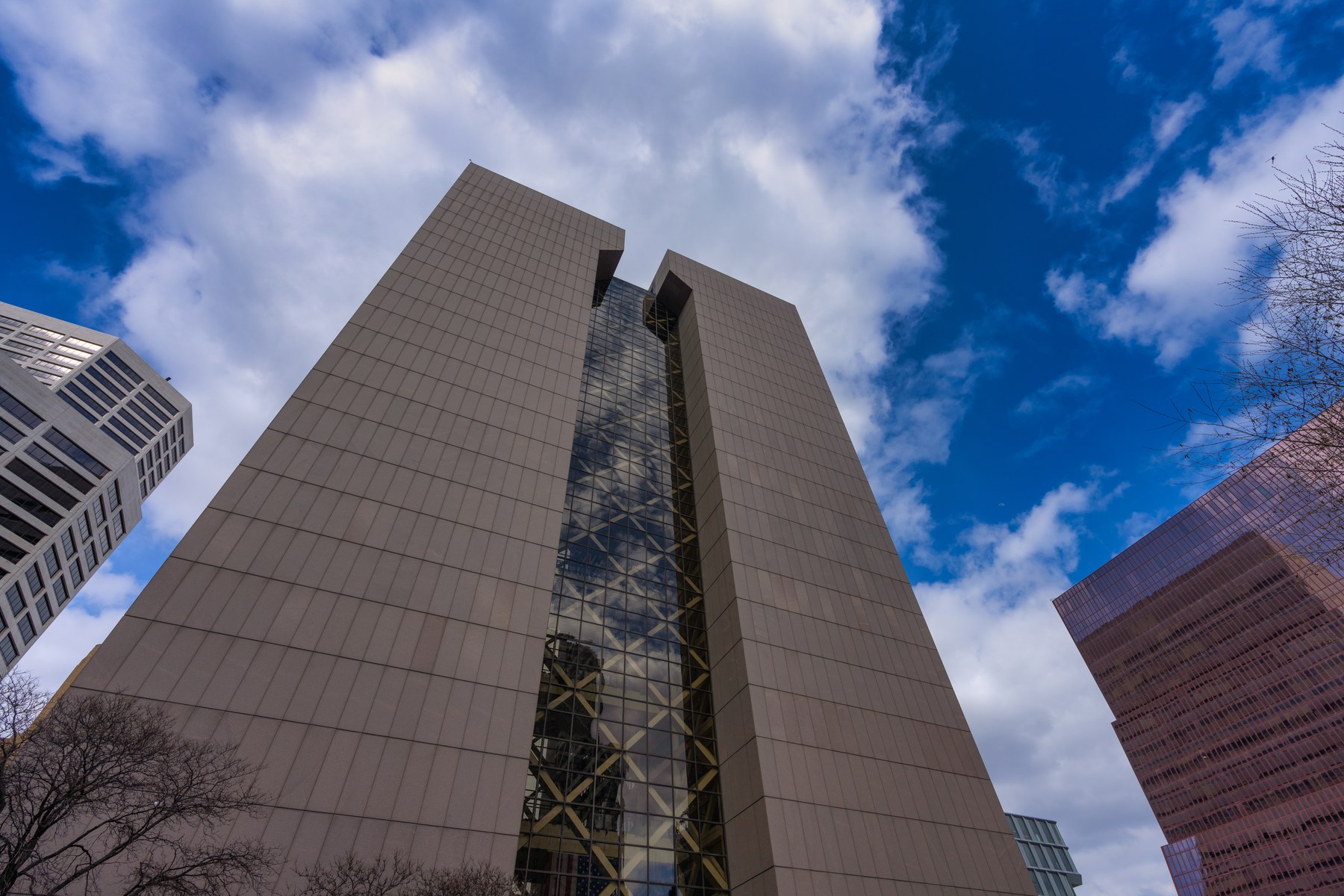
The Hennepin County Government Center in Minneapolis, where case No. 27-CR-26-12537 is filed. Castro has never appeared in it. Photo by Tony Webster, CC BY 2.0, via Wikimedia Commons.
Attorney General Keith Ellison says he is still deciding his next move in the extradition suit. "We will never drop this," he told MPR. "Mr. Castro will face justice in Minnesota. I can't guarantee exactly when, but I can guarantee that that's going to happen." Moriarty, speaking to WCCO after the release, put the timing problem more bluntly: "The question is when will that be and also where will Christian Castro be?"
That is not a rhetorical question. In a filing last week, an investigator in Ellison's office wrote that Castro and his romantic partner, who lives in Mexico, discussed marrying and buying a home there in recorded jail calls. He was released without conditions in a county on the Mexican border, and nobody has said publicly whether anyone is tracking him.
Why conservatives should want this tried
ICE officers get shot at, spat on, doxxed and ambushed, and the people doing that job deserve the presumption of innocence like anyone else. Castro has it. He has also never answered a single question under oath about a round he fired through a closed door into a house with four adults and two children behind it, a round that came to rest in the wall of a child's bedroom.
The strongest argument for hard immigration enforcement has always been that the law applies to everybody. That argument does not survive an outcome where the agency investigates itself, the prosecutors who charged the wounded man decline to charge the officer, and a governor sits on a signature until the jail has to open the door. A Minneapolis jury is free to acquit Christian Castro. What it cannot do is hear the case, and that is the one part of this that people in power have actually managed to prevent.
Hero image: the Diana E. Murphy United States Courthouse in Minneapolis, home of the U.S. District Court for the District of Minnesota and the grand jury that was never asked to consider Castro's case. Photo by Tony Webster, CC BY 2.0, via Wikimedia Commons.