ICE officer Christian Castro walked out of the Cameron County jail in Brownsville, Texas, shortly before 7 a.m. Thursday, still charged in Minnesota with four felony counts of second-degree assault and still not extradited. Gov. Greg Abbott never signed the one piece of paper that would have put him on a plane to Minneapolis, and once the 90th day hit, Texas law made the sheriff open the door.
Sheriff Manuel Trevino confirmed the release, Houston Public Media reported. Photographers caught Castro getting into a car outside the Carrizalez-Rucker detention center surrounded by reporters. He has said nothing publicly, and no lawyer ever appeared for him in the Texas extradition case.
The clock that ran out is a Texas statute, not a federal deadline
Here is the actual machinery. The Extradition Clause (Article IV, Section 2, Clause 2) says a person charged with a felony in one state who flees and turns up in another "shall on Demand of the executive Authority of the State from which he fled, be delivered up." Congress supplied the procedure in the Extradition Act of 1793, now 18 U.S.C. 3182. Texas and Minnesota both layered the Uniform Criminal Extradition Act on top of it.
Under the UCEA as Texas enacted it (Code of Criminal Procedure art. 51.13), the demanding governor signs a requisition warrant and the asylum governor signs a rendition warrant. Gov. Tim Walz signed his June 2. Abbott's office received it June 3. Article 51.07 is the tripwire: a fugitive "not arrested under a warrant from the Governor of this State before the expiration of ninety days from the day of his commitment" must be discharged. Castro was arrested May 29 by the Texas Rangers. Ninety days later was Thursday. That deadline caps how long Texas can hold a man. It puts none at all on the governor.
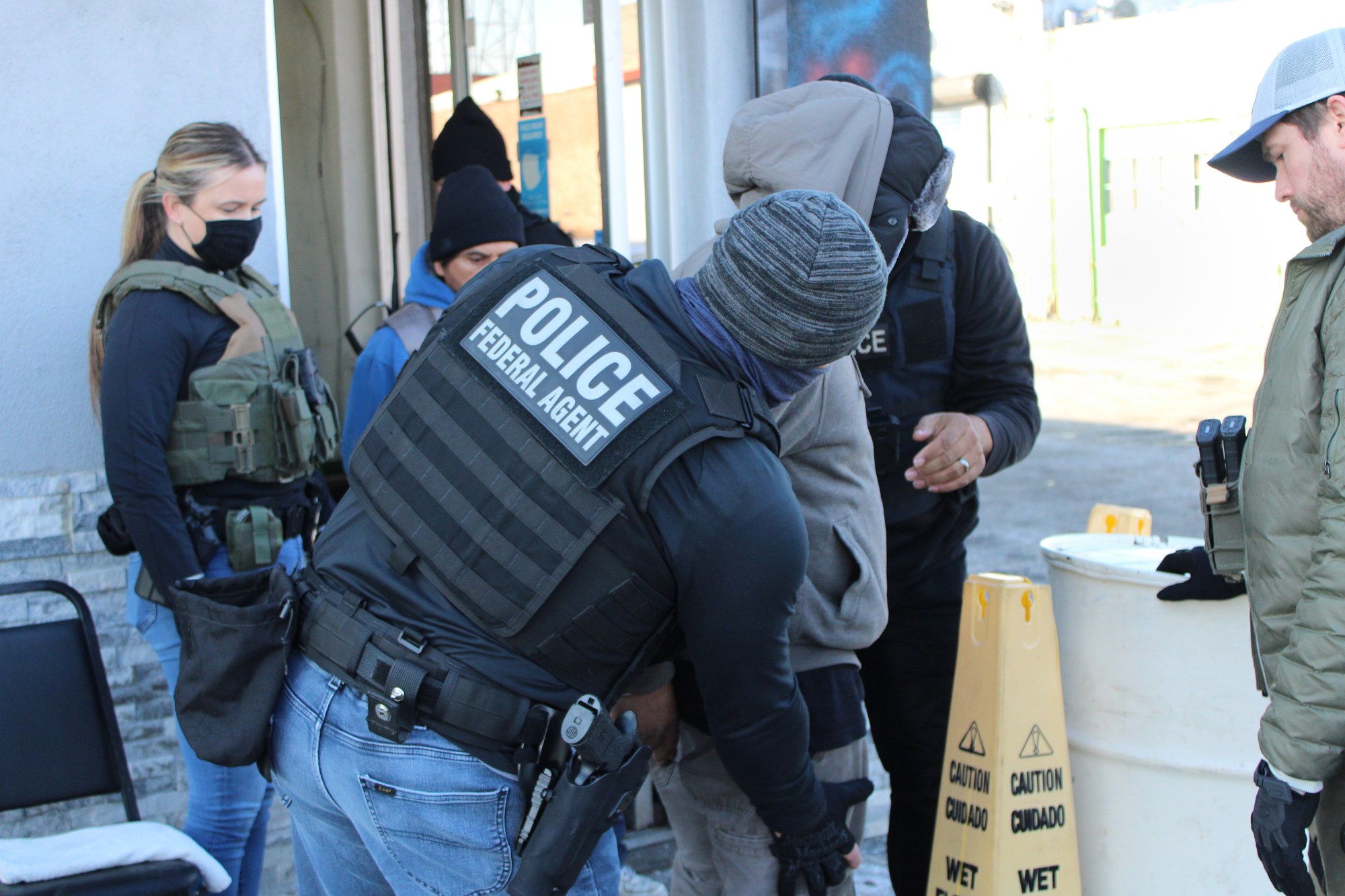
ICE Enforcement and Removal Operations officers during a field operation in West Palm Beach, Florida, February 2025. File photo of ERO officers, not Christian Castro and not the January 2026 Minneapolis shooting. Photo by U.S. Immigration and Customs Enforcement, public domain, via Wikimedia Commons.
Abbott's whole argument comes down to one word
Abbott never said no. That distinction decided the case. On July 31, one day after Hennepin County Attorney Mary Moriarty wrote asking him to sign, Abbott sent a letter to interim Secretary of State Robert Howden invoking section 4 of the UCEA, which lets a governor order an investigation into whether the person demanded "ought to be surrendered."
His reason is the interesting part. Castro did not drive himself out of Minnesota. The Justice Department confirmed in an August 24 Statement of Interest that ICE Field Office Director Patrick Divver ordered Castro back to his duty station in Harlingen on or about January 15, the day after the shooting, "based upon concerns for DO Castro's personal safety and the safety of other ICE officers in Minnesota." Castro was in Texas by January 16, four months before Minnesota charged him.
So Abbott's question is whether a federal employee whose agency ordered him out of a state is a "fugitive" who "fled" it. Minnesota calls that a smokescreen and says the only facts that matter are undisputed: Castro was in Minnesota when it happened and is in Texas now.
Official record
Letter from Gov. Greg Abbott to Texas Secretary of State Robert Howden, July 31, 2026, published by the Legislative Reference Library of Texas.
"Based on publicly available information indicating that Mr. Castro was compelled to return to Texas on orders of the federal government, I have serious doubts that the prerequisites for extradition have been met." — Gov. Greg Abbott to Secretary Howden
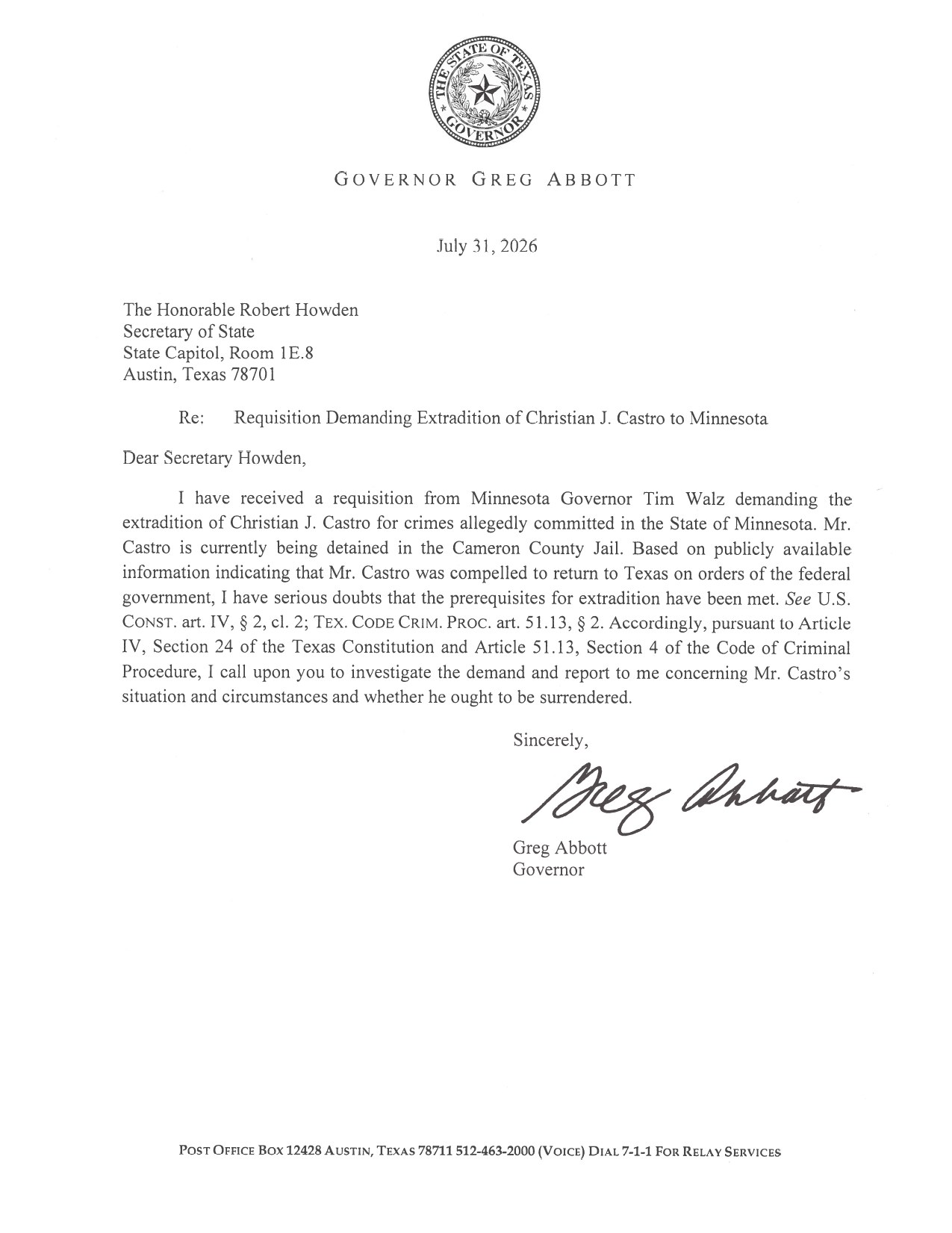
Read the full one-page letter (PDF), hosted by the Legislative Reference Library of Texas
What Judge Rodriguez held, and what he pointedly did not
Minnesota sued Abbott and Trevino in Brownsville on August 18, asking for a writ of mandamus forcing Abbott to sign and an injunction barring the sheriff from letting Castro go. U.S. District Judge Fernando Rodriguez Jr., appointed to the bench in 2018, heard argument August 25 and denied the restraining order the next day.
He did not hold that Abbott wins. He held the case is not ripe, because Abbott has not refused anything yet. "Minnesota alleges that Governor Abbott has 'refused to sign' and has 'with[eld]' the rendition warrant," Rodriguez wrote. "But the record reflects only that Governor Abbott has neither agreed nor refused to sign." Minnesota was really asking a federal court to invent a deadline that neither the Constitution nor either statute contains.
The footnotes are less comfortable for Texas. In footnote 4 the judge says he has "doubts that caselaw supports the construction of 'fugitive' that Texas is considering," citing Roberts v. Reilly, 116 U.S. 80 (1885), which asks only whether the accused in fact left the state. He also refused to rule out that an open-ended investigation could someday become a constructive denial. This record just does not show one yet.
Official record
Order denying temporary restraining order, Walz v. Abbott, No. 1:26-cv-00906 (S.D. Tex., Brownsville Div.), Doc. 28, signed August 26, 2026.
"No party disputes this chronology of events, and the Court accepts that Governor Abbott has considered this particular extradition request for an atypically-long duration. Nevertheless, Minnesota identifies no statutory or constitutional provision requiring Governor Abbott to complete his investigation and decide whether to sign the rendition warrant within a particular time period." — Order, Doc. 28, at 10
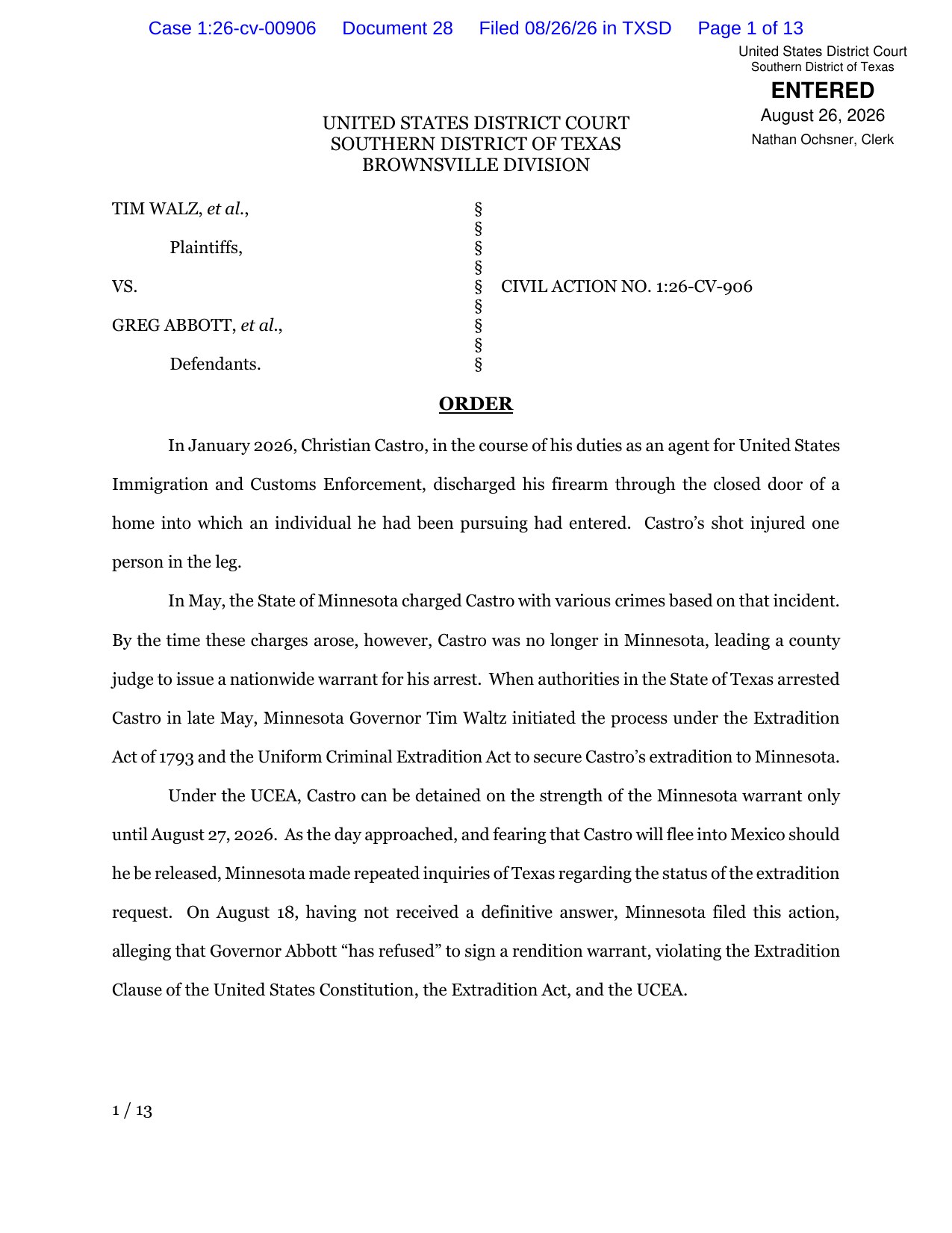
Read the full 13-page order (PDF), via CourtListener RECAP, or the full docket in No. 1:26-cv-00906
The part conservatives should not wave away
Minnesota's complaint puts numbers on the table that are hard to argue with. Over five years Minnesota asked Texas for about 11 people and Abbott signed in under 30 days on average, once in 17 days on a second-degree assault case. Texas asked Minnesota for about 21 people and Walz signed in under five days on average. While Castro's paperwork sat, Abbott signed rendition warrants for three other Minnesota defendants, on June 30, July 1 and August 5.
Abbott also said out loud why he is in no hurry. He told reporters he does not trust Walz "on anything, let alone something like this," then added a condition of his own, per the Texas Tribune: "It's time for Minnesota to step up and repay the United States of America and Americans for all the fraud that they have committed in their state under federal programs." Minnesota's welfare fraud scandal is real. It has nothing to do with one man boarding a plane.
That is the precedent worth worrying about. New York and California already refused Louisiana's extradition demands for doctors indicted over abortion pills, as law professor Steve Vladeck noted last week. If a Republican governor can hold a rendition warrant hostage to an unrelated grievance, a Democrat can hold one hostage to a gun charge or a border case. Article IV exists so state lines stop being a hiding place.
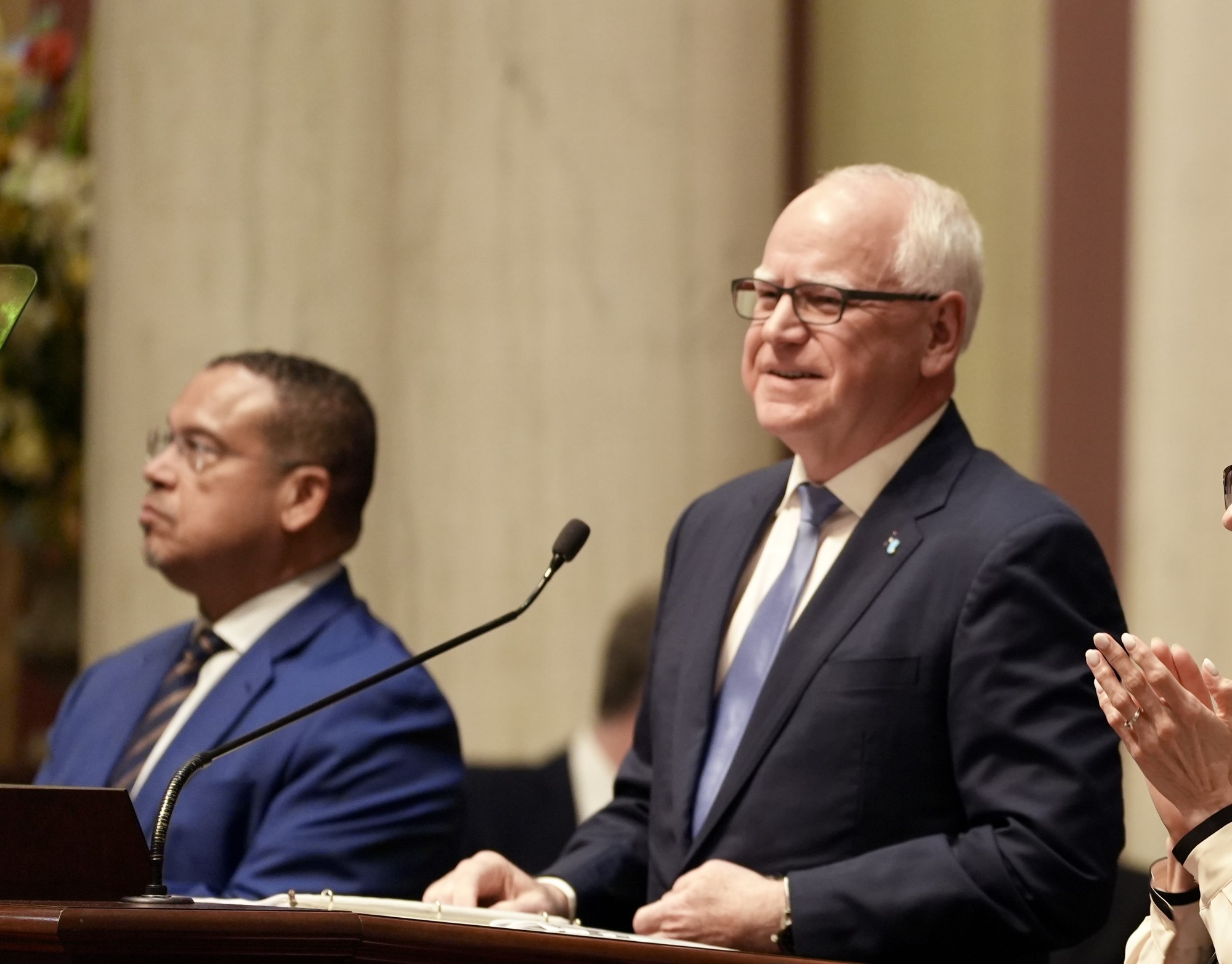
Minnesota Attorney General Keith Ellison, left, and Gov. Tim Walz at the State of the State address in St. Paul on April 23, 2025. The two brought the Brownsville lawsuit against Abbott. File photo by the Office of Governor Tim Walz and Lt. Governor Peggy Flanagan, public domain, via Wikimedia Commons.
What Castro is accused of, stated plainly
On January 14, during Operation Metro Surge, Castro fired one round through the closed front door of a home in north Minneapolis. The bullet hit Julio Sosa-Celis in the leg and stopped in the wall of a child's bedroom. The Hennepin County Attorney's Office charged Castro, 52, on May 18 with four counts of second-degree assault and one count of falsely reporting a crime, case No. 27-CR-26-12537.
DHS said in a January 15 press release, as UPI recounted this week, that an officer fired a defensive shot after being attacked with a snow shovel and a broom handle. Prosecutors say that account is false, that Castro was alone in the front yard under no physical threat, and that nearby video is what proved it. ICE Director Todd Lyons has acknowledged two agents lied about the incident. Castro is presumed innocent. He also has never answered any of it in a courtroom.
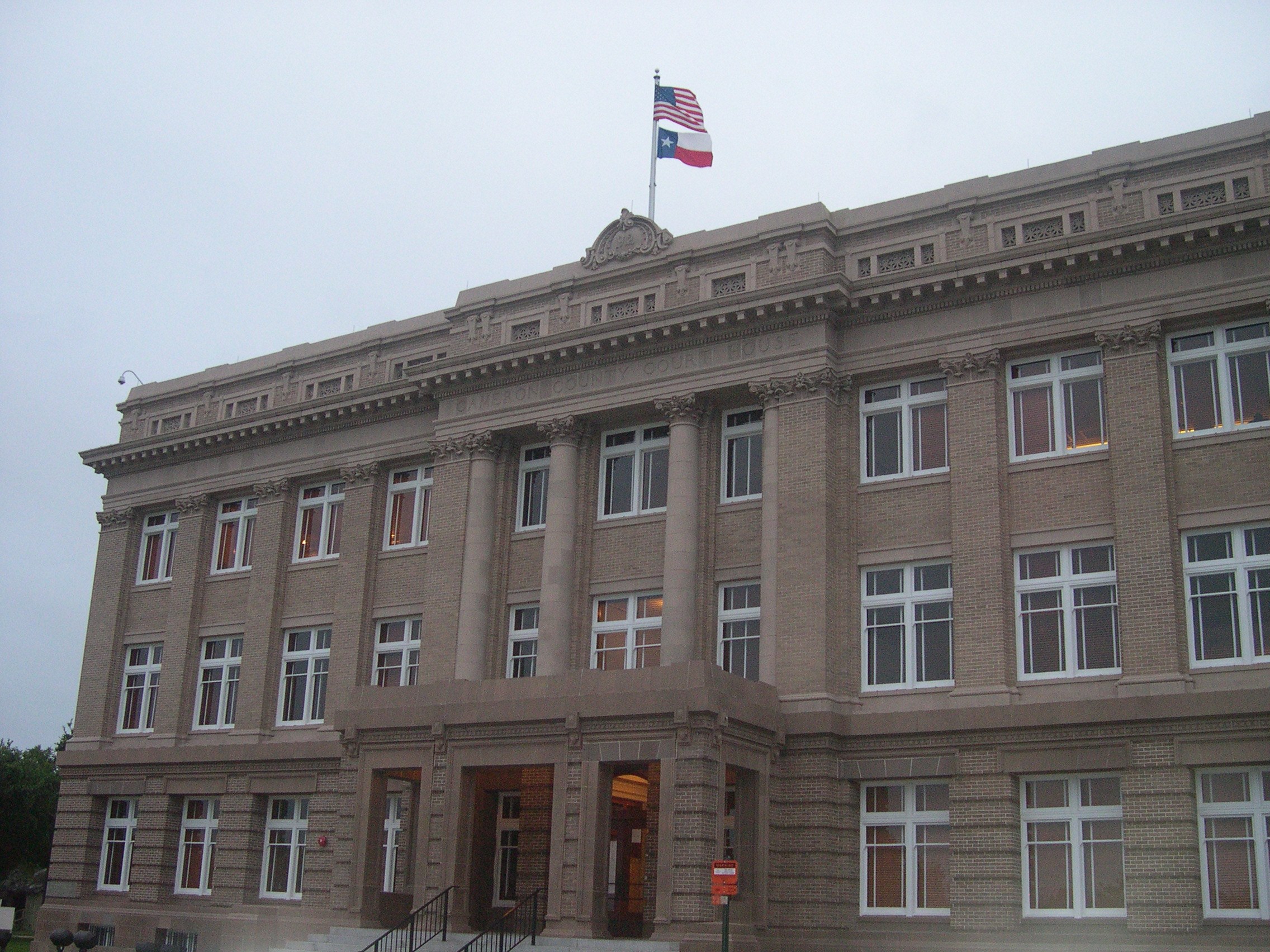
The Cameron County Court House in Brownsville, Texas, in a 2007 file photo. Castro was held at the county's separate Carrizalez-Rucker Detention Center, and Minnesota filed its suit against Abbott in the Brownsville Division of the U.S. District Court for the Southern District of Texas. Photo via Wikimedia Commons, public domain.
The federal supremacy fight is still coming
There is a serious federal argument buried under the extradition mess, and it is not the one Abbott is making. A federal officer charged in state court over on-duty conduct can move the case to federal court under 28 U.S.C. 1442(a)(1) and can raise Supremacy Clause immunity, the doctrine from In re Neagle, 135 U.S. 1 (1890), which protects an officer who did no more than was necessary and proper in carrying out a federal duty. Hennepin County said in May it expected exactly that motion, and noted the case would still be tried under Minnesota law by county prosecutors.
That fight belongs in front of a judge. It is not something a governor settles alone with a filing cabinet. The Supreme Court held unanimously in Puerto Rico v. Branstad, 483 U.S. 219 (1987), that the commands of the Extradition Clause "are mandatory, and afford no discretion to the executive officers or courts of the asylum state."
Where it stands now
Attorney General Keith Ellison called Castro "a fugitive from justice who still must answer for his crimes in Minnesota" and said he should turn himself in. Abbott press secretary Andrew Mahaleris said the order "rebuffs Minnesota's efforts to conscript federal courts into commandeering the authority of Governor Abbott's office." Ellison, in his statement on the ruling, accused Abbott of "turning Texas into a sanctuary state for violent criminals."
The case is not over. Abbott's motion to dismiss is pending and Rodriguez has an initial conference set for October 27. Howden's report still has not come back. Meanwhile Castro is free in a county that touches the Mexican border, in a case where Minnesota put sworn evidence in front of a federal judge that he has discussed buying property there, and where the judge agreed the flight risk is real before concluding he could do nothing about it. Everyone here got the process they were owed except the people inside that house.
Hero image: Texas Gov. Greg Abbott at a roundtable in Edinburg, Texas, on February 9, 2026. File photo by the U.S. Department of Agriculture, public domain, via Wikimedia Commons.