President Trump is moving to fire Federal Reserve Governor Lisa Cook a second time, two months after the Supreme Court told him he could not simply order her out. On Wednesday her lawyer answered the White House with a five-page letter saying the mortgage-fraud allegations against her "remain unfounded and untrue," and then aimed the same accusation at the President, Treasury Secretary Scott Bessent and Attorney General Todd Blanche.
The clock on this started August 5, when deputy chief of staff Dan Scavino sent Cook a notice that Trump was considering removing her because there was "sufficient reason to believe that you made false statements on one or more mortgage agreements." She got 21 days. Abbe Lowell filed her answer with White House Counsel David Warrington on the deadline and handed it to reporters that evening. The White House had not commented as of Thursday, according to Axios and CNBC.
What the Supreme Court actually held in June, and what it deliberately left open
A lot of coverage has flattened Trump v. Cook into "the Court said Trump can't fire her." That is not what the June 29 opinion says. The vote was 5 to 4, with Chief Justice John Roberts writing and Justices Sotomayor, Kagan, Kavanaugh and Jackson joining. Justices Thomas, Alito and Barrett each wrote separately in dissent, with Gorsuch joining Alito.
The Court decided three things. Courts can review whether a president had cause. "Cause" under the Federal Reserve Act carries a "substantial threshold" that turns on "the seriousness of the alleged misconduct, and the extent of any nexus that may exist to the Governor's professional duties." And a governor with a fixed term is entitled to notice and an opportunity to respond before removal takes effect, an opportunity the Court said can be handled on written materials alone, with no live hearing and no meeting with the President. Then it stopped. The Congressional Research Service read it the same way in its July 6 legal sidebar: the ruling preserves the status quo and sends the facts back to the district court.
Official record
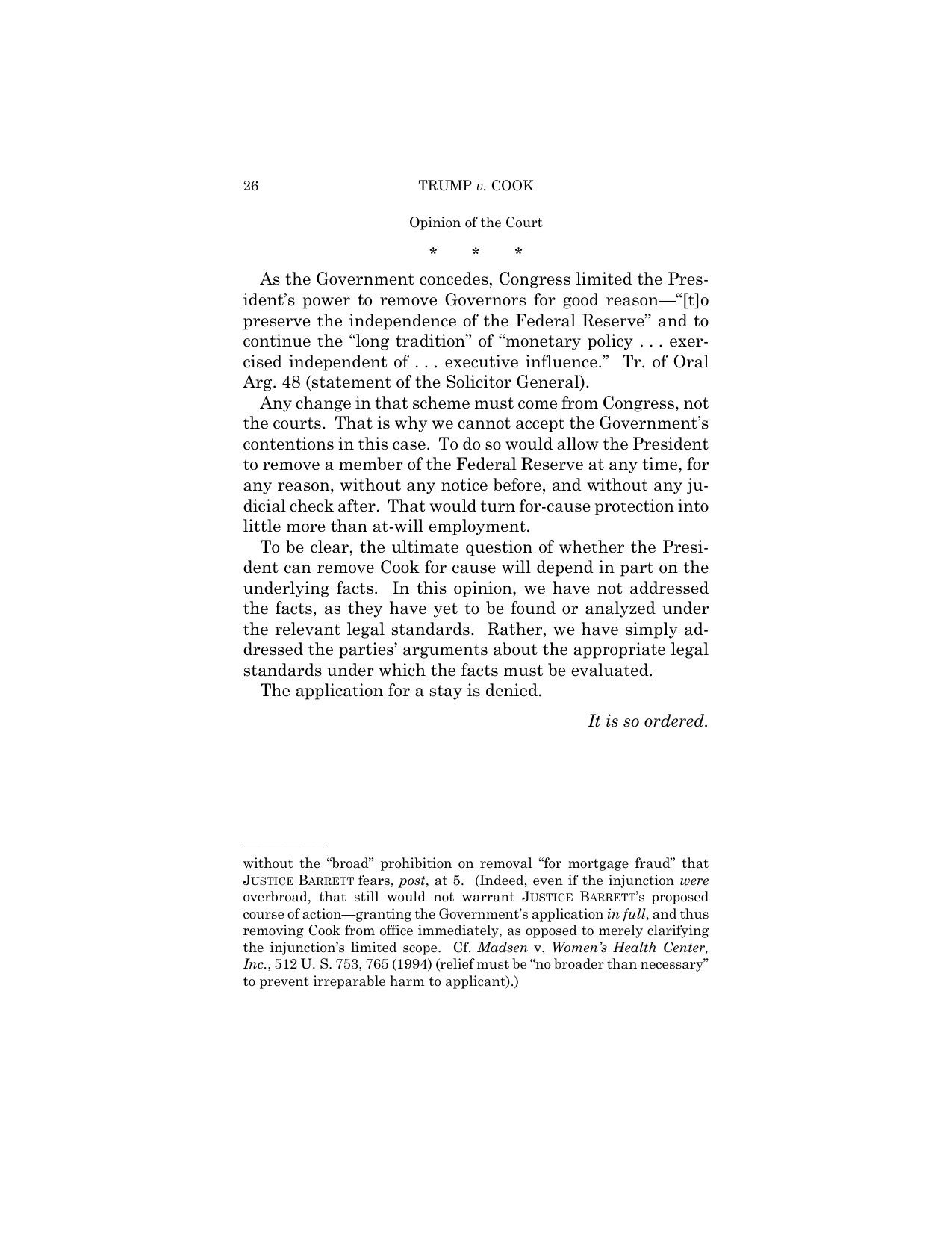
Trump v. Cook, No. 25A312 (U.S. June 29, 2026), slip opinion at 26. Argued January 21, 2026. Decided June 29, 2026.
"To be clear, the ultimate question of whether the President can remove Cook for cause will depend in part on the underlying facts. In this opinion, we have not addressed the facts, as they have yet to be found or analyzed under the relevant legal standards. Rather, we have simply addressed the parties' arguments about the appropriate legal standards under which the facts must be evaluated." — Chief Justice Roberts, opinion of the Court, slip op. at 26
Read or download the full 83-page slip opinion (PDF) · the same opinion on supremecourt.gov · district court docket in Cook v. Trump, No. 1:25-cv-02903 (D.D.C.)
Read that twice. The Court did not clear Cook. It refused to decide whether her mortgage paperwork amounts to cause, and it left the President a route: notice, then her answer, then a decision. The Scavino letter and Lowell's reply are that route being walked.
Four words from 1913 are carrying all of this weight
The statute is 12 U.S.C. 242, and the operative language is short. Each member "shall hold office for a term of fourteen years from the expiration of the term of his predecessor, unless sooner removed for cause by the President." Congress wrote no list of causes and no procedure. Compare that to the Federal Trade Commission Act, which names inefficiency, neglect of duty and malfeasance in office.
That silence is why both sides had a case. The government argued "cause" meant any concern about conduct, ability, fitness or competence. Cook argued it meant the FTC standard. Roberts called the first too lenient and the second too stringent, then declined to "fully demarcate the contours" of the term. Justice Thomas, in dissent, said the historical standard "required nothing more than what the plain meaning suggests, a cause," and was "so low as to be functionally unreviewable." He is not obviously wrong about 19th century practice. He lost anyway.
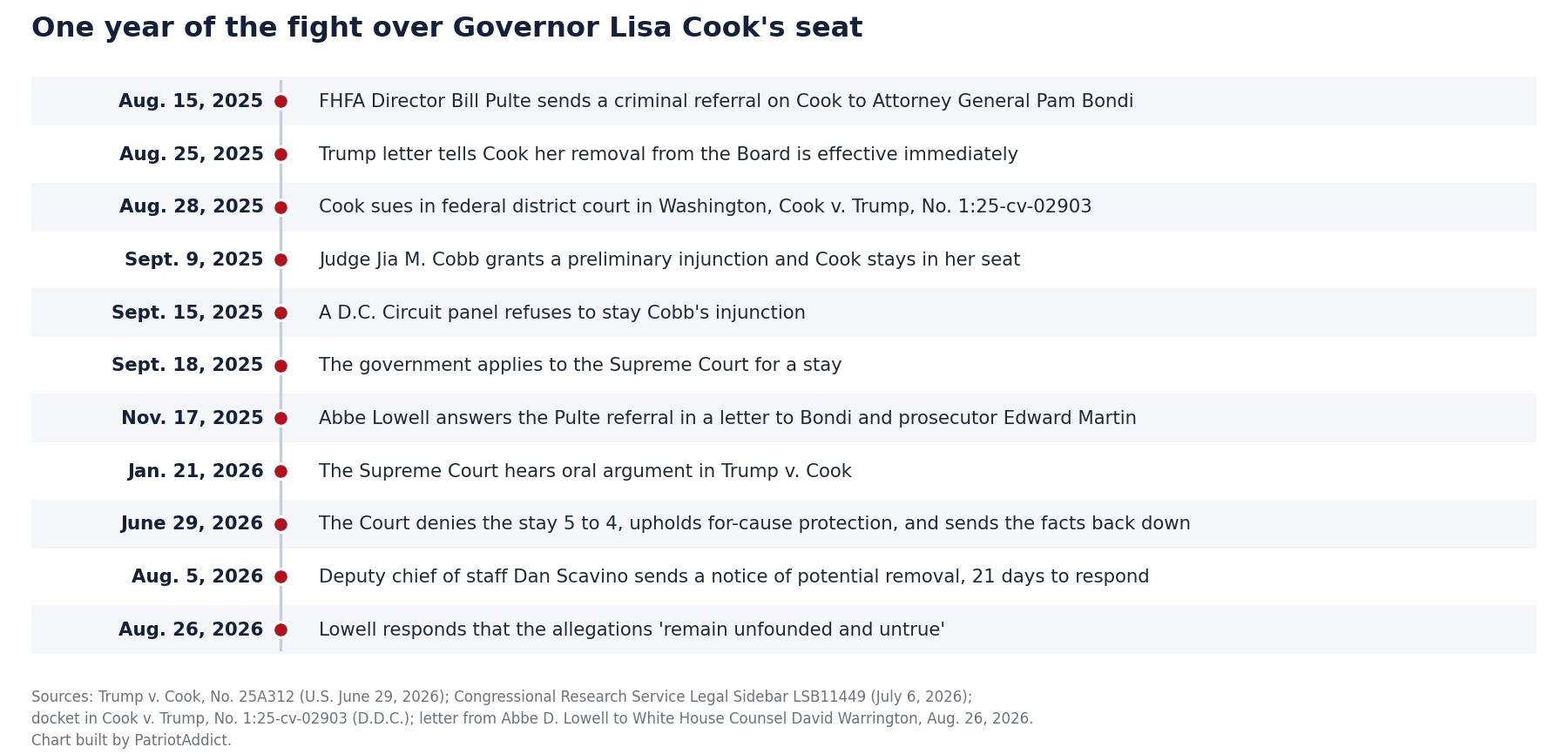
The sequence, start to finish. Chart built by PatriotAddict from the slip opinion in Trump v. Cook, the Congressional Research Service sidebar LSB11449, the district court docket in No. 1:25-cv-02903, and Abbe Lowell's August 26 letter.
The whole case is two mortgage forms signed two weeks apart
Federal Housing Finance Agency Director Bill Pulte sent his criminal referral to then-Attorney General Pam Bondi on August 15, 2025. It says Cook signed a June 2021 Michigan security instrument covering her Ann Arbor home with a covenant to occupy it as her principal residence, then signed a July 2, 2021 Georgia security deed on an Atlanta condominium with the identical covenant. Pulte announced a second referral on X on August 28, 2025, then deleted the post. Ten days after the first referral, Trump declared Cook removed. She sued three days later.
One year on, Cook has not been charged with anything. NPR still describes the allegations as untested. Scavino's August letter conceded the point in its own way, arguing that "even if your conduct does not rise to the level of felony offense," it shows "a level of gross negligence in financial transactions that calls into question your competence and trustworthiness as a financial regulator."

FHFA Director William J. Pulte, whose August 2025 criminal referral is, by Cook's account, the only thing the White House's removal notice rests on. Official agency portrait (Federal Housing Finance Agency, public domain, via Wikimedia Commons).
Cook's answer is that the President did the same thing in 1993
Lowell's letter does not argue the forms are clean. It argues the signature was "an entirely inadvertent oversight," and that Cook shopped the Atlanta loan on the lender's website as a "vacation home," told the same lender she had lived in Michigan for more than 15 years while teaching full time at Michigan State, and listed the condo as a "2nd Home" in her own submissions. It also notes she never rented the Atlanta property, which knocks out the second half of Scavino's theory.
Then it gets personal. Citing ProPublica, Lowell writes that in 1993 Trump took primary-residence mortgages on two Florida homes seven weeks apart while living in New York, and listed both for rent. Bloomberg reported that Bessent did the same in 2007 with homes in New York and Massachusetts. Blanche reportedly took out two in 2020. ProPublica found three more current or former Cabinet members with the same paperwork, naming Sean Duffy, Lee Zeldin and Lori Chavez-DeRemer. None of them drew a public referral from Pulte, and none were fired.
"Surely the President does not believe himself 'unfit for office' because he signed these contradictory 'primary' mortgage documents," Lowell wrote. That line is uncomfortable, and it should be. If the same paperwork disqualifies a Fed governor but not the man who runs the Treasury, the rule is doing something other than what it says on its face.
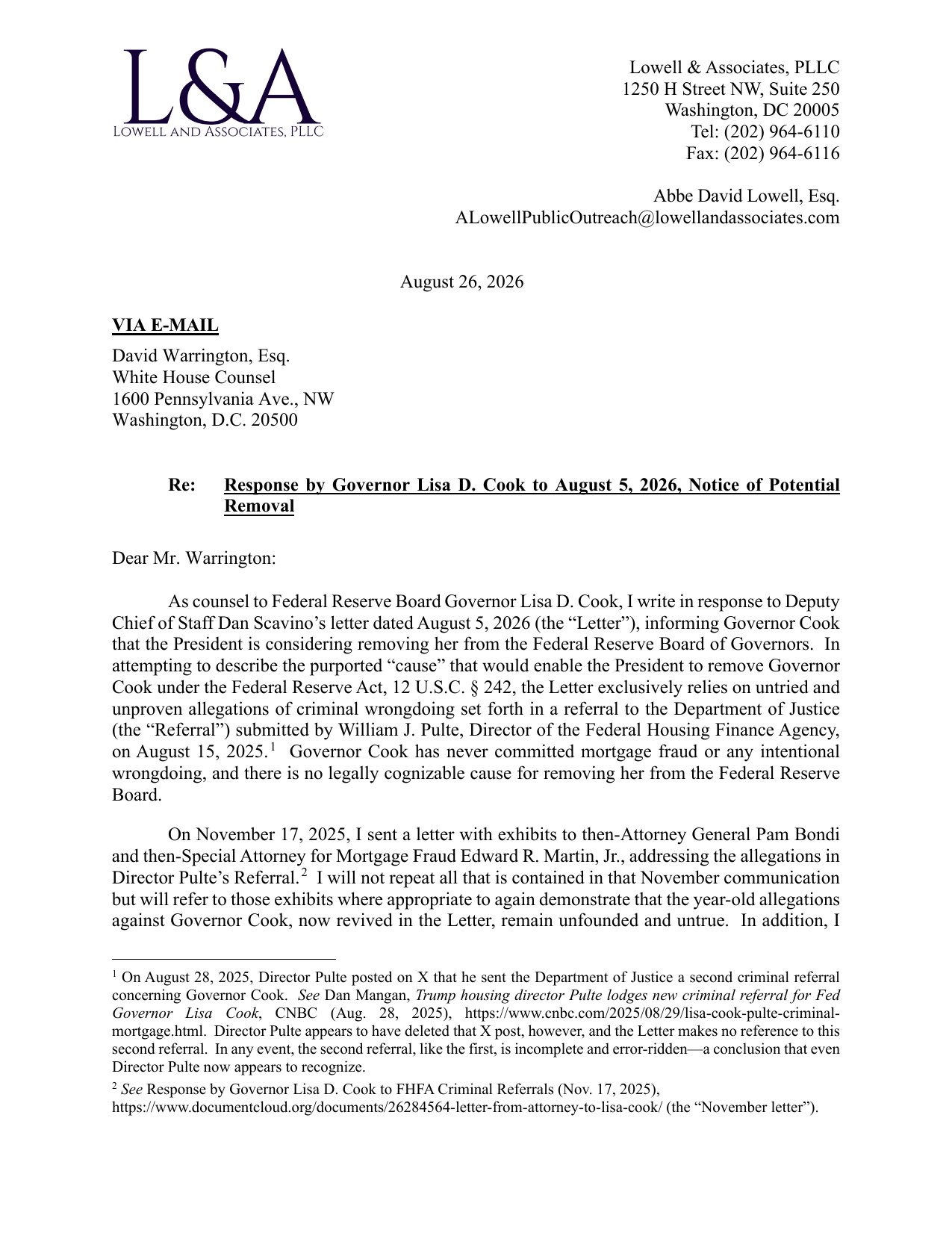
Page one of Abbe Lowell's August 26 response to White House Counsel David Warrington, released publicly by Cook's legal team. The full 10-page filing includes a sworn declaration from Suffolk University law professor Kathleen C. Engel, who states that neither security instrument shows the loans were priced more favorably because of the occupancy box. Read the full letter and declaration (PDF).
Why a paperwork fight decides what your next mortgage costs
Trump wants lower rates. He has said so for two years, and the Fed already has a new chairman, Kevin Warsh, who took the chair in May when Jerome Powell's term in that job ran out. It has not worked. The Federal Open Market Committee held the target range at 3.50 to 3.75 percent on July 29 by a 9 to 3 vote, and the three dissenters, Beth Hammack, Neel Kashkari and Lorie Logan, all wanted rates a quarter point higher.
The data explain why. The PCE price index ran 3.7 percent over the year through July, with core at 3.3 percent, both released Wednesday, the same day as Lowell's letter. That is a long way from the 2 percent target. Freddie Mac's survey put the 30-year fixed mortgage at 6.66 percent on Thursday. Long rates price expected inflation, and expected inflation prices the credibility of the people setting policy. A central bank that markets believe takes orders from a president who wants cheap money gets punished at the long end, which is where your mortgage lives.
Justice Jackson made that argument in her concurrence, quoting an amicus brief from former Treasury secretaries. The majority made it structurally, tracing the Fed back through the Second Bank and the First Bank to a founding generation that wanted the currency held at arm's length from politics. You do not have to like the modern Fed to notice that the argument runs on original design.
Where this actually goes
Trump has a serious constitutional case in general. The same day it decided Cook, the Court held in Trump v. Slaughter that for-cause protection for most independent agencies violates Article II, so the President can now fire FTC commissioners at will. The Fed is the one carved-out exception, and the government never challenged the Fed's protections here, a choice Justice Kavanaugh flagged in his concurrence.
So the fight narrows to one question. Is signing two occupancy covenants in 2021, in private life, before she ever joined the Board, serious enough and connected enough to a governor's duties to clear a "substantial threshold"? If Trump fires her on this record, Judge Jia Cobb gets the case back with the same five-justice majority waiting behind her. If he does not, the process still gave him something he lacked in August 2025, which is a record.
Cook's term runs to January 31, 2038. She is not going quietly, the Justice Department has not charged her, and the White House has said nothing since her lawyer's letter landed. The next move is Trump's, and this time the Supreme Court has already written down the standard he will be graded against.
Hero image: Governor Lisa D. Cook, official Federal Reserve Board portrait (Board of Governors of the Federal Reserve System, public domain, via Wikimedia Commons), cropped to 3:2.