A federal judge in Boston froze the Postal Service's new ballot mail rule for 14 days on Thursday night, 68 days before the midterm election. Judge Indira Talwani had erased her own nationwide block on the same executive order a day earlier, and the Supreme Court cleared the administration's path on Monday. Both of those things are still true. What landed Thursday night is a new order resting on new ground, and anyone who read our piece yesterday saying the last block was gone deserves the whole sequence, not a fresh headline pretending nothing moved.
What the order actually does, and what it leaves alone
The document is an 11-page memorandum and order, Doc. 218, entered August 27 in League of Women Voters of Massachusetts v. Trump, No. 1:26-cv-11549-IT, which Talwani has now joined for briefing with a brand-new case, California v. United States Postal Service, No. 1:26-cv-13917-IT. It grants a fourteen-day stay under Federal Rule of Civil Procedure 65(b). It runs out September 10 unless something replaces it.
It does not strike down Executive Order 14399. It does not touch the Homeland Security half of the order, which has not produced a regulation yet. It freezes seven specific provisions of the USPS final rule at 91 FR 54966, only to the extent those provisions are mandatory, and only as to elections held on or before November 3. The order adds that USPS "may take no further preparatory steps" for those elections. Motions for a longer preliminary injunction stay under advisement, with a hearing set for September 3.
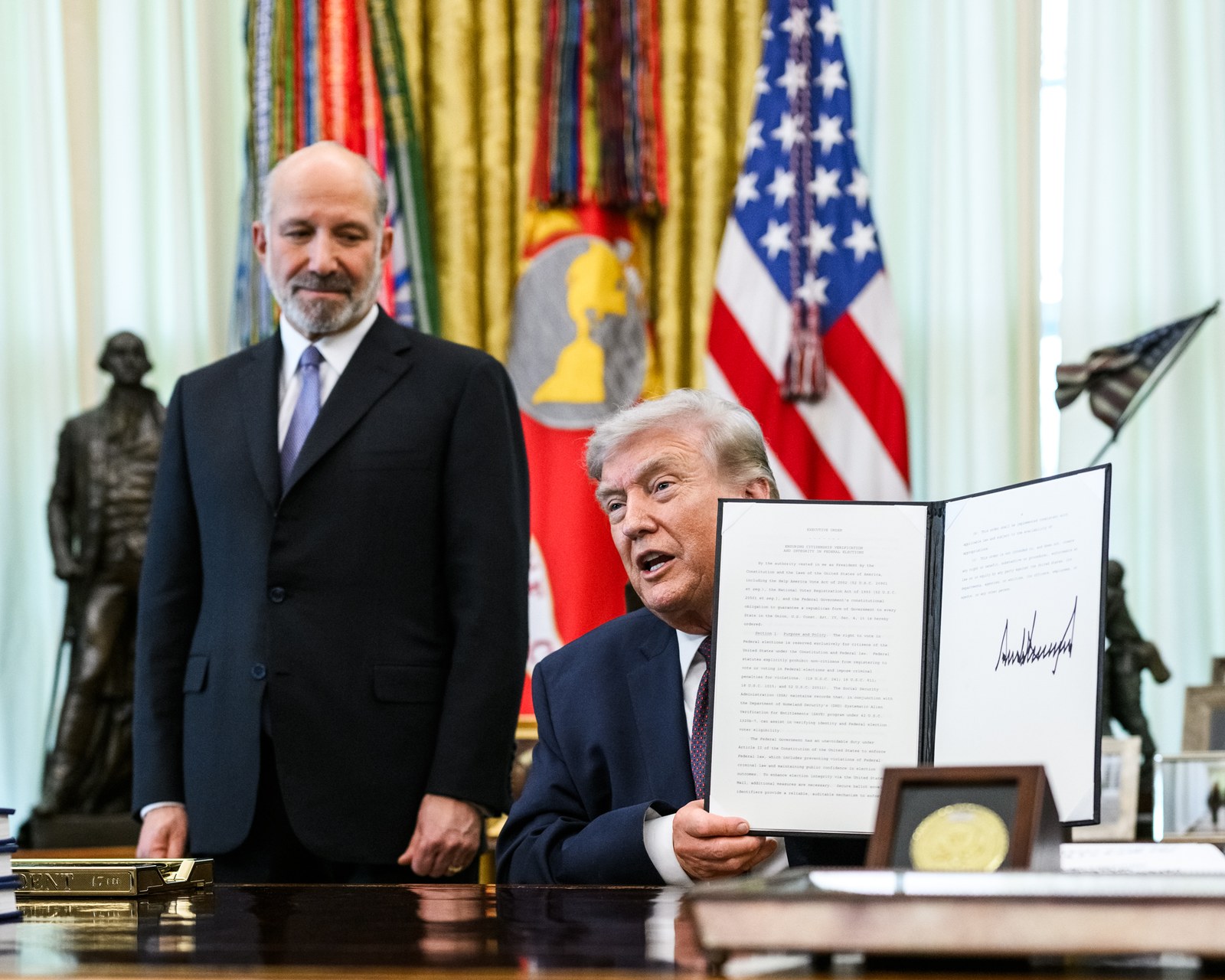
President Trump holds up Executive Order 14399, "Ensuring Citizenship Verification and Integrity in Federal Elections," after signing it in the Oval Office on Tuesday, March 31, 2026. Section 3 of that order is what told the Postmaster General to start the rulemaking now sitting under a temporary restraining order. Official White House Photo by Joyce N. Boghosian, public domain, via Wikimedia Commons.
The Supreme Court never decided this, and Talwani quoted it saying so
Monday's per curiam order in Trump v. California, No. 26A124 was a 6-3 ruling about timing. The justices held the district court had jumped in before there was anything to review, and the line Talwani leans on says "[f]ederal courts review final rules, not proposed rules" and "certainly not antecedent internal directives to propose a rule." She then quotes the sentence most coverage skipped, which is the Court's own caveat that its disposition "does not mean that any measure taken by the Government to implement the Order will necessarily be lawful."
So the reasoning that cost the challengers their injunction on Monday handed them a ripe case on Thursday. There is now a final rule. Talwani's footnote 4 is worth reading twice: the government told her that publication of the final rule was "already known to the Supreme Court" when the justices ruled, and offered no citation for it. The government's supplemental brief hit the Supreme Court docket a few hours before the order came down. She declined to assume the justices had read it.
Official record
Memorandum and Order Granting in Part Plaintiffs' Motions for a Temporary Restraining Order, League of Women Voters of Massachusetts v. Trump, No. 1:26-cv-11549-IT, and California v. United States Postal Service, No. 1:26-cv-13917-IT (D. Mass. Aug. 27, 2026), Doc. 218. The operative holding is on page 10.
"The court grants an emergency fourteen-day stay of the implementation or enforcement of the following sections of the Final Rule as to elections occurring before or on November 3, 2026. USPS Defendants may take no further preparatory steps or implement in any way for elections occurring before or on November 3, 2026" — Judge Indira Talwani, Doc. 218 at 10
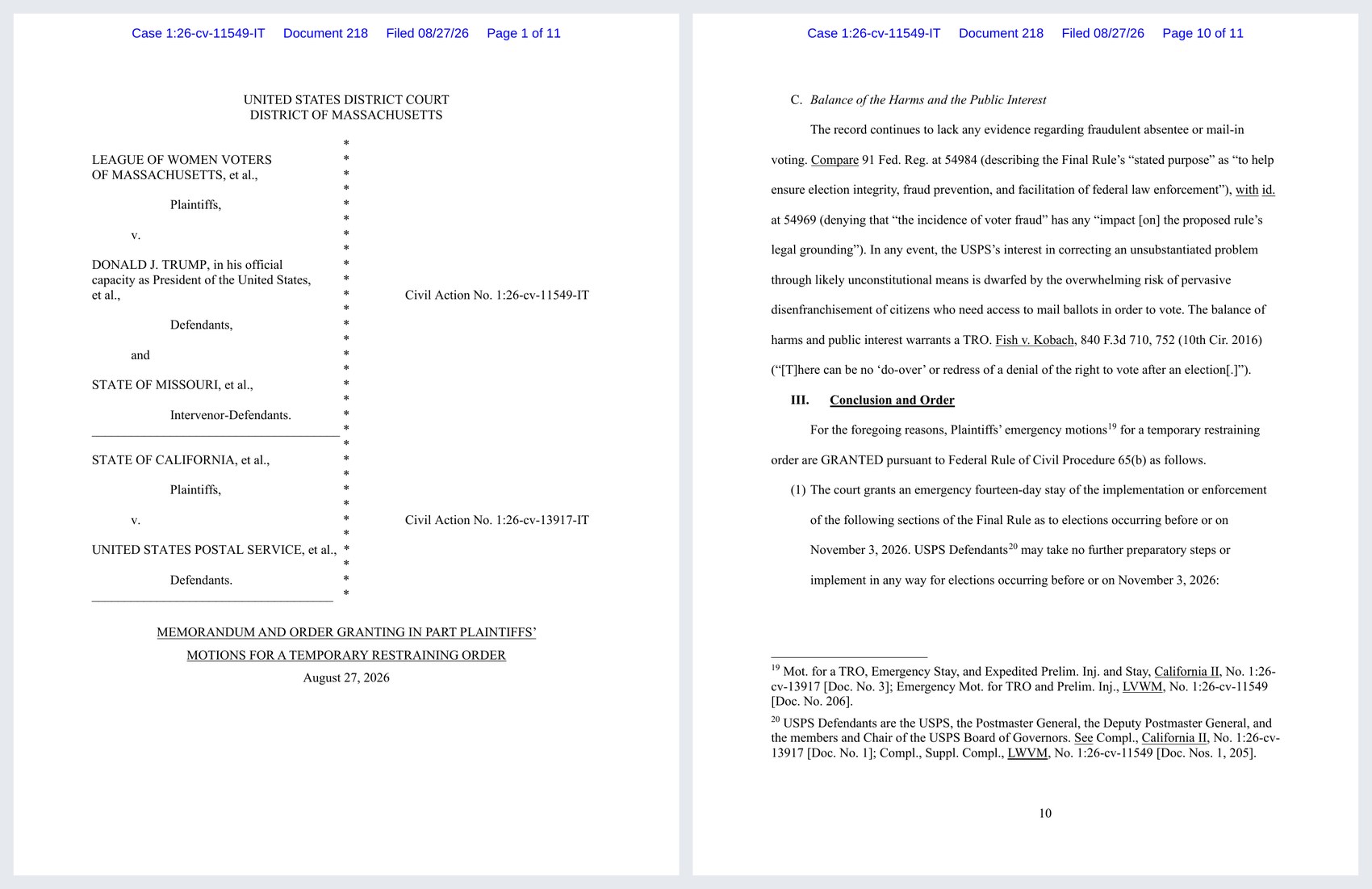
Read or download the full 11-page order (PDF) · the same document on DocumentCloud · the full docket on CourtListener
The Justice Department argued itself into this corner
Two weeks before the rule issued, government counsel told Talwani at an August 7 hearing that if the finished rule hurt a voter, "they certainly have standing to challenge that final rule," and added that "it would only take a very short amount of time for a temporary restraining order or a preliminary injunction to issue." Two days before this order, arguing she should vacate her August 11 injunction, the government said the plaintiffs could "simply amend their complaint."
So they moved. The League of Women Voters and its co-plaintiffs supplemented their complaint, 23 states plus the District of Columbia and Pennsylvania's governor filed the new California case the same day the rule published, and the government's opposition then argued they were too late because "appellate review in the ordinary course would come too late for the 2026 midterms." Talwani's answer is one sentence and it lands: "But the question is not when appellate review will be completed."
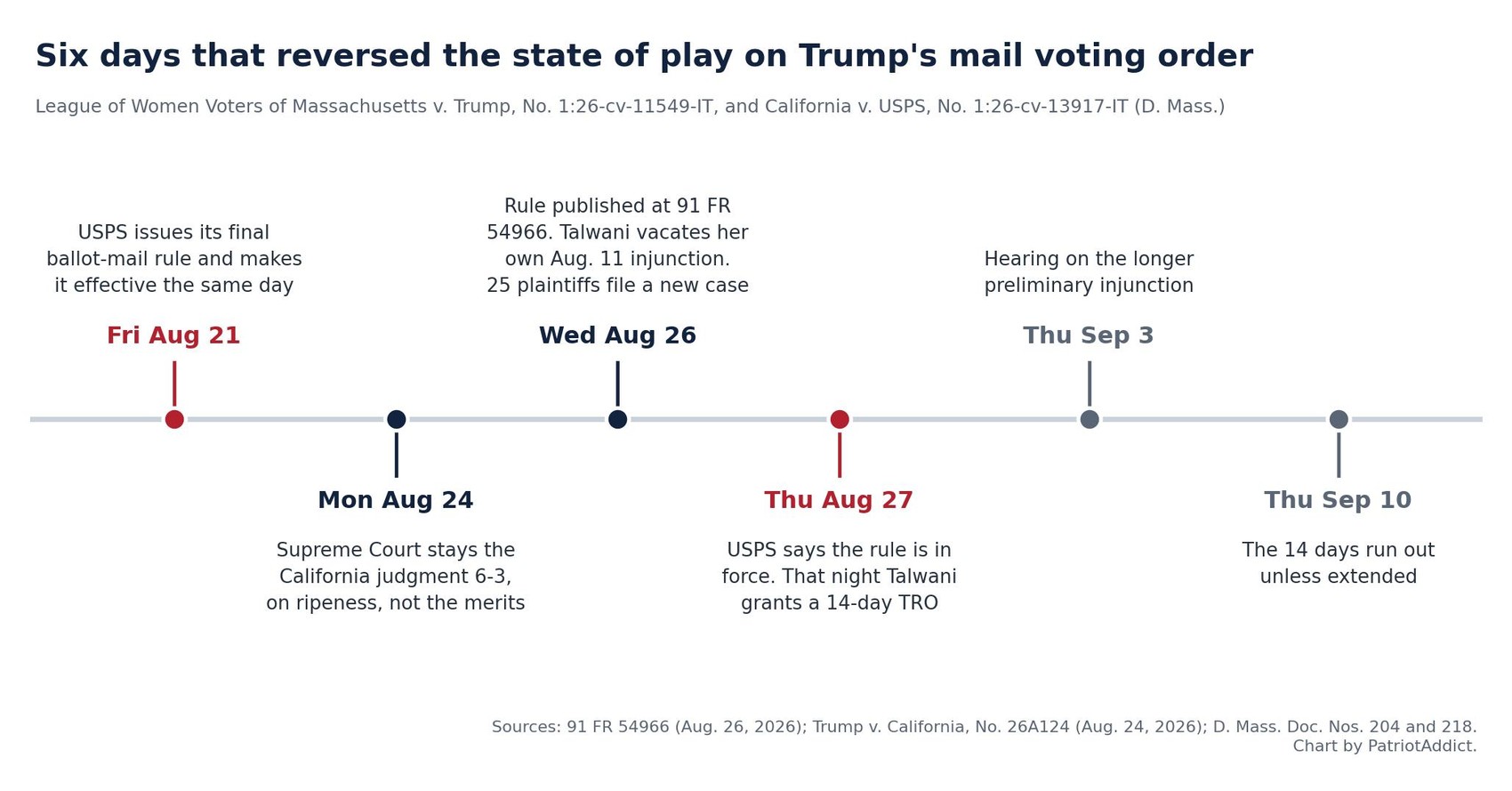
Six days, four reversals. Chart built by PatriotAddict from the Federal Register entry for the final rule, the Supreme Court docket in No. 26A124, and Doc. Nos. 204 and 218 in the District of Massachusetts.
The fraud record is the weakest ground here, and USPS wrote it that way
Talwani found that the record "continues to lack any evidence regarding fraudulent absentee or mail-in voting." That will read to a lot of people as a judge waving away a real concern. Read the rule itself before deciding that. At 91 FR 54984 the Postal Service describes the rule's stated purpose as helping "ensure election integrity, fraud prevention, and facilitation of federal law enforcement." Fifteen pages earlier, answering commenters who said there is no fraud problem to solve, the agency writes that "the incidence of voter fraud does not impact the proposed rule's legal grounding."
The agency's own defense is that the rule stands or falls on visibility into the mail stream rather than on fraud numbers. Having taken that position in its own preamble, USPS cannot act shocked when a court holds it to it.
The harder problem is the one nobody has answered. Talwani writes that she is "unaware of, and no party has proffered, any delegation Congress has made that would permit the USPS to regulate election mail." She backs that with FCC v. Consumers' Research and with Justice Gorsuch's concurrence in Learning Resources, Inc. v. Trump, which says a clear statement is required to support a claim to an extraordinary delegated power. Those are conservative authorities, cited by a judge President Obama put on the bench in 2014, against a Republican administration. That is what an evenly applied nondelegation principle looks like.
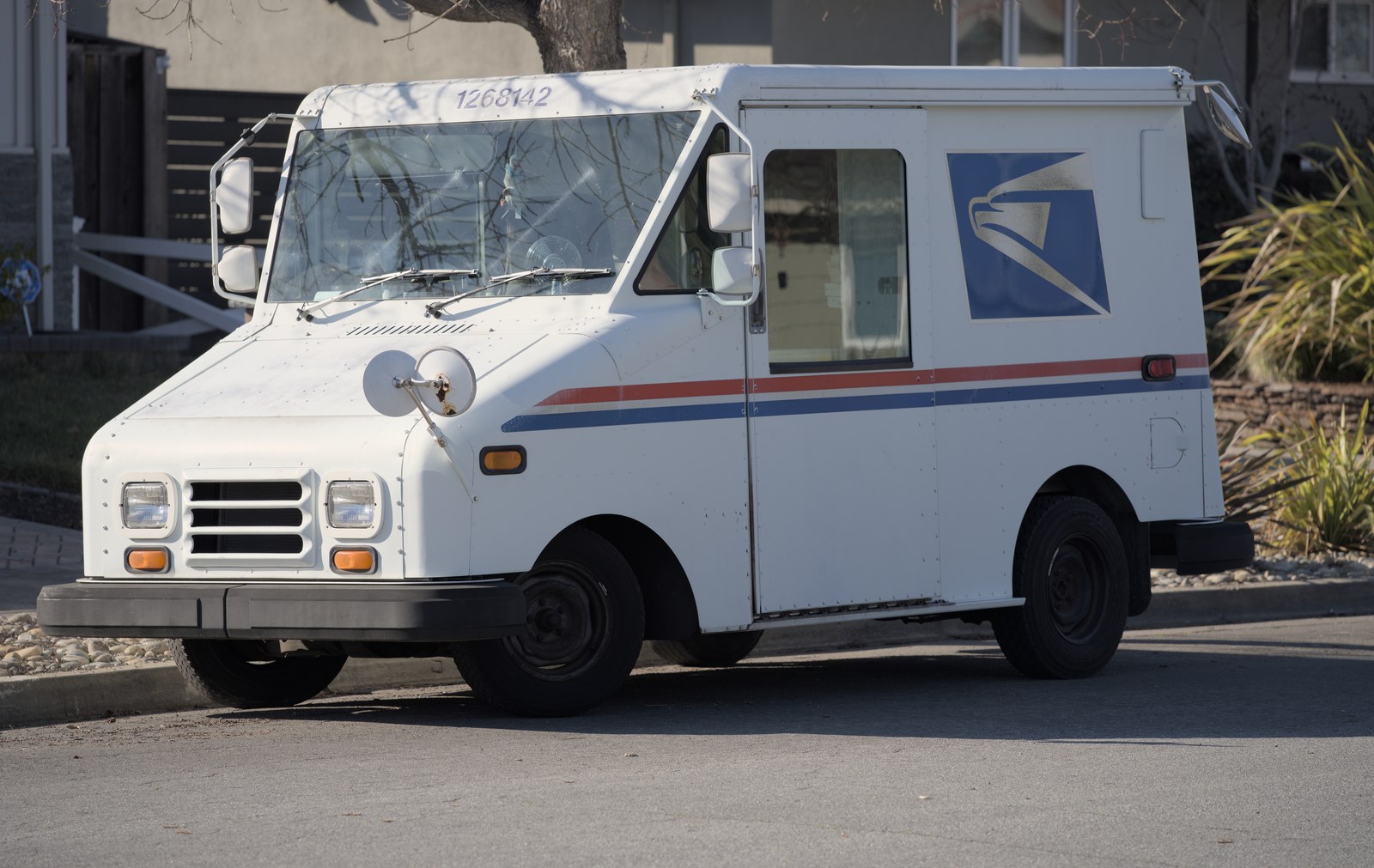
A Postal Service Grumman LLV delivery vehicle, photographed in 2023. Under the final rule, USPS would not carry a state's ballots at all unless the agency first approved that state's envelope designs and the state uploaded each voter's information to a new USPS portal. Photograph by Daniel Lu (Wikimedia Commons user Dllu), CC BY-SA 4.0.
The calendar is the whole case
USPS issued the final rule on Friday, August 21, and made it effective that same day. It published five days later. On Thursday morning the agency told reporters the restrictions were already in force. By Thursday night they were not.
The rule sets no deadline for USPS to approve a state's envelope designs, and it forbids election officials from uploading voter data until that approval comes. Talwani found that plaintiff states "have neither time nor funds to design new mail ballots, seek approval of the new designs, order production of mail ballots, update their own election management systems, train election officials to use the USPS portal, and upload citizen data to the portal, all before the midterms." Most of those states have already ordered their ballots. Some are required by state law to start mailing them next week.
The line that should worry the administration most is procedural. On the states' claim that compliance is flatly impossible this cycle, she notes that the government and the twelve intervenor states led by Missouri "offer no reply." Their brief instead argues the rule "merely imposes modest conditions on the sending of mail," which is an answer to a different question.
Where this actually goes
New York Attorney General Letitia James posted Thursday night that "states are responsible for processing our elections, and the USPS does not have the authority to decide who can and cannot vote by mail," a line Newsweek quoted in full. That is a press release, not a holding. The Washington Times reports the Justice Department is likely to try to appeal, while noting that temporary restraining orders are not always appealable. The realistic path runs through the September 3 hearing, then whatever preliminary injunction comes out of it, then the First Circuit, then the Supreme Court again on a fuller record.
Here is the part worth holding onto. Unique barcodes on ballot envelopes and a real chain of custody are not fringe ideas, and the Postal Service already carries the ballots for the nearly one in three Americans Newsweek says vote by mail. If Congress wants USPS holding that gate, Congress can say so and write it down. What the administration did instead was drop a mandatory nationwide rule on every state election office in the country on a Friday evening in late August of an election year, with no approval deadline in it and no answer to the states' sworn declarations that compliance is impossible. The goal was defensible. The calendar was not, and that is why a rule that had been on the books for six days is frozen this morning.
Hero image: President Trump in the Oval Office on March 31, 2026, after signing Executive Order 14399. Official White House Photo by Joyce N. Boghosian, public domain, via Wikimedia Commons.