A New Orleans history teacher asked the Supreme Court on Tuesday to stop Louisiana from making him hang the Ten Commandments on his classroom wall. The justices now have three separate petitions in front of them over classroom Ten Commandments mandates, and one of the three was filed by the state of Louisiana itself.
Chris Dier teaches AP U.S. history at Ben Franklin High School, was named Louisiana Teacher of the Year in 2020, and told WVUE in New Orleans he could be terminated for refusing to post the display. "I respect the Ten Commandments and the place religion holds in millions of Americans' lives, undoubtedly," he said in a statement reported by the Louisiana Illuminator. "But the state cannot turn my classroom into a place to deliver its own religious message."
Three separate petitions now put the same question in front of the justices
Louisiana's own officials went first, on May 21, in Brumley v. Roake, No. 25-1360. State Superintendent Cade Brumley and the state education board are represented by Attorney General Liz Murrill's office and the Becket Fund for Religious Liberty. On August 17, more than two dozen Texas families across 22 districts filed a joint petition in Nathan v. Alamo Heights Independent School District and Cribbs Ringer v. Comal Independent School District, brought by the ACLU, Americans United, the Freedom From Religion Foundation and Simpson Thacher and Bartlett.
Dier's petition, filed by Arnold and Porter appellate lawyer Andrew Tutt, landed on August 25. "It's not a matter of if, but when. We think now is the moment," Tutt told WVUE. SCOTUSblog led its Wednesday newsletter with it.
The Texas families press both Religion Clauses and ask for summary reversal, meaning a decision without argument, before falling back on a request for full review.
Official record
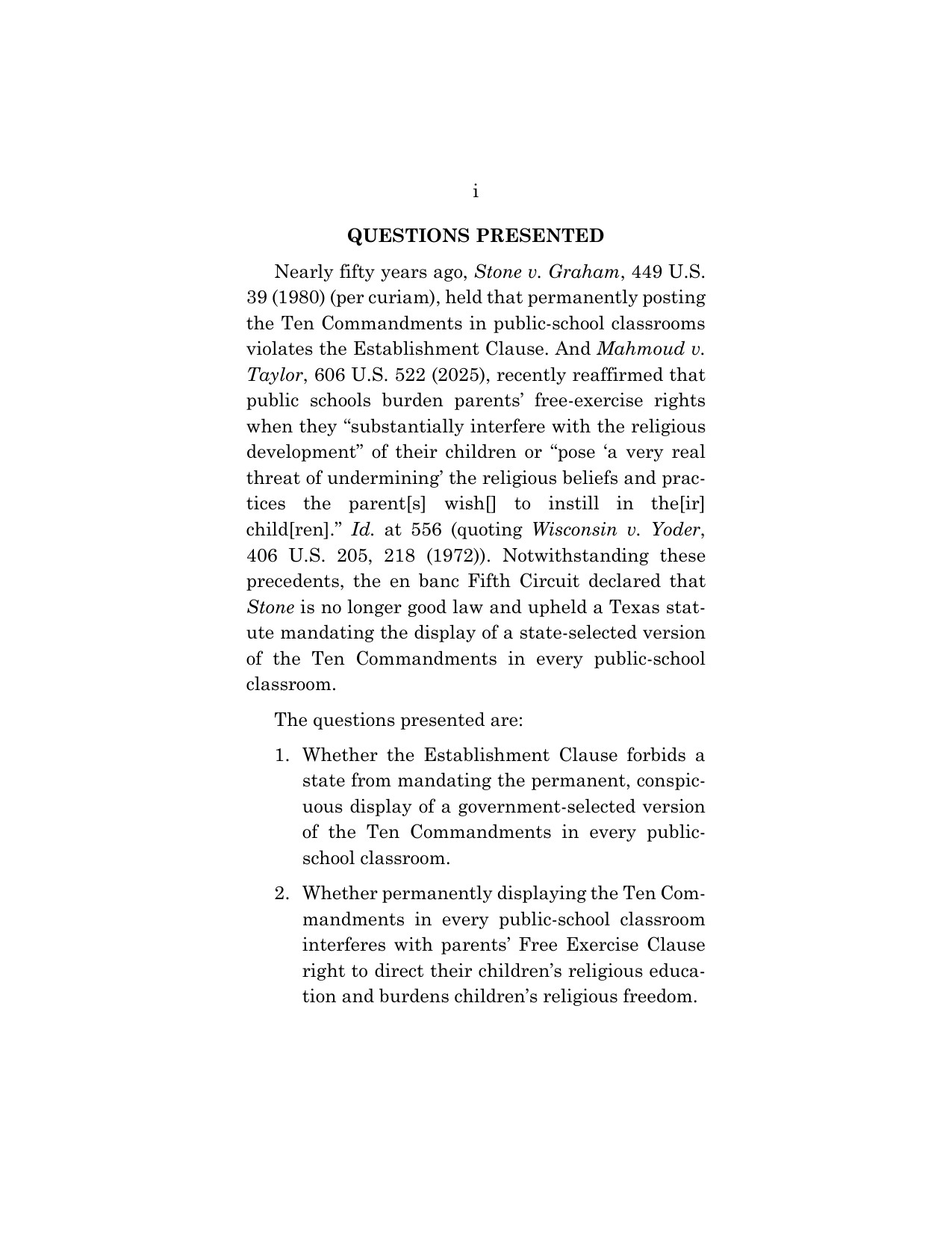
Joint Petition for a Writ of Certiorari, Nathan v. Alamo Heights Independent School District and Cribbs Ringer v. Comal Independent School District, filed in the Supreme Court of the United States on August 17, 2026. The Questions Presented appear on page i.
"Nearly fifty years ago, Stone v. Graham, 449 U.S. 39 (1980) (per curiam), held that permanently posting the Ten Commandments in public-school classrooms violates the Establishment Clause. ... Notwithstanding these precedents, the en banc Fifth Circuit declared that Stone is no longer good law and upheld a Texas statute mandating the display of a state-selected version of the Ten Commandments in every public-school classroom." — Joint Petition, Questions Presented
Read or download the full 314-page petition and appendix (PDF) · view the same document hosted by Americans United · Supreme Court docket in Brumley v. Roake, No. 25-1360
What Texas actually requires, down to the inches
Gov. Greg Abbott signed S.B. 10 on June 20, 2025, and it took effect that September 1. Codified at Texas Education Code section 1.0041, it orders every public school to display in a conspicuous place in each classroom a durable poster of the Ten Commandments, at least 16 inches wide and 20 inches tall, legible from anywhere in the room. Schools must accept compliant donated posters. The author was Sen. Phil King.
The part carrying the most legal weight is the text. The statute permits one wording and no other, a King James rendering that opens "I AM the LORD thy God." That single drafting choice is why the plaintiff list includes a rabbi, a cantor, two Reverends, a Baptist pastor, Hindu parents and Baha'i parents alongside atheists. A state that picks a translation has picked a side among believers, not only between belief and unbelief.
King said as much on the record. The petition quotes him saying "we want every kid ... every day, in every classroom they sit in to look on the wall and read ... those words [] that God says." Lt. Gov. Dan Patrick said students "are going to see the Ten Commandments, and they are going to know about God." Those quotes are now Exhibit A for the other side.
The Fifth Circuit did not split the difference. It said Stone is dead.
On April 21, 2026, the full Fifth Circuit upheld S.B. 10 by a single vote, 9 to 8, in No. 25-50695. Judge Stuart Kyle Duncan wrote for the majority, joined by Chief Judge Jennifer Walker Elrod and Judges Jones, Smith, Willett, Ho, Engelhardt, Oldham and Wilson.
The reasoning is not a dodge. Duncan wrote that Stone v. Graham, the 1980 decision striking down a nearly identical Kentucky law, rested entirely on the Lemon test, and that the Supreme Court threw out Lemon in Kennedy v. Bremerton School District in 2022. "With Lemon extracted, there is nothing left of Stone," the opinion says.
In its place the court asked whether S.B. 10 resembles a founding-era religious establishment, and said it does not. The statute tells no church what to believe and punishes nobody who rejects the text. On coercion, the majority was blunter still: "S.B. 10 requires no religious exercise or observance. ... It puts a poster on a classroom wall."
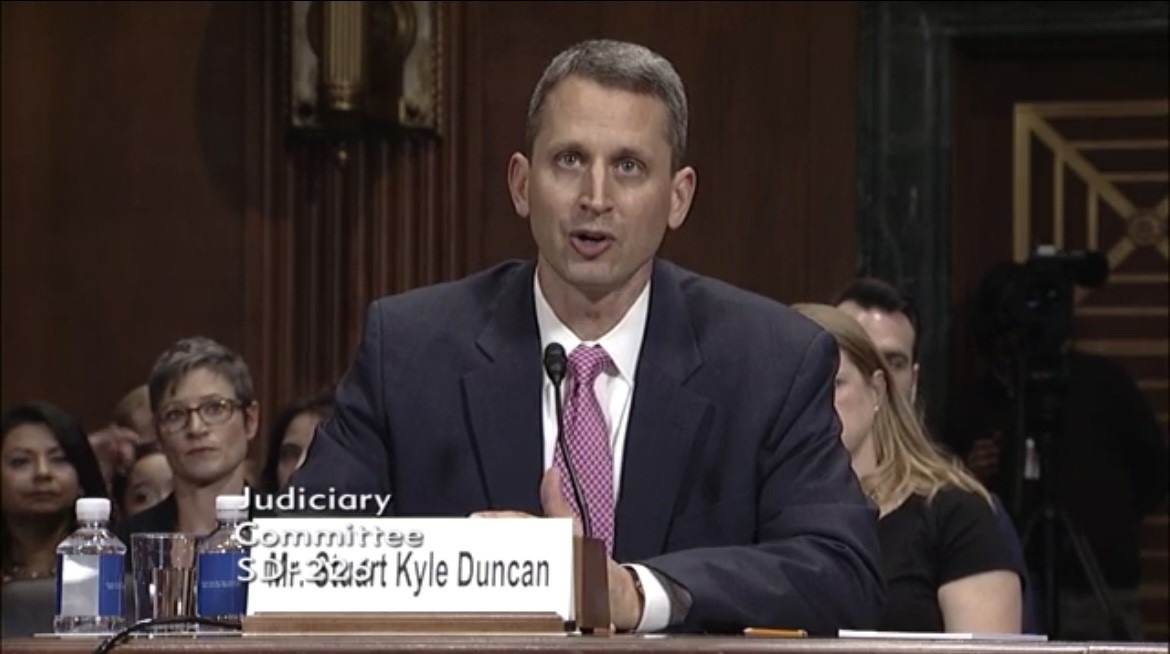
Stuart Kyle Duncan at his Senate Judiciary Committee confirmation hearing in November 2017. Duncan, appointed to the Fifth Circuit in 2018, wrote the 9-8 en banc opinion upholding Texas S.B. 10. Still from committee video (U.S. Senate Judiciary Committee, public domain, via Wikimedia Commons).
One of the dissents deserves a hearing from people who agree with the law
Judge Irma Carrillo Ramirez wrote the principal dissent, joined in whole or part by Judges Stewart, Richman, Haynes, Graves, Higginson and Douglas. Her argument is narrow and hard to wave off: Stone is a Supreme Court holding on a nearly identical statute, and only the Supreme Court can overrule it. A circuit declaring a precedent dead by inference is a problem no matter which way the inference runs.
Then there is Judge Leslie Southwick, confirmed to the Fifth Circuit in October 2007 after a George W. Bush nomination. He dissented separately, and he opened by refusing the frame that this is religion against secularism. "What is not part of my dissent is a rejection of the importance of searching for faith," he wrote. "Religion, though, is a matter of the mind and the heart. Faith cannot flourish when it is forced."
That is a conservative judge making a conservative argument, and it is the one worth sitting with. A poster mandated by a legislature, printed to a state-approved wording, hung by a teacher who may not agree with it, is a government product. None of that makes S.B. 10 unconstitutional. It does mean this is not the easy layup either press release claims.
How many states are now waiting on this
Five states have Ten Commandments school-display laws on the books, and the petition counts at least 24 state legislatures that have adopted or considered such bills in the past two years. Louisiana's law reaches public colleges too, and posters went up on Louisiana campuses in June. Arkansas is on the losing end so far, with a permanent injunction against the sued districts now on appeal at the Eighth Circuit.
Tennessee took the permissive route, and the fight there is already house to house. On August 20 the ACLU and the Freedom From Religion Foundation demanded records from five county districts that voted to post, saying they are "launching an investigation of every school district that foolishly accepts the state's invitation to trample those rights."
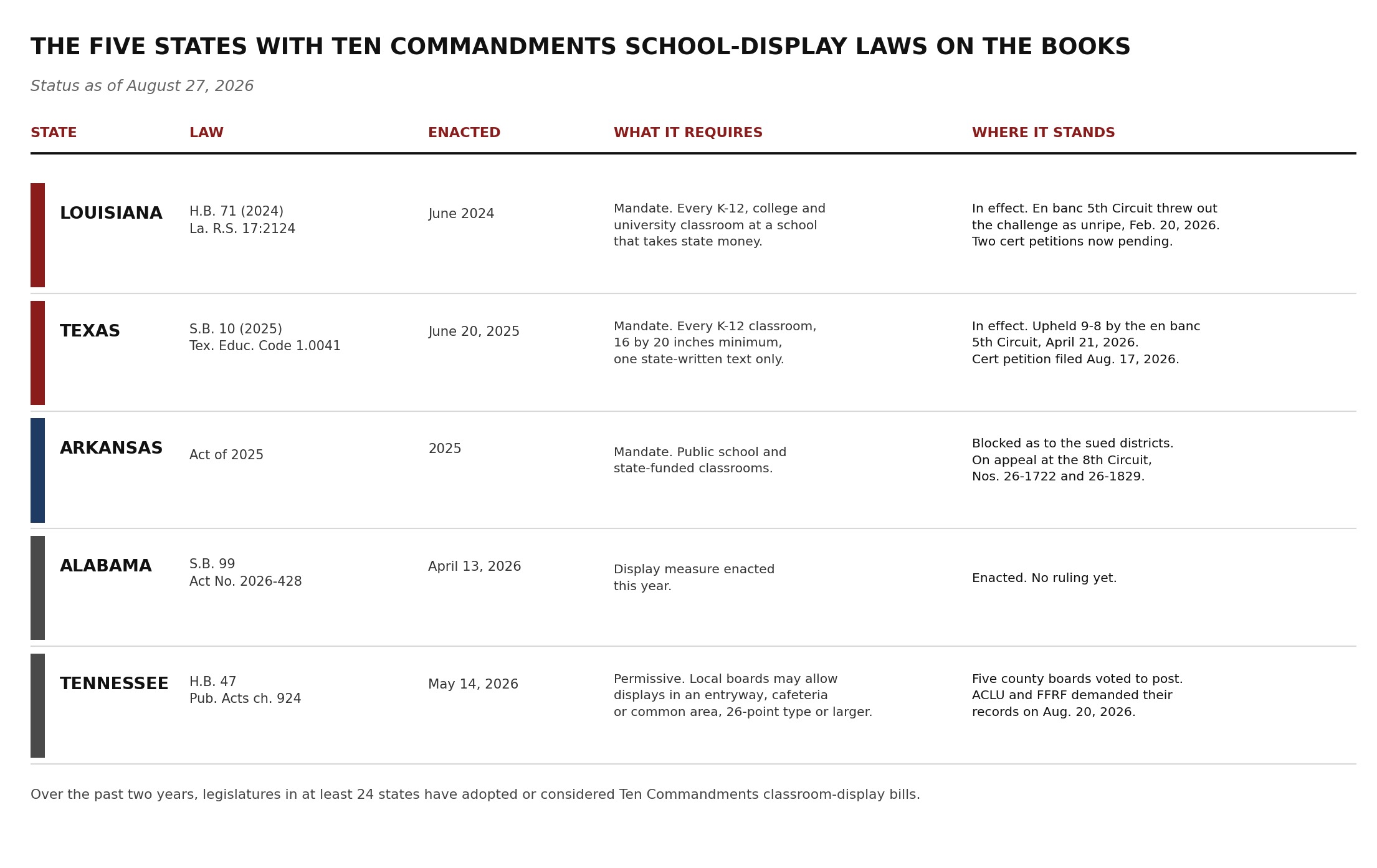
Where each of the five state laws stands as of today. Chart built by PatriotAddict from the statutes themselves, the Fifth Circuit's en banc opinions in Nathan and Roake, the Supreme Court docket in No. 25-1360, and the case citations in the August 17 joint certiorari petition.
Louisiana is asking the Court to deny the case and take it anyway
The strangest filing in the pile is the state's own. Louisiana won below on ripeness, not on the merits: the en banc Fifth Circuit vacated the injunction against H.B. 71 on February 20, 2026, holding the challenge was not ready because parish school boards still had discretion over what the displays look like. Louisiana wanted an outright dismissal and did not get it.
So its lawyers filed what they call a purely protective measure. "This Court should deny any petition to review the Fifth Circuit's decisions in Roake and Nathan," the petition says. "But, if the Court were inclined to grant review, it should consider both cases together." Their stated fear is that the challengers would seek review in Texas only, giving the justices "a blinkered view of the consolidated proceedings below."
The docket is where it gets interesting. The Roake respondents waived their right to respond on July 6, which usually means a petition dies quietly, and the case was distributed for the September 28 long conference two days later. Then on July 28 the Court did something it does not have to do. It requested a response, due today, August 27. On August 10 the justices pushed that deadline to September 28, the same day the case was set for conference, so it now has to be redistributed. A call for a response is not a grant. It does mean somebody in that building is reading.
What this looks like from inside a Texas classroom
The plaintiffs are not the only parents with a view. Brittany McFarland, an Austin-area mother whose kindergartner attends Texas public school, told Fox News Digital she was "pleasantly surprised" by the displays and argued that a poster nobody recites or pledges to is not religious instruction. Her district tells teachers to say the poster is up because of state law and to send questions about its contents home to parents.
Rabbi Joshua Fixler of Houston, a plaintiff, says the displays "put children in the position of having to defend themselves and their families' religious beliefs against a government mandate." ACLU national legal director Cecillia Wang was blunter. "Fifty years ago, the ACLU won a Supreme Court victory against a nearly identical Kentucky law," she said, "and we aim to do it again."
Coverage split on cue. The Washington Examiner led with the ACLU going to the high court, while PBS News and The Hill led with the Texas mandate.
The Court has to answer one question it has been avoiding
Strip away the press releases and one question is left, and it is about judicial discipline rather than theology. In 2022 the Supreme Court retired the Lemon test. It never went back and said what that did to Stone v. Graham. Nine judges on the Fifth Circuit filled the silence one way, eight filled it the other, and five legislatures have written laws assuming the first group is right.
Conservatives who spent fifty years calling the Lemon era a judicial invention should want this decided out loud, by the Court that owns the precedent. If Stone is gone, the justices should say so in a published opinion instead of letting a 9 to 8 circuit vote do it for them. If it is not gone, Texas and Louisiana are entitled to know before their districts buy more posters. Dier says he will keep his wall bare either way. The Court's first real chance to answer is September 28.
Hero image: the Ten Commandments monument on the grounds of the Texas State Capitol in Austin, presented by the Fraternal Order of Eagles of Texas in 1961 and upheld by the Supreme Court in Van Orden v. Perry (2005). Photograph by Carol M. Highsmith, Library of Congress, public domain, via Wikimedia Commons.