The Federal Reserve's preferred inflation gauge came in at 3.7 percent for the twelve months through July, the same figure it printed for June. Take only the last three months of that number and prices are running at a 2.4 percent annual pace. Kevin Warsh walks into Jackson Hole on Friday morning holding both figures, and which one he reads out loud decides whether anything in a household budget gets cheaper this year.
Most of that 3.7 percent already happened, and the arithmetic shows it
The Bureau of Economic Analysis released Personal Income and Outlays for July at 8:30 a.m. Eastern Wednesday as BEA 26-39. The PCE price index rose 0.2 percent on the month and 3.7 percent over twelve months, and excluding food and energy the readings were 0.2 and 3.3. All four match June.
Now walk the twelve-month window. BEA has the monthly change at 0.5 percent in May, minus 0.1 percent in June and 0.2 percent in July. Compound those and prices rose 0.60 percent across three months, a 2.4 percent annual pace. Divide the full 3.7 percent by that 0.60 and the nine months from August 2025 through April 2026 come out at 3.08 percent, a 4.1 percent annual pace. The headline is an average of a spring that ran hot and a summer that did not.
BEA rounds those monthly changes to one decimal, so 2.4 percent is approximate, and rounding cuts both ways. Omair Sharif of Inflation Insights told Reuters' Dan Burns the unrounded July core figure was 0.246 percent, "so it barely missed out on rounding to 0.3." That annualizes near 3.0 percent, and Sharif's verdict was blunt: "This is data that supports a hike."
Two measures of the same underlying trend read milder. John Carney at Breitbart pulled the Cleveland Fed's median PCE, up 2.7 percent over twelve months, and the Dallas Fed's trimmed mean, at a 2.3 percent annual pace over six months. Neither is the index the Fed targets. Both sit closer to 2 percent than 3.7 does.
What Americans actually bought in July, and what they stopped buying
Consumer spending rose $36.3 billion in July, a figure that hides two opposite movements. Services climbed $86.2 billion while goods fell $49.9 billion, and BEA prints the category detail on page one.
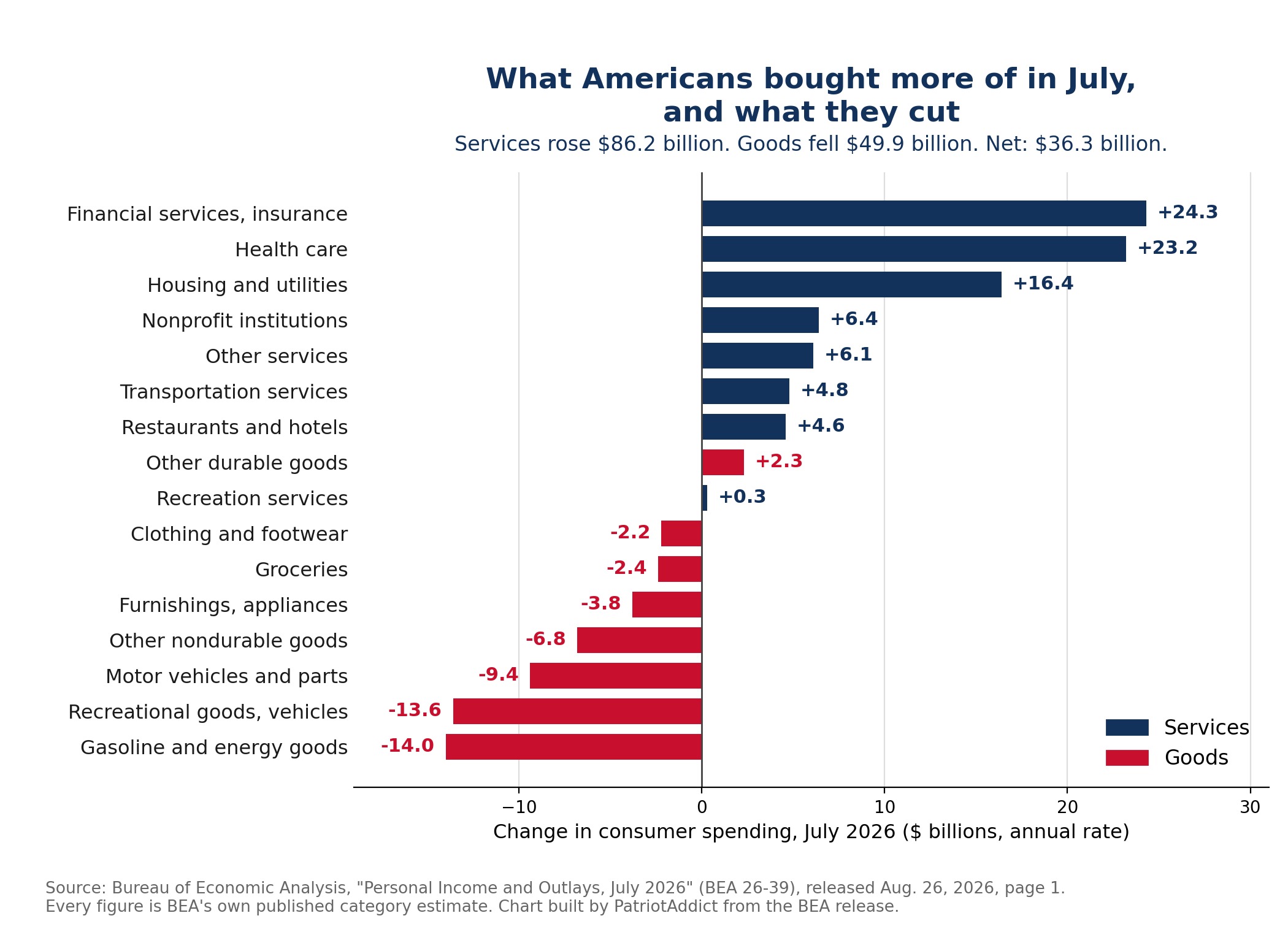
Chart built by PatriotAddict from page 1 of Bureau of Economic Analysis release BEA 26-39, "Personal Income and Outlays, July 2026," Aug. 26, 2026. Every bar is BEA's own estimate, at a seasonally adjusted annual rate.
The biggest increase was financial services and insurance, at $24.3 billion. Health care came next at $23.2 billion, then housing and utilities at $16.4 billion. Those are the bills that arrive whether or not anyone opts in.
The cuts were the discretionary half of a family's month: groceries down $2.4 billion, clothing and footwear $2.2 billion, furnishings and household equipment $3.8 billion, motor vehicles and parts $9.4 billion, recreational goods and vehicles $13.6 billion. Adjusted for inflation, Carney put real durable goods purchases down 1.4 percent on the month.
Real spending, meaning spending after inflation, came in at exactly 0.0 percent, and BEA's own historical comparison file lists the last month that flat as May 2023. The saving rate was 3.0 percent, up from a June figure now revised to 2.6, and the same file says 3.0 was last matched in February 2008. Fox Business notes the rate peaked at 5.5 percent in April 2025 and started this year at 4.4, so the cushion has roughly halved in sixteen months.
Heather Long, chief economist at Navy Federal Credit Union, put it plainly: "The impacts of the war in Iran are still apparent with $4 gas and $5.60 diesel. It's not getting worse, but it didn't get any better in July either."
Q2 GDP did not move. The parts underneath it moved a lot.
BEA published the second estimate of second-quarter GDP the same morning, and real growth stayed at a 1.5 percent annual rate. That is where most coverage stopped. The revision table on page 3 is where the story is.
Consumer spending was revised up to 3.4 percent from 3.2. Real final sales to private domestic purchasers, which is consumer spending plus business fixed investment, went from 3.9 percent to 4.2, the strongest since the first quarter of 2023 by Reuters' count. Private America grew at 4.2 percent last quarter. The headline says 1.5, and the 2.7-point difference is government spending falling and imports rising.
Official record
Bureau of Economic Analysis, GDP (Second Estimate) and Corporate Profits, 2nd Quarter 2026, release BEA 26-38, issued 8:30 a.m. EDT Wednesday, August 26, 2026. Five pages. Release page on bea.gov.
"An upward revision to consumer spending was partly offset by an upward revision to imports. ... For imports, the revision was led by other goods (notably the territorial adjustment for Puerto Rico), primarily reflecting new U.S. Census Bureau trade in goods data for June." — BEA 26-38, Technical Notes, page 4
Part of the reason a stronger consumer did not lift the headline is a statistical adjustment for how the national accounts treat trade with Puerto Rico. Page 3 also carries the price lines nobody quoted: the quarter's PCE price index revised up to a 5.3 percent annual rate, gross domestic purchases prices to 5.8.
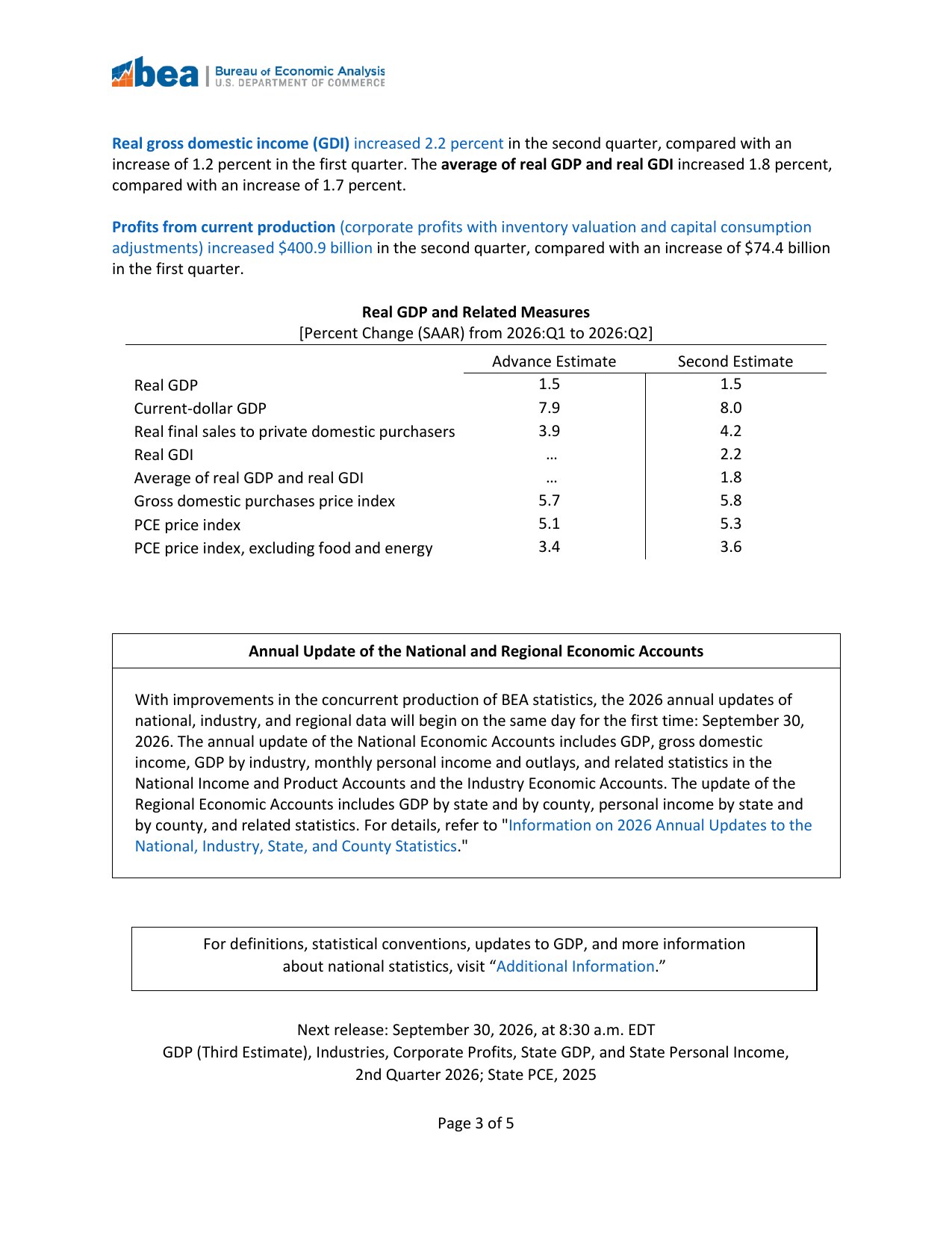
Read or download the full 5-page release (PDF) · BEA gross domestic product data page
Give the administration its due on two lines in that release. Corporate profits from current production jumped $400.9 billion, which Reuters called the second-largest quarterly increase on record, and gross domestic income rose 2.2 percent against 1.2 in the first quarter.
Two outlets read the same futures market and got opposite answers
Reuters had fed funds futures putting the odds of a September rate hike near 40 percent after the report, up from about 36 percent just before it. Breitbart had roughly 38 percent Wednesday morning, down from about 40 on Tuesday. Both are honest reads of a market that moves all day.
The defensible summary is narrower than either headline. A September hike is a live minority outcome and a cut is not on the table. Three officials voted to raise rates in July, the target range has sat at 3.50 to 3.75 percent since December, and we walked through that box on Tuesday.
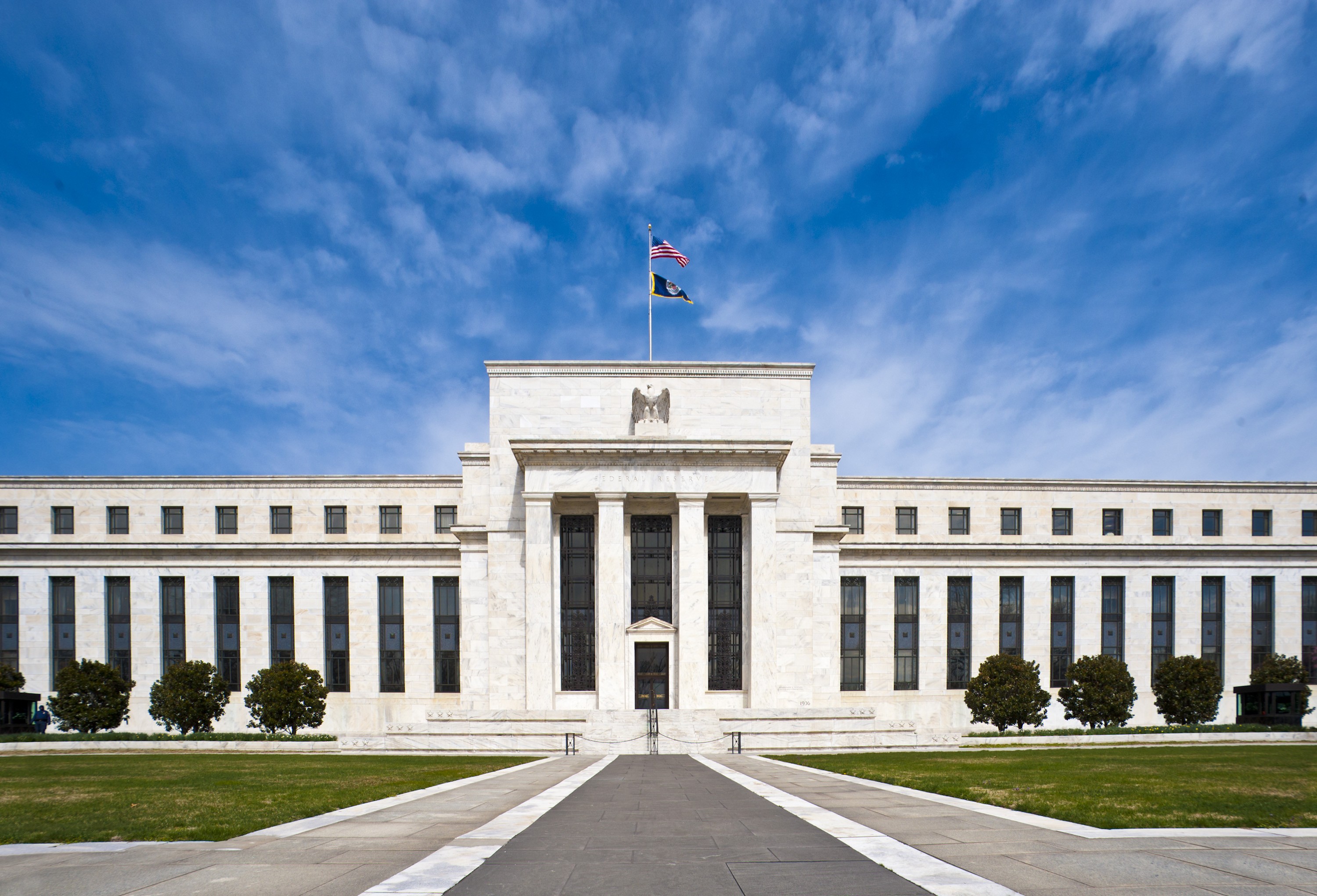
The Marriner S. Eccles Federal Reserve Board Building in Washington. Photo by the Federal Reserve Board, public domain, via Wikimedia Commons. The Federal Open Market Committee next meets September 15 and 16.
The theme at Jackson Hole this year is not inflation
The Federal Reserve Bank of Kansas City announced on August 25 that its 49th symposium runs Thursday through Saturday at Jackson Lake Lodge in Grand Teton National Park. The theme is "Financial Innovation: Implications for Payments and Policy," and the bank's description points at instant payments, cryptocurrencies and stablecoins. The full agenda does not post until 8:00 p.m. Eastern Thursday.
That is a serious subject. It is not the subject the country is asking about. Reuters counted July as the 65th consecutive month with PCE inflation above the Fed's 2 percent target, a streak that began in February 2021. Olu Sonola, head of U.S. economics at Fitch Ratings, put it this way: the Fed "still has considerable ground to cover before markets see 2% inflation as a credible outcome rather than a distant aspiration." Warsh speaks Friday at 10:00 a.m. Eastern on the bank's YouTube channel, his first Jackson Hole address as chairman.
The bond market did not treat Wednesday as good news
Anyone told that stocks rallied on the inflation print should check the tape. Yahoo Finance's market blog, updated at 4:05 p.m. Eastern, has the Dow down 0.2 percent and the other two major indexes below the flat line.
Treasury's daily par yield curve is the number that reaches a mortgage, and it went the wrong way. Treasury's own file puts the 10-year at 4.66 percent Wednesday against 4.64 Tuesday, and the 30-year at 5.18 against 5.17. Tuesday's soft housing and confidence data had knocked six basis points off both, as this site reported yesterday. Wednesday handed a third of it back.
What had not printed yet when this went up
The Labor Department posts initial jobless claims for the week ending August 22 at 8:30 a.m. Eastern Thursday, after this piece went live, so anybody quoting that figure earlier was quoting a forecast. The August 20 release had seasonally adjusted claims at 206,000 for the week ending August 15, down 6,000, on a four-week average of 204,000. That is a labor market with no visible crack in it, which removes the usual argument for cutting.
Regular gasoline averaged $4.085 a gallon in the Energy Information Administration's week of August 24, and Carney flagged that PCE energy prices fell 1.5 percent in July, so the recent move in oil has not reached the data yet. Jeffrey Roach of LPL Financial told Fox Business core inflation could fall below 3 percent as soon as October if tensions ease.
The Fed's stated target is the headline index, and Warsh said in July that it was "our number." That number is 3.7 percent. The three months behind it say 2.4. A family sitting on a 6.65 percent mortgage quote is waiting to learn which one the chairman decides to believe.