AAA put the national average for a gallon of regular at $4.0969 on Tuesday, against $3.1613 a year ago. The 30-year Treasury just touched a level Americans have not seen since 2007, and the Federal Reserve's own July minutes say the next move on rates is more likely up than down. Three government price and housing reports land between this morning and Wednesday.
The one number Kevin Warsh says he grades himself on comes out Wednesday
The Bureau of Economic Analysis publishes Personal Income and Outlays for July 2026 at 8:30 a.m. Eastern on Wednesday, August 26. That is on BEA's own release schedule, and it carries the PCE price index, the specific measure the Fed treats as its target.
Warsh said so himself. Asked at the July 29 press conference which measure he relies on, he pointed to the Board's January strategy document and said, "that's our number, we're sticking with it," while adding that he watches broader price data too. The transcript is on federalreserve.gov. The last print was nowhere near 2 percent.
Official record
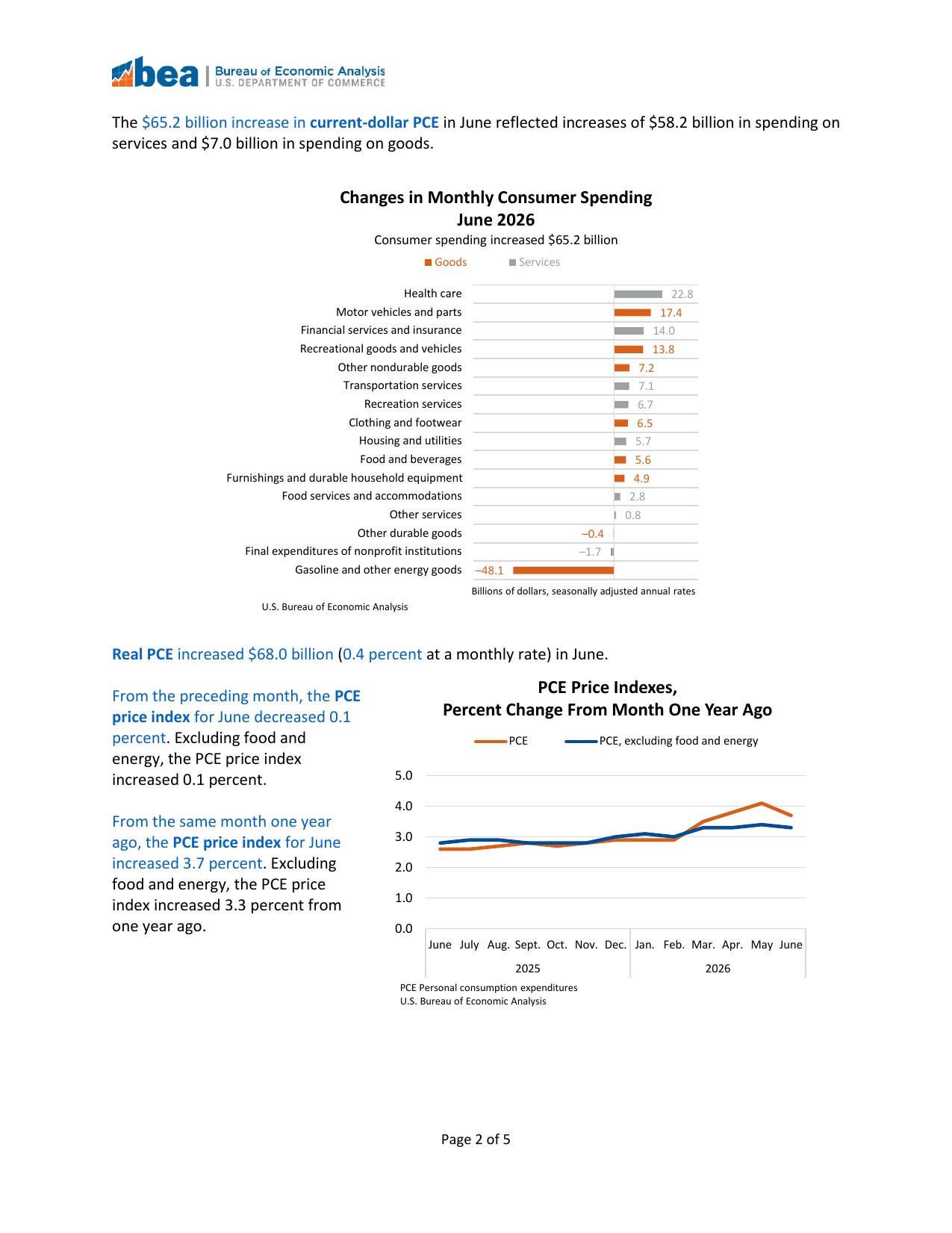
Bureau of Economic Analysis, Personal Income and Outlays, June 2026, news release BEA 26-36, issued 8:30 a.m. EDT Thursday, July 30, 2026. Five pages. Release page on bea.gov.
"From the same month one year ago, the PCE price index for June increased 3.7 percent. Excluding food and energy, the PCE price index increased 3.3 percent from one year ago." — BEA 26-36, page 2
The same page shows where the money went. Consumer spending rose $65.2 billion in June, and the largest offsetting drop in any category was gasoline and other energy goods, at minus $48.1 billion at a seasonally adjusted annual rate. BEA put the personal saving rate at 2.7 percent of disposable income.
Read or download the full 5-page release (PDF) · BEA personal income data page
The Fed did nothing on July 29. The bond market tightened anyway.
The Federal Open Market Committee held the federal funds target range at 3.50 to 3.75 percent by a 9-to-3 vote. Beth Hammack, Neel Kashkari and Lorie Logan voted against, and all three wanted the range raised a quarter point, not cut.
The part of the market that prices a mortgage kept moving anyway. Treasury's daily par yield curve shows the 30-year bond closing at 5.31 percent on August 17. The last time it finished a day at or above that level was June 12, 2007. It settled at 5.23 percent Monday, the 10-year at 4.70 percent.
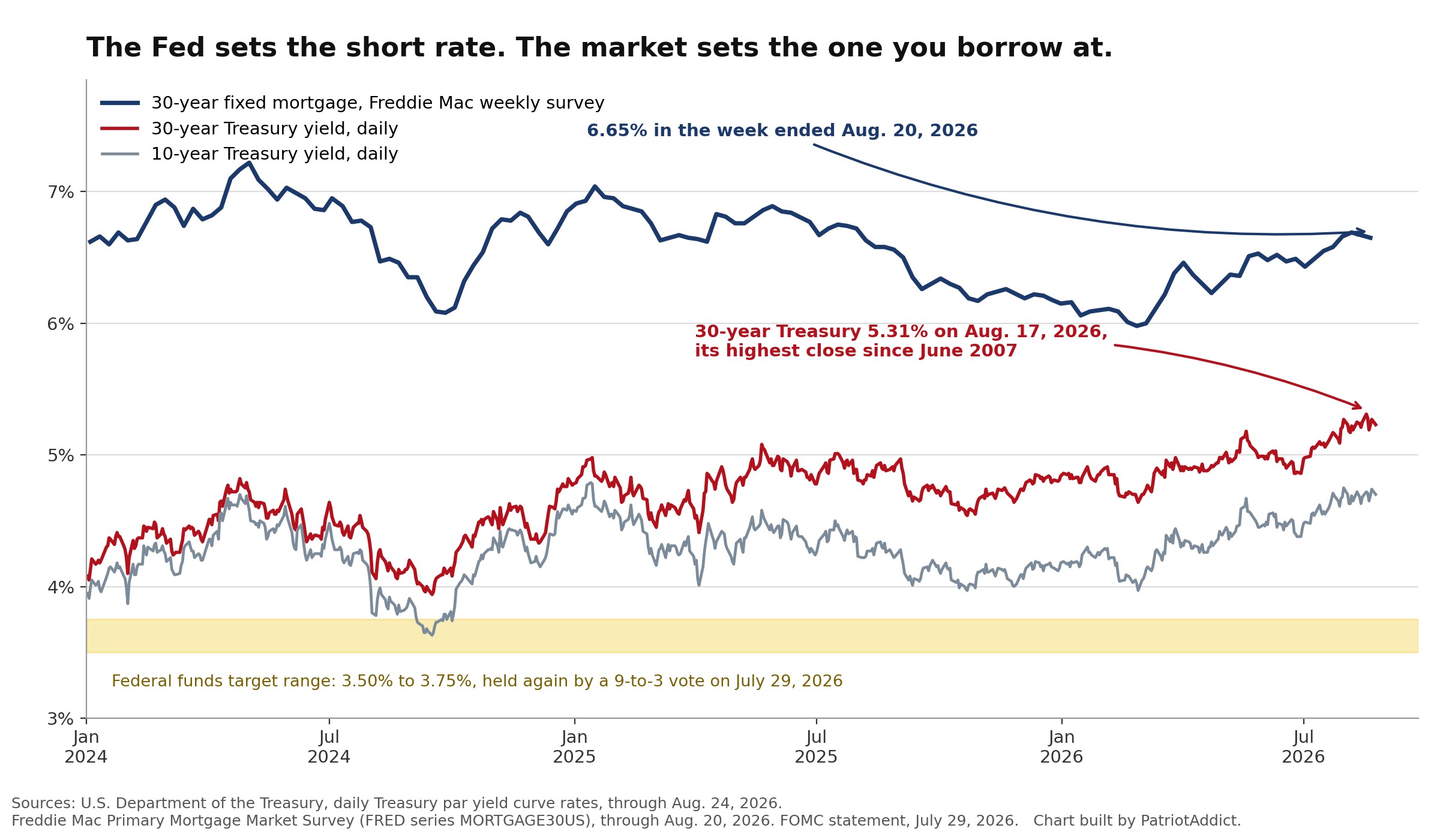
Chart built by PatriotAddict from the U.S. Treasury's daily par yield curve rates through Aug. 24, 2026, Freddie Mac's Primary Mortgage Market Survey through the week ended Aug. 20, 2026, and the July 29, 2026 FOMC statement. The gap between the shaded policy rate and the two lines above it is the part the Fed does not directly control.
One correction worth making: the 10-year is not at a high since January 2025. Its best close this month was 4.74 percent on Friday, August 21, under the 4.75 percent it hit on July 31 and under the 4.79 percent peak of January 13, 2025. The 30-year is the one at a 19-year extreme, and it is the one that sets a fixed-rate mortgage.
Warsh flagged the move before anyone asked, telling reporters that "nominal and real yields are materially higher across the Treasury curve" and putting the intermeeting increase "among the most significant in the last two decades, ranking around the top decile or so." Note what he claimed and what he did not: the jump was near a two-decade record, not the level. He then said the Fed had not done much in 42 days and "the markets have done quite a bit."
Why your mortgage rate did not follow the fed funds rate down
Freddie Mac's Primary Mortgage Market Survey put the average 30-year fixed rate at 6.65 percent for the week ended August 20. It peaked this year at 6.69 percent in the week of August 6, and you have to go back to the week of July 31, 2025 to find a reading that high.
If you have seen a higher number quoted, both can be right, because they measure different things. Freddie Mac polls lenders early in the week, publishes Thursday, and describes a borrower with strong credit and 20 percent down. Daily trackers such as Mortgage News Daily read lender rate sheets each afternoon and reflect what an applicant is quoted now, points included. When yields climb, the daily number leads and the survey lags.
Both track the long end of the Treasury curve plus a lender spread, and the Fed does not set the long end. That is the mechanical reason a September cut would not hand anyone a 5 percent mortgage.
The housing market already stopped waiting
The National Association of Realtors reported on August 11 that existing-home sales fell 1.7 percent in July to a 4.06 million annual rate, still 0.7 percent above July 2025. Inventory slipped to 1.54 million units, a 4.6-month supply. The median price was $434,100, up 2.0 percent, the 37th straight month of year-over-year increases.
Builders reacted faster than buyers. Census and HUD reported on August 18 that housing starts ran at a 1,239,000 annual rate in July, down 12.4 percent from June's revised 1,415,000 and down 13.5 percent in a year. Permits, which run ahead of the shovel, rose 5 percent, so July reads as a pause rather than a retreat.
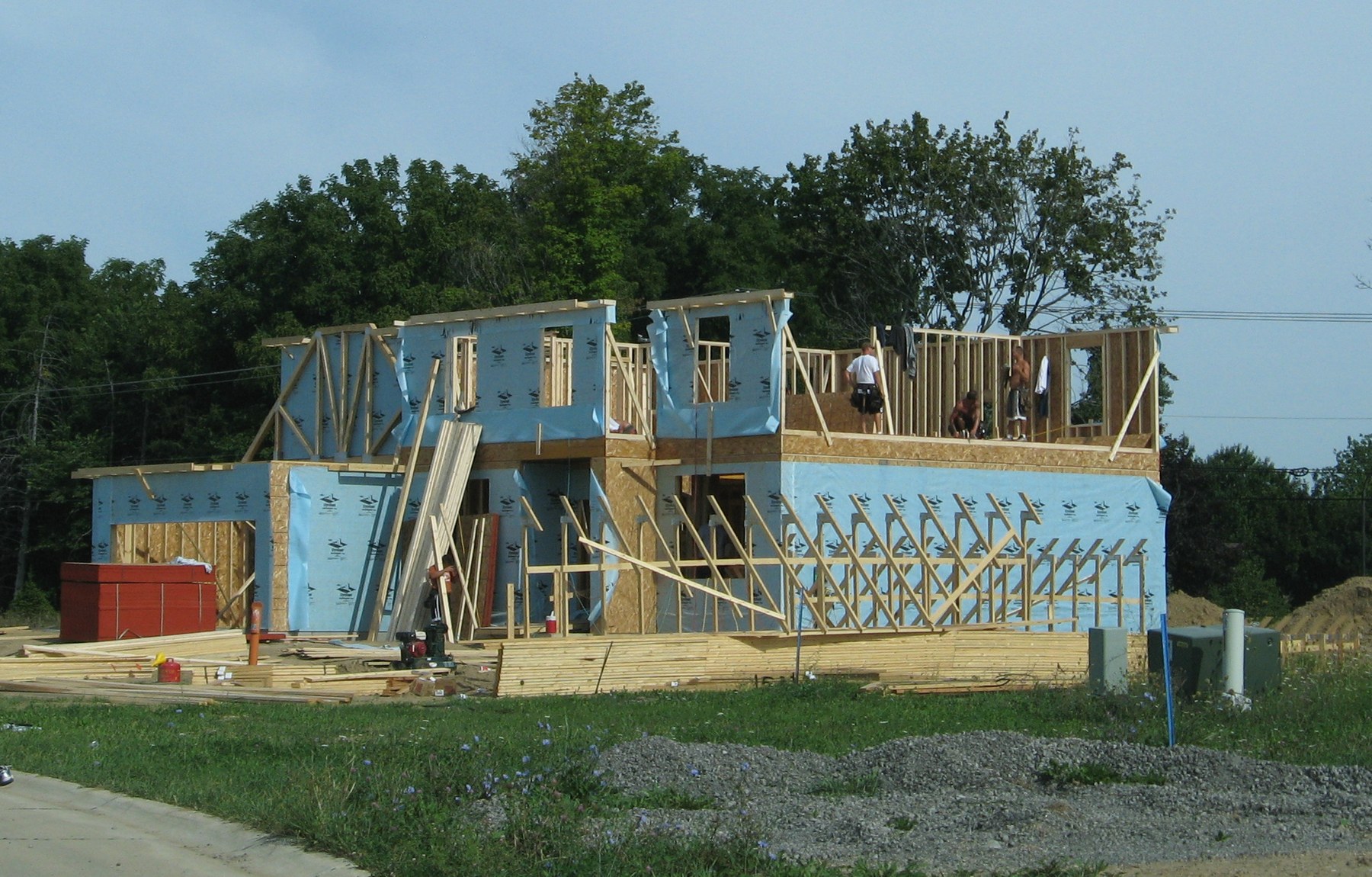
Single-family construction in Pittsfield Township, Michigan. File photo taken Aug. 23, 2011, by Dwight Burdette via Wikimedia Commons, CC BY 3.0. Census and HUD put July 2026 single-family starts at an 808,000 annual rate, down 9.9 percent from June.
Two more readings land Tuesday, August 25. Case-Shiller publishes June home prices that morning, its first update since the May figures posted July 28, which had prices up 1.1 percent in a year. Census and HUD release July new home sales at 10 a.m. Eastern, against a June rate of 628,000. Neither had posted when this piece went up, and anyone quoting a figure before then was quoting a forecast.
NAR chief economist Lawrence Yun named the variable in that release: "Year-to-date sales are up 2.4% and there's no doubt that the housing market would be thriving if average mortgage rates were to return near 6%." That is a 65-basis-point wish, and it runs through the 30-year Treasury rather than through Warsh.
What a tank of gas and a grocery cart cost right now
AAA's national average for regular was $4.0969 as of Tuesday, August 25, against $4.0654 a week earlier and $3.1613 a year ago, a 29.6 percent increase in twelve months. Diesel, which sets the cost of moving everything a family buys, was $5.6199 Tuesday against $3.6815 a year ago.
The Energy Information Administration reads lower, at $4.049 for the week of August 17, with the August 24 week not yet posted. They differ for a reason: EIA prices a fixed sample of outlets on Monday and publishes weekly, a survey snapshot with a lag, while AAA refreshes a far larger station count daily. Use EIA for history. Use AAA for today.
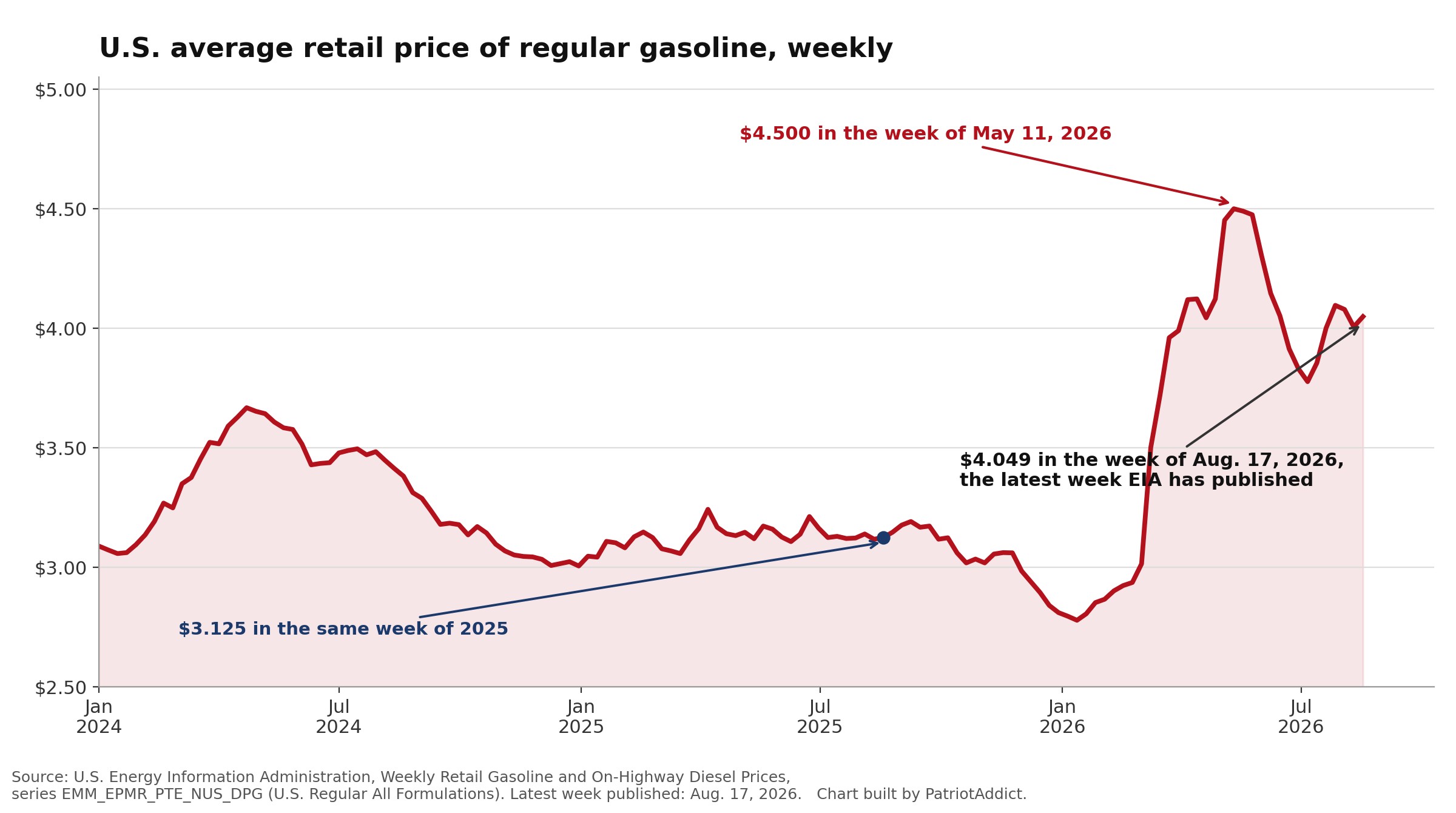
Chart built by PatriotAddict from the Energy Information Administration's weekly retail gasoline series, EMM_EPMR_PTE_NUS_DPG, through the latest published week of Aug. 17, 2026. The spring spike follows the closure of the Strait of Hormuz.
The proximate cause is the war and the shipping disruption in the Gulf, which this site covered yesterday. The Fed's July minutes name it, recording that the Middle East conflict had clouded the inflation outlook.
Now put that against a paycheck. The Bureau of Labor Statistics put July CPI at 3.4 percent over twelve months, with energy up 14.7 percent and gasoline of all grades up 24.6 percent. Shelter rose 3.2 percent, core inflation 2.5 percent. Average hourly earnings rose 3.2 percent to $37.62, which sounds fine until you adjust it: real average hourly earnings were $9.94 in constant 1982-84 dollars, down 0.1 percent in a year. An hour of American work now buys slightly less.
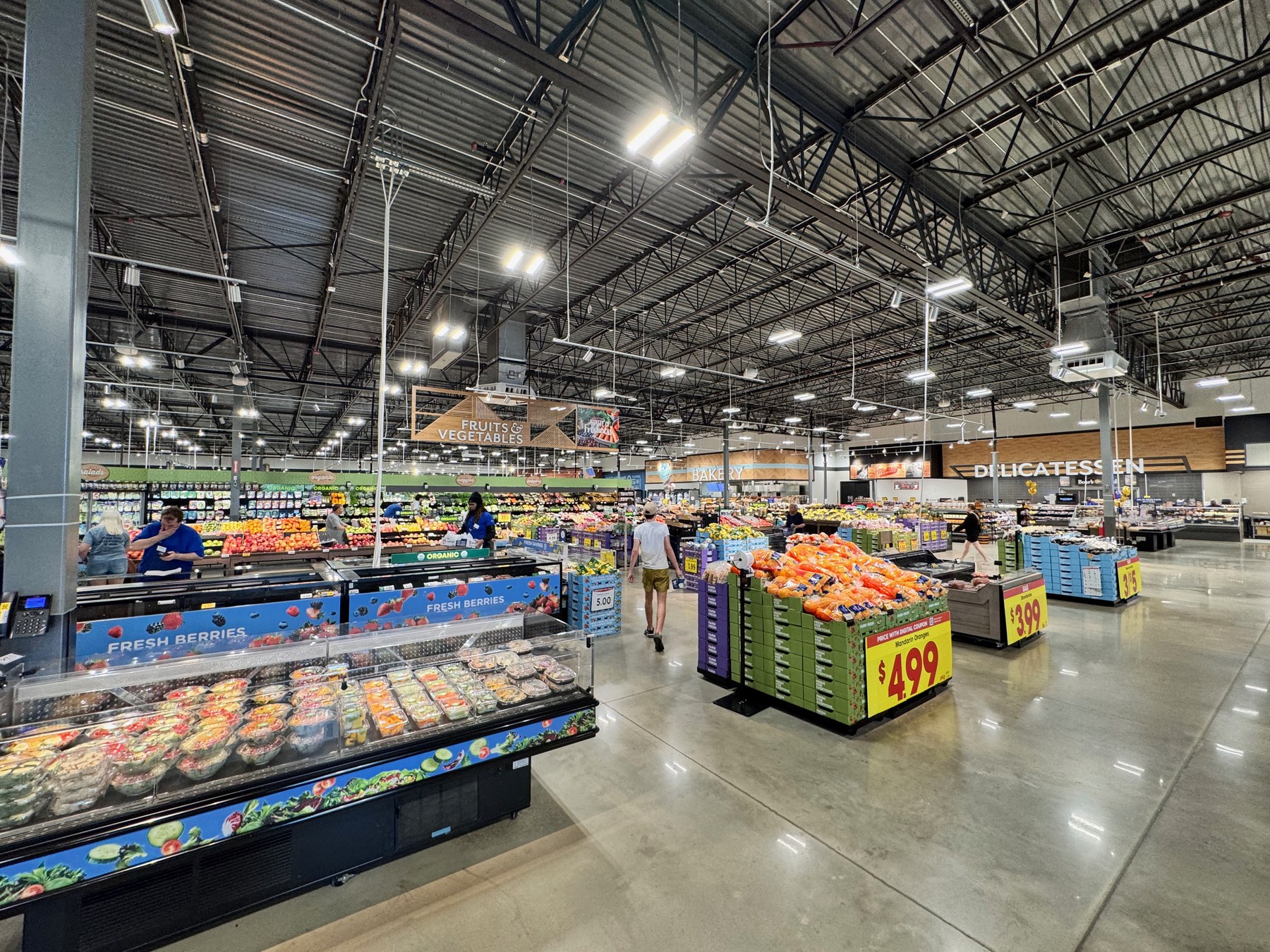
The produce section of a Kroger Marketplace in Athens, Georgia, photographed March 22, 2026, by Harrison Keely via Wikimedia Commons, CC BY 4.0. BLS put food-at-home prices up 2.7 percent over the twelve months through July 2026, far below energy.
The administration's side of this, with the actual numbers
Give the White House its due where the data supports it. American crude production hit an all-time monthly record of 13,967,000 barrels a day in April 2026 in EIA's field production series, about 1.7 million a day above the 2019 average. Without that, a closed Hormuz would cost drivers considerably more than $4.09.
The labor market is holding too. Unemployment was 4.1 percent in July, down from 4.3 percent a year earlier, and the Fed's own staff expects total inflation to fall through the second half as gasoline prices come down.
Tariff receipts are real money. Treasury's Monthly Treasury Statement shows customs duties of $24.8 billion in July and $154.5 billion this fiscal year, against $135.7 billion over the same stretch of fiscal 2025, per Treasury's fiscal data. The trend inside that total belongs in the same paragraph: monthly collections peaked at $33.1 billion last October and have fallen every quarter since.
Why a rate cut would not fix any of this
The July minutes, released August 19, are blunt about direction. "Many participants assessed that policy tightening would likely be necessary if inflation did not decline," they read, and "some participants commented that financial conditions might not currently be sufficiently restrictive." Risks to the inflation forecast were recorded as skewed to the upside.
That is the box. Cutting with PCE inflation at its June reading of 3.7 percent would weaken the dollar, which raises the price of oil quoted in dollars, which pushes the gasoline number back up. Holding does nothing for the 30-year Treasury, where the mortgage lives. Raising deepens the freeze that just took 12.4 percent off housing starts in a month.
Warsh has not pretended otherwise. Pressed by Reuters' Ann Saphir on why five years of above-target inflation had produced no action, he said he hears the same impatience from households and businesses, then said the quiet part out loud: "we've got no magic wand. This isn't something that we're going to be able to carry out in days or weeks."
What to watch between now and September 16
Wednesday's PCE report is the read that counts, because it is the measure Warsh named. Later this month he gives his first Jackson Hole address as chairman, a speech he said on July 29 he had not begun writing. Then the FOMC meets September 15 and 16, with a Summary of Economic Projections attached. Three officials already voted to raise rates in July. A household betting its refinance on a cut is betting against the Fed's written record.