Treasury Secretary Scott Bessent unveils the toughest Iran sanctions in American history at 2 p.m. Eastern Monday. The targets are not in Iran. They are the third-country refiners, shippers and banks that still buy Iranian oil and clear the payments for it. That is what "secondary sanctions" does, and it is why this announcement matters more than the six months of pressure that came before it.
One thing needs saying plainly up front. As of 5:30 a.m. Eastern Monday, none of it existed on paper. The Office of Foreign Assets Control's Recent Actions page showed no new Iran designation. Its most recent Iran action is dated Aug. 20, and the newest item on the page at all is an Aug. 21 Venezuela general license. No new executive order has appeared in the Federal Register. Anyone publishing a target list this morning is guessing.
What Bessent has actually committed to, on the record
Bessent wrote an opinion piece in the Financial Times on Sunday, and it is the most specific thing he has published. "At dawn begins an economic D-Day, the single greatest financial offensive ever marshalled against an adversary," he wrote, as quoted by CNN. "The world should understand that our objective is to sever every economic lifeline that sustains the tyrannical regime until Tehran stands alone."
The op-ed spends most of its energy on other governments, not on Iran. "Iran's enablers purchase and transport its petroleum," Bessent wrote. "They turn a blind eye to seaborne fuel transfers and the illicit use of their banks." His warning to them: "these countries calculate appeasement of the regime to be the safer course. But they would do well to consider the consequences of sustaining it."
On CNBC last Thursday he was blunter. "We are going to them and saying you are either with us or against us," he said, per CNBC. "It is time for our allies and the rest of the world to make a decision." He stated the goal without softening it: the blockade plus sanctions is "a one-two punch," and "we are going to collapse this regime," he told the network.
The real weapon is the correspondent account
Here is the mechanism, because it is the whole story. American sanctions cannot stop a Chinese refinery from buying Iranian crude. They can tell the bank that clears the payment to pick one: access to the U.S. dollar, or the Iranian business. That is a correspondent account sanction, and the authority to impose it has been on the books since 2018.
Official record
No new Treasury or OFAC document had been published as of the time of writing, so this is the existing authority the announcement is expected to run through: Executive Order 13846, "Reimposing Certain Sanctions With Respect to Iran", signed Aug. 6, 2018, published at 83 FR 38939.
"With respect to any foreign financial institution determined by the Secretary of the Treasury in accordance with this section to meet any of the criteria set forth in subsections (a)(i)-(a)(v) of this section, the Secretary of the Treasury may prohibit the opening, and prohibit or impose strict conditions on the maintaining, in the United States of a correspondent account or a payable-through account by such foreign financial institution." — Executive Order 13846, Sec. 2(b)
The triggering conduct in Sec. 2(a)(iv) is a significant financial transaction "for the purchase, acquisition, sale, transport, or marketing of petroleum or petroleum products from Iran." Sec. 3 adds a separate menu of penalties for any person who knowingly does the same.
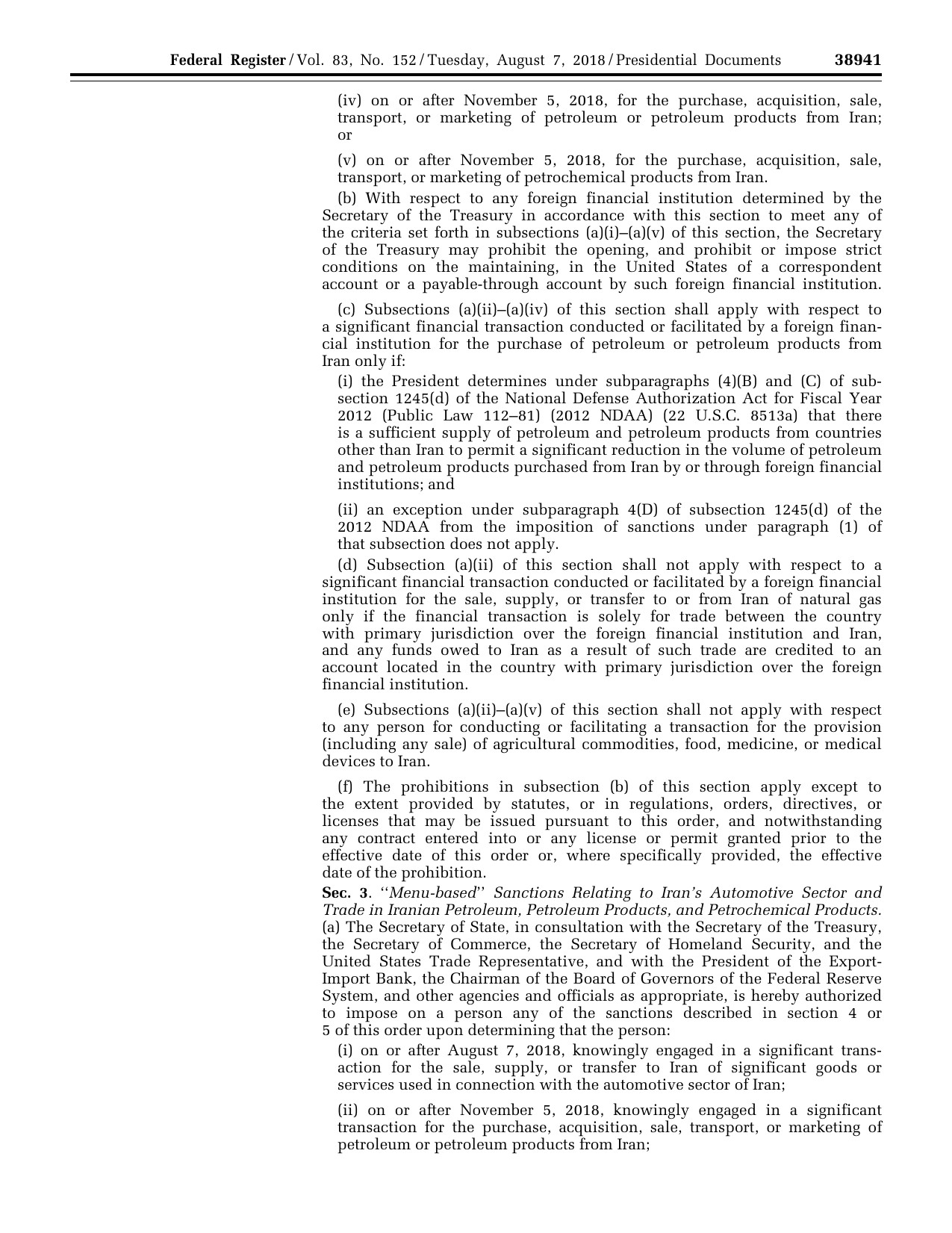
Read or download the full 11-page executive order as published in the Federal Register (PDF) · page 3 shown, where the correspondent-account provision sits
Applying it to a large Chinese bank has never been done. Washington has sanctioned small Chinese "teapot" refineries and shipping intermediaries and left the major banks alone, and The National reports Beijing is watching that line closely, with President Xi Jinping due at the White House next month. Asked whether China is a target, Bessent said only that "many conversations are best to have in private."
The numbers explain the ducking. China takes more than 80 percent of Iran's shipped oil, per 2025 figures from the analytics firm Kpler cited by NBC News. We covered Beijing's on-record refusal to help, in Foreign Ministry spokesman Lin Jian's own words, in Friday's piece. That position has not moved.
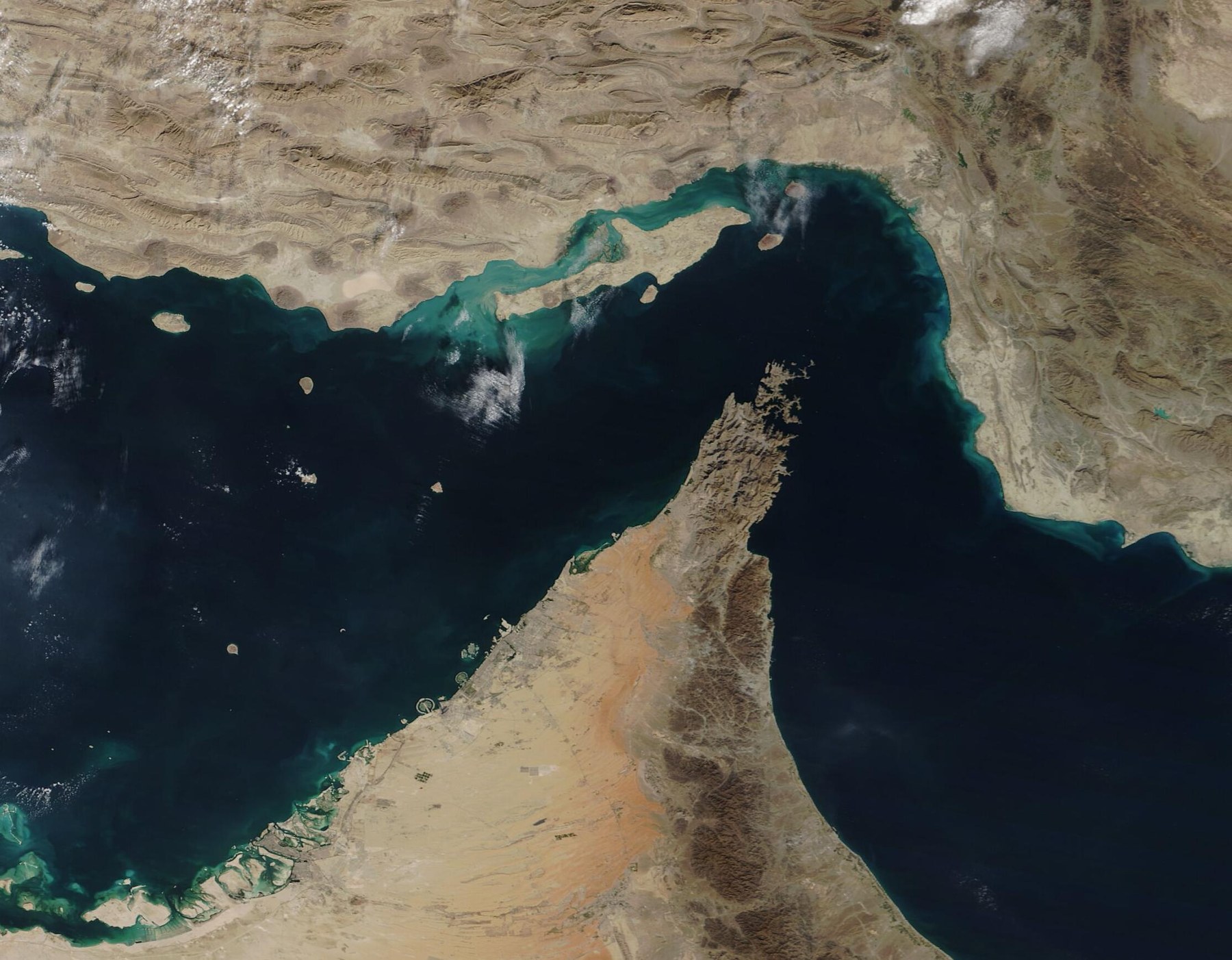
The Strait of Hormuz, roughly 21 miles wide at its narrowest point, with Iran to the north and the Musandam Peninsula of Oman jutting into it from the south. Satellite image taken Dec. 2, 2020, well before the current war. (MODIS Land Rapid Response Team, NASA Goddard Space Flight Center, public domain via Wikimedia Commons)
The blockade has already done most of the damage
Before the war, oil flows through the Strait of Hormuz averaged 20.9 million barrels a day in the first half of 2025, about a fifth of global petroleum liquids consumption, according to the Energy Information Administration. Energy Secretary Chris Wright says the U.S. military has helped move a seven-day average of 8 million barrels a day through it, a figure reported by NBC News. Traffic is still thin enough to count by hand. CNN logged at least six vessels transiting in the 24 hours to Sunday, three of them tankers.
The physical squeeze is already in place. Sanctions add legal exposure for the buyers who kept trading anyway, a different lever than a warship. Helima Croft, head of global commodity strategy at RBC Capital Markets, put the doubt on the record with CNBC: Iran is already among the most sanctioned countries on earth, and "the question is how is this going to change with additional economic sanctions." The National counts more than 6,000 sanctions already on Iran.
Tehran answered before the announcement was made
Iran's Foreign Ministry did not wait for 2 p.m. Spokesman Esmaeil Baghaei called the coming package an "assertion of extraterritorial sovereignty over every independent member state of the United Nations" in a Saturday post on X. "Such secondary sanctions find no foundation in international law," he wrote. That is Tehran running the same legal argument Beijing ran a week ago, which is not a coincidence.
The harder threat came from Mohsen Rezaee, the new secretary of Iran's Supreme National Security Council. "If countries neighboring Iran cooperate with the Americans in the economic war, we will target their interests," he said in a state media interview reported by CNN. "If they start such an action, we will not allow a single drop of oil to pass through the Persian Gulf." He said Tehran would also hit the export routes Saudi Arabia and the UAE built to bypass Hormuz.
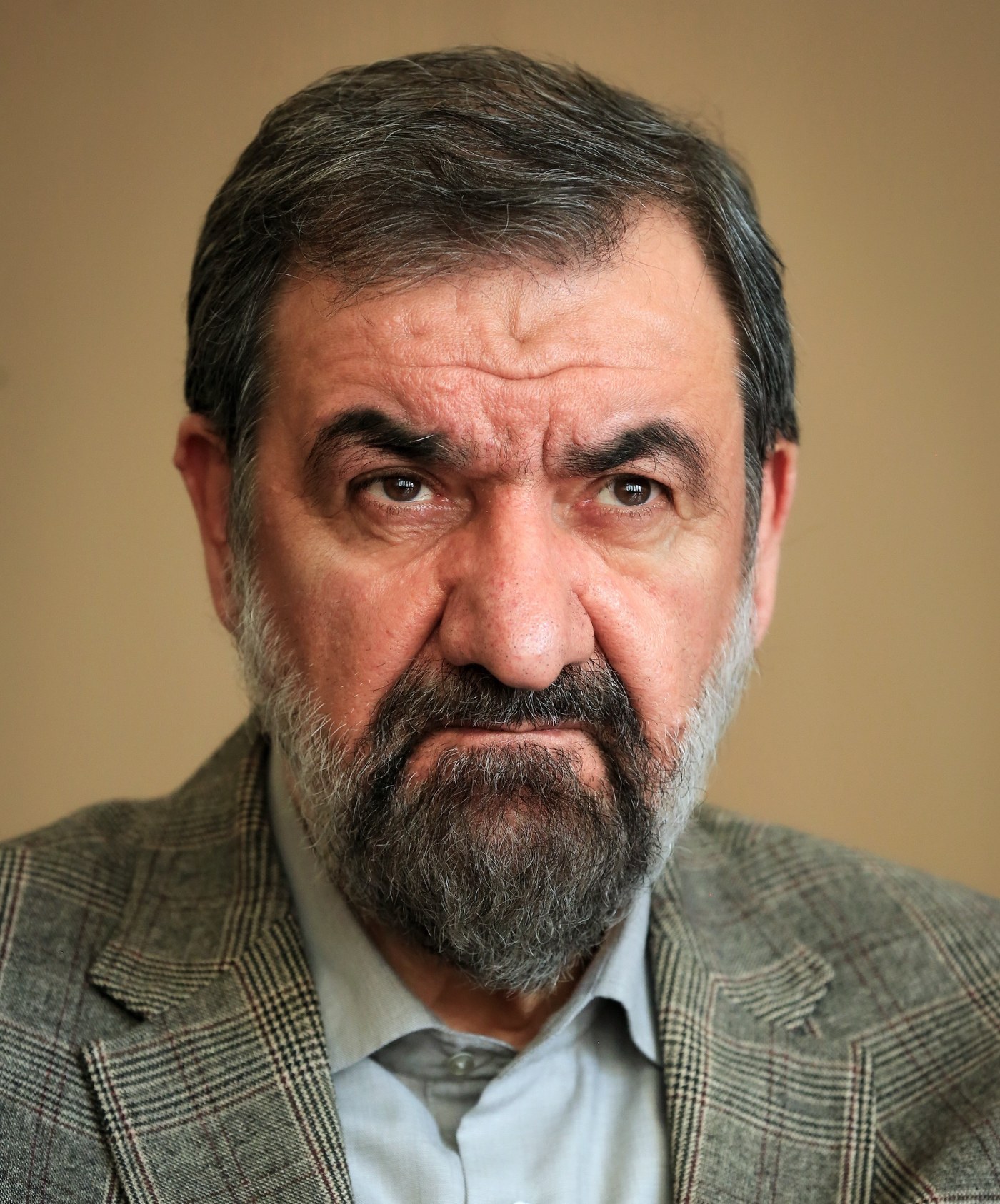
File photo from 2020: Mohsen Rezaee, the former Islamic Revolutionary Guard Corps commander named secretary of Iran's Supreme National Security Council this month, pictured six years before his current appointment. (Photo: khamenei.ir, CC BY 4.0, via Wikimedia Commons)
The Islamic Revolutionary Guard Corps was dismissive. Trump's economic war "amounts to an implicit admission of the enemy's humiliating defeat in the military arena," an IRGC spokesman said Sunday, per Iranian state media quoted by CNBC.
The crack inside Tehran is the real news
Bravado from the security establishment is cheap. Iran's president saying the opposite in public is not. Masoud Pezeshkian told two Tehran audiences Sunday that the country "cannot continue with war forever" and defended the June memorandum of understanding with Washington, despite the reported misgivings of Supreme Leader Mojtaba Khamenei. "One day, a decision must be made to save the country from the state of neither war nor peace," he said, per the state news agency IRNA, conceding that "we find ourselves in a full-scale economic, military, and security war."
Parliament speaker Mohammad Bagher Ghalibaf, Iran's lead negotiator in the mediated talks, told Iranian and Iraqi businesspeople last week that "no matter how much military power we have, we won't survive if people are hungry." Hamidreza Azizi of the Clingendael Institute read the split for CNN: the executive and legislature still favor diplomacy, while "the military-security establishment is increasingly preparing for another round of escalation." That gap is the pressure campaign working. Whether Monday's package widens it or hands the hardliners their argument is the real question.
The bill is landing on American drivers, and the Fed just said so
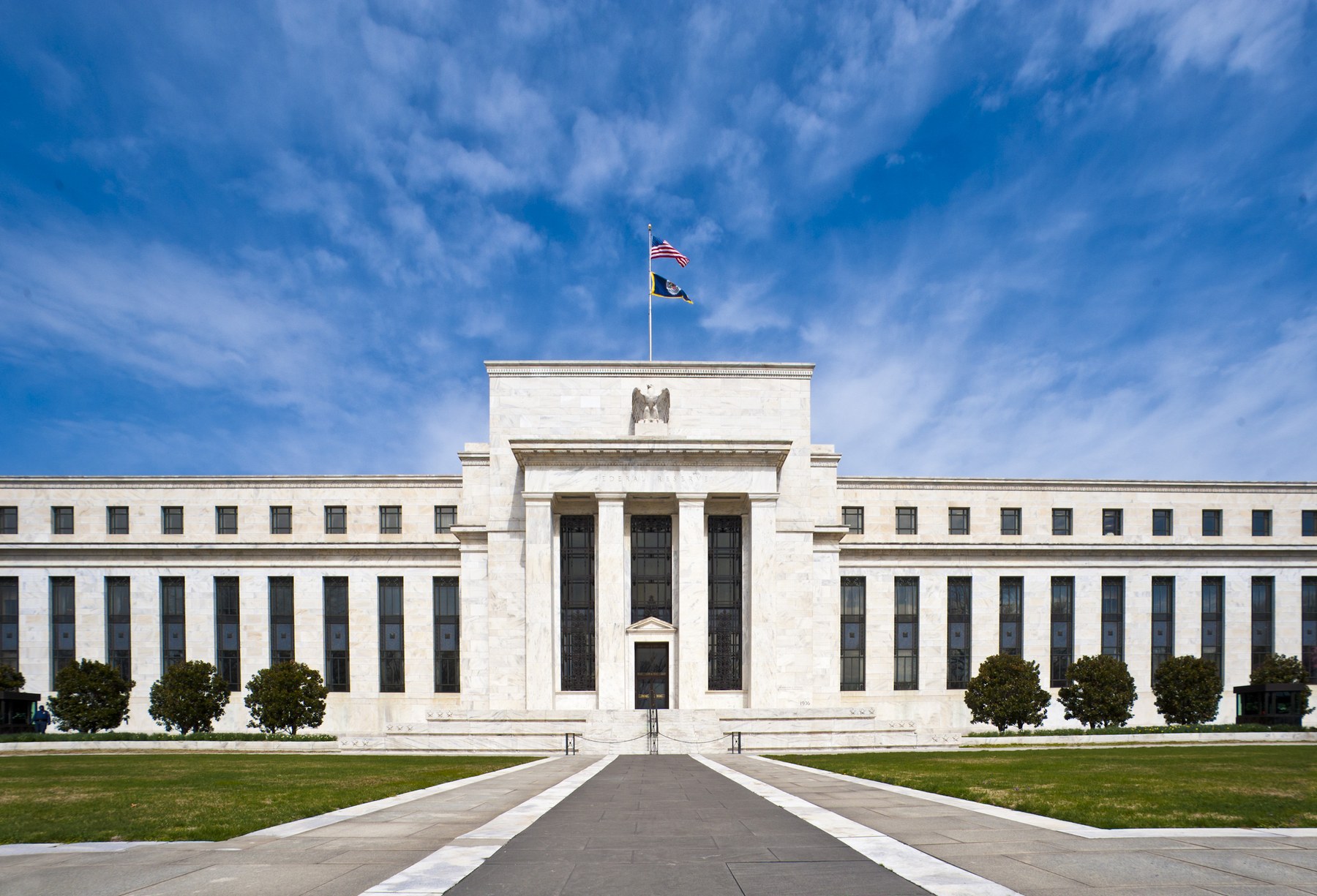
File photo: the Marriner S. Eccles Federal Reserve Board Building in Washington. Minneapolis Fed President Neel Kashkari said Sunday that the Fed's 2 percent inflation target is likely out of reach while the Iran war continues. (Photo: Board of Governors of the Federal Reserve System, public domain via Wikimedia Commons)
The national average for regular gasoline was $4.09 a gallon on Sunday, per AAA data cited by CNN, roughly 37.5 percent higher than before the war began on Feb. 28. Brent settled at $93.77 a barrel. Energy prices ran 14.7 percent above a year earlier in July, per the Bureau of Labor Statistics. We ran the year-over-year pump math off the EIA's weekly series in Friday's post, and nothing has improved since.
Minneapolis Fed President Neel Kashkari said the quiet part on CBS's "Face the Nation" Sunday. "The longer the Iran war goes on, the less confident I am that inflation is going to return to target," he said. "Eventually, we're gonna have to do more." Trump has called the conflict "a little detour" and blamed inflation on Democrats. Both things are true at once: the war is worth finishing, and it is costing people who fill a tank for a living real money right now.
Four things to watch at 2 p.m.
Does any Chinese financial institution appear on the SDN list, or does the package stop at refineries, traders and shipping companies again? That one question decides whether "you are either with us or against us" has teeth or an exception. Second, does Treasury move under E.O. 13846's correspondent-account provision or a new executive order? A new order would be the stronger signal, and it would show up in the Federal Register.
Third, watch the wind-down periods and general licenses. Sanctions effective in 180 days are a negotiating posture. Sanctions effective immediately are not. Fourth, watch whether the SDN list updates today at all. Bessent promised specifics at a Monday press conference once before, on Aug. 20, and we reported then that the details did not exist yet. This is that Monday. By tonight there will either be names, dates and legal authorities on Treasury's website, or there will be another press conference.
Hero photo: Treasury Secretary Scott Bessent at a White House press briefing, May 28, 2026. Official White House photo by Abe McNatt, public domain, via Wikimedia Commons.