China told Washington on Friday it will not help strangle Iran's oil trade. That answer lands two days before Treasury unveils the harshest sanctions yet. Beijing has taken roughly nine of every ten barrels Iran ships for the past decade, so the one government that could actually finish the job just declined, and American drivers are already paying 92 cents a gallon more than they did a year ago.
Beijing said no in plain language, on the record
At the Chinese Foreign Ministry's regular press briefing in Beijing on Friday, AFP asked spokesman Lin Jian directly about Treasury Secretary Scott Bessent's call for China to join the pressure campaign. Lin did not hedge. "China opposes illicit unilateral sanctions that lack basis in international law and UN Security Council mandate," he said, according to the official transcript of the briefing.
Asked by Iranian state broadcaster IRIB whether Trump has any card left to play, Lin went further: "China believes that military means, sanctions and pressure tactics are not the solution. On the contrary, they will only lead to escalation that serves no one's interests." He had said essentially the same thing the day before. That is Beijing telling the White House, twice in 48 hours, that it is not coming.
Bessent had spent Thursday on CNBC calling the plan "the greatest coordinated economic isolation in the history of the world." Asked point blank whether China itself would be targeted, he declined to answer, saying some conversations are better held "in private." Foreign Policy summed up the bind in a Friday headline: Trump Needs China's Help to Effectively Sanction Iran.
The blockade is working better than the sanctions are
Here is the part that cuts against Beijing's position. The naval blockade of Iranian ports that Trump ordered in April has already done what six months of diplomacy could not. Traffic through the Strait of Hormuz fell off a cliff in the first days of March, right after the war began on February 28, and has never recovered. Fox News reported Friday that what movement remains has shifted to the Omani corridor rather than Iran's preferred northern route.
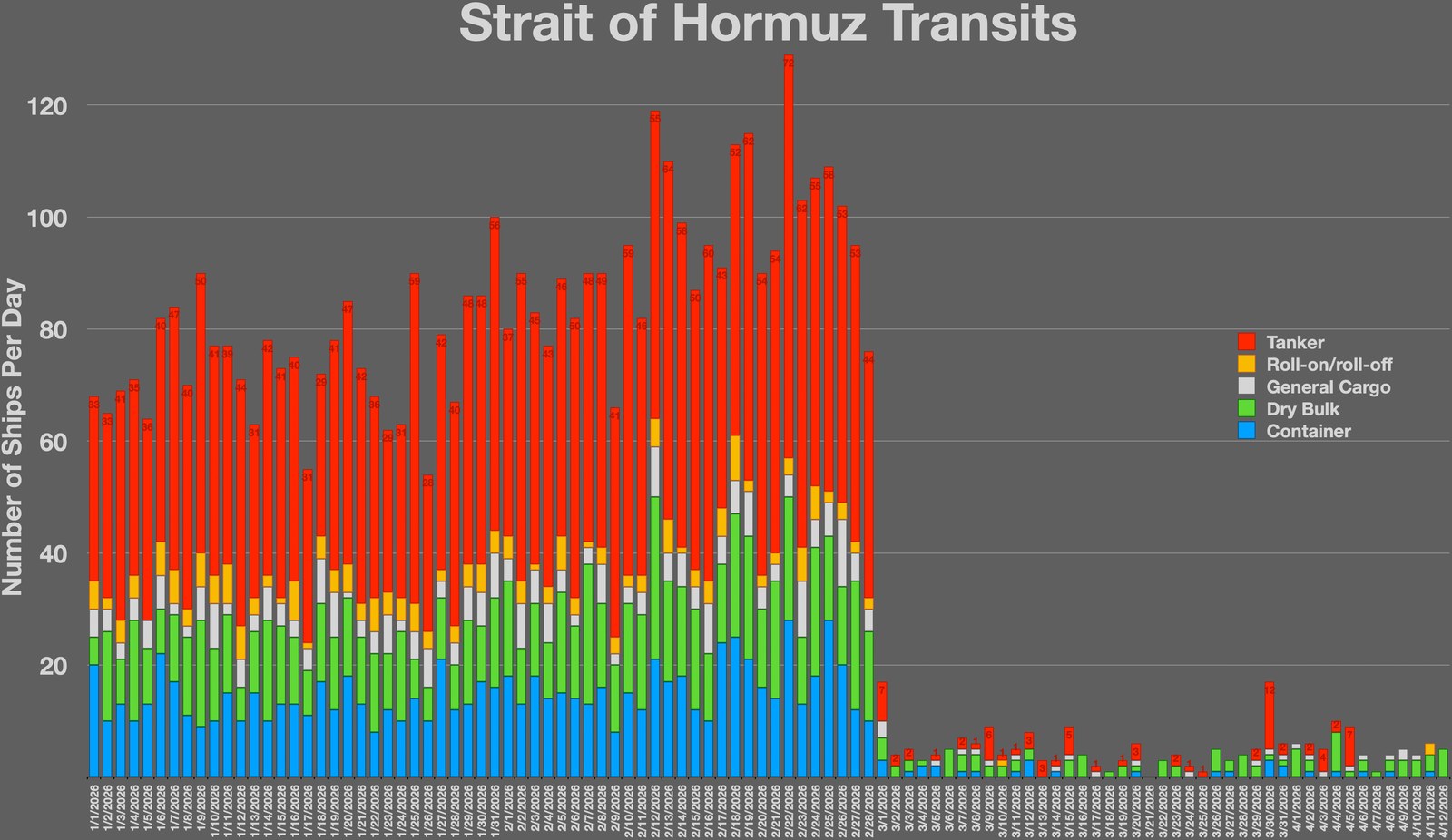
Daily ship transits through the Strait of Hormuz, January through mid-April 2026, charted from International Monetary Fund PortWatch data. The drop-off begins the week the war started. (Wikimedia Commons, CC0 public domain dedication, by contributor Wikideas1)
Before the war, roughly 130 ships a day moved through the strait, carrying about a fifth of the world's oil and liquefied natural gas, according to Al Jazeera's tally. Kpler senior crude analyst Muyu Xu wrote this week that buyers now face "virtually no new Iranian supplies available for late-September delivery onwards since no laden Iranian tankers have so far managed to break through the US blockade." She estimates 40 million barrels of Iranian crude are sitting on ships in Malaysian waters, most of it already spoken for.
China's purchases fell hard, but they did not stop
The numbers tell the real story. China took about 90 percent of Iran's oil exports before the war, averaging roughly 1.7 million barrels a day, Wall Street Journal reporter Austin Ramzy told NPR earlier this month. Reuters figures cited by Fox put Chinese imports of Iranian crude at an estimated 534,000 barrels a day in August, down from about 823,000 in July.
That is a brutal cut. It is also not zero, and the way Beijing keeps the tap open is the whole reason Bessent's threat may land softer than advertised. Ramzy laid out the mechanics: payments in renminbi instead of dollars, straight barter where China builds infrastructure in Iran in exchange for crude, a sanctioned "ghost fleet" that runs ship-to-ship transfers east of Malaysia so the cargo shows up in Chinese customs records as Malaysian or Indonesian oil.
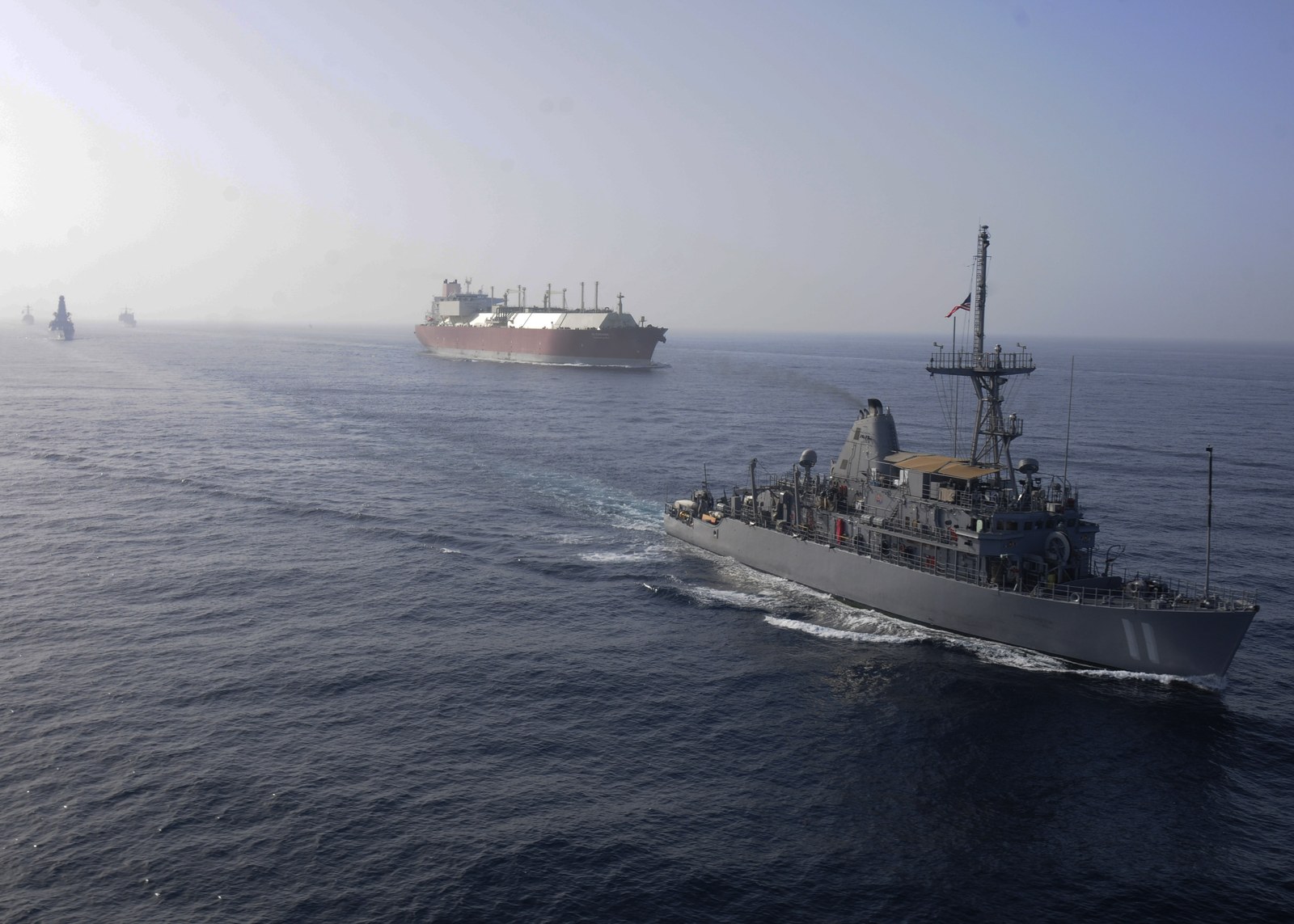
File photo: the mine countermeasures ship USS Gladiator escorts a liquefied natural gas tanker in the Persian Gulf during a multinational exercise, May 21, 2013. Convoy escort of commercial shipping in these waters is not a new mission. (U.S. Navy photo by MC2 Bryan Blair, via Wikimedia Commons, public domain)
None of that is a secret. Washington has watched it for a decade and priced it in. What has changed is that the administration is now betting the outcome of a six-month war on shutting it down, and the only government with the standing to do that has publicly declined.
Washington has already put the Hormuz shakedown in writing
One piece of this is not a talking point, it is federal guidance already on the books. Iran created an entity it calls the Persian Gulf Strait Authority to collect fees from vessels transiting Hormuz, and Treasury designated it in May as a supporter of the Islamic Revolutionary Guard Corps. Any shipping company thinking about quietly paying Tehran for safe passage has been told, in a published Office of Foreign Assets Control ruling, exactly where that lands.
Official record
U.S. Department of the Treasury, Office of Foreign Assets Control, Iran Sanctions FAQ 1249, released April 28, 2026 and updated May 29, 2026.
"Payments to and guarantees from the Government of Iran or the Islamic Revolutionary Guard Corps (IRGC), directly or indirectly, for safe passage through the Strait of Hormuz would not be authorized for U.S. persons, including U.S. financial institutions, or for U.S.-owned or -controlled foreign entities." — OFAC, FAQ 1249
Read the underlying guidance: OFAC Alert: Sanctions Risks of Iranian Demands for Strait of Hormuz Passage (PDF) · State Department statement on the August 7 shadow banking designations
Treasury has been running this campaign under the name Economic Fury since early in the war. The August 7 action was OFAC's eighth of 2026 aimed at Iran's shadow banking network alone. Whatever Bessent announces Monday is an escalation of something already underway, not a standing start.
What this is costing Americans at the pump
Now the part nobody in Washington wants to lead with. The U.S. average price of regular gasoline was $4.049 a gallon for the week of August 17, according to the Energy Information Administration's weekly retail price series. The same week a year ago it was $3.125. That is 92 cents, and it is real money for anyone commuting or hauling for a living.
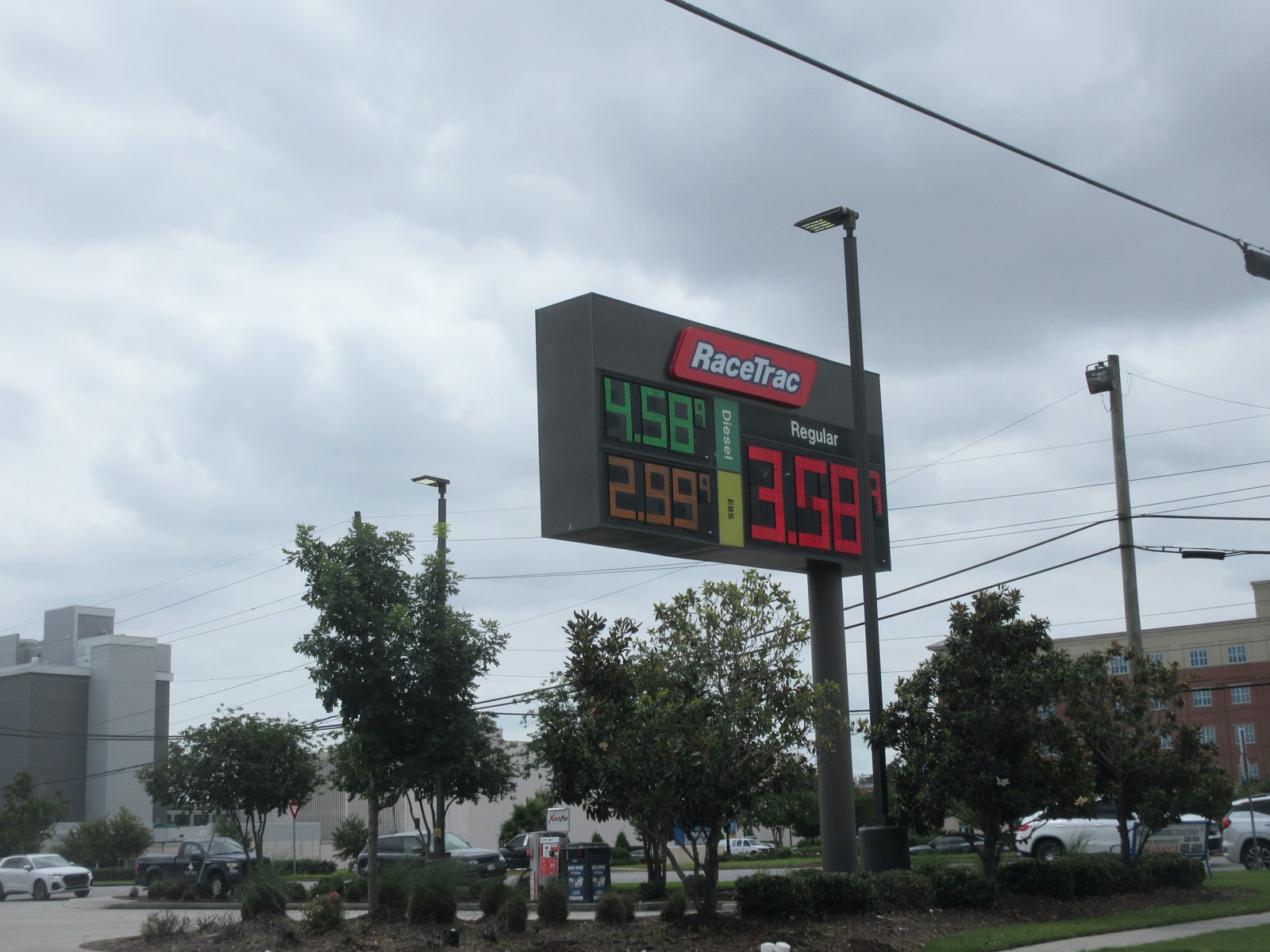
File photo: a RaceTrac station in Jefferson Parish, Louisiana on June 4, 2026, one of the cheaper fuel markets in the country. EIA put the national average for regular at $4.305 on June 1 and $4.146 on June 8. (Wikimedia Commons, CC BY-SA 4.0, photo by Infrogmation of New Orleans)
Crude is doing the same thing. Brent settled at $93.78 a barrel Thursday, up 2.4 percent and the highest close since July 24, with West Texas Intermediate at $87.83. Brent was trading around $66 before the war began and touched $119 in March. Bessent's argument is that everyone benefits once the strait reopens and prices come down. He is right about that. The open question is whether more sanctions get the strait open faster, or simply lock in the standoff at a higher price.
Trump is now threatening the country doing the mediating
Oman has spent weeks negotiating with Iran over a workable shipping arrangement through Hormuz, with Qatar helping broker it. Tehran says the two sides have agreed on a new route and are drafting a joint declaration. Trump's response, in a Fox News interview on Monday, was blunt: "If Oman gets in the way, we'll bomb the s--- out of them." It was the second such threat, after telling reporters at a May cabinet meeting that "Oman will behave just like everybody else, or we will have to blow them up."
Oman is a nearly 200-year American partner with a free trade agreement and security cooperation treaties, and Iran hit targets on its soil during this war. It is also the only party still talking to both sides. Threatening to bomb the mediator while asking Beijing for help is a hard combination to sell, and it is worth remembering that the same week Trump said he would declare the Strait of Hormuz a territory of the United States.
What is still unknown going into Monday
Bessent has said he will hold a press conference at Treasury on Monday. As of Saturday morning, the actual content has not been released: no target list, no effective dates, no statement on whether Chinese refiners or banks are in scope. Anyone telling you what is in the package is guessing. Iran's armed forces chief of staff, Gen. Ali Abdollahi, has already promised "revolutionary, crushing, regret-inducing and devastating responses" in a message carried by Iranian state media, and Vice President JD Vance says the war is entering a new phase.
Trump's underlying position has not moved since our coverage of the "Economic D-Day" announcement on Wednesday: no Iranian nuclear weapon, and no reward for stalling. That is the right call. But a pressure campaign is only as strong as its weakest link, and China has now stood up in front of the cameras and volunteered to be it. Monday will show whether Bessent is willing to put American sanctions on Chinese banks to prove otherwise, or whether "you are either with us or against us" turns out to have an exception written into it for the buyer that matters most.