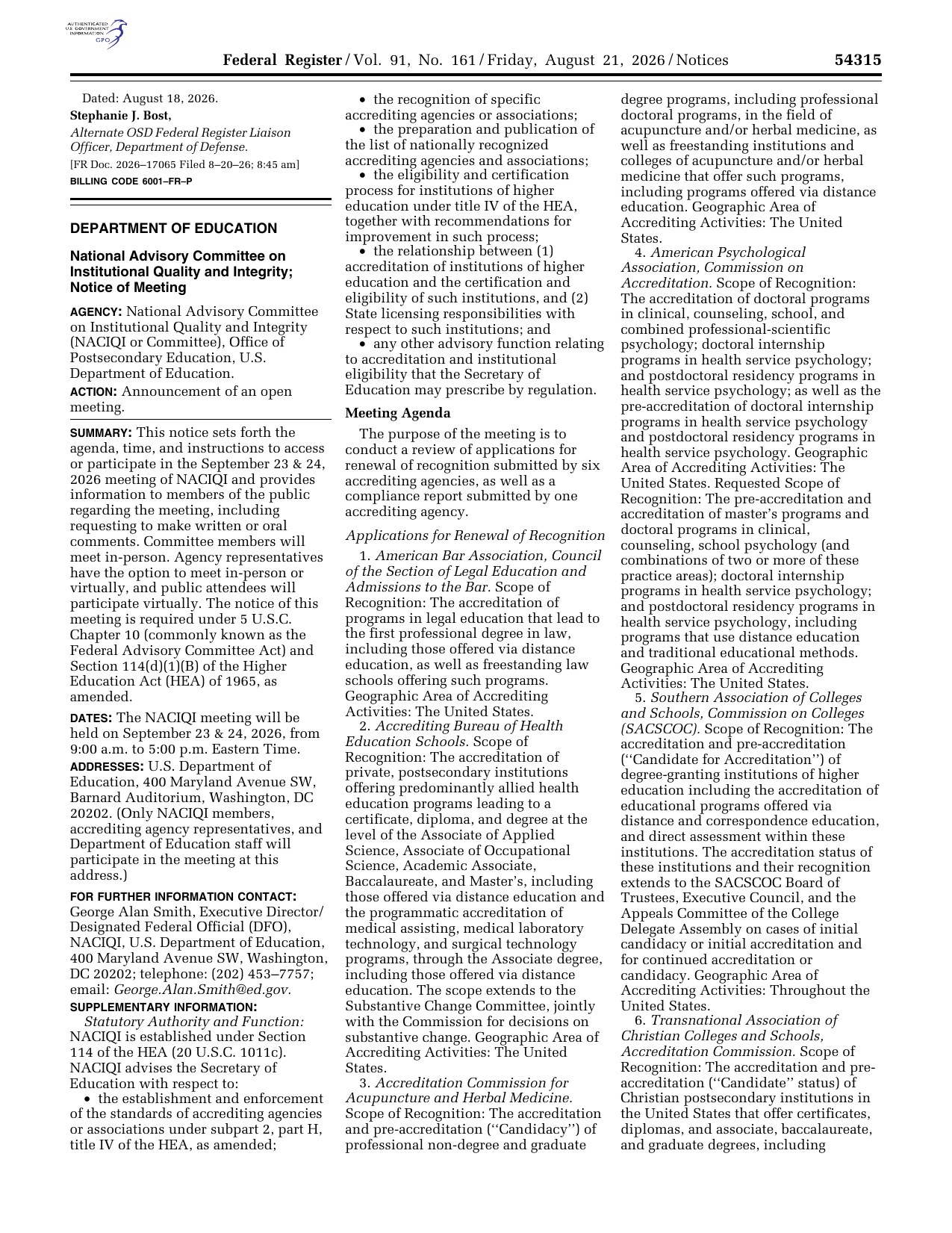
The Department of Education's staff review of the American Bar Association's law school accrediting arm ends in two words: deny recognition. That recommendation reached the ABA on Friday morning, August 21, and it sends the group's 74-year federal monopoly over legal education in front of a government advisory panel on September 23.
The staff analysis cites 26 separate violations
The document is the Department's Final Staff Report on the Council of the Section of Legal Education and Admissions to the Bar, cleared at 7:47 a.m. on August 21 and published through the Department's e-Recognition portal. Its recommendation section is one line long. It says: "Deny recognition." The report cites 26 criteria in 34 C.F.R. Part 602 the agency "does not meet," plus three more where staff found only substantial compliance.
First on the list carries the most weight: 602.14(b), which requires an accreditor tied to a professional membership group to be "separate and independent" from it. Staff wrote that the Council "did not provide the approved revisions" establishing separate bylaws and "did not provide the approved changes to the House of Delegates (HOD) concurrence process." The Council has held federal recognition since 1952 and accredits 197 law schools by the Department's count, 198 by the ABA's own list.
Most of those 26 findings are paperwork, and conservatives should say so out loud
Read the findings in order and a pattern shows up fast. Line after line says the same thing: "The agency did not provide the updated Standards and Rules of Procedure for Approval of Law Schools." That sentence drives most of the noncompliance calls. So anyone telling you the report is 500 pages of DEI is not describing the document. The acronym DEI does not appear in the staff analysis at all, and the word "diversity" appears twice, both times inside one finding.
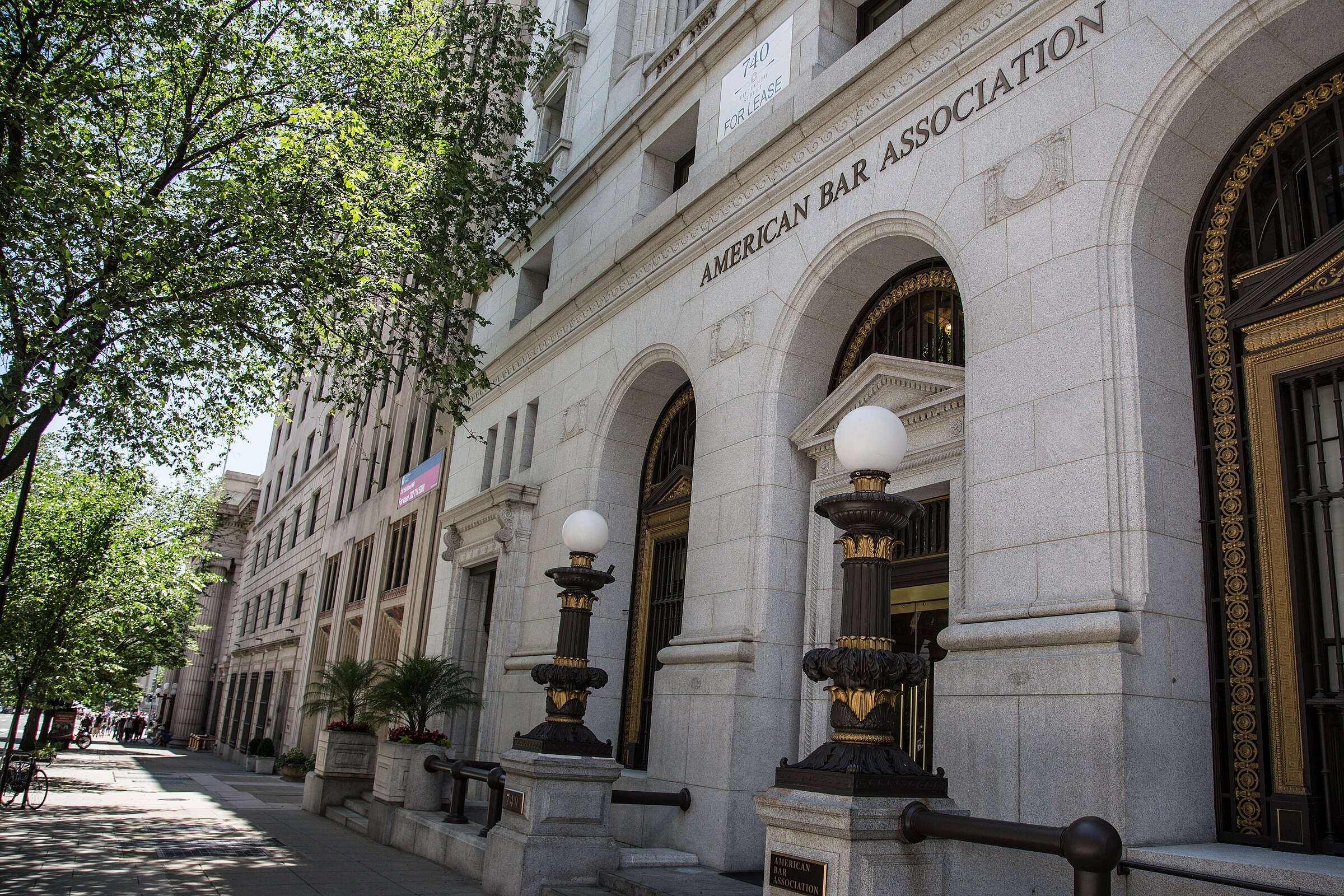
The American Bar Association building in Washington, D.C., photographed June 1, 2014. The accreditation Council itself operates out of the ABA's Chicago headquarters at 321 North Clark Street. (Photo by Tony Webster via Wikimedia Commons, CC BY 2.0)
That one finding is the worst page in the report for the ABA
It sits under 602.21(c) and (d), which gives an accreditor 12 months to start fixing a standard once it decides the standard needs fixing. In 2022 the ABA's Standards Committee revised Standard 206, citing the "effective educational use of diversity" interest recognized in Grutter and Fisher. Warned that the rule could produce racial balancing, the committee answered that "should the legal standards on affirmative action change, Standard 206 will be revised at that time as needed."
The legal standards changed in June 2023, in Students for Fair Admissions. The Council's own 2023-2024 training materials kept telling site reviewers that law schools should show "concrete efforts" toward a diverse faculty, staff and student body, while conceding in the same document that "the Council will need to change the language of Standard 206." The 2024-2025 materials said substantially the same thing.
The Council did not suspend the standard until February 2025, then ordered questions 15 through 18 redacted from site reports, including for four law schools already visited that fall. Staff's conclusion is the Council's own paper trail turned around on it: the Council "expressly anticipated in 2022" that the law might change, acknowledged in 2023 that it had, and kept evaluating schools under Standard 206 into the 2024-2025 cycle. Roughly 20 months.
Trump named this exact standard 16 months ago
Executive Order 14279, signed April 23, 2025, called out the Council by name, quoted Standard 206's demand that law schools "demonstrate by concrete action a commitment to diversity and inclusion," said the Attorney General had already concluded that requirement "blatantly violates" Students for Fair Admissions, and warned that "Federal recognition will not be provided to accreditors engaging in unlawful discrimination in violation of Federal law."
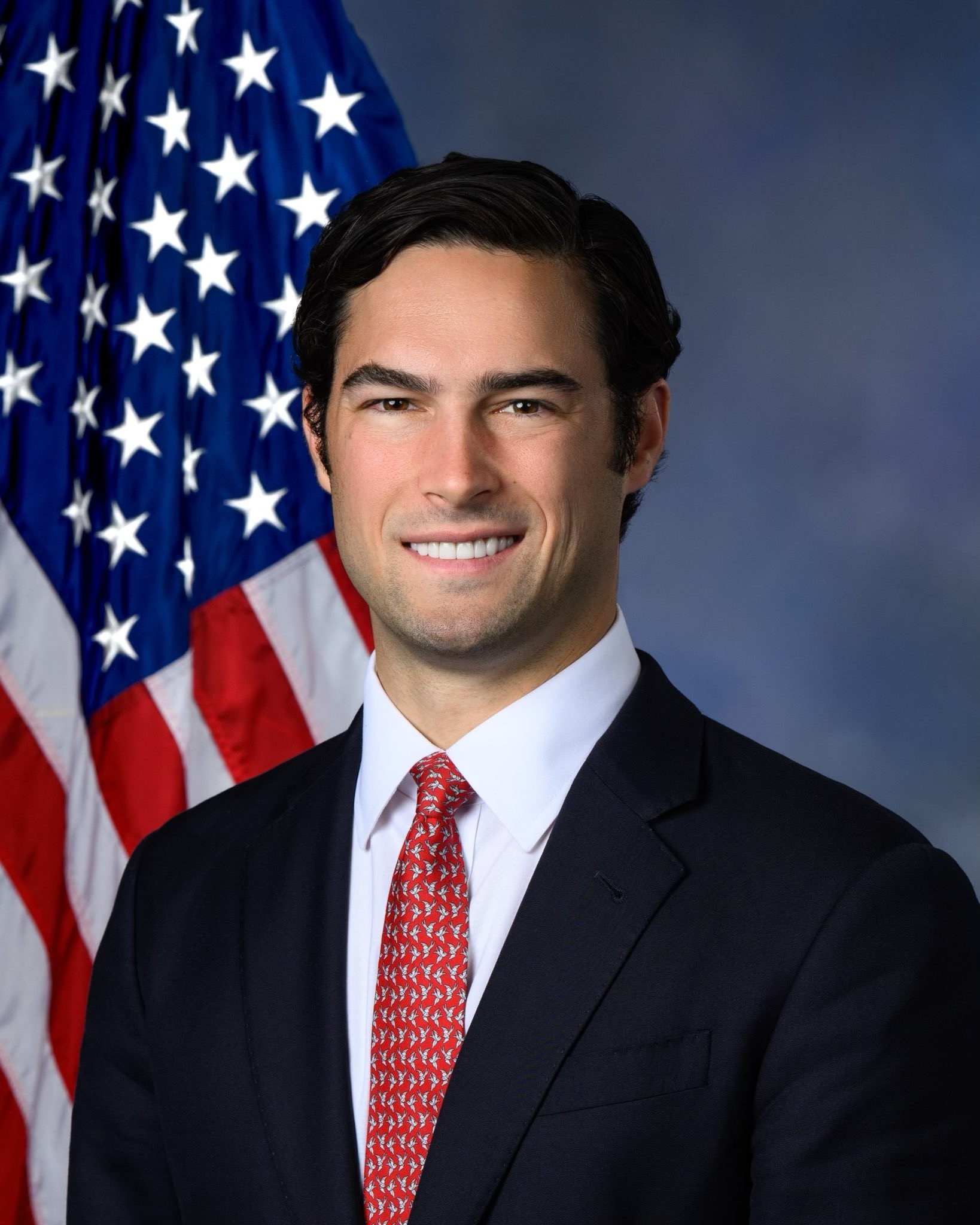
Rep. Brandon Gill, R-Texas, in his official portrait for the 119th Congress, dated Dec. 16, 2024. Gill chaired the House Oversight subcommittee hearing on DEI in law schools and the legal profession. (U.S. House Creative Services, public domain)
House Republicans ran the same argument through Oversight, where Rep. Brandon Gill of Texas told Fox that the ABA has been pushing DEI "for a very long time." Two days before the staff report landed, the Department proposed rewriting Part 602 outright, 82 pages in the Federal Register. Barker put the theory plainly to the Journal: "We have said many times that accreditation, in general, operates like a cartel."
The ABA's answer is not weak
Melissa Hart, who chairs the Council, got the final analysis Friday morning and said so from the podium at the Council's quarterly meeting in Chicago. "Although it is difficult to comment on a recommendation we haven't yet received, we look forward to the opportunity to address any misconceptions and clarify the record," she told the ABA Journal. "The council is confident it complies with the Higher Education Act and with the department's requirements for accreditors."
She is right that this is one step in a routine five-year review. And the same report shows the Council putting Inter American University of Puerto Rico School of Law on probation last September for missing the bar-passage standard since 2020, which is the job the Department says accreditors skip. Washington has cried wolf here before, too: Prof. Ben Barton of Tennessee has documented 17 noncompliance findings in 2011 and a recommended one-year suspension in 2016 the Department declined to impose. Notre Dame's Derek Muller calls the skepticism "nothing new" while granting that permanent removal is "a different threat in kind."
Nothing has been decided. Here is the real calendar.
On September 8 the Council votes on whether to repeal Standard 206 outright. It has been suspended since February 2025 and the suspension runs through August 31, 2027, so no law school's obligations change either way. On August 21 the Council already voted to repeal Standard 303(c), the 2022 rule on bias and cross-cultural competency training, and approved changes trimming Standard 205, both of which go to the House of Delegates in February.
On September 23 and 24 the advisory panel meets at Department headquarters, with Daniel Thies, the Council's immediate past chair, sitting for the agency. Under 34 C.F.R. 602.36 the senior Department official, Under Secretary Nicholas Kent, then has 90 days to decide, and his menu includes continuing recognition while the Council files a compliance report. Under 602.37 the ABA can appeal to the Secretary, which stays the decision. Anyone telling you the ABA lost its accreditation power on Friday is wrong.
The people who could actually get hurt are students at about a dozen schools
Recognition is what makes a school's students eligible for Title IV federal loans and grants. Law schools inside a university would fall back on the university's institutional accreditor. Freestanding law schools have nothing to fall back on. The Department's report counts 13 freestanding ABA-approved schools and says nine independent schools plus one program rely on ABA approval for Title IV; RedState puts it at nine, and Muller's estimate of schools that would genuinely need a new accreditor is two to four.
There is no other federally recognized accreditor for J.D. programs, and Fox Business reported that the administration has not said publicly how those schools would keep aid access. That gap deserves an answer before a decision, not after one. A student who enrolled at a standalone law school did not sign up for a fight over bylaws.
The states are already doing what Washington is only proposing
The ABA's real leverage was never Title IV. It is that most states will only let graduates of ABA-approved schools sit for the bar exam. Texas cut ABA-only approval in January, Alabama cut the Council out of its licensure process, and Ohio and Tennessee are weighing the same move.
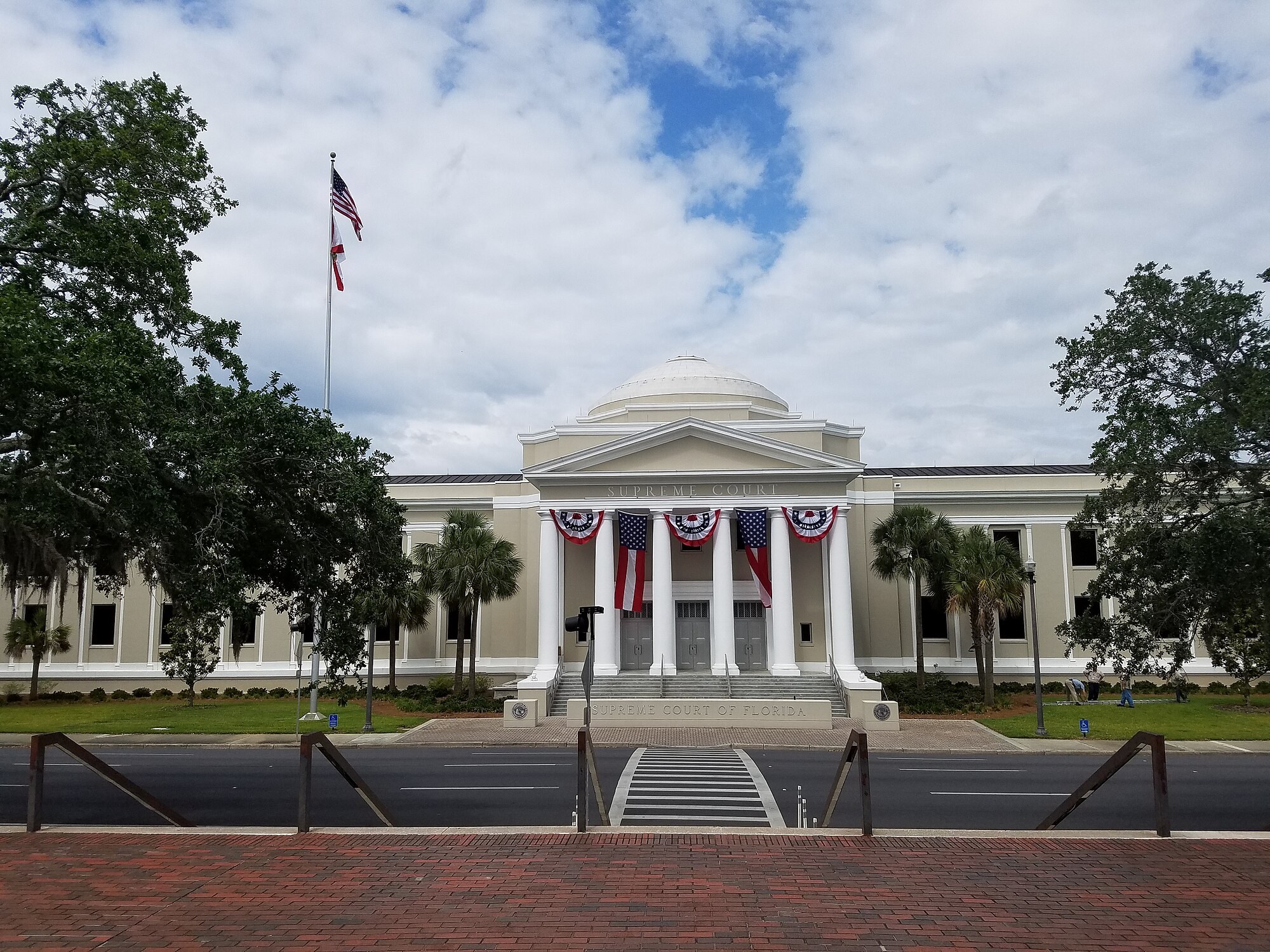
The Supreme Court of Florida in Tallahassee. File photo taken May 9, 2019, when the building was hung with bunting for a justice's investiture. The court ended the ABA's status as sole accreditor for Florida Bar eligibility on Jan. 15, 2026. (Photo by Bruin79 via Wikimedia Commons, CC0)
Florida went furthest. In No. SC2025-2064, decided January 15, 2026 and effective October 1, the state supreme court struck the ABA's status as sole accreditor for bar eligibility, saying its goal was "to promote access to high-quality, affordable legal education in law schools that are committed to the free exchange of ideas and to the principle of nondiscrimination."
Now notice the catch. Under Florida's new rule a replacement accreditor must be "recognized by the U.S. Department of Education" and approved by the court, and the ABA is the only recognized accreditor for law schools. The court said it would canvass the seven institutional accreditors ED does recognize. De-recognize the ABA and Florida's own escape hatch has nobody standing in it yet.
Justice Jorge Labarga dissented, arguing the ABA "has developed incomparable expertise in the accreditation process" across 34 years and that its standards protect students "against predatory admissions and poor programs outcomes."
Break the monopoly, then build the replacement
The case for ending one private trade group's chokehold on who gets to become a lawyer is strong, and the ABA handed the Department its evidence by sitting on Standard 206 for 20 months after the Supreme Court told the country what the law was. Barry Currier, who used to run the ABA's own legal education operation, has argued the Council should just resign its federal recognition, which he says its regulatory function does not need. He may get his way involuntarily.
But a monopoly ends properly when something exists on the other side of it. Right now there is one recognized law school accreditor, one proposed rule meant to create more, and a Title IV cliff for a handful of standalone schools that nobody in the administration has addressed on the record. September 23 is the hearing. The harder work starts the day after.
Header photo: the Lyndon Baines Johnson Department of Education Building, 400 Maryland Avenue SW, Washington, D.C., where the advisory panel will meet on September 23 and 24. Photographed March 21, 2016, by Carol M. Highsmith for the General Services Administration (Library of Congress, public domain).