Tetra Tech EC has paid $57 million to settle Justice Department allegations that it falsified the radiation testing at a former Navy shipyard in San Francisco. The department announced the deal Monday, and the court file tells a harder story than the press release does. A federal judge had already refused to approve that number once, telling the government it had offered "a quarter of a page of bromides" instead of a reason.
What the government says the contractor did
The Navy hired Tetra Tech under contracts issued between 2003 and 2014 to survey the soil and buildings at the former Hunters Point Naval Shipyard and clean up anything still radioactive, so the land could be handed to the City of San Francisco for redevelopment. The base had housed the Naval Radiological Defense Laboratory, where ships exposed to atomic weapons testing were decontaminated after World War II, and it has been on the Superfund list since 1989.
According to the Justice Department's announcement, the government alleged that Tetra Tech instructed field technicians to throw away soil samples taken from potentially contaminated spots, swap in "clean" dirt already known to pass the release criteria, and send the substituted samples to the lab. The government also alleged the company manipulated scan results in its own database so that surveys taken at different places appeared to have been run by the same technician at the same moment.
Prosecutors say the payoff was money the company had not earned: award fees it collected and remediation work it never had to perform. None of that has been tested in front of a jury. The department's own release ends with a single italicized line: "The claims resolved by the settlement are allegations only and there has been no determination of liability."
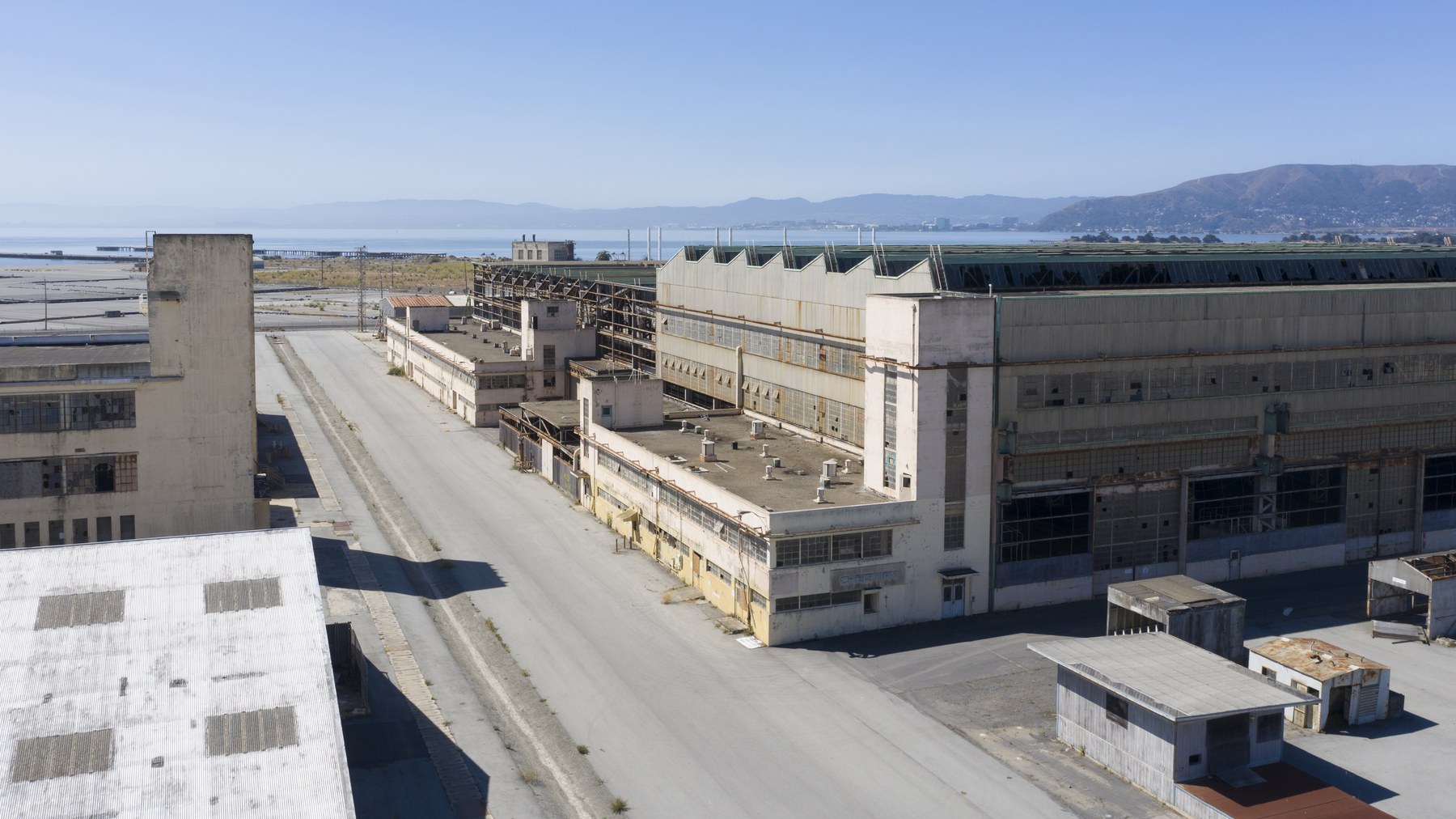
Industrial buildings at the former Hunters Point Naval Shipyard, San Francisco. File photo taken August 3, 2020. (Christopher Michel, Wikimedia Commons, CC BY-SA 4.0)
A federal judge threw the first version of this deal back
Under the False Claims Act, a whistleblower settlement is not final until a district judge signs off that it is "fair, adequate, and reasonable under all the circumstances." On November 7, 2025, Judge James Donato of the Northern District of California declined to do that.
Quoting the Eleventh Circuit, Donato wrote that courts "cannot just rubber stamp the government's justifications," and then said flatly that rubber-stamping was what the government had asked for. It "did not explain in a meaningful way the rationale for entering into this particular settlement, and presented only a quarter of a page of bromides that would apply to any decision to settle a case." He called the gap "all the more striking because it is not at all obvious that the settlement is fair and reasonable in light of radiation remediation concerns and other serious circumstances present in this case."
He gave both sides until December 5, 2025 to file supplemental briefs of up to thirty pages, with declarations and evidence, and warned that skipping any issue he had flagged would count as a waiver. He also struck the whistleblowers' 98-page statement of their own contributions to the case.
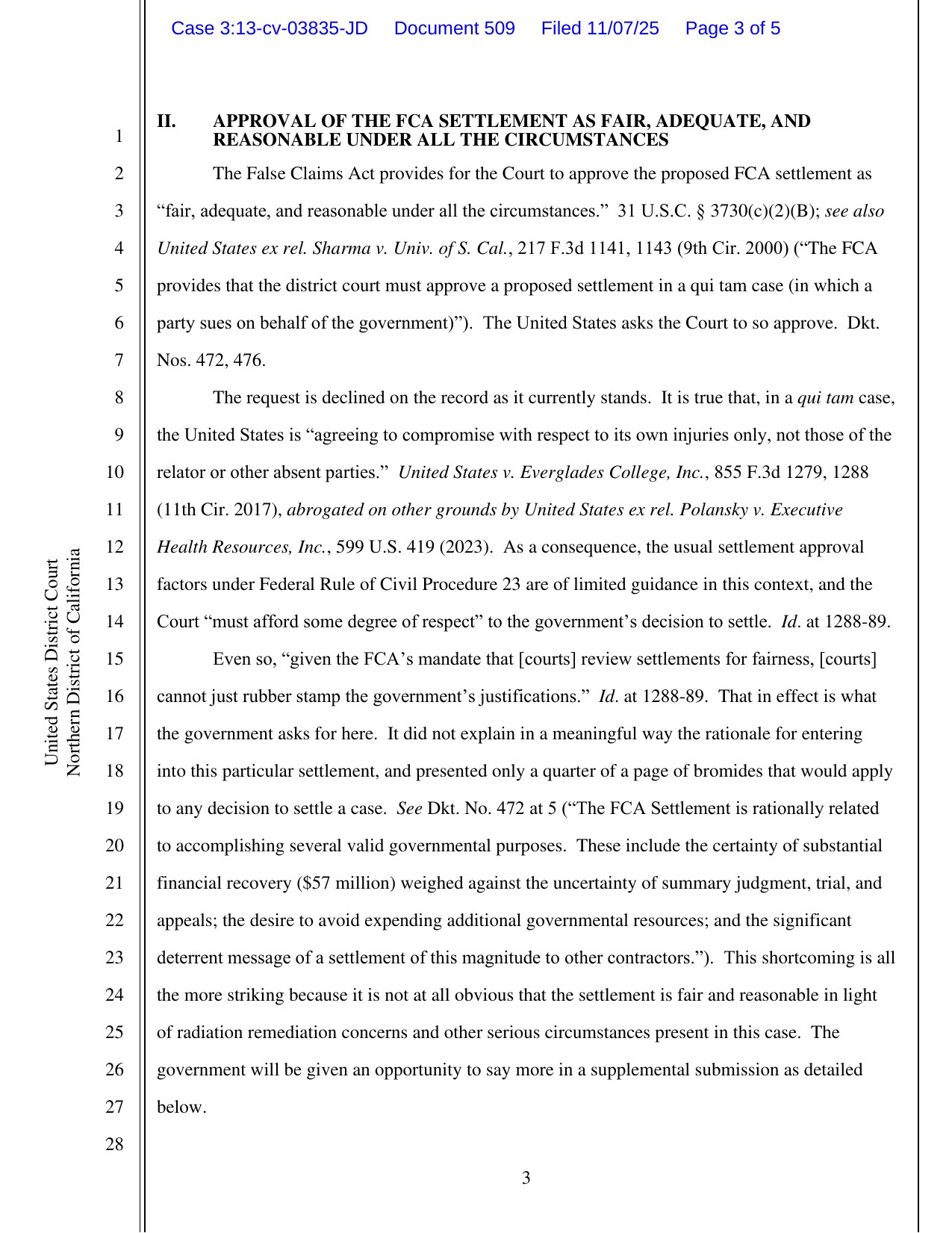
Page 3 of Judge Donato's November 7, 2025 order declining to approve the settlement on the record as it then stood. Docket No. 509, Case No. 3:13-cv-03835-JD (N.D. Cal.). (U.S. District Court filing, public record via CourtListener)
The government argued two of the three whistleblower groups should get nothing
The Justice Department's Monday release says the relators' share is "approximately $11,970,000." What it does not say is that the government fought over who was entitled to it. Seven former Tetra Tech employees and contractors brought the three underlying suits, and the United States intervened in all three of them back in 2018.
When it came time to split the money, the government argued that two of the three whistleblower groups were shut out by the False Claims Act's first-to-file bar, which blocks later relators from recovering on a claim someone else already filed. Donato rejected that. His order notes the government "did not ask to dismiss the Smith and Wadsworth/McLean complaints on this basis, and instead chose to intervene in all three cases," and awards all three groups a share of the 21 percent.
The whistleblowers lost one fight of their own. They argued they were entitled to a cut of the separate $40 million the company paid the Navy under a Superfund consent decree entered in July 2025. Donato said no, because a cost-recovery claim is not the kind of fraud claim the False Claims Act covers.
Official record
United States ex rel. Jahr, et al. v. Tetra Tech EC, Inc., Case No. 3:13-cv-03835-JD, U.S. District Court for the Northern District of California. Docket No. 540, "Second Order re United States' Settlement and Relators' Shares Under False Claims Act," signed by Judge James Donato on August 12, 2026. The full docket is public on CourtListener, and this order is one of the filings available there free.
"The Court has reviewed the settlement for fairness, and on the record as it now stands, finds it appropriate to grant approval. The Court finds that the United States' proposed FCA settlement with Tetra Tech EC, Inc. is 'fair, adequate, and reasonable under all the circumstances.' 31 U.S.C. § 3730(c)(2)(B). No party or person has objected otherwise."
Judge James Donato, Docket No. 540 at 3
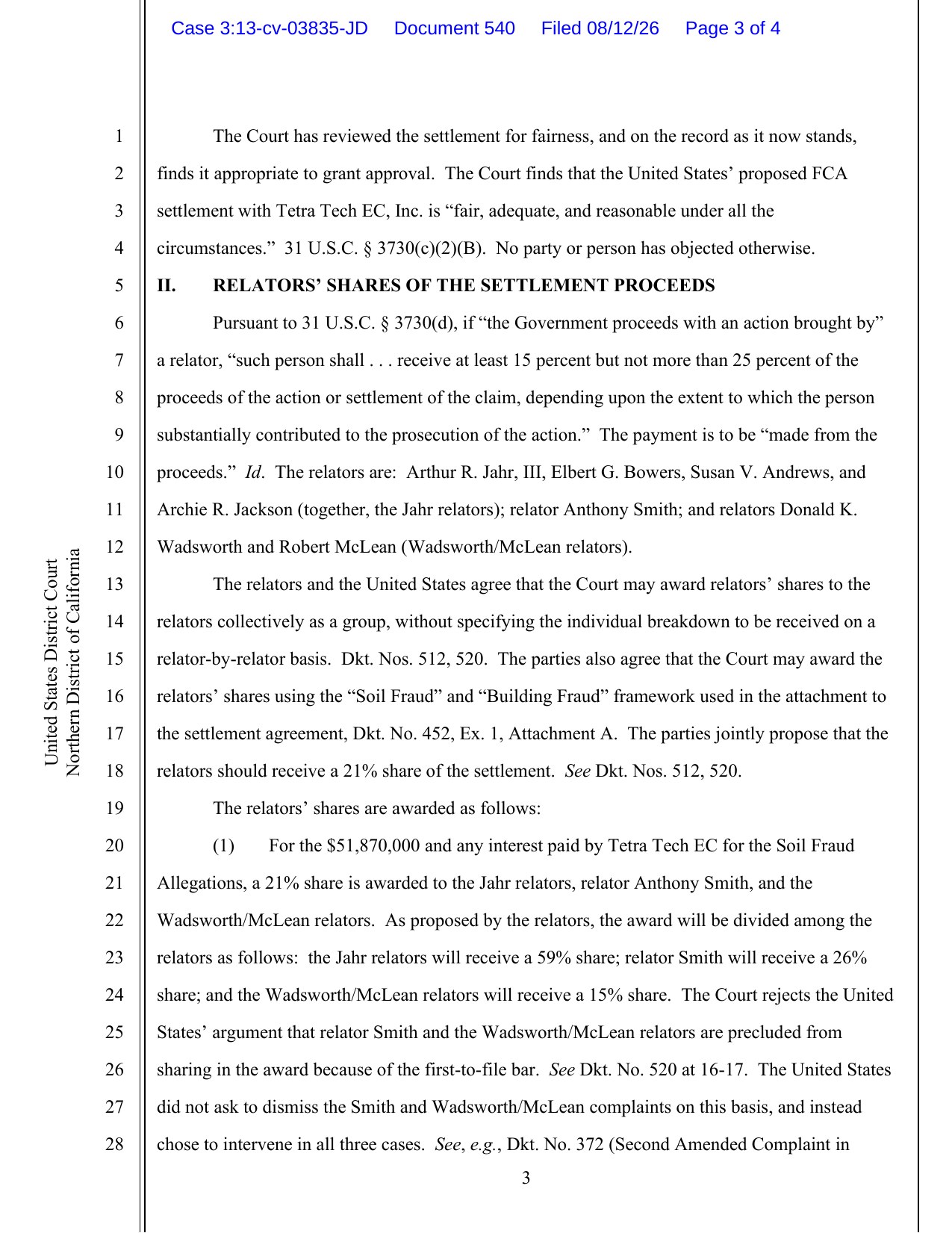
Read or download the full 4-page order (PDF) · the case was terminated the same day it was signed
What has been proven here, and what has not
Two things are settled fact. Stephen C. Rolfe and Justin E. Hubbard, both radiation control technician supervisors at the site, each pleaded guilty in federal court to one count of falsifying records under 18 U.S.C. 1519 and were sentenced to eight months in prison in 2018. Rolfe admitted directing subordinates to fetch clean dirt from outside the marked survey units roughly twenty times in 2012. The judge who sentenced them was James Donato, the same judge who approved this settlement eight years later.
Everything else about the company remains an allegation. Tetra Tech EC did not admit liability, no jury heard the case, and no court has found the corporation liable for anything. A payment is not a verdict, and the size of a settlement is not a measure of guilt. The San Francisco Standard reported that senior managers were named in court filings as partly responsible, but naming someone in a filing is an accusation, not a finding, and none of them has been charged.
The Standard also reported that inspectors found radiological materials and chemical containers in a Navy building on the site this spring, kicking off three new criminal investigations. Those are investigations. No one has been charged, and nobody should be treated as though they had been.
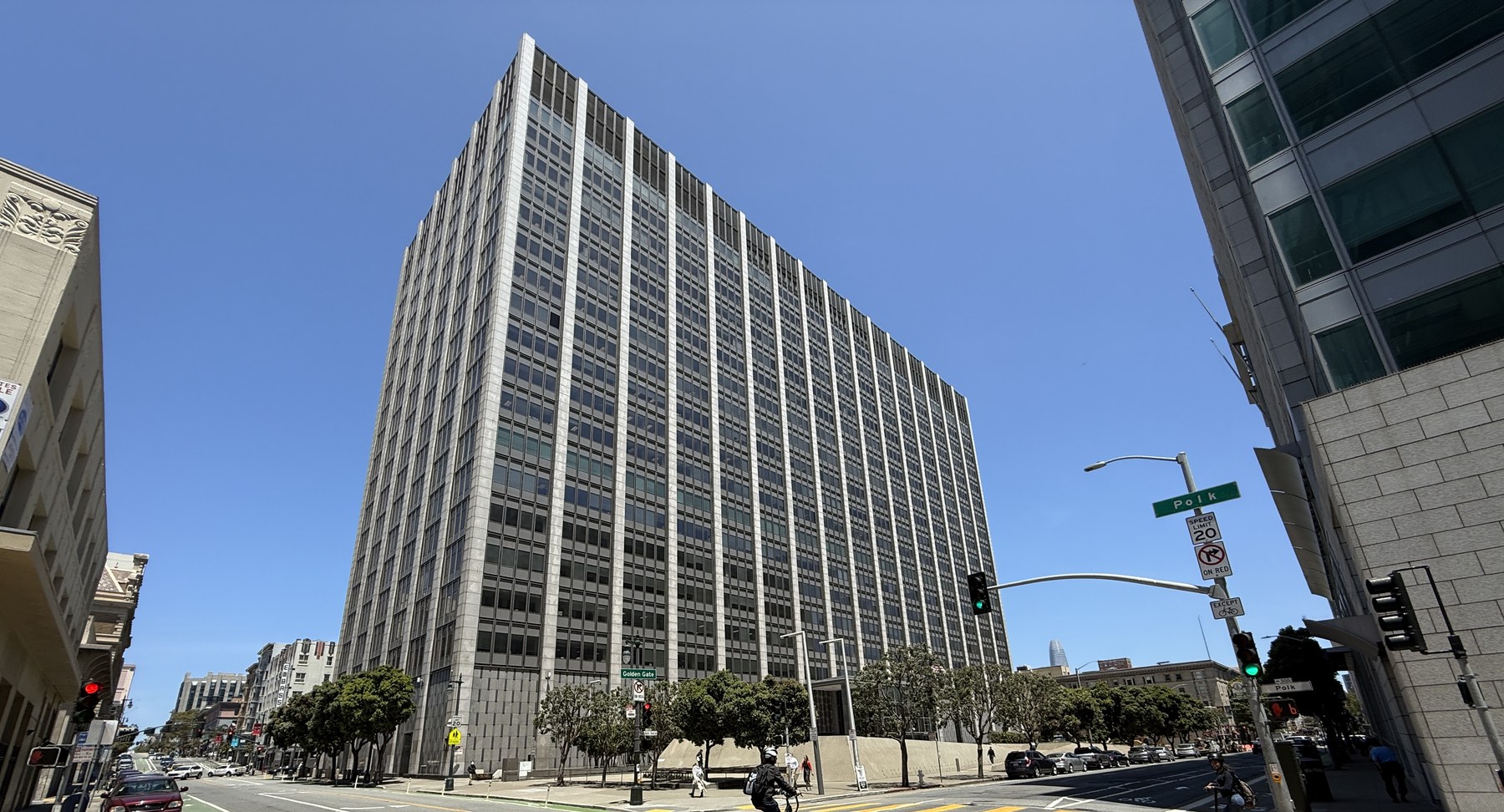
The Phillip Burton Federal Building and United States Courthouse, 450 Golden Gate Avenue, San Francisco, where the Tetra Tech case was heard. File photo taken June 26, 2025. (Marincyclist, Wikimedia Commons, CC BY-SA 4.0)
The $97 million does not buy a finished cleanup
The fraud case is closed. The shipyard is not. The Navy's own base closure program office states plainly that "the Navy and regulatory agencies agree that all Tetra Tech radiological work areas need to be retested." The Navy and the EPA never even agreed on how much of the data was bad, only that all of it had to be redone.
Retesting began with a single parcel in 2018 and is still running. Mission Local reports it may be another decade before the cleanup is finished. The San Francisco Standard reports that an air sample last fall showed plutonium-239 at nearly double the level that triggers a required investigation, and that the Navy did not tell the city for almost a year.
The people who live nearest to it have collected almost none of the $97 million. More than 300 homeowners in the shipyard's one finished residential neighborhood sued over collapsed property values, and Donato threw that case out on August 4, eight days before he approved this settlement, holding that the 1957 Price-Anderson Act permits suits for bodily injury from radiation and not for lost property value. A separate group of about 6,000 residents settled with the company in February for $1.5 million, a minimum of roughly $230 per plaintiff.
DOJ launched a fraud detection center the same day
Hours before the Tetra Tech announcement on Monday, the Justice Department stood up the National Fraud Detection Center, a prosecutor-led team pulling in the FBI, Homeland Security Investigations, IRS Criminal Investigation, FinCEN, the Treasury Department and the inspectors general of a dozen agencies. It sits under the Fraud Division created in April and supports the Task Force to Eliminate Fraud chaired by Vice President J.D. Vance. The stated problem it solves is a lack of cross-program visibility that lets the same bad actors work several federal programs at once without being spotted.
That is a real gap. It is not the gap this case exposes. Nobody had trouble spotting the Hunters Point fraud. The company's own employees reported it, two supervisors confessed in 2017, and the government intervened in 2018. What took thirteen years was everything after detection: the litigation, the settlement, the judge sending the government back to explain itself, and a retesting program that still has years to run. A detection center does not shorten any of that.
It is the same shape as the Medicaid transport indictment out of the Bronx we covered yesterday, where federal auditors had flagged the payment controls twice and the recommended fix was still sitting open when prosecutors finally charged the case. Enforcement is the visible part. The control that would have stopped the money going out the door is the part that keeps not getting fixed.
The number to remember
The government recovered $97 million from a contractor it had paid to certify that a radioactive Navy site was clean, and the seven people who reported the problem are getting a real share of it. It also took thirteen years, a judge who would not sign the first draft, and a retesting bill the taxpayer is still paying. Whether $57 million was the right price for the soil claims is a question the public will never see answered, because the case ended without a trial.
Hero photograph: Hunters Point Naval Shipyard by Christopher Michel, Wikimedia Commons, CC BY-SA 4.0. Taken August 3, 2020.