Federal prosecutors in Manhattan have charged four Bronx men with running a $12 million Medicaid fraud ring behind a charity called the Forward Foundation. The nine-count racketeering indictment, unsealed Thursday, alleges they logged hundreds of fake medical transport rides a week for methadone clinic patients and paid those patients kickbacks in cash and in fentanyl and heroin.
Louis Trejo, 43, Kenneth Garner, 48, Harold Stevenson, 59, and Erihk Belis, 50, are charged with racketeering conspiracy, assault with a deadly weapon in aid of racketeering, firearms use, wire and health care fraud, an Anti-Kickback Statute conspiracy, narcotics conspiracy and money laundering conspiracy. None of it has been proven. Every one of them is entitled to the presumption of innocence, and the case is a long way from a jury.
What the government says the scheme actually was
Medicaid pays for rides to and from clinics, including the methadone clinics that treat opioid addiction. According to the U.S. Attorney's announcement, the four men allegedly recruited Medicaid-eligible patients from clinics in the Bronx and Manhattan, signed them up for reimbursable rides, then entered their names into cellphones loaded with the ride-tracking app real drivers use to log real trips.
No one was actually driven anywhere, the government says. To make the logs survive a look, prosecutors allege the group ran a GPS spoofing app on the same phones to fake the pickup and drop-off coordinates. The indictment puts the output at hundreds of fabricated rides per week, fed to New York-area transportation companies that billed Medicaid off the data.
The patients were allegedly paid to keep lending their identities. The indictment says the kickbacks were weekly, in cash, in drugs, or both, and it names fentanyl and heroin specifically. That is the allegation that takes this out of the paperwork-crime category. If the government proves it, the people whose Medicaid numbers generated the billing were the same people being handed opioids by the men billing for their addiction treatment.
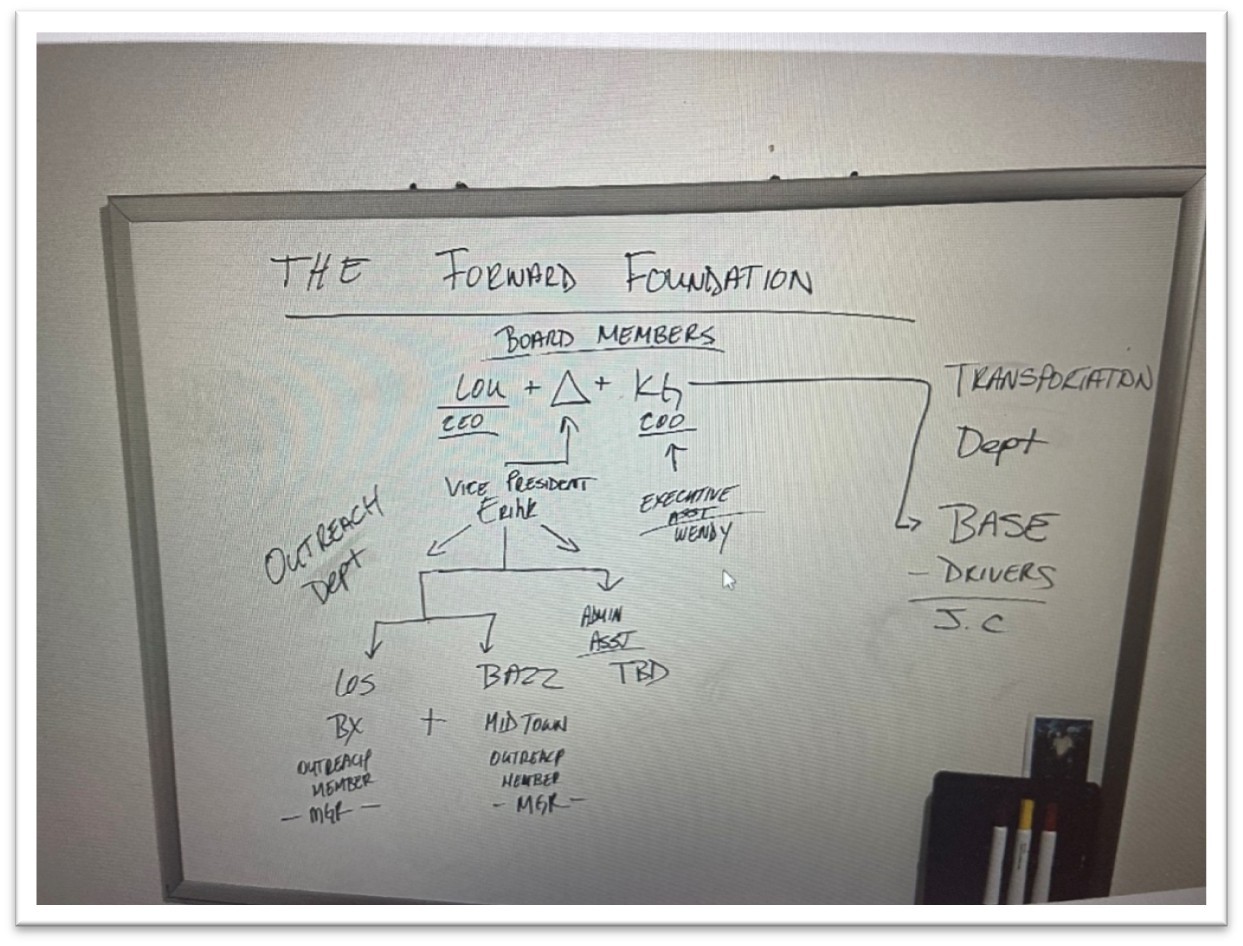
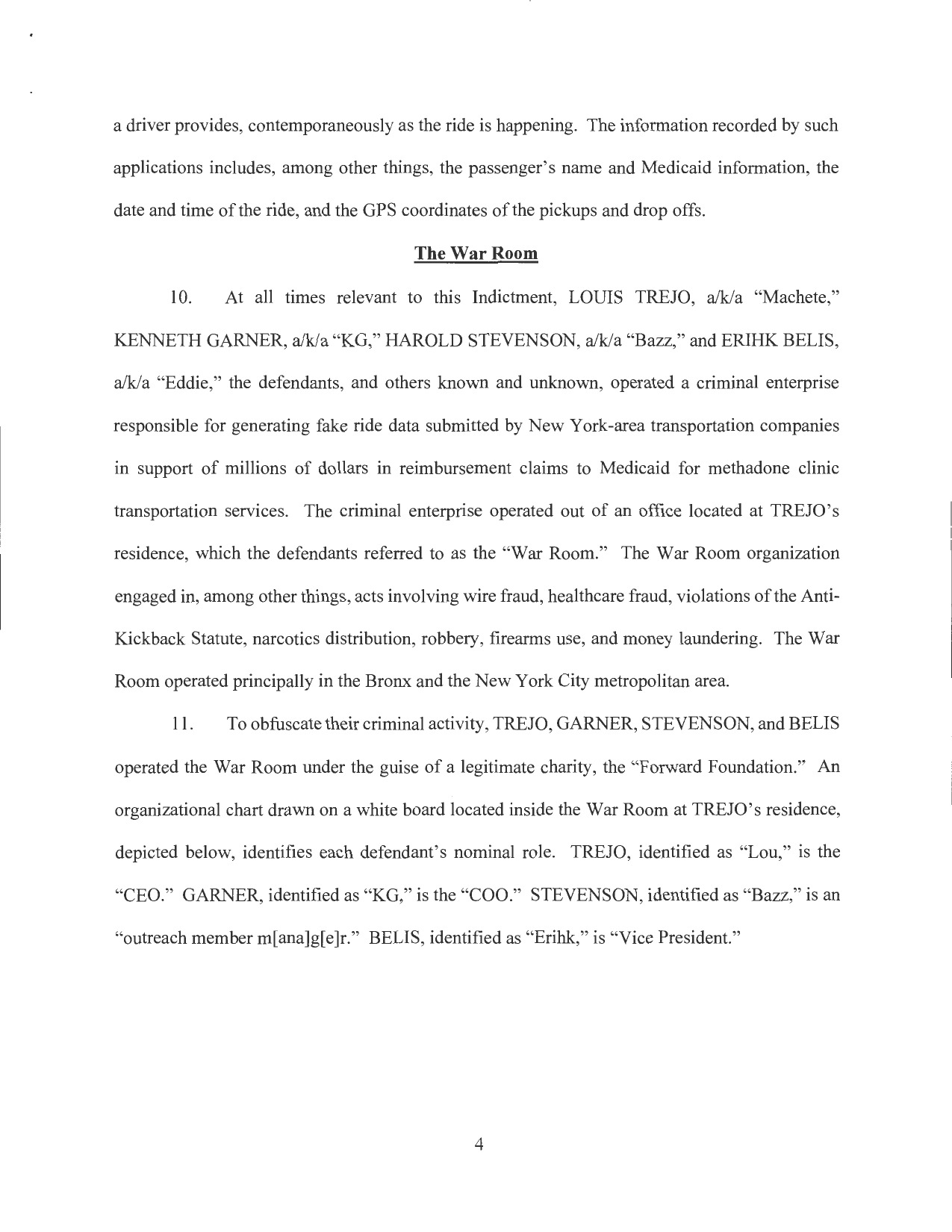
The whiteboard organizational chart federal prosecutors say was hanging inside the room at Louis Trejo's residence that the defendants called the War Room. It is headed "The Forward Foundation, Board Members" and assigns titles including CEO, COO and Vice President. Evidence photograph released with the Aug. 20, 2026 indictment. (U.S. Department of Justice, public domain)
Was the Forward Foundation ever a charity at all?
That is the detail that will stick with people. Prosecutors allege the enterprise operated under the cover of a nonprofit, and they quote its own 2023 tax records, which the indictment says Trejo prepared, back at it: the Foundation purportedly "provide[s] resources, support, and assistance to individuals in need as well as develop[s] programs and raise[s] public awareness related to affordable housing and social programs."
Inside the room at Trejo's residence that the men allegedly called the War Room, agents photographed a whiteboard. Per the indictment, "Lou" is CEO, "KG" is COO, "Erihk" is Vice President and "Bazz" is an outreach member manager. There is a Transportation Department and an admin assistant slot marked TBD.
Read the indictment yourself
Why the Justice Department reached for RICO instead of just fraud charges
Health care fraud is usually a wire fraud and false claims case. What pushed this one into racketeering territory is what prosecutors say happened when the money got contested. The indictment alleges that multiple fraud rings were competing for the same patients at the same clinics, and that in October 2023 Trejo and Garner decided to rob one of their competitors.
The government says they handed a crew a tracking device, told them to stick it on the rival's car, and followed him for weeks. On Jan. 12, 2024, per the indictment, masked men with a gun entered a home in Teaneck, New Jersey, tied up the occupants with zip ties and held them at gunpoint for hours. They allegedly expected to find millions in cash and drugs. They allegedly left with about $25,000.
Two things are worth saying plainly about that. One, the man identified as Victim-1 is described by prosecutors as the leader of a rival Medicaid fraud ring, and he has not been charged in this case. Two, none of the alleged violence has been tested by cross-examination. The firearms count carries a mandatory minimum of seven years if the government proves it, and that count is charged against Trejo and Garner only.
Where the case actually stands right now
Trejo, Garner and Belis were arrested the morning of Aug. 20 and were expected to be arraigned that day before U.S. Magistrate Judge Robert W. Lehrburger in Manhattan. The Daily Signal reported that all three were arraigned Thursday. Stevenson was still at large as of the department's announcement. The case is assigned to District Judge John G. Koeltl.
No plea has been publicly reported for any of the four. No one has been convicted, and no one has received any sentence. The numbers circulating in coverage of this case, up to and including life in prison on the racketeering count, are statutory maximums Congress wrote, not outcomes, and the Justice Department said so in its own release.
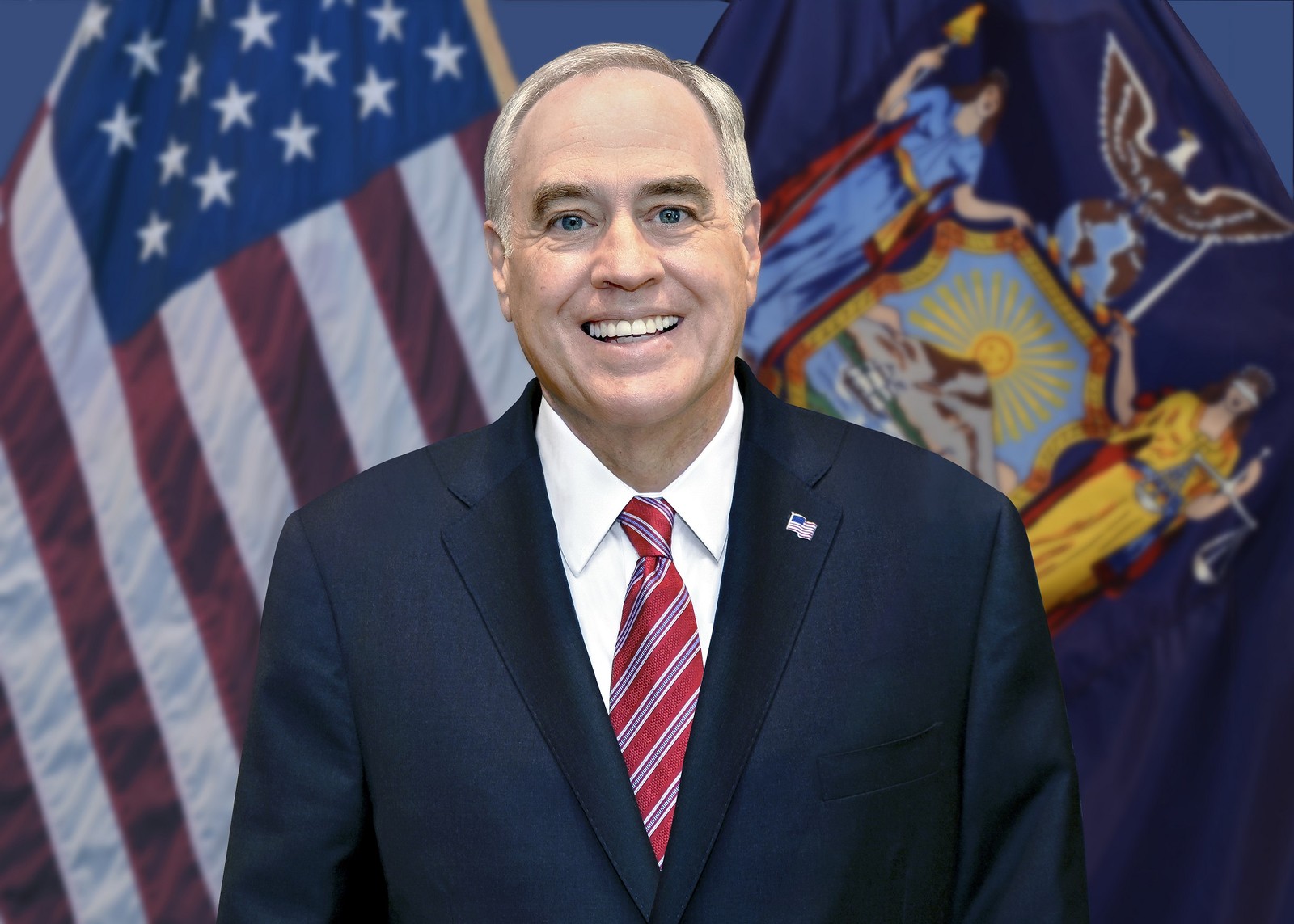
New York State Comptroller Thomas P. DiNapoli, whose office worked the case with federal investigators. Official headshot dated July 21, 2020. (Office of the New York State Comptroller, CC BY-SA 4.0, via Wikimedia Commons)
Auditors mapped this exact hole in 2011, then again in 2022, and it is still open
Here is the part that should bother taxpayers more than the indictment does. The vulnerability these men allegedly exploited was not a secret. The HHS Office of Inspector General audited New York City's Medicaid ride program in 2011 and found major deficiencies in the state's oversight. New York said it would build a quality assurance program.
OIG came back and checked. Report A-02-21-01001, issued September 2022, sampled 100 payments out of 4.77 million made to New York City transportation providers in 2018 and 2019. Seventeen of the 100 complied with federal and state requirements. Forty-one did not and were unallowable. For the other 42, auditors could not tell either way. Extrapolated, that is $84.3 million New York improperly claimed and another $112 million it may have improperly claimed.
Auditors recommended New York refund the $84.3 million. As of this week, that recommendation is still listed as open and unimplemented, with a status update due Dec. 5, 2026. Four years after the report, and roughly fifteen years after the first warning, the money has not come back. New York State Comptroller Thomas P. DiNapoli, whose office helped build the criminal case, said the defendants "allegedly engaged in a systematic fabrication of data and kickbacks to steal over $12 million at the expense of New Yorkers in need."
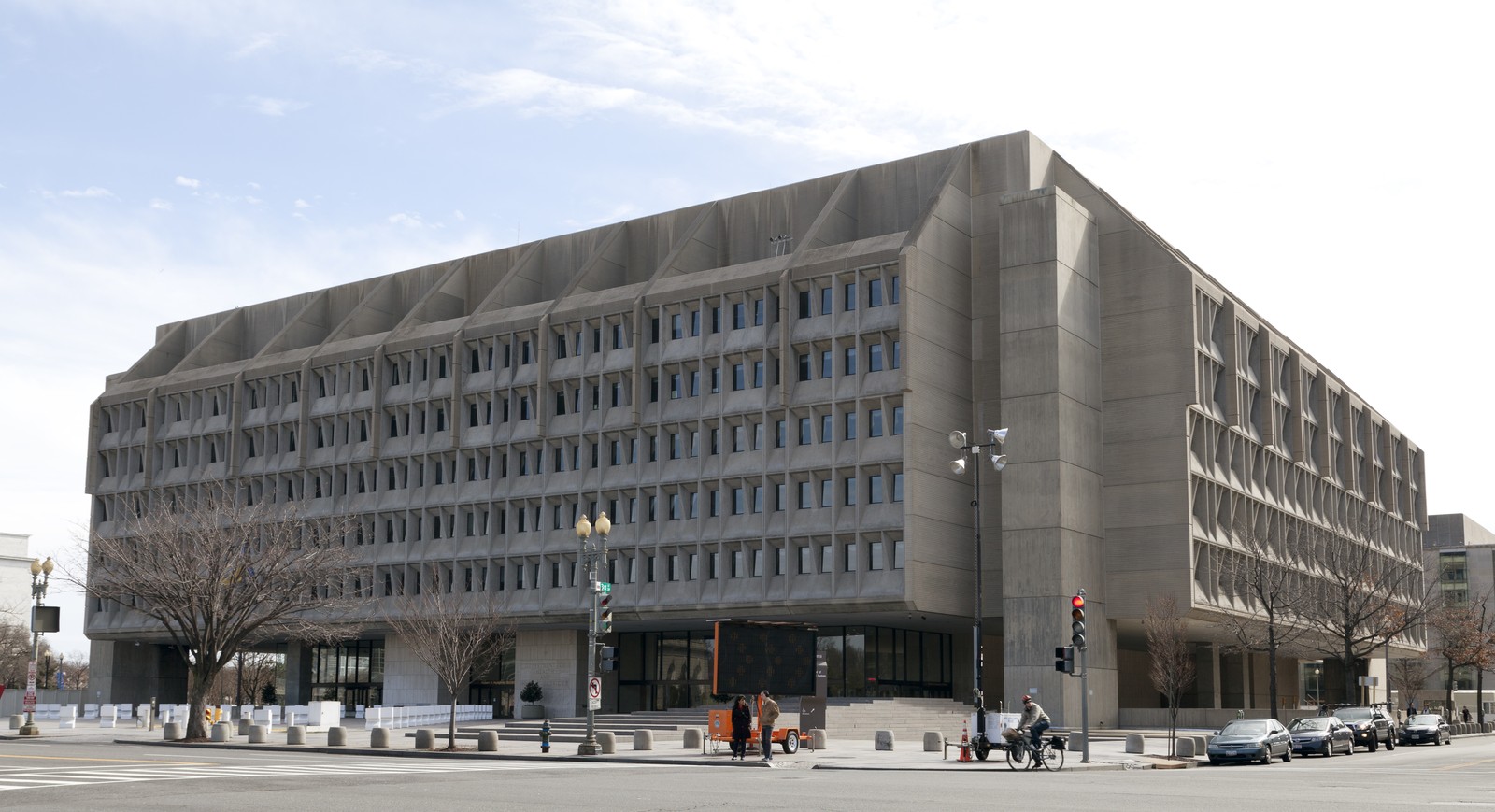
The Hubert H. Humphrey Building in Washington, headquarters of the Department of Health and Human Services, whose Office of Inspector General flagged New York City's Medicaid ride program in 2011 and again in 2022 and worked this criminal case. File photo. (Carol M. Highsmith, Library of Congress, public domain)
The companies that actually billed Medicaid are not charged
Read the indictment closely and a gap opens up. The four defendants are accused of manufacturing the ride data. The entities that took that data and submitted the claims are identified only as Transportation Company-1, Transportation Company-2 and Transportation Company-3. They are not named. They are not charged. Prosecutors say those three companies paid the War Room nearly $2 million between November 2023 and September 2025, routed through bank accounts held by an LLC in Stevenson's name, then moved through a network of LLCs and nearly a dozen accounts.
The $12 million figure in the headline is the total the three companies allegedly submitted in "unmatched" claims, meaning rides billed on days when no medical provider billed for treating the patient. That is a mismatch a computer can catch. The claims went through anyway.
This is what the new enforcement architecture was built to catch
The case did not come out of nowhere. Trump signed Executive Order 14395 in March 2026, creating a Task Force to Eliminate Fraud chaired by Vice President JD Vance, and the Justice Department stood up a National Fraud Enforcement Division on April 7. In June, that machinery produced a national takedown of 455 defendants over $6.5 billion in alleged fraud, including 295 Medicaid defendants and $518 million in Medicaid claims, which the department called its largest Medicaid haul ever.
U.S. Attorney Jamie McDonald put this week's arrests in the same frame: "Today's arrests dismantled the War Room's racketeering operation and demonstrate that we will relentlessly pursue those who defraud federal benefit programs and endanger our communities through drugs and violence." Townhall picked up the case on Aug. 22.
Good. Prosecute it, prove it in front of a jury, and let the sentence follow the evidence. But an indictment is a symptom, not a cure. A scheme like the one described here does not work unless the payment system on the other end waves through hundreds of rides a week that no doctor's visit corresponds to. Federal auditors documented that failure in New York, in writing, twice. The $84.3 million they asked for is still sitting on the open-recommendations list. Four arrests in the Bronx do not change that line item.
Header photo: the Daniel Patrick Moynihan United States Courthouse at 500 Pearl Street in Manhattan, home of the U.S. District Court for the Southern District of New York, where the case is assigned to Judge John G. Koeltl. Photo by Ken Lund, CC BY-SA 2.0, via Wikimedia Commons.