Congress already voted twice to avoid an October shutdown. The only thing left unsettled is whether the next funding deadline falls on December 4 or December 11. Both chambers moved before the August recess, and the two versions still have to be reconciled before funding runs out September 30.
Two bills, two dates, and neither one is law
The House went first. On July 21 it passed H.R. 9770, the Continuing Appropriations Act, 2027, an 18-page stopgap carrying current spending to December 4, 2026. The Clerk's roll call shows 220 to 205, with Republicans at 213 to 1. The lone Republican no was Thomas Massie of Kentucky.
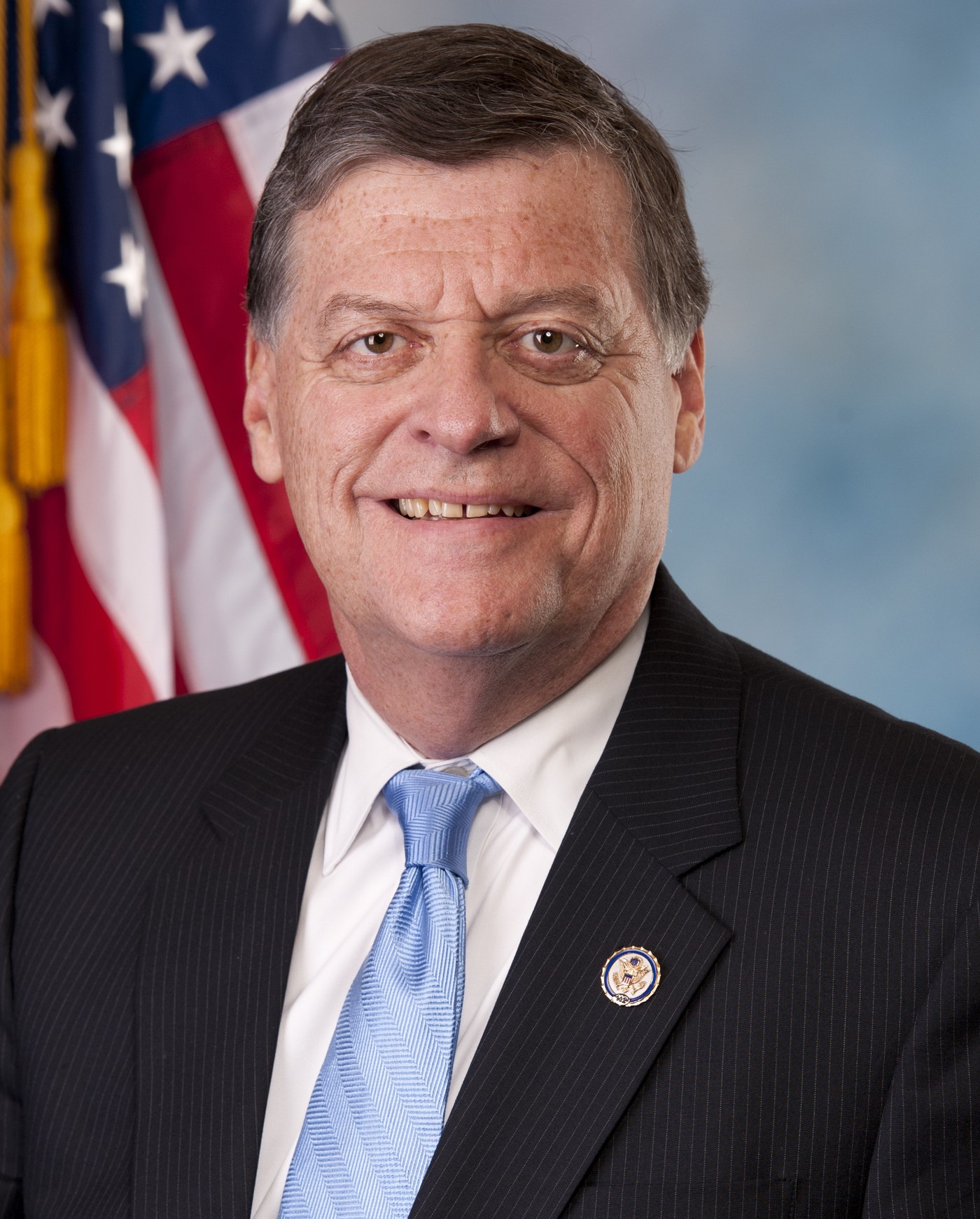
Rep. Tom Cole, R-Okla., chairman of the House Appropriations Committee, who wrote and moved the December 4 stopgap. Official House portrait, file photo, 112th Congress (U.S. House of Representatives, public domain, via Wikimedia Commons).
Cole framed the early vote as a refusal to play chicken. "Too many members in Congress mistake a cliff's edge for political leverage," he said in the committee's own release. "There is no virtue in waiting until every option has disappeared before deciding to act."
The Senate never took up that bill. It reached instead for H.R. 6500, a bill the House passed in January to extend duty-free treatment for imports from certain African countries and to extend customs user fees. Appropriations Chair Susan Collins of Maine offered a substitute striking everything after the enacting clause and inserting 58 pages of continuing appropriations. The Senate passed that 90 to 6 at 3:37 in the morning on August 8, with Rand Paul and Bill Cassidy the Republican no votes.
Official record
H.R. 6500, Engrossed Amendment as Agreed to by Senate, 119th Congress, August 8, 2026. The operative date sits in Section 106, on page 6 of 58, hosted by the U.S. Government Publishing Office.
"Appropriations and funds made available and authority granted pursuant to this Act shall be available until whichever of the following first occurs ... (3) December 11, 2026." — H.R. 6500 EAS, Sec. 106
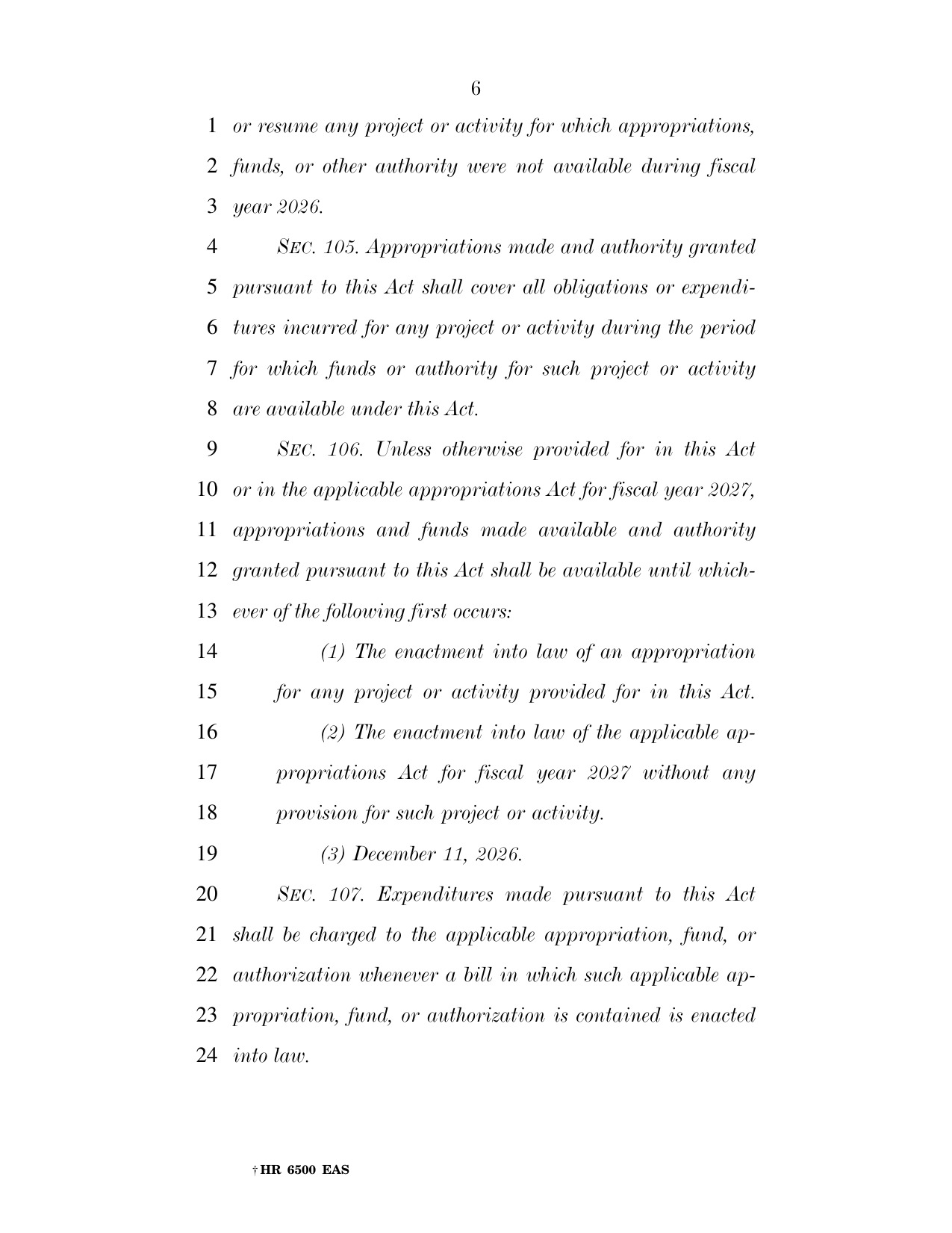
Read or download the full 58-page Senate-passed text (PDF) · view the same document on govinfo.gov
Why an October shutdown was never really on the table
Fiscal 2026 was a disaster and every appropriator knows it. By the Committee for a Responsible Federal Budget's count the government shut down three times: 43 days from October 1 to November 12, 2025, the longest lapse in modern history; a short one from January 31 to February 3; and a Homeland Security shutdown running February 14 to April 30. Full-year fiscal 2026 funding was not done until April.
Collins said the quiet part on the floor. "After three unnecessary lapses in funding during the fiscal year 2026 cycle, putting the possibility of yet another harmful shutdown off the table should be a priority for each and every one of us," she said in remarks her committee posted. She has a second reason. She is on the ballot for a sixth term, she is the only Senate Republican from a state Kamala Harris carried in 2024, and hers is the seat Democrats need most. An October shutdown with the Appropriations gavel in her hand is the worst hand anyone could deal her.
Is either December date realistic?
Not for twelve individual spending bills. All twelve fiscal 2027 bills have cleared the House Appropriations Committee. Three have passed the House floor: Military Construction and Veterans Affairs 400 to 15 on May 15, Agriculture 213 to 210 on June 4, National Security and State 217 to 209 on July 15. In the Senate, as of CRFB's August 12 update, the count reported out of committee is zero, and so is the count passed on the floor.
The House committee puts the blame in one sentence: "Senate Democrats have prevented any FY27 appropriations movement in the upper chamber." Cause aside, the arithmetic is fixed. Nine House bills and all twelve Senate bills would have to clear both chambers across a stretch that includes an October most members intend to spend campaigning. CRFB dates the last fiscal year that opened with every bill enacted to 1997.
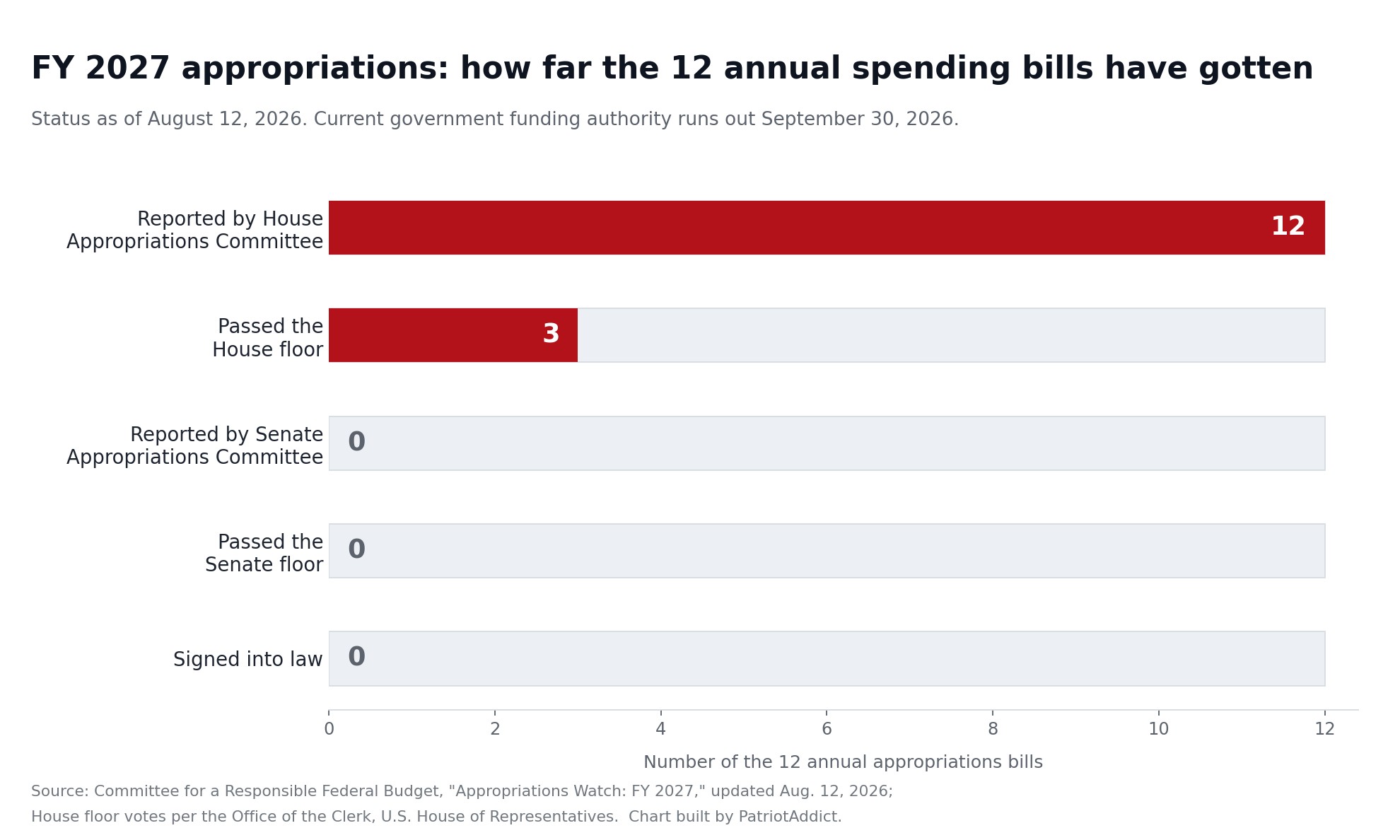
Where the twelve annual fiscal 2027 spending bills actually stand, as of August 12, 2026. Chart built by PatriotAddict from the Committee for a Responsible Federal Budget's Appropriations Watch tracker and House floor votes recorded by the Clerk of the House.
So who gains from December 4, and who gains from December 11?
Start with what they share. Election Day is November 3, and both land after it. The Congress voters replace, or re-elect, is the same Congress that writes the December bill in a lame duck. Neither party proposed a date that puts this argument in front of voters first. That is the part worth being cynical about.
The seven days cut in opposite directions. December 4 leaves roughly three weeks before Christmas; December 11 leaves about two. The closer a funding cliff sits to the holidays, the stronger the hand of whoever holds a finished package and can wait, historically the appropriators. House Republicans put the objection in writing: "House Republicans do not support end-of-the-year, pork-filled omnibuses." Cole's date leaves more room to move bills one at a time.
December 11 fits the Senate's actual pace. Vice Chair Patty Murray of Washington was direct about the runway. "I'm ready, as ever, to use the time this CR provides to reach a reasonable bipartisan topline funding agreement," she said in her committee remarks. A chamber sitting at zero of twelve needs every week it can get.
The extra week buys policy, not just time. Per Roll Call's account of the talks, the Senate text freezes the Office of Management and Budget's proposed grants rule until December 11, closes what Democrats call a loophole allowing more money to move to Border Patrol, and drops the $1 billion the White House wanted for Trump-class battleships. Murray said the rule "is delayed; it is not dead," and added, "I absolutely intend to kill it." Those restrictions die with the CR, so the date is the expiration date on the leash.
The September fight is about hemp, not the calendar
What is actually waiting for House leadership is Section 2019 of the Senate text, which delays until December 11 a ban on intoxicating THC-infused hemp products otherwise taking effect November 12. House Freedom Caucus Chairman Andy Harris of Maryland, who chairs the Agriculture appropriations subcommittee, wrote that ban into law last year with Mitch McConnell.
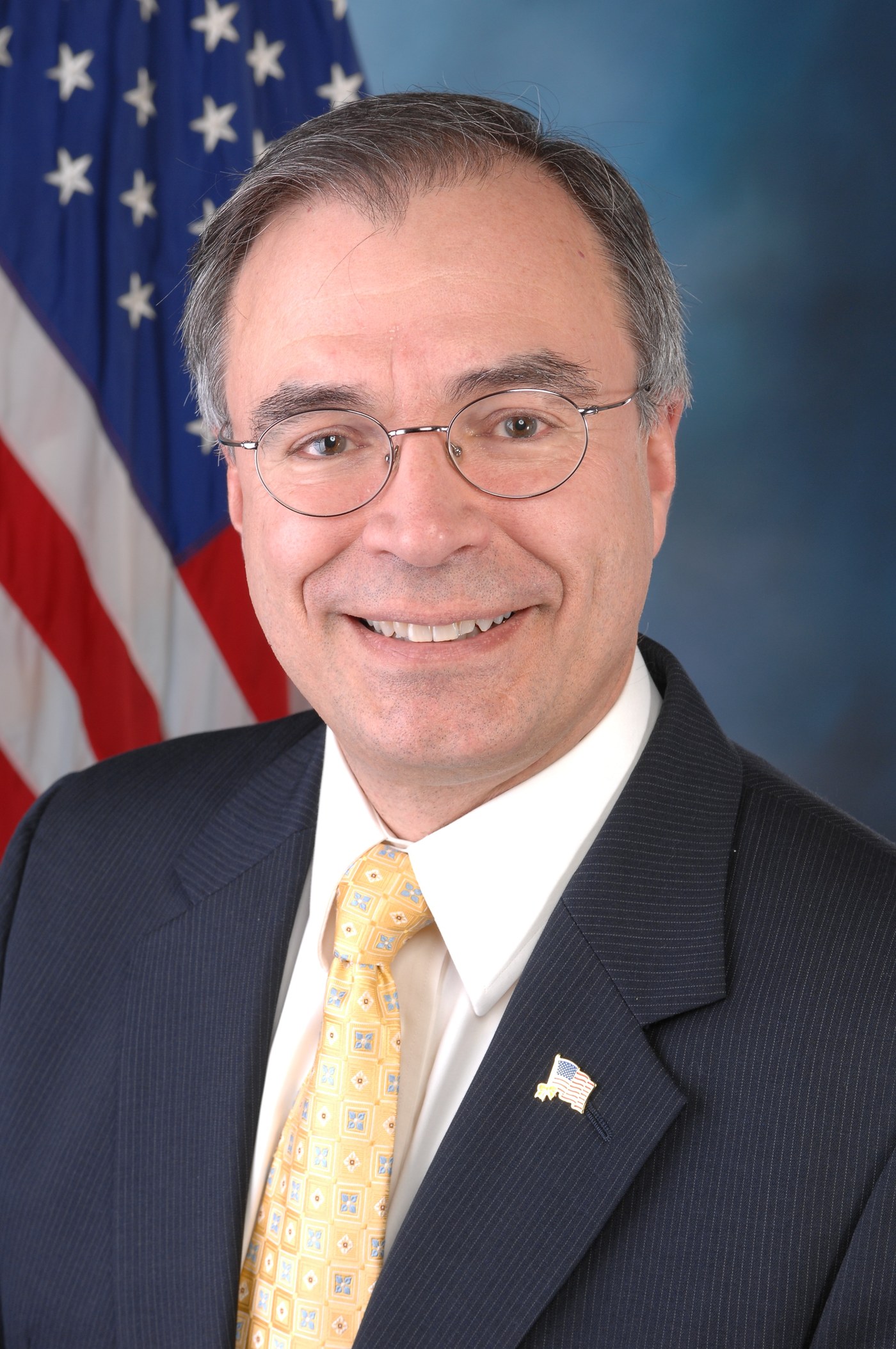
Rep. Andy Harris, R-Md., House Freedom Caucus chairman and chairman of the Agriculture appropriations subcommittee, who has said he will fight the Senate stopgap's hemp provision. Official House portrait, file photo, 112th Congress (U.S. House of Representatives, public domain, via Wikimedia Commons).
Harris has not said he will vote the stopgap down, but he has been loud. "Let's be clear: these are not harmless hemp products," he wrote on X in a post quoted by Roll Call on August 24. He has company. When Ted Budd of North Carolina moved to strike the delay, the Senate tabled his amendment 61 to 32, with 21 Republicans voting to keep the fight alive.
That leaves Speaker Mike Johnson two bad options. A rule requires a party-line vote hemp holdouts can sink, and allowing an amendment to strike the delay bounces the bill back to a Senate that has gone home. Suspension clears that hurdle but needs two-thirds, so Democratic votes. Rep. Morgan Griffith of Virginia put it plainly: "If the Democrats decide to oppose the stopgap spending measure across the board, then there are probably enough 'no' votes to take that out."
What actually happens on October 1 if nothing passes
Mandatory spending keeps running. Social Security, Medicare and Medicaid are not funded by annual appropriations, so checks go out, though CRFB notes that services with a discretionary staffing component, such as benefit verification, have stalled in past lapses. Immigration and border personnel got mandatory funding in the One Big Beautiful Bill Act of 2025 and would likely keep being paid.
Everywhere else, agencies furlough non-excepted staff and order excepted employees to work unpaid. Both groups are guaranteed retroactive pay once funding resumes, under the Government Employee Fair Treatment Act of 2019. Contractors have historically gotten nothing. Air traffic control and TSA screening continue without paychecks, which is how the 2018-19 and 2025 lapses became airport delays. None of it saves money either: the Congressional Budget Office put last fall's 43-day shutdown at $11 billion in lost real GDP.
The vote nobody is taking
Here is what should bother a spending hawk more than the date. A continuing resolution carries last year's numbers forward without asking whether any of it should be spent. As CRFB puts it, a CR keeps funding programs the President's budget proposed eliminating. Congress is not choosing between spending levels. It is choosing not to choose.
That is the same machinery behind the number this site covered days ago, when the national debt blew past $40 trillion and Budget Chairman Jodey Arrington started talking about Article V. Autopilot funding is not a rounding error on that trajectory. It is the mechanism. Every stopgap locks the prior year's baseline in as the new floor, and the real decisions land in a December package written under deadline pressure.
The honest read on the Collins-Murray deal is that it is competent work removing a real risk of a fourth shutdown in twelve months, and that it removes any chance voters weigh in before the money is decided. Both are true at once. When the House returns it will argue about hemp gummies and seven calendar days. Whichever date wins, the number that keeps moving is the one nobody is voting on.
Hero image: Sen. Susan Collins, R-Maine, center, and Sen. Patty Murray, D-Wash., arrive for a Senate Appropriations Committee budget hearing on April 10, 2024. File photo by the U.S. Department of Homeland Security, public domain, via Wikimedia Commons.