The national debt crossed $40 trillion on Aug. 18, and House Budget Committee Chairman Jodey Arrington says Congress has already proven it will not fix it. So he is asking the states to do it instead, through a constitutional convention the country has never once convened in 237 years.
What Treasury's own ledger actually says
This is not an estimate or a think tank projection. Treasury's Debt to the Penny report recorded total public debt outstanding at $40,047,425,768,420.22 on Aug. 18, 2026. The day before, it was $39.99 trillion. On the same date in 2017, it was $19.85 trillion.
That is a doubling in nine years. The most recent trillion took about five months to pile up, according to NPR, which noted the debt had only passed $39 trillion in mid-March.
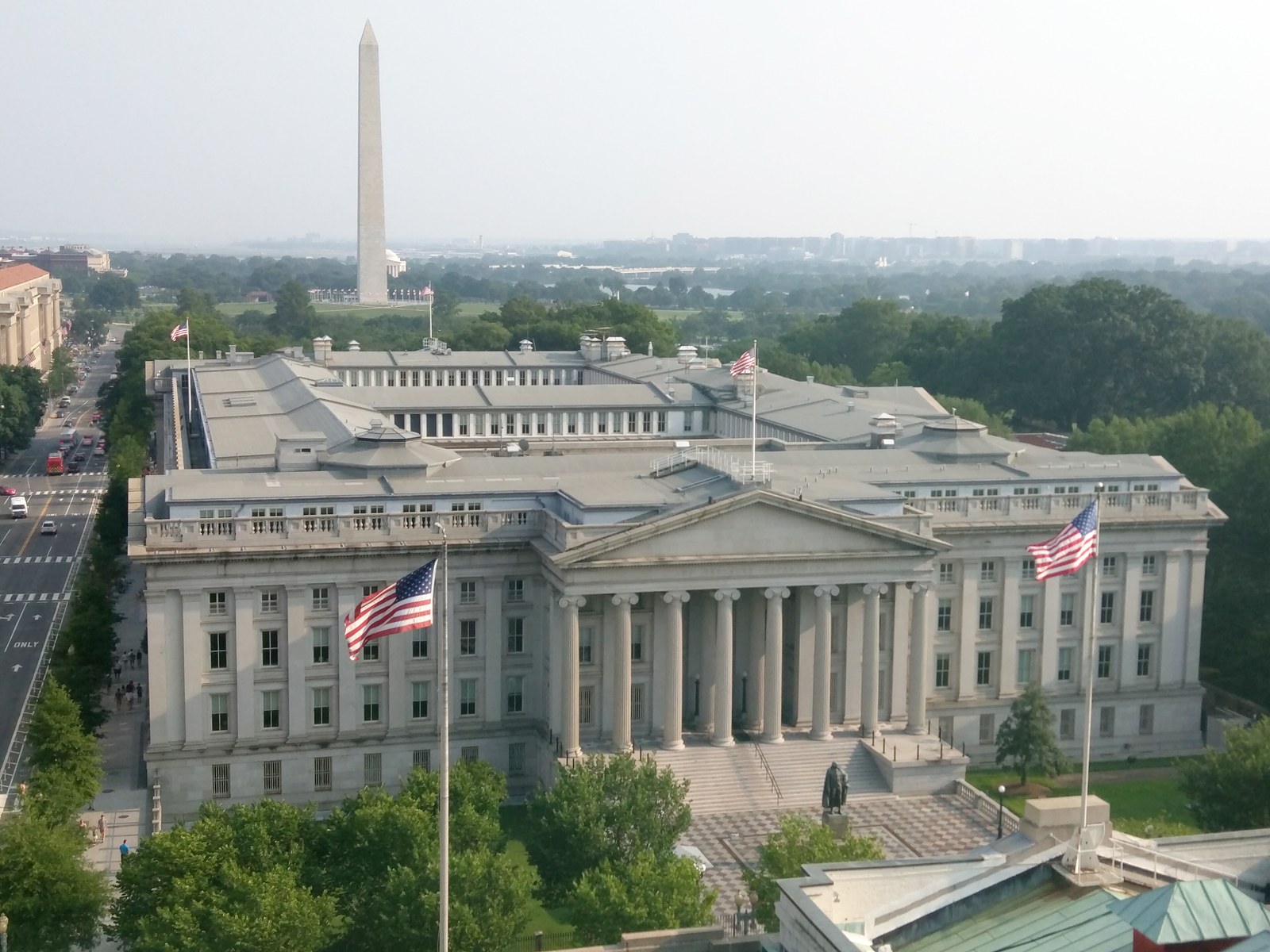
The Treasury Department in Washington, whose daily Debt to the Penny report logged the $40 trillion crossing on Aug. 18. (Photo by MeanieHyaena, Wikimedia Commons, CC BY 4.0)
Six billion dollars a day, and half of it is just interest
Arrington put the daily number in his statement: the federal government borrows roughly $6 billion every day, and more than half of that is interest on money already borrowed. He said that interest bill is now larger than the entire national defense budget.
Outside scorekeepers land in the same place. "We've borrowed an astounding $1.8 trillion this fiscal year, with $431 billion in the month of July alone, and equating to nearly $6 billion per day," Maya MacGuineas of the Committee for a Responsible Federal Budget told Fortune. "We're on track to surpass $2 trillion in borrowing this fiscal year despite not being in a recession. That is not normal."
Interest is now the government's second-largest expense, behind only Social Security, NPR reported. Net interest costs in the first 10 months of this fiscal year ran $117 billion higher than the same stretch last year, a 14 percent jump, per CBO's Monthly Budget Review.
What an Article V convention would actually do
Article V gives the states a second route to amend the Constitution, one that does not run through Congress at all. If the legislatures of two-thirds of the states apply, currently 34, Congress must call a convention to propose amendments. Anything that convention proposes still has to be ratified by three-fourths of the states, currently 38, according to the Congressional Research Service.
It has never happened. CRS records that the closest the country ever came was the balanced budget amendment push of the 1970s and early 1980s, which collected 32 state applications and stalled two short of the threshold. Arrington argues that campaign actually cleared the bar and Congress simply ignored it, which is a contested reading, not a settled fact.
He tried the ordinary route first. On March 18 he took the House floor for H.J.Res.139, a balanced budget amendment, and told his colleagues what he expected to happen to it. "Here's another, stunning and startling for some, but for all a sobering fact: we won't even get a simple majority vote today," he said, per his own office's transcript. "Both parties have failed. This institution has failed."
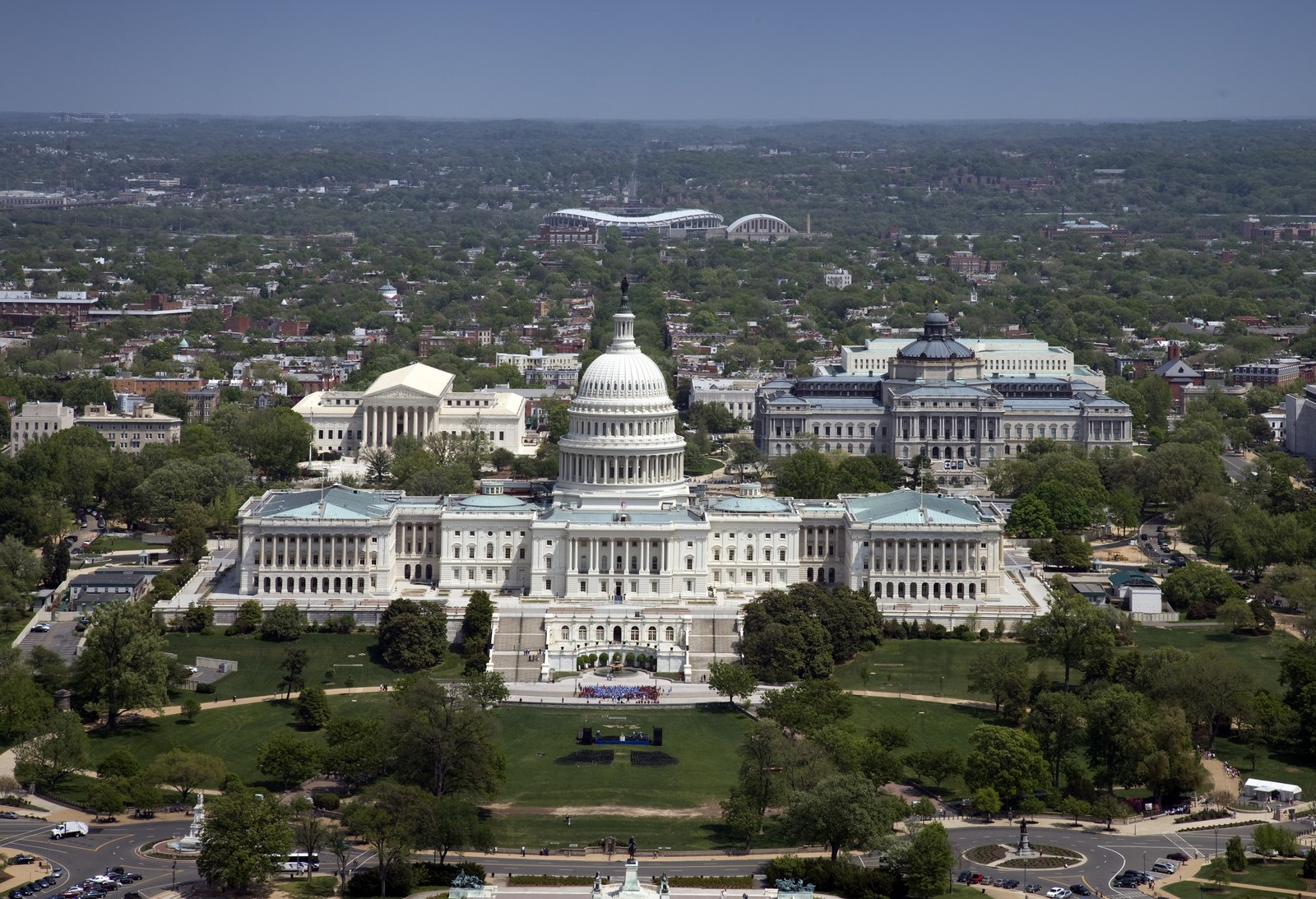
The U.S. Capitol. Arrington told the House in March that the institution "has not mustered the political will" to rein in its own spending. (Photo by Carol M. Highsmith, Library of Congress, public domain)
The part conservatives should say out loud too
Some of this year's acceleration is self-inflicted by the right. On Feb. 20 the Supreme Court ruled that the International Emergency Economic Powers Act does not give a president tariff authority, wiping out the revenue stream the administration had been counting on as an offset. CRFB estimates the decision cuts revenue by $1.9 trillion and adds $2.4 trillion to the debt through 2036.
The bill is already coming due. CBO now puts the fiscal 2026 deficit at $2.1 trillion, up from the $1.9 trillion it forecast in February, with tariff and customs collections running $250 billion below projection, Fortune reported. In July the government refunded $36 billion in duties while collecting only $26 billion. Roughly $100 billion has been paid back so far on tariffs the Court found were collected without legal authority.
Nor is tariff money the whole story. The Congressional Budget Office estimates the One Big Beautiful Bill will add $4.2 trillion to the debt through fiscal 2034. Social Security, Medicare and Medicaid outlays are up a combined $181 billion this fiscal year. Corporate income tax receipts fell $89 billion, or 23 percent.
And the rot predates this administration by decades. The federal government has run a deficit in every one of the past 24 fiscal years, CRFB notes. Michael Peterson of the Peter G. Peterson Foundation put it plainly to CBS News: "Many administrations and many Congresses have taken steps in the wrong direction." The White House, for its part, blamed the last one. "President Trump pledged to clean up Joe Biden's fiscal mismanagement," spokesman Kush Desai told NPR. Debt as a share of GDP has still gotten worse since January 2025.
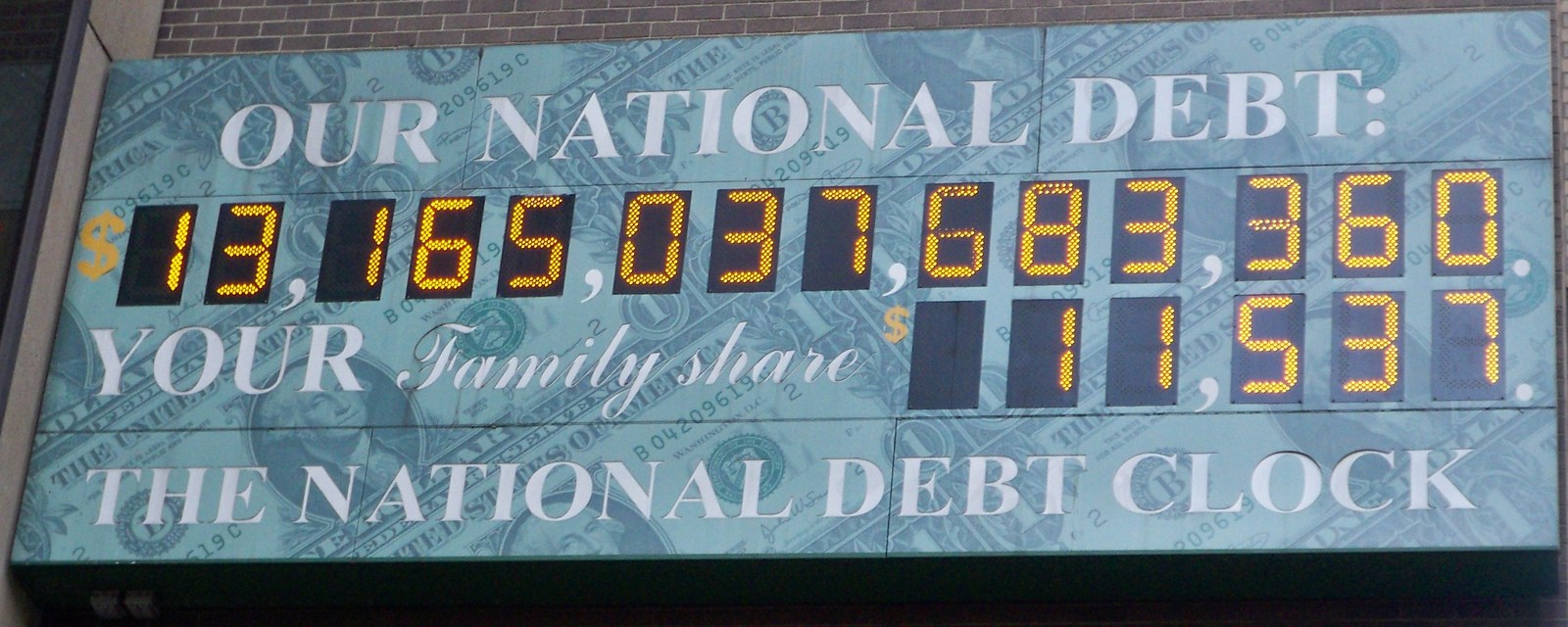
The National Debt Clock in Manhattan, photographed in July 2010, when it read $13.1 trillion and put the family share at $11,537. The debt has roughly tripled since. (Photo by Matthew Bisanz, Wikimedia Commons, CC BY-SA 3.0)
What $40 trillion costs a family that never voted for any of it
Here is where the abstraction stops. The yield on 30-year Treasurys hit a 19-year high this week, and the average 30-year mortgage rate neared 6.7 percent, according to Freddie Mac. Those two things are connected, because when Washington has to pay more to borrow, so does everybody else.
"If the Treasury rate is going up, that means your mortgage rate is going up, your car loan is going up, your credit card rates are going up," Peterson told CBS News. He calls the second effect "crowding out," where the interest bill eats so much of the budget that every other program gets squeezed and taxes get pushed up to cover the gap.
Margaret Spellings, who runs the Bipartisan Policy Center, was blunter. "Federal debt is already raising the cost of living and choking out other spending and investment, threatening our economy and Americans' long-term prosperity," she told NPR.
The next deadline is already on the calendar
The One Big Beautiful Bill Act raised the statutory debt limit by $5 trillion last July, to $41.1 trillion. At the current pace, some analysts expect that ceiling to be reached in 2027, CRFB says. Gross debt is now around 126 percent of GDP, within striking distance of the all-time record set in 2020.
Arrington's proposal is a real constitutional mechanism with a real threshold, and 34 legislatures is a long way from a press release. But he is right about the thing that makes it necessary. Congress had a balanced budget amendment on the floor five months ago and could not deliver a simple majority for it, and the debt added another trillion dollars while members went home for August.
"$40 trillion should be a wake-up call. But neither Congress nor the president have a credible plan to stop it from growing," said Carolyn Bourdeaux of Concord Action, quoted by NPR. "We owe the next generation better than this crushing debt and another hollow promise that someone else will deal with it later."
If Washington will not stop borrowing $6 billion a day, the only people left with standing to make it stop are sitting in 50 state capitols. Arrington just handed them the invoice.