An Alabama federal jury ordered The New York Times to pay $9.25 million to a former Alabama walk-on it falsely placed at the scene of a deadly shooting. The verdict landed Thursday night in Tuscaloosa after a nine-day trial, and by the paper's own account it is the first defamation case The Times has lost in this country in more than half a century.
What the jury actually decided
The eight-person jury came back at roughly 4:45 p.m. Thursday after a little more than five hours of deliberation, Tuscaloosa Patch reported from the courthouse. Jurors found The Times at fault on both of Kai Spears' claims: defamation, and false light invasion of privacy.
The award breaks down heavily toward punishment. Roughly $7.5 million of the $9.25 million is punitive damages, per Patch. Spears' lawyers had asked for $15 million total. "They were chasing a headline at the expense of a child," Tuscaloosa attorney Matt Glover told jurors in closing arguments, according to Patch's account of the closings.
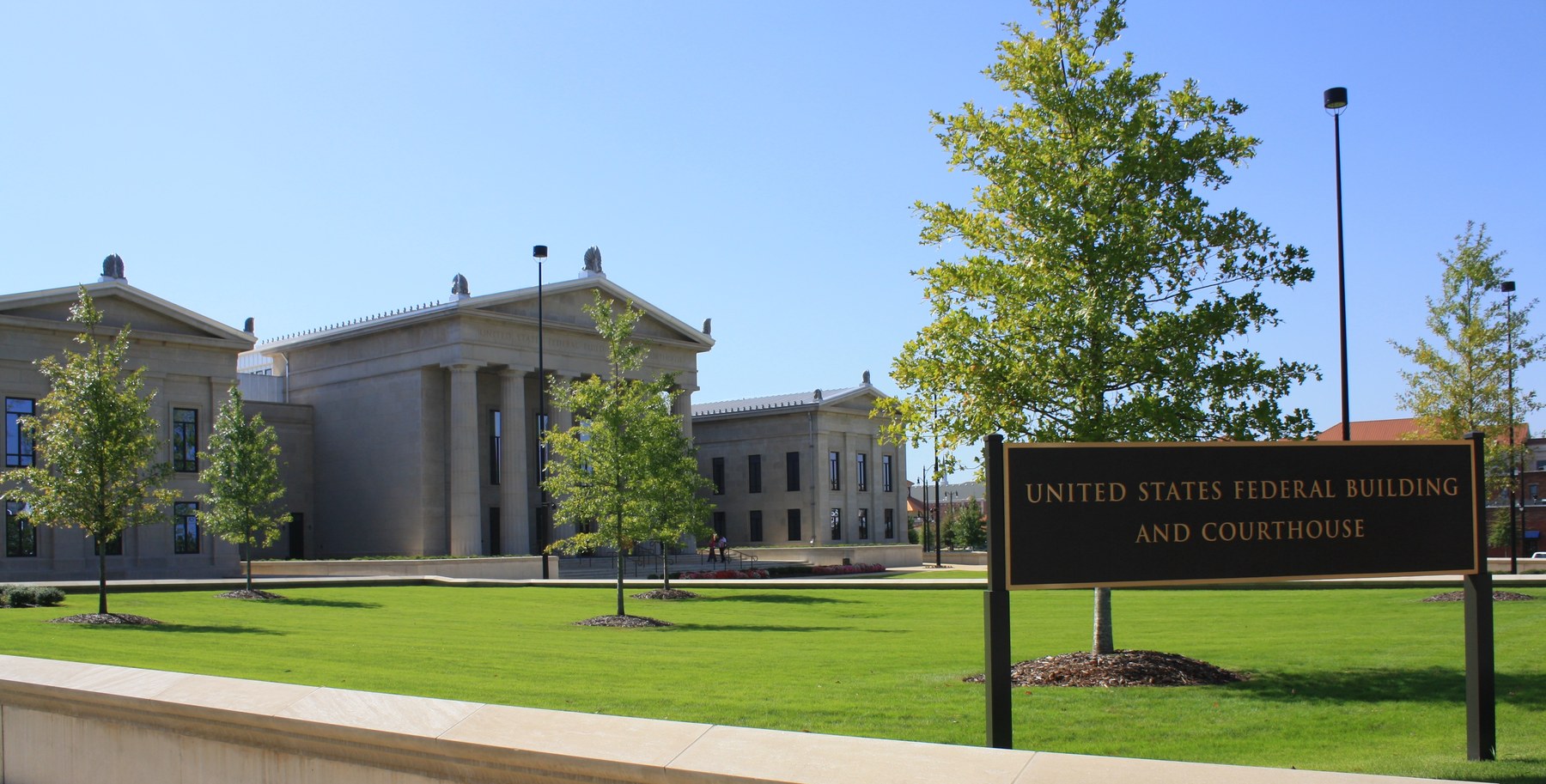
The federal courthouse in Tuscaloosa, where the nine-day trial was held in the Western Division of the U.S. District Court for the Northern District of Alabama. (Photo by Wikimedia Commons user Deutschlandreform, CC BY-SA 3.0)
The story that put a freshman walk-on at a murder scene
On March 15, 2023, The Times published an article by sportswriter Billy Witz headlined "A Fourth Alabama Player Was at a Deadly Shooting, in a Car Hit by Bullets." It reported that Spears, then an 18-year-old freshman walk-on for the Crimson Tide, was a passenger in teammate Brandon Miller's car at the scene when 23-year-old Jamea Harris was shot and killed near campus on Jan. 15, 2023.
He was not there. The other person in the car was Cooper Lee, a student manager for the team, and Spears was several blocks away in a different vehicle when the gunfire started, Fox News Digital reported. That is not a contested point anymore. It is what The Times itself eventually printed.
One anonymous source, and a correction that took months
Witz built the passage on a single anonymous source he met in Tuscaloosa the morning the story ran. He testified the source was a "high-level person, professional," and told jurors that "Source A, by their job title and by virtue of their access to the transcript, videos and impound photos, was somebody who knew a lot about this case," Patch reported from his testimony.
A second anonymous source was vaguer still. That person told Witz, "I can tell you it's a white guy on the basketball team, I just don't remember his name," per Witz's own testimony as reported by Fox News. Witz apologized to Spears from the witness stand and conceded, "Yes, [the story] had a mistake, no question," while maintaining he followed the paper's standards for anonymous sourcing.
The correction did not come quickly. The Times ran a lengthy editor's note in June 2023, after Spears had already sued. "The original version of this article, published March 15, misidentified the person who was in the car with [Crimson Tide star player] Brandon Miller when the shooting occurred," the note begins. It goes on to acknowledge that Alabama's athletic director and Spears' father both denied he was present, that The Times reviewed its reporting anyway, and "did not conclude that any other change to the article was warranted at that time."
The paper also fought hard to keep those sources secret. The Alabama Supreme Court ruled this year that the state's shield statute protects only information that would inevitably reveal a confidential source, not anything that might conceivably lead to one, as Courthouse News reported. That narrowed the ground The Times could stand on before trial ever started.
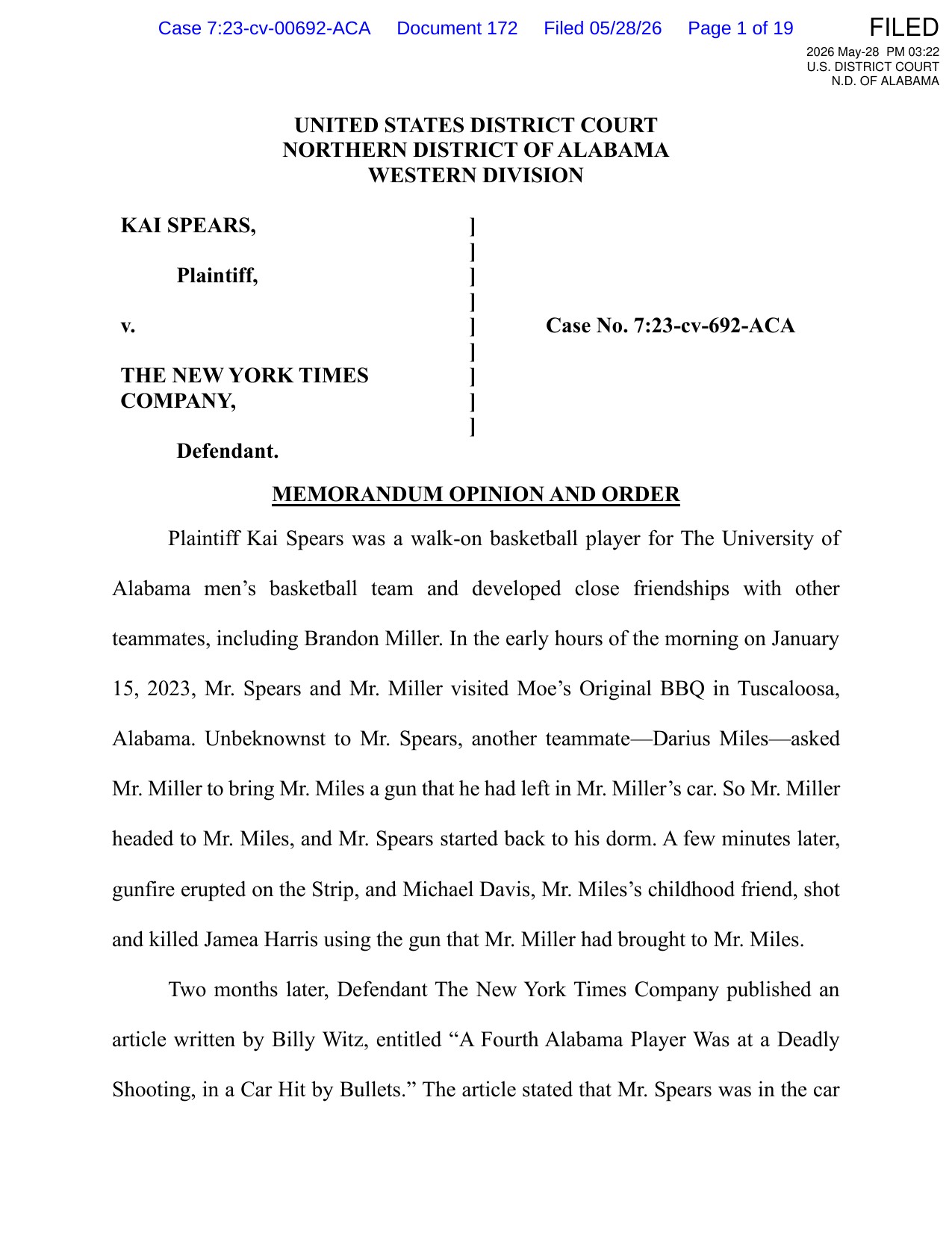
Spears and his father did not sound like people who wanted money
"I first want to thank God for the outcome," Spears told Patch minutes after the verdict. "It's been a long journey to get to this point and I'm grateful to the jury for awarding this case in my favor. My hope is that we all lead with love and always seek the one constant truth in this life."
His father, Christian Spears, was blunter about what it took to get there. "Our goal was a simple retraction from The New York Times," he told Patch. "Instead, the Times defended its inaccurate article and continued to distort facts rather than acknowledge the harm they caused, acting as if its power made it untouchable. The Alabama jury made it clear to the New York Times that they were wrong to do what they did."
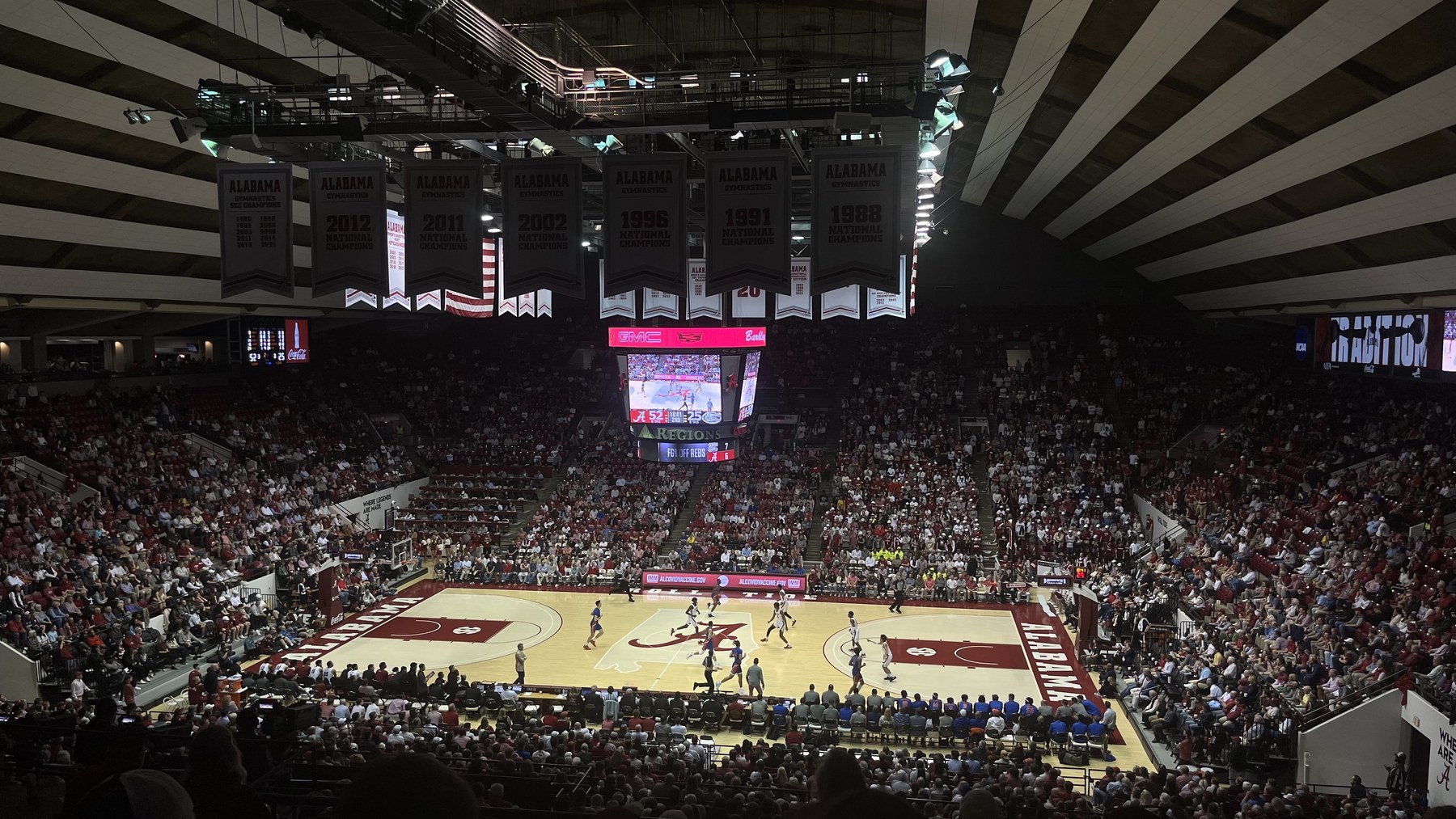
Coleman Coliseum during Alabama's Feb. 8, 2023 home game against Florida, the season Kai Spears spent as a freshman walk-on. (Photo by Wikimedia Commons user Benhen1997, CC BY-SA 4.0)
The Times calls it an honest mistake and is weighing an appeal
Birmingham attorney Michael L. Bell, defending the newspaper, used that exact framing with the jury. "This is a case of an honest mistake," he said in closing, Patch reported, arguing Spears could not show serious damage given that he earned a full scholarship at Alabama the next season.
The paper is holding that line. "We're disappointed the jury found The Times liable for an honest mistake," a Times spokesperson told Fox News Digital. "We thank the jury for its service, but believe the verdict and award of damages are contrary to law and not supported by the evidence. We are reviewing our legal options."
In its own report on the loss, The Times noted that it had not lost a defamation lawsuit brought in the United States over one of its articles in more than 50 years. The New York Sun framed the verdict the same way. No appeal timetable has been announced.
What this verdict does not decide
This case was about one newspaper article and one young man's name. It settles nothing about the underlying killing, and the people involved in that case deserve to be described accurately.
Jamea Harris, 23, was shot and killed near the Tuscaloosa Strip in the early hours of Jan. 15, 2023. Michael Lynn Davis was found guilty of capital murder and has been sentenced to life in prison without the possibility of parole. Former Alabama player Darius Miles is charged in connection with her death, pleaded not guilty, and as of the day of this verdict was still awaiting trial. He has not been convicted of anything, and he is entitled to the presumption of innocence.
Brandon Miller, who drove the car, was never charged. Kai Spears was never a suspect in anything. He was a teenager whose name got attached to a homicide scene he was not at, by the most-cited newspaper in the country, and it stayed attached for months.
Why a Tuscaloosa jury verdict lands harder than a correction
Corrections cost a legacy outlet nothing. An editor's note appended weeks later does not travel the way the original headline did, and everyone in the business knows it. That is the entire complaint conservatives have been making about national media for a generation, and it usually goes nowhere because the standard for winning a defamation case in America is deliberately steep.
Eight Alabamians looked at how the story got made, a single anonymous source, a second one who could only offer "a white guy on the basketball team," and a months-long refusal to move, and put a $9.25 million number on it. The Times may well get that number cut or the verdict tossed on appeal. It does not get to un-lose the trial.