U.S. District Judge Indira Talwani vacated the last injunction against President Trump's mail voting executive order on Wednesday, and nothing now blocks any part of it. The Boston judge wrote that Monday's Supreme Court ruling "compelled" her to do it, then spent most of her nine-page order explaining why she thinks that ruling is wrong. The Postal Service is now free to stand up a national ballot-tracking system with 69 days until Election Day.
What Talwani actually wrote, and what she pointedly refused to say
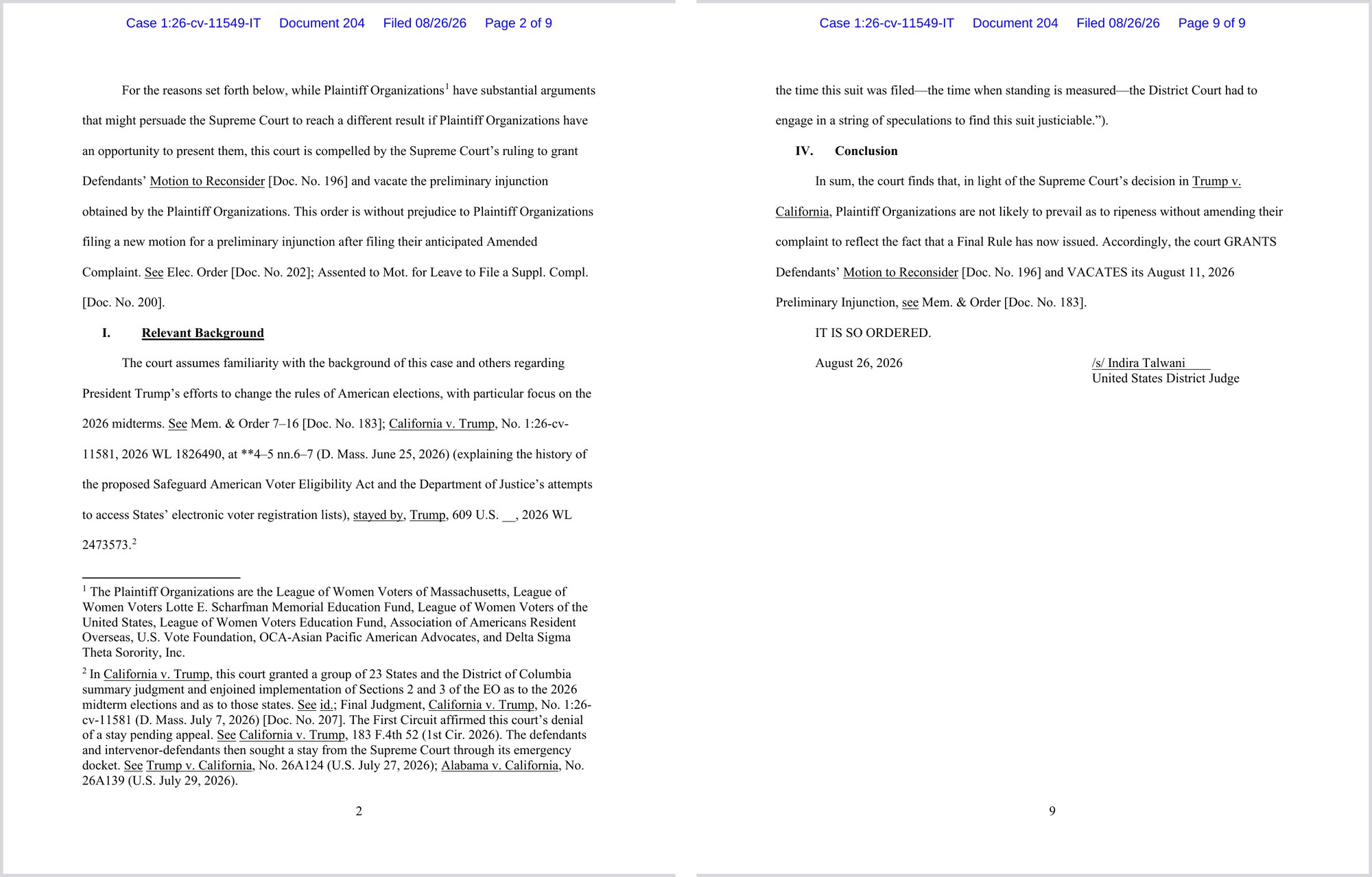
The order is Document 204 in League of Women Voters of Massachusetts v. Trump, No. 1:26-cv-11549-IT. It grants a motion to reconsider that the Justice Department filed at 10:08 p.m. on Aug. 24, hours after the Supreme Court issued its stay in Trump v. California. We covered that ruling Monday: a 6-3 stay on timing grounds that decided nothing about legality.
Talwani vacated the injunction without prejudice, which means the plaintiffs can come straight back. She also drew the distinction that will decide what happens next. The 23 states and the District of Columbia in the Supreme Court case claimed fiscal and sovereign injuries. The League of Women Voters coalition claims ongoing harm to its members from "the confusion and chaos wrought by the EO's likely unconstitutional attempt to change election rules a few short months prior to the 2026 midterms." The Supreme Court, she noted, "has not yet had the opportunity to consider the sufficiency" of that injury.
She ruled against them anyway, on ripeness rather than standing. Her holding is one sentence and narrower than every headline written about it: the plaintiffs "are not likely to prevail as to ripeness without amending their complaint to reflect the fact that a Final Rule has now issued." Not that the order is lawful. That the paperwork is out of date.
The day before, she found the Postal Service broke her order and then did nothing about it
Tuesday's order makes Wednesday's easier to read. The Aug. 11 injunction barred the Postal Service from "initiating or completing rulemaking" on Section 3 of the order for any election on or before Nov. 3. USPS sent its final rule to the Federal Register anyway on Friday night. The published document timestamps itself on its last page: "FR Doc. 2026-17238 Filed 8-21-26; 9:00 pm."
The government's defense was the escape hatch written into the rule itself: USPS "will not take actions to implement the rule specifically for the 2026 election unless and until the government obtains relief from those injunctions." Talwani rejected it. "These arguments ignore the court's explicit directive not to 'initiat[e] or complet[e]' rulemaking," she wrote in Document 201. The government "feigned complete compliance," she added, when it told the Supreme Court on July 27 it was losing ground with "every day that the agencies are unable to take steps to carry out the Executive Order."
Her remedy was nothing. "[T]he court finds that Defendants violated the court's Preliminary Injunction but imposes no remedy other than identifying the violation." Just the News caught the "feigned" line the same day. A judge who says the government defied her and then does nothing has told you how much authority she thinks she has left.
What the Postal Service is now free to actually do
The rule published Wednesday morning at 91 Fed. Reg. 54966 runs 27 pages and is effective as of Aug. 21. Every state has to register officials in a new Federal Ballot Mail Portal at least two business days before an outbound ballot mailing, then submit each mail voter's name, address and unique Intelligent Mail barcode. No state can upload a single voter record until it has sent its envelope design to USPS and received feedback. Mail that fails the check "will not be accepted and will be returned to the authorized ballot mailer."
Two features cut in the administration's favor and deserve saying plainly. The verification step applies only to outbound ballots, never to the ballot a voter fills out and mails back. And Section 24.6 disclaims the thing critics say the rule does: "The Postal Service does not purport to alter the eligibility of any individual to vote under state or federal law," and "States are fully responsible for the contents of each State's Mail-In and Absentee Participation List." Whoever ends up on that list, the state put them there.
One provision is harder to defend. Under Section 24.4.3, USPS hands each state its list back "on or about the date of the federal election." States upload voter data in September and find out what Washington recorded on Election Day.
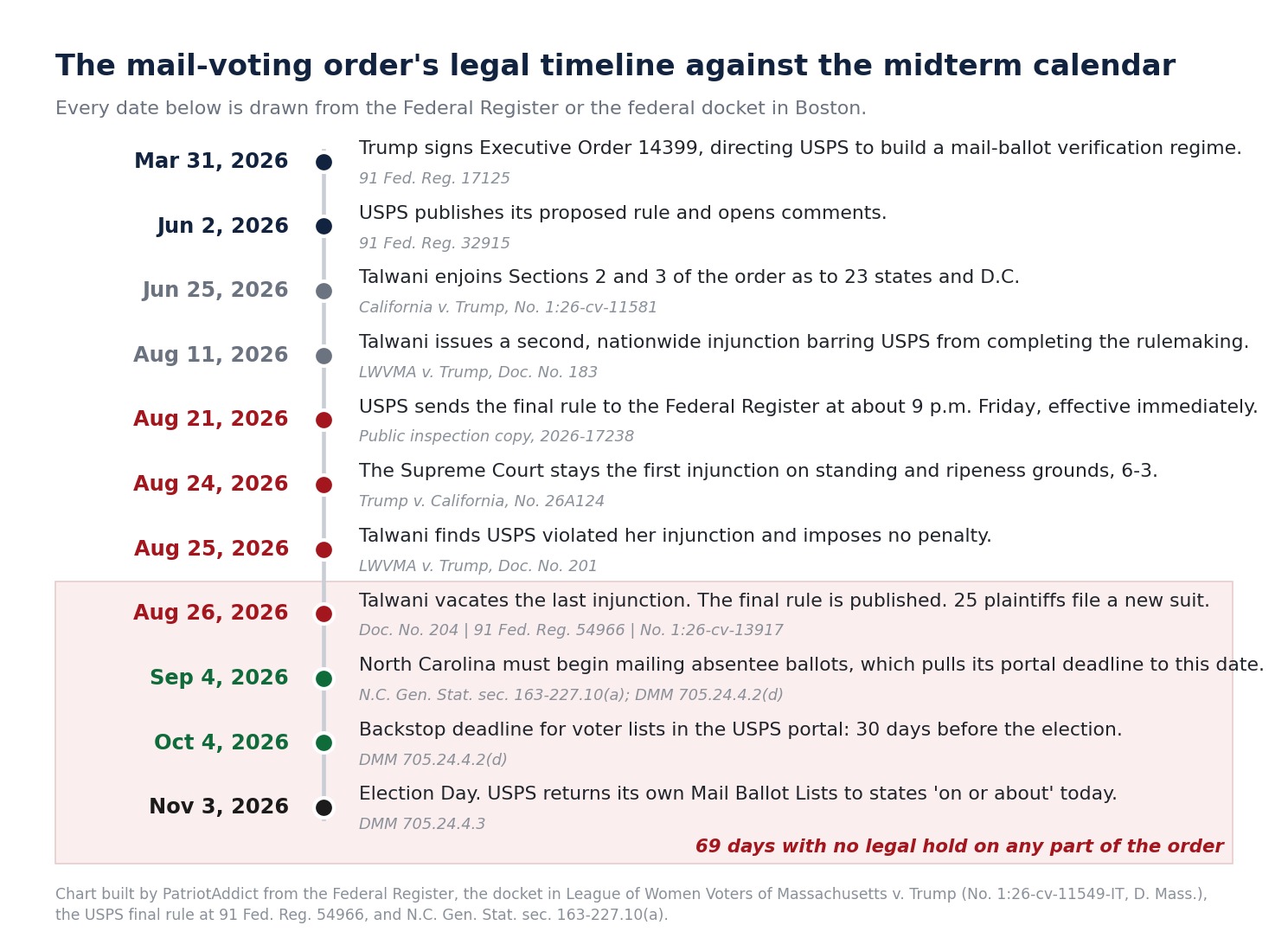
Every date here comes from the Federal Register or the Boston docket. Chart built by PatriotAddict from the Federal Register, the docket in League of Women Voters of Massachusetts v. Trump (No. 1:26-cv-11549-IT, D. Mass.), the USPS final rule at 91 Fed. Reg. 54966, and N.C. Gen. Stat. section 163-227.10(a).
The calendar was always the real opponent
North Carolina law requires county boards to start mailing absentee ballots on Sept. 4, eight days from now. Because the rule's portal deadline is 30 days out "or by the date on which mail-in or absentee ballots may begin to be mailed under state law," North Carolina's real deadline is Sept. 4, not Oct. 4. The Postal Service processed more than 99 million ballots in 2024 by its own post-election analysis, and election officials told USPS during the comment period that the portal meant to carry the matching voter records does not yet exist.
USPS answered that objection in the rule itself, and the answer is a choice rather than an evasion: "despite any logistical or financial difficulties states may face complying with the rule, including some claims that immediate implementation would prove impossible, the visibility and law-enforcement benefits of the rule, including for this election cycle, are such that there is no compelling reason for any delay." White House spokesperson Lauren Bis called the changes "commonsense measures that protect the security of mail-in ballots" in remarks reported by the Associated Press.
A renewed challenge has to be a new lawsuit, not an amended one
That is why two separate filings landed on the same day. Hours before Talwani ruled, 23 states, the District of Columbia and Pennsylvania Gov. Josh Shapiro filed a new 53-page complaint in the same Boston court, No. 1:26-cv-13917, naming the Postal Service, Postmaster General David Steiner and the entire Board of Governors. Trump is not a defendant this time. The states are suing the rule.
Their opening claim is the whole fight in one line: "Congress has not afforded USPS any authority whatsoever to set rules for federal elections or mail voting, even though Americans have cast ballots by mail for generations." On burden, the complaint says states "must accomplish multiple Herculean tasks, each necessary to address the disruption caused by the Rule, in a matter of weeks, with limited resources." New York Attorney General Letitia James was blunter: "USPS has no authority to decide who can and cannot vote by mail."
Filing fresh rather than amending is a deliberate choice, and Talwani explained why in a sentence most coverage skipped. Because the Supreme Court never separated ripeness from standing, she wrote, it "appears to be implying that ripeness must also be measured when the suit is filed." If that is right, every case brought before Aug. 21 was born unripe and no amendment repairs it. A complaint filed Aug. 26 against a rule that already exists has no such defect. The League of Women Voters plaintiffs are amending anyway, with the Justice Department's consent, and Democracy Docket reported that national Democrats renewed their own bid in the parallel Washington case Tuesday.
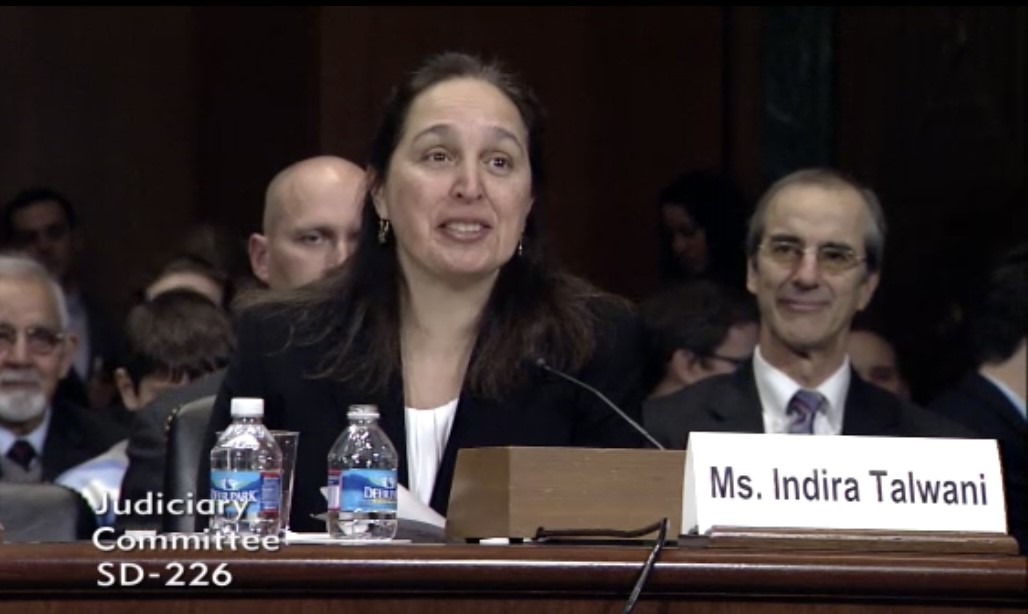
Indira Talwani at her Senate Judiciary Committee confirmation hearing on Jan. 8, 2014. Nominated by President Obama, she wrote both injunctions against Trump's mail voting order. The Supreme Court stayed the first one on Monday and she vacated the second one herself on Wednesday. (U.S. Senate Judiciary Committee, public domain, via Wikimedia Commons)
The part conservatives should not skip
The security case for this rule is real. A traceable mail ballot is a better ballot than an untraceable one, and nothing in the rule inspects a ballot's contents or audits a voter roll. Voters who care about chain of custody have asked for this for six years.
The problem is that the administration has not defended the order on the merits anywhere, leaning on standing and timing instead. Justice Ketanji Brown Jackson made the point in Monday's dissent: "the Government has not even bothered to assert, much less demonstrate, that the President has the constitutional authority to issue an order that directs the manner in which the mail-in ballot aspect of federal elections is to be administered."
Article I, Section 4 hands the times, places and manner of federal elections to state legislatures, subject to Congress. It does not mention the president or the Postal Service. That was the conservative argument from 2020 through 2024 about consent decrees and pandemic rules, and it does not stop being true when the executive signing the order is one we voted for.
The legislative version of this fight is stuck. The SAVE Act, H.R. 22, would require documentary proof of citizenship to register for a federal election. It passed the House 220-208 in April 2025 and its Senate companion has not moved. An executive order nobody will defend on the merits is what an administration reaches for when it cannot get 60 votes.
For now the administration has what it wanted: no injunction, a rule in force, 69 days. What it does not have is a working portal, a state that says it can comply by Sept. 4, or a court that has ever held a president may tell the Postal Service how to run an election. Talwani draws the new states' case too, and her order Wednesday already calls this one a "likely unconstitutional attempt to change election rules a few short months prior to the 2026 midterms."
Hero image: the John Joseph Moakley U.S. Courthouse in Boston, where Judge Talwani sits. Photo by Ajay Suresh, licensed CC BY 4.0, via Wikimedia Commons.