The Supreme Court sided with President Trump 6-3 on Monday and lifted the injunction blocking key parts of his executive order on mail-in voting in 23 states. It did not rule the order lawful. The justices decided a timing question, and they said so in the order itself. The stay covers those 23 states plus Washington, D.C., and a second injunction, issued by the same Boston judge two weeks ago, still blocks the Postal Service from acting on the order in all 50 states. Votebeat counted Monday as one of two blocks coming off, not a green light.
The justices answered a timing question, not a constitutional one
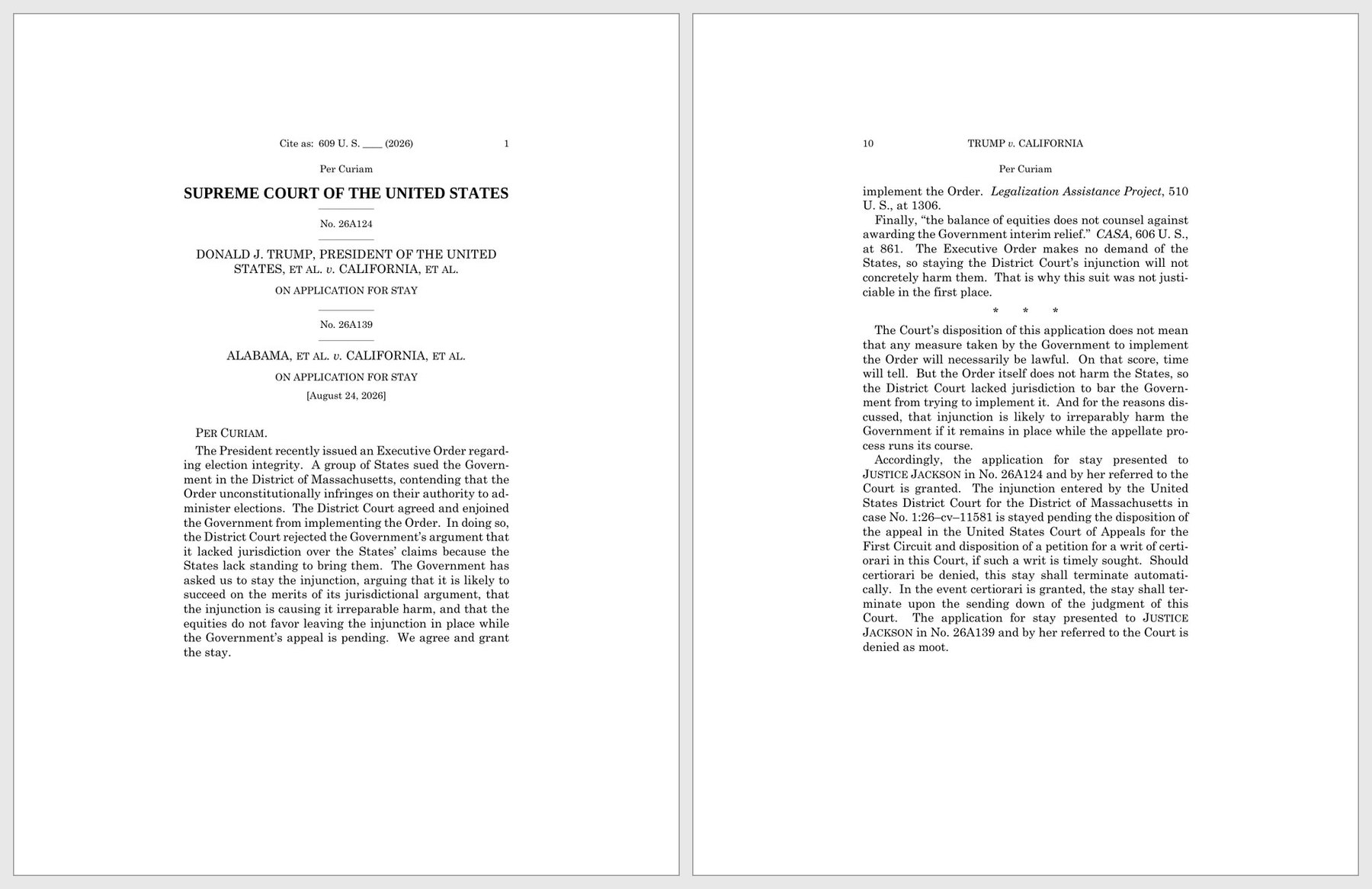
The ruling came on the emergency docket in Trump v. California, No. 26A124, an unsigned per curiam opinion issued Aug. 24. The Court granted the government's application for a stay of the injunction that U.S. District Judge Indira Talwani entered on June 25 against Sections 2 and 3 of Executive Order 14399, which Trump signed March 31. A companion application from Alabama and 11 other Republican-led states, No. 26A139, was denied as moot.
The whole opinion turns on standing and ripeness. Twenty-three states and the District of Columbia sued four days after the order was signed, before DHS had compiled a single list and before the Postal Service had proposed a rule. The majority held they sued too early, then said in as many words that this holding decides nothing about whether the order is legal.
The majority's reasoning is narrower than either side's headlines
Read the order and the government's argument is genuinely strong on its own terms. Section 2(a) tells the DHS secretary to compile State Citizenship Lists and send them to each state's chief election official, but only "to the extent feasible and consistent with applicable law," and the states concede nothing in the order requires them to use those lists. The majority's line: "It imposes no obligations on the States, so they 'suffer no concrete harm from' it."
Section 2(b) directs the attorney general to prioritize investigating officials who hand federal ballots to ineligible voters, and setting charging priorities is core Article II work. On the states' worry about being prosecuted for giving primary ballots to 17-year-olds under their own laws, the Court noted that "the Government has unsurprisingly disavowed any intention to prosecute state officials for lawfully providing ballots to 17-year-olds." Section 3 orders the Postal Service to propose a rule. As the majority put it, "Federal courts review final rules, not proposed rules." If the final rule hurts the states, they can sue over that.
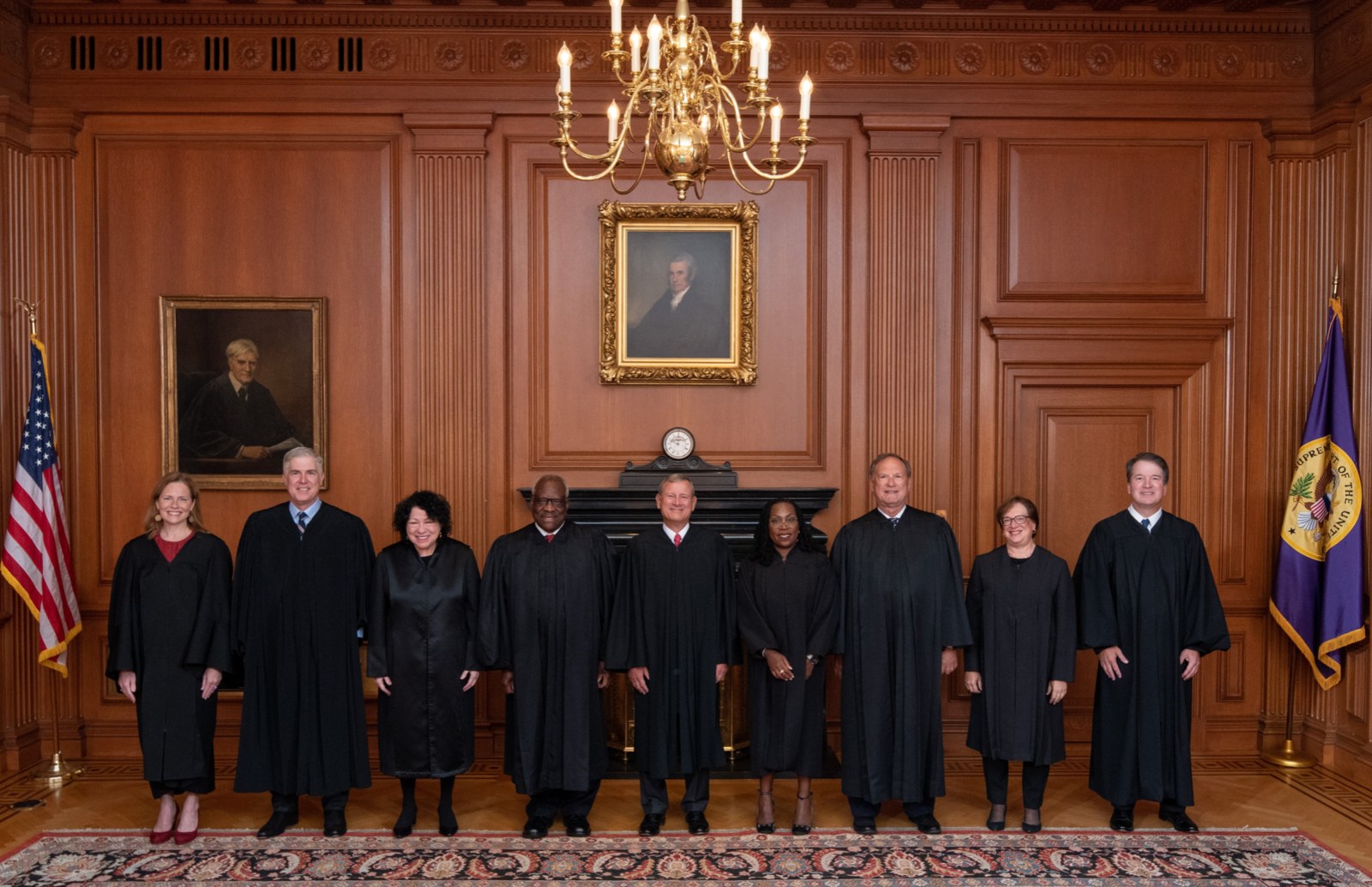
The Roberts Court. The Aug. 24 order was unsigned and did not list which justices joined it, but the three Democratic appointees all dissented, making it 6-3. Official group portrait, September 2022 file photo. (Supreme Court of the United States, public domain, via Wikimedia Commons)
One injunction is gone. The other one is the one that matters right now.
Here is the part most of Monday's coverage compressed into a clause. Talwani issued a second injunction on Aug. 11 in a different case, League of Women Voters of Massachusetts v. Trump, brought by nonprofit groups rather than states. That one reaches every state and specifically blocks the Postal Service. The Supreme Court's order does not mention it.
NPR, Votebeat and CNBC all reported Monday that the Aug. 11 order still stands and still bars USPS from putting its new system in place for Nov. 3. NBC News read it differently, writing that the Supreme Court's decision "is likely to apply to that ruling, too." Fox News reported that the Postal Service and the Justice Department said they would move immediately. Nobody knows yet, and anyone telling you otherwise is guessing.
The Postal Service rule is narrower than the order that produced it
USPS issued its final rule on ballot mail last Friday, effective Aug. 21, after taking more than 200,000 comments on the June proposal. It is worth reading before believing the scare version of it. States, not the Postal Service, decide who goes on the list: "the Postal Service will exercise no discretion or authority over whether an individual should or should not be on the list a state provides." The rule also says it "does not involve or authorize inspection of a mail-in ballot's contents, review of individual voter's eligibility, or auditing of state voter rolls," and the verification step does not apply to the ballot a voter mails back.
U.S. Postal Service headquarters at L'Enfant Plaza in Washington. USPS issued its final ballot mail rule on Aug. 21 and said it will not implement it for 2026 unless both injunctions come off. File photo, June 2024. (Photo by Tony Webster, licensed CC BY 2.0, via Wikimedia Commons)
The teeth are real, though, and honest coverage should say so. An outbound ballot mailing that fails the barcode and data check "may be temporarily rejected (and thus not permitted to enter the mailstream)," and the rule contemplates that a state refusing to submit the required data would face what USPS calls an "acceptance refusal." An Alabama-led coalition of 13 state attorneys general backed it in comments, arguing the rule "addresses real vulnerabilities inherent in mail-in voting, responds to legitimate and widespread public concerns about federal election integrity, and equips States with tools that strengthen their own oversight capabilities without displacing their authority."
Jackson's dissent lands one punch the majority never really answers
Justice Ketanji Brown Jackson wrote 23 pages calling the ruling a "Kafkaesque nightmare" that "needlessly injects chaos and uncertainty into the upcoming midterm elections." Most of it is heat. One passage is not. The Court has long held under Purcell v. Gonzalez that election claims can arrive too late to be heard; Jackson's point is that Monday's order now establishes "that such claims can also come too early," without saying when the window opens.
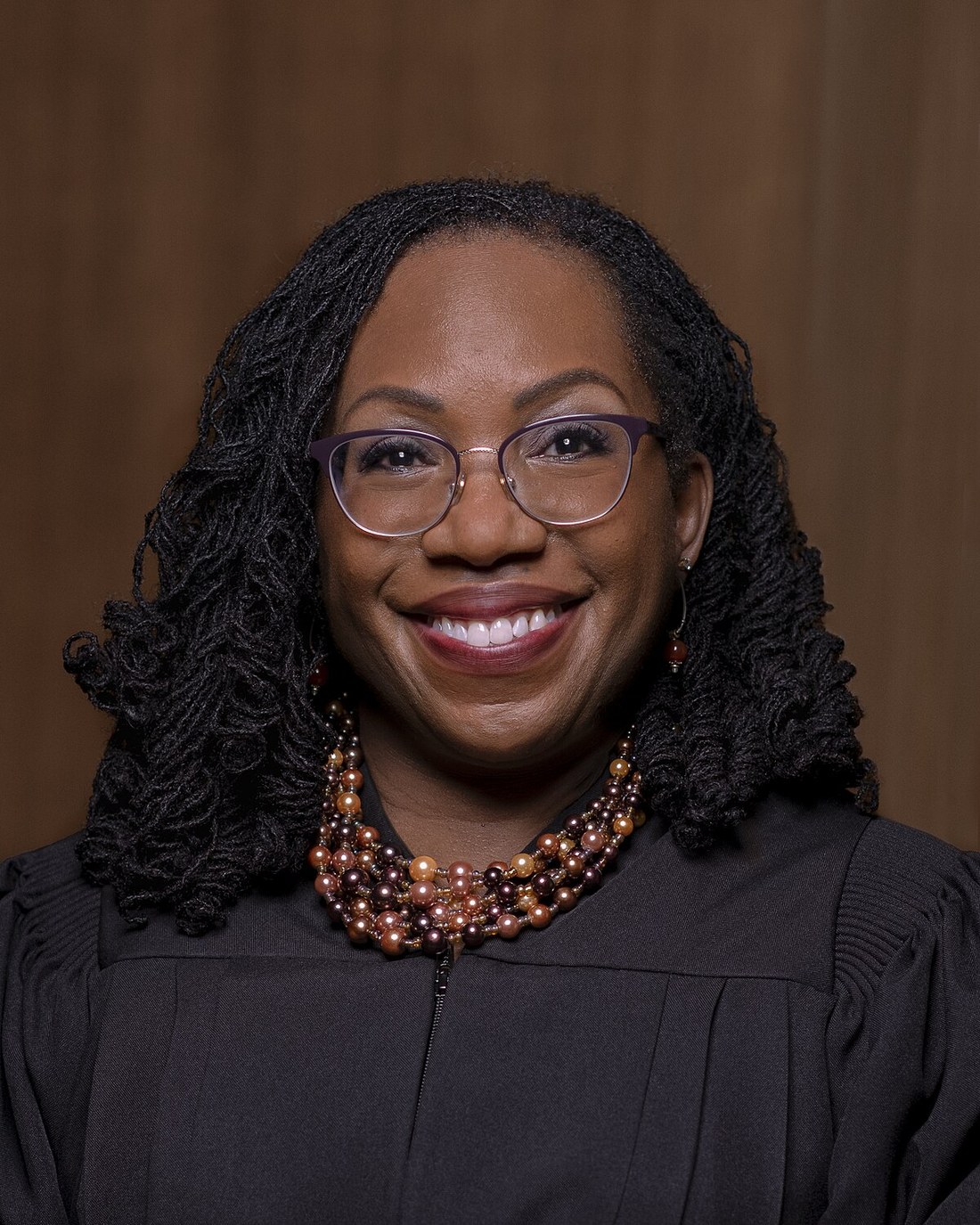
Justice Ketanji Brown Jackson, who wrote the longer of the two dissents and accused the majority of "taking its eye off the ball." Official portrait, 2022. (Fred Schilling, Collection of the Supreme Court of the United States, public domain, via Wikimedia Commons)
Justice Sonia Sotomayor, joined by Justice Elena Kagan, wrote the shorter dissent and the sharper argument. The government told the Court the order was too speculative to challenge, then told the same Court it urgently needed the injunction lifted so it could implement that order before November. "The Government cannot have it both ways," Sotomayor wrote. She also opened by conceding the point that matters most here: "Today's decision does not address whether the President's attempts to interfere with States' administration of the November 2026 elections are lawful."
Everything now runs on the calendar
Election Day is Nov. 3, and some states begin mailing ballots to military and overseas voters in early September. Solicitor General D. John Sauer warned the justices in a supplemental brief that continued litigation would "effectively run out the clock." The states answered in their consolidated opposition that changing the rules this close to November "would be extreme."
White House spokesperson Lauren Bis called the order's provisions "commonsense measures." New York Attorney General Letitia James said "This decision is a painful setback, but it will not be the final word." California Gov. Gavin Newsom posted that "California WILL SUE again to BLOCK Trump's attack on mail-in voting." The League of Women Voters and the ACLU had already gone back to Talwani on Aug. 22 with an emergency motion, arguing that by issuing the final rule "the Trump administration has flouted the court's injunction." UCLA election law professor Rick Hasen predicted, in remarks quoted by Votebeat, that Talwani will issue a fresh injunction aimed at the now-final rule and that it "may end up at the Supreme Court within a week."
This is the same fight as the Census noncitizen report, one step downstream
Yesterday we covered the Census Bureau brief claiming 24,000 noncitizens voted in 2020, and Georgia Secretary of State Brad Raffensperger's request that the Bureau hand over the names so his office could check them. It has not. That story and this one are the same problem from two ends: there is no comprehensive federal list of American citizens, so every claim about noncitizen voting collapses into a records-matching argument nobody can audit. Section 2(a) is the administration's answer, a DHS-built citizenship list pushed to every state before every federal election. Whether that list would be accurate enough to use is the question neither the Census brief nor Monday's order touches.
Mail voting itself is not fringe. Roughly 30 percent of ballots in 2024 were cast that way, by voters of both parties, and a 2025 Brookings Institution study cited by Al Jazeera put documented fraud at about four cases per 10 million mail ballots. The administration's better argument was never prevalence. It is chain of custody and a paper trail that can be reconciled after the fact, which is what the Postal Service rule builds.
The Court gave Trump the procedural win and withheld the substantive one. Nothing in Monday's order says a president may direct how states run their elections, and the government never asked it to. What the administration bought is time and permission to try. What it has to beat now is a second injunction, a fresh round of lawsuits, and a Postal Service with ten weeks to stand up a national ballot-tracking portal it has never run before.