The State Department has told U.S. embassies and consulates worldwide to cancel and reschedule immigrant visa interviews while every consular officer is retrained on public charge. Applicants started receiving the cancellation emails on August 24 and 25, most with no reason attached and no replacement date.
The department has not said when interviews resume. It has not confirmed in writing that a pause exists at all. What it has confirmed is the training, and the training is the part worth reading closely, because it goes at the single provision that has quietly made public charge unenforceable for decades.
What the department actually said, word for word
Asked about the cancellations, the press office sent The Christian Science Monitor a statement that never uses the word pause: "Since early this year the State Department has been working on updating guidance and training related to public charge to ensure all consular officers are fully equipped to evaluate every visa applicant comprehensively and consistently." The department "launched a global training initiative" in early August at all embassies and consulates, the statement continued, and "to accommodate this in-depth training, appointments for visa services will be adjusted."
A department official gave Fox News Digital the same two sentences. Fox reported that for most posts the sessions were expected to run during the week of August 24, and that the department would not say when applicants get new dates. Reuters broke the story on August 25; the immigration firm Boundless and the corporate immigration practice Fragomen both put out client advisories the next morning.
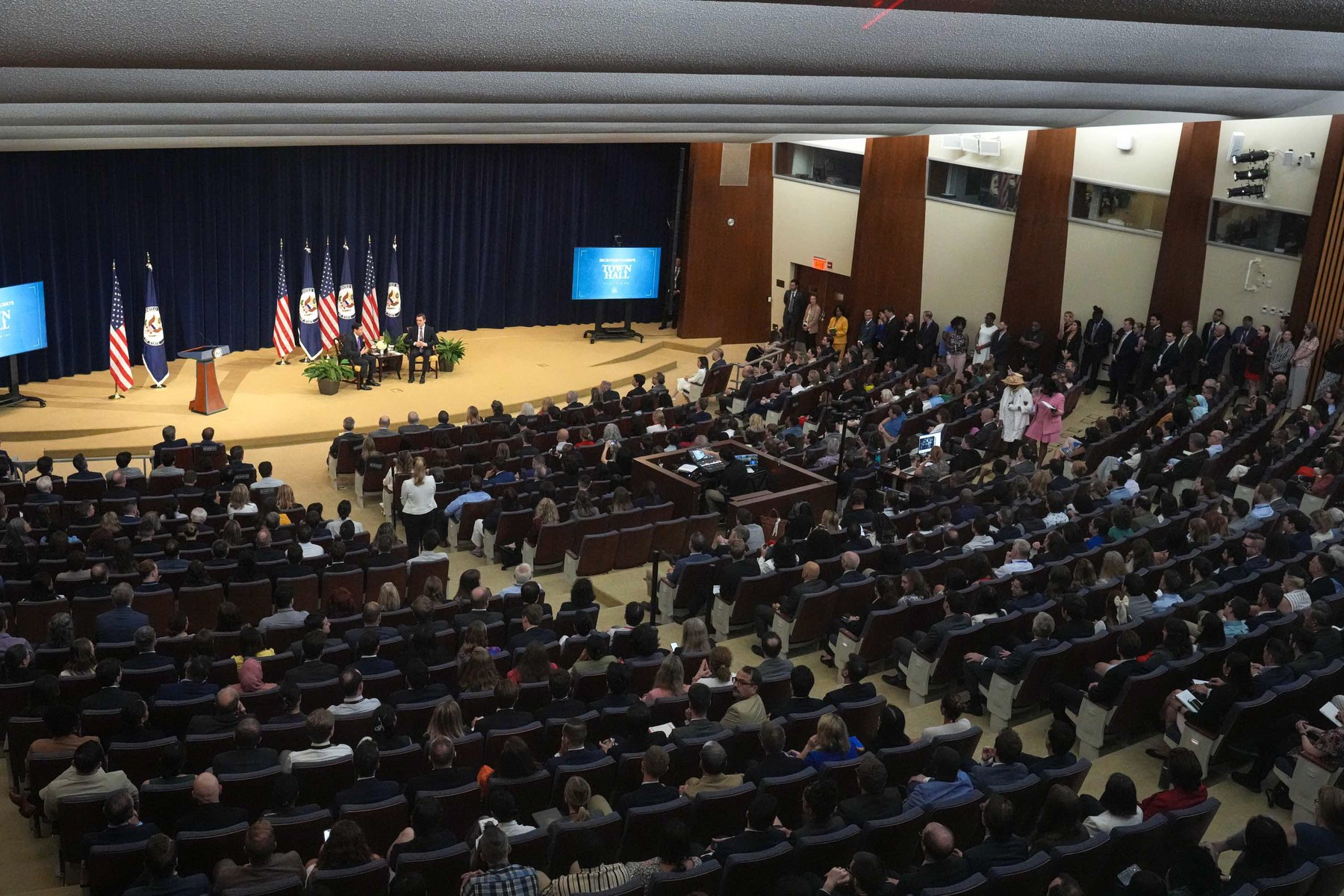
Secretary of State Marco Rubio addresses Department employees in the Dean Acheson Auditorium at the Harry S. Truman Building in Washington on July 2, 2026, five weeks before the global public charge training launched. (Official State Department photo by Freddie Everett, via Wikimedia Commons, public domain)
Is this the 75-country ban wearing a new label?
The cancellations landed three days after Judge Jeannette Vargas voided Secretary of State Marco Rubio's suspension of immigrant visas for nationals of 75 countries, and plenty of coverage has treated the sequence as cause and effect. On the record, it is not that simple, and the honest answer cuts in the administration's favor.
The department's statement says the guidance rewrite has been underway "since early this year" and that the training launched in early August, both before the August 21 opinion. Nothing in the statement references the ruling. And Vargas herself did not touch individualized public charge screening: as we wrote when the opinion came down, she expressly declined to hold that the policy violated the public charge statute, and she entered judgment for the government on the claim that the policy needed a notice-and-comment rulemaking first. Case-by-case screening is not a loophole around her order. It is the procedure her order says the statute demands.
Which does not mean the department is being gracious about losing. "This rogue judge's misguided opinion wrongfully undermines the longstanding legal authority of the Secretary of State," spokesman Tommy Pigott told Fox News Digital on August 24. "American taxpayer-funded public benefits belong to Americans."
What a public charge finding legally requires
The authority is 8 U.S.C. 1182(a)(4), section 212(a)(4) of the Immigration and Nationality Act. Any applicant who "in the opinion of the consular officer at the time of application for a visa" is "likely at any time to become a public charge" is inadmissible. Congress then told the officer what to weigh, at a minimum: age, health, family status, assets and resources and financial status, and education and skills.
The department's own instructions to officers sit in 9 FAM 302.8, which converts those factors into a "totality of the circumstances" test and tells officers they "may not refuse a visa based on 'what if' possibilities." The FAM also draws the line narrowly on benefits: many forms of non-cash and supplemental federal assistance "would not create ineligibility under INA 212(a)(4)," and programs funded for the general good, like public education and childhood vaccination, are not counted at all. The department's February 26 public guidance defines a public charge as someone "primarily dependent on the government for subsistence," meaning cash welfare or long-term institutional care.
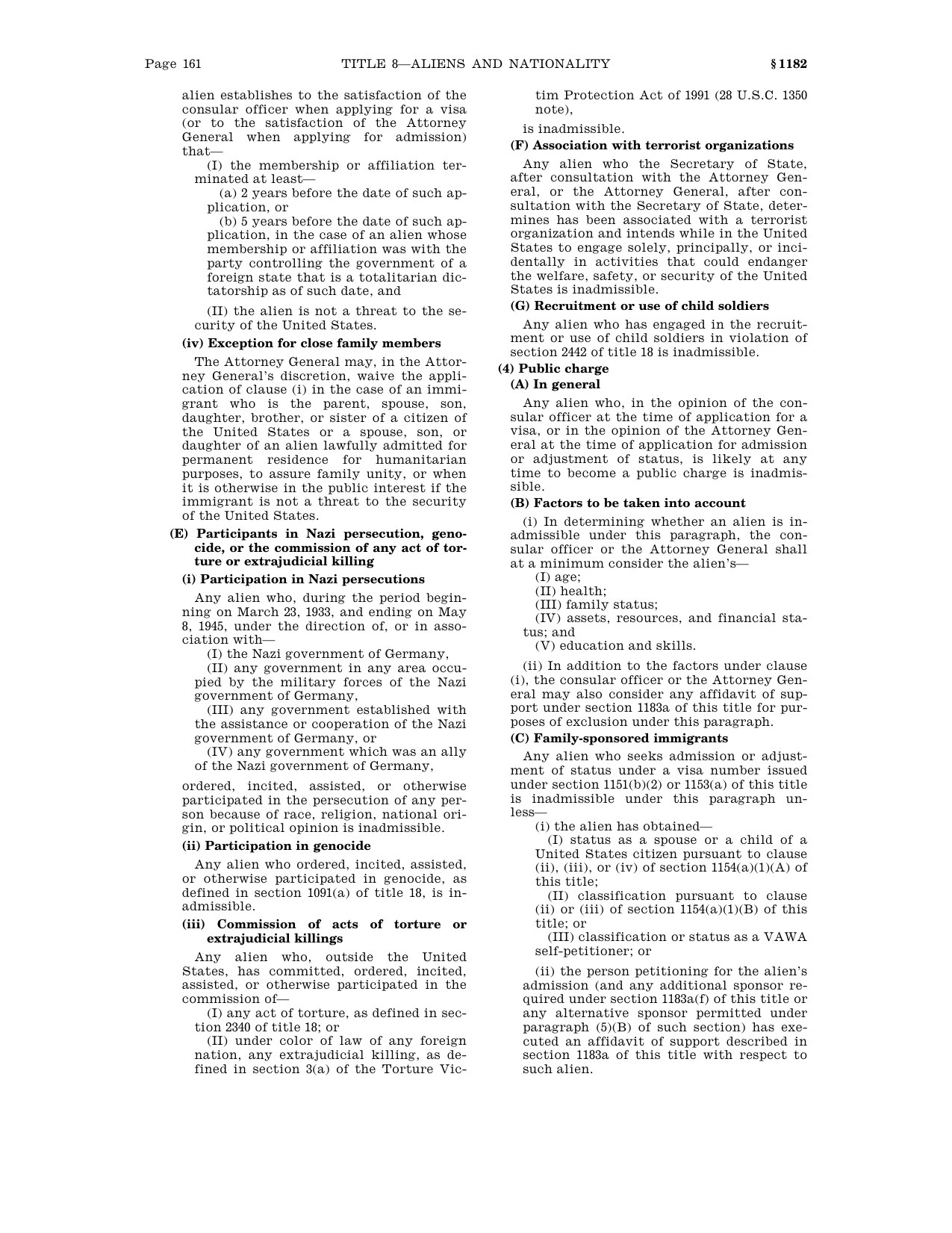
The one sentence in the manual that made the law a formality
Read clause (ii) again. The affidavit of support is optional for the officer to consider. Then read what the department told its own officers to do with it in 9 FAM 302.8-2(B)(2): "A properly filed, non-fraudulent Form I-864, is normally sufficient to satisfy the INA 212(a)(4) requirements." A relative signs a form promising to support the immigrant, and the analysis is over.
Simon Hankinson, a senior research fellow at the Heritage Foundation who spent his career as a Foreign Service officer, put the practical effect bluntly to the Monitor: enforcement has been "practically impossible" because of those affidavits. He wants more public charge enforcement, and he ties it to the size of the national debt. Whatever the training slides say, that FAM sentence is the target. Congress wrote five mandatory factors and one discretionary one, and the manual let the discretionary one swallow the other five.
Who this actually stops, and who it does not
Only immigrant visas. Student, work and tourist visas are nonimmigrant categories and are not part of this, a distinction Boundless flagged in its advisory and one that a lot of the reaction ran past. Immigrant visas are the ones that produce a green card on arrival, and the interview is the last gate before the visa is printed.
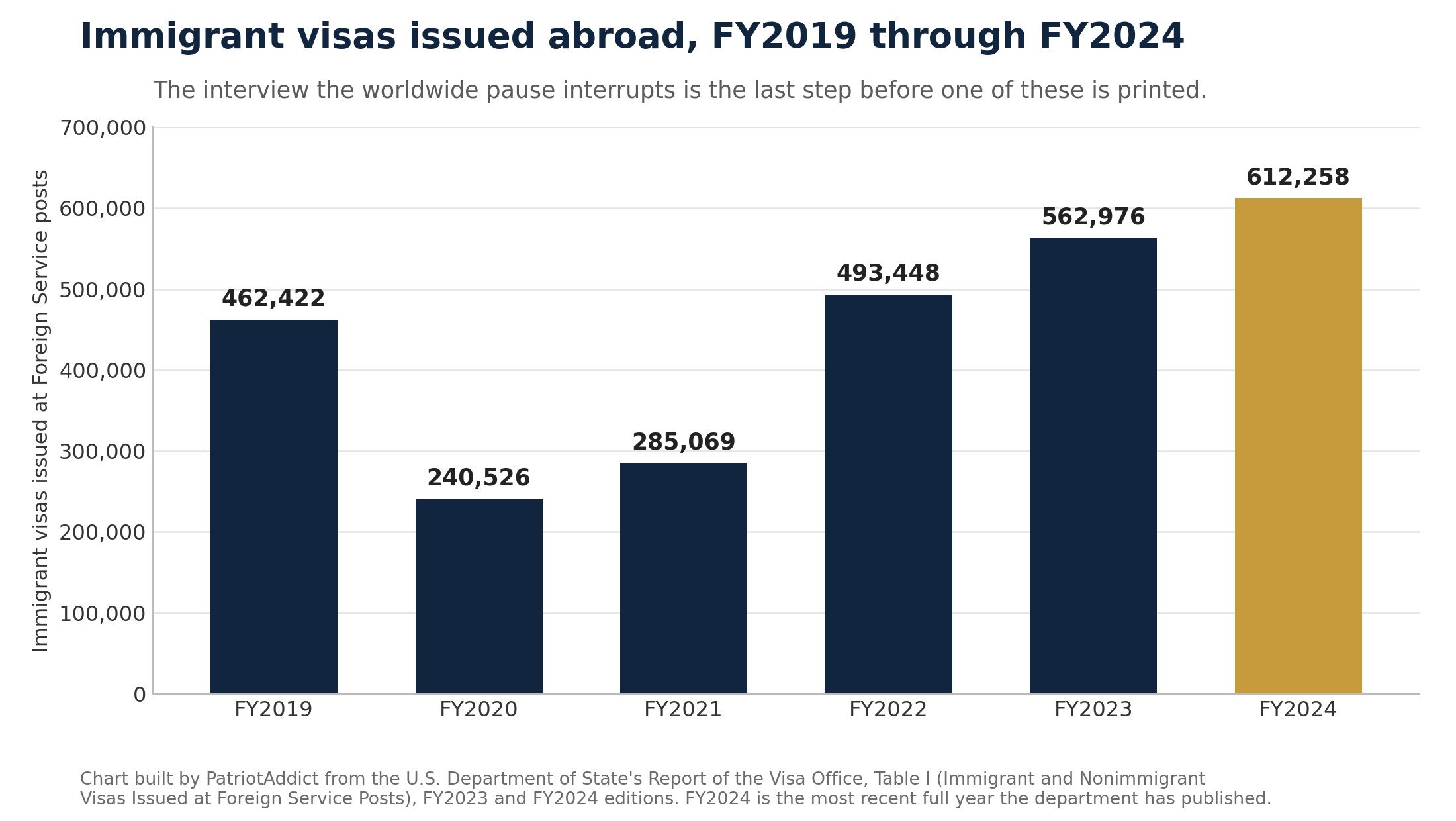
Immigrant visas issued at Foreign Service posts, FY2019 through FY2024. FY2024 is the most recent full year the department has published. (Chart built by PatriotAddict from the State Department's Report of the Visa Office, Table I)
The department issued 612,258 immigrant visas abroad in fiscal 2024, roughly 51,000 a month. Every one of them ran through an interview at a post. Ramon Curiel, a Texas immigration lawyer, told the Monitor that a client had already driven several hundred miles to the consulate in Ciudad Juarez when the cancellation email arrived, with no reason and no new date, and that a sign outside the building said the same thing. Shev Dalal-Dheini of the American Immigration Lawyers Association said the applicants "did what the government asked them to do."
The department already built the tool it needs
On August 5, three weeks before any of this hit the news, the department announced a public charge bond pilot, and the opening line reads like a mission statement: "Immigrating to the United States is a privilege, not a right. Those who wish to obtain a U.S. immigrant visa must be capable of demonstrating that they will be a benefit rather than a burden to our nation." Under the pilot, an officer who has refused a visa under 212(a)(4) can require the applicant to post a bond with USCIS on Form I-945, in an amount the officer sets case by case under 8 CFR 213.1(b), and then issue the visa if the bond is approved.
That is a real answer to the affidavit problem, and it needed no rulemaking, no country list and no Secretary reaching into a decision Congress assigned to consular officers. It is exactly the kind of instrument Vargas said the statute leaves open.
What to watch
Three things. Whether the department ever posts the interview pause on its own visa news page, which as of this writing tops out at an August 18 nonimmigrant scheduling pilot and the August 5 bond announcement, with nothing about cancelled interviews. Whether the rewritten 9 FAM 302.8 keeps the sentence making Form I-864 "normally sufficient," because that single clause decides whether any of this changes an outcome. And September 11, the deadline Vargas set for both sides to propose how to resolve the six claims still live in the 75-country case, with no notice of appeal filed yet on the public docket.
Retraining every consular officer on earth is a slow, unglamorous way to change immigration policy, and it produces no press release worth writing about. It is also the only version of this the courts have not blocked.