U.S. forces bombed two Iranian rocket launchers on Larak Island in the Strait of Hormuz on Sunday, the first American military action against Iran in 32 days. Central Command says Revolutionary Guard crews were loading those rockets with sea mines, one week after the same command announced it had finished clearing mines out of the strait's shipping lanes.
Iran answered before dawn Monday with ballistic missiles at two Jordanian air bases and drones at a base outside Dubai. Brent crude went above $91. And the maritime advisory issued four hours before the strike says the mine-surveying boats never stopped working.
CENTCOM confirmed the strike in a statement, not a press release
Navy Capt. Tim Hawkins, the CENTCOM spokesperson, put the confirmation out in writing to news outlets rather than through the command's own release feed. "I can confirm that earlier today U.S. forces struck two Iranian launchers on Larak Island," Hawkins said, per the Daily Caller. "Islamic Revolutionary Guard Corps forces were observed preparing to launch rockets with sea mines into the Strait of Hormuz."
There is no press release for this one. CENTCOM's public releases page still tops out at an Aug. 15 item about the commander's travel, and the last formal announcement of strikes on Iran is dated July 29. The only thing the command published under its own name was a post on X calling an IRGC statement false: "U.S. forces took limited, precise action against IRGC minelaying forces posing an imminent threat in the Strait of Hormuz."
Larak sits off Bandar Abbas, east of Qeshm. The gap between it and Oman's Great Quoin Island is the narrowest part of the strait, about 24 miles. Anything dropped there lands in a lane that normally moves about a fifth of global petroleum liquids consumption.
The mines were supposed to be gone already
Read Hawkins' sentence again: CENTCOM cleared the strait's international shipping routes. The routes, not the strait. That distinction got flattened last week when President Trump said the waterway had been cleared of mines, a claim Al Jazeera recorded without a caveat.
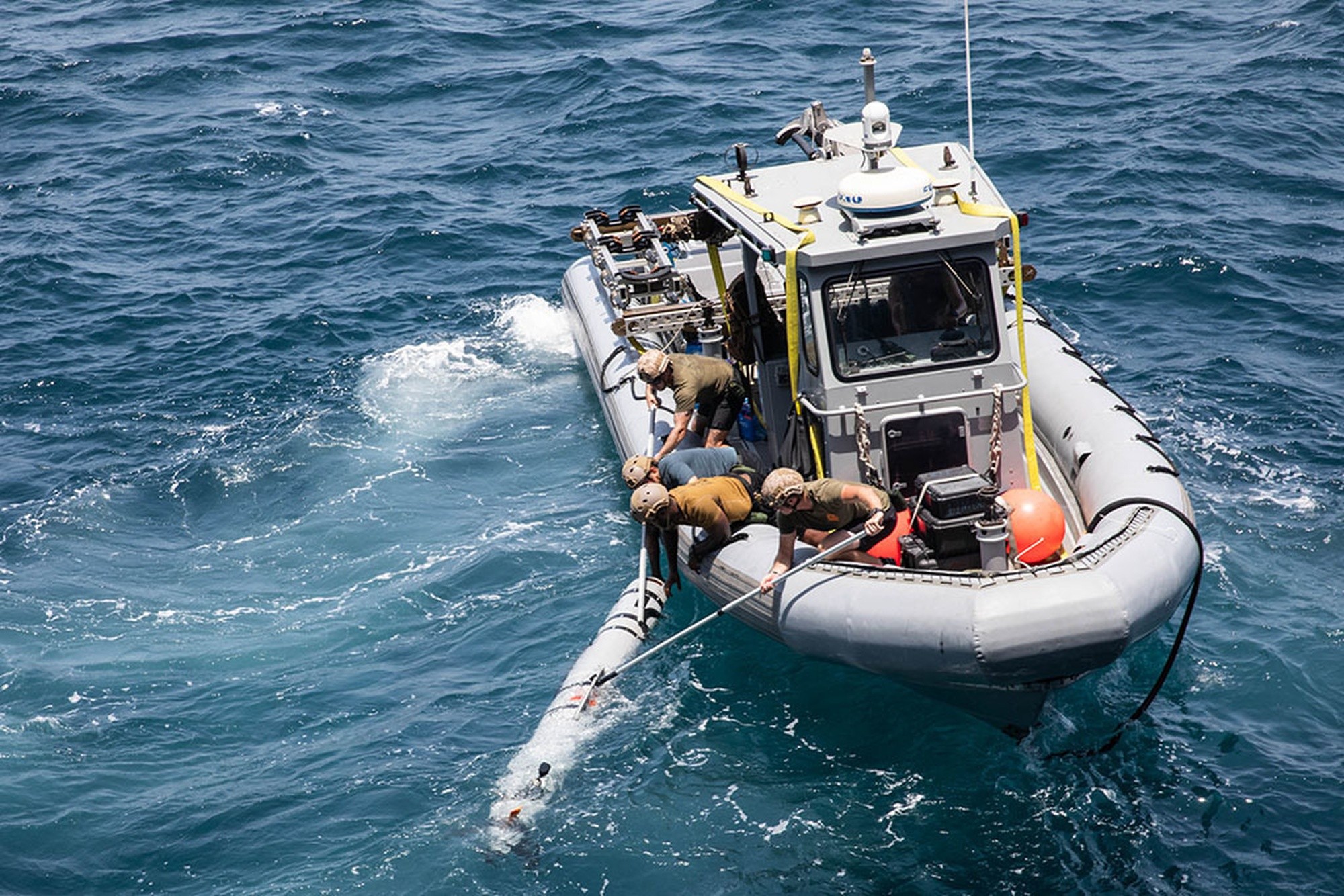
Sailors assigned to Commander, Task Force 52 retrieve a Mark 18 Mod 2 unmanned underwater vehicle during mine countermeasures training in the Arabian Gulf, June 28, 2021. Task Force 52 runs mine warfare for U.S. 5th Fleet. File photo, U.S. Navy via DVIDS, public domain. Photo by Spc. Joseph DeLuco.
The Joint Maritime Information Center disagrees with the tidier version. Its Update 091 advisory carries an information cut-off of 15:00 UTC on Aug. 30, roughly four hours before the launchers were hit, and it holds the Strait of Hormuz at SEVERE. Mine-risk reporting, it says, "remains relevant." Clearance work is described in the present tense.
Official record
Update 091 to JMIC Advisory Note, 01 March to 30 August 2026, Joint Maritime Information Center, JMIC# 001 26, published via UKMTO. Threat level for the Strait of Hormuz: SEVERE.
"Navigation interference persists, and mine-risk reporting remains relevant within and adjacent to the TSS. Clearance and mine-surveying operations continue throughout the Strait of Hormuz." Joint Maritime Information Center, Update 091, page 6.
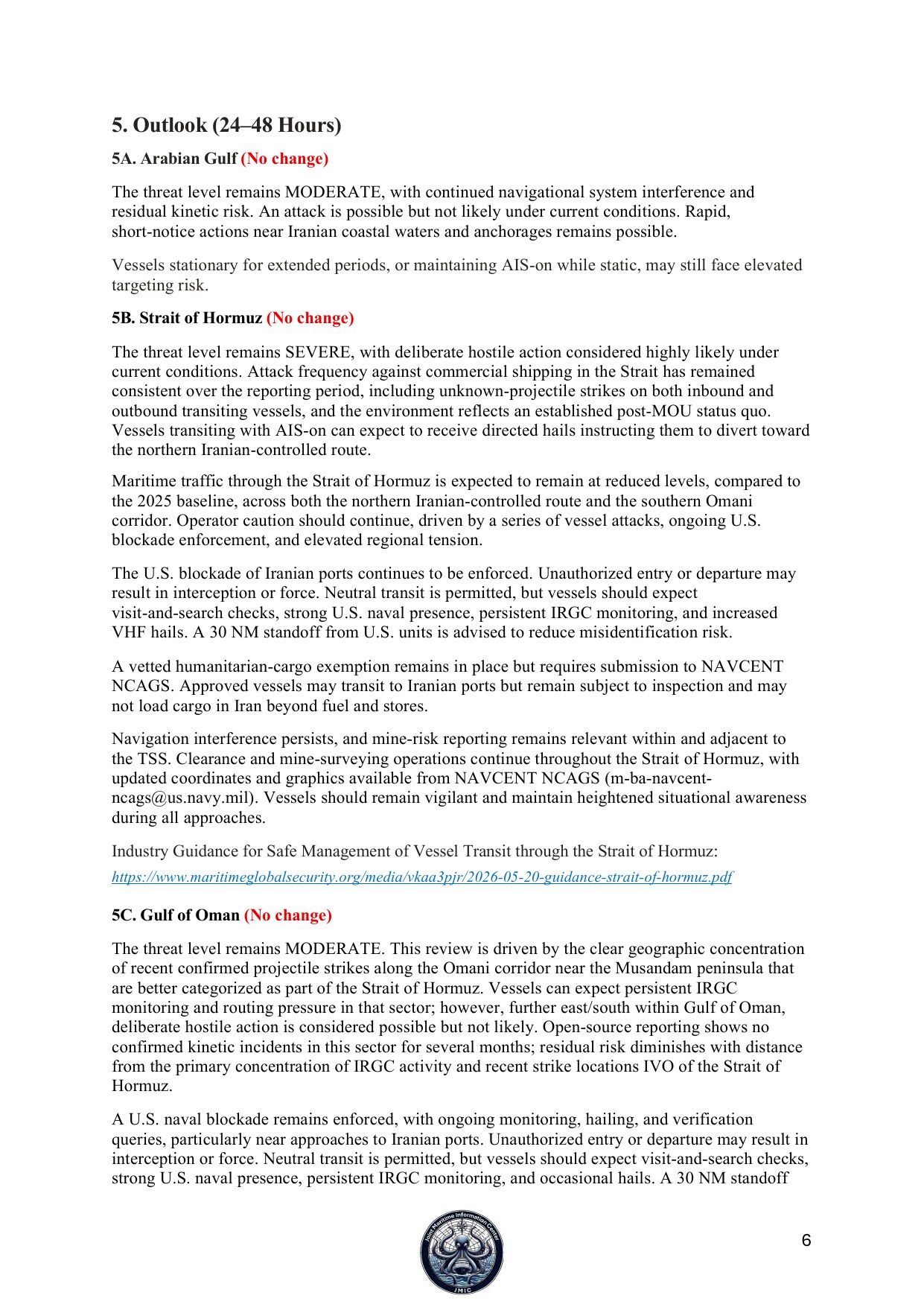
Read or download the full 11-page document (PDF)
Can you actually lay a minefield with a rocket?
Not everyone buys the method. Harlan Ullman, a retired senior U.S. naval officer, told Al Jazeera the rocket-delivered mine claim is implausible. "It would strike me that a rocket, when it impacts in the water, the impact would be such that it would do a lot of damage to the mines," he said. Iran has easier ways to do this, he added: "I would like to know from CENTCOM why they think Iran was using rockets, which to me is very, very novel."
There is a precedent, thin as it is. In January 2025 Iranian state television appeared to show the IRGC laying mines with the Fajr-5, a truck-mounted rocket system with a range near 47 miles. Iran has never confirmed it uses the Fajr-5 that way.
Iran did make one claim that helps Washington's argument. The IRGC Navy said a supertanker struck two sea mines in the southern strait for taking what it called an illegal route. Tehran never named the vessel or its flag, and nobody confirmed mines caused the damage. Either the mines are gone or a tanker just hit two of them.
Iran's answer landed on Jordan
The IRGC Aerospace Force said it struck King Hussein Air Base near Mafraq and the Al Azraq base, also known as Muwaffaq Salti, claiming heavy damage to maintenance infrastructure and fighter deployment sites. Jordan's account is shorter. An official spokesman for the Jordan Armed Forces said through the state news agency Petra that air defenses "intercepted and destroyed eight missiles" that violated Jordanian airspace, destroying them "before they could pose any threat to citizens or property."
Muwaffaq Salti is not an abstraction to American families. Three U.S. troops died there on July 17 in an Iranian ballistic missile strike, with four more wounded and flown to Jordanian hospitals. Dozens of American fighter jets operate from that base, which is exactly why Iran keeps aiming at it. No U.S. casualties have been confirmed from Monday's attack, though no named military official has said so on the record either.
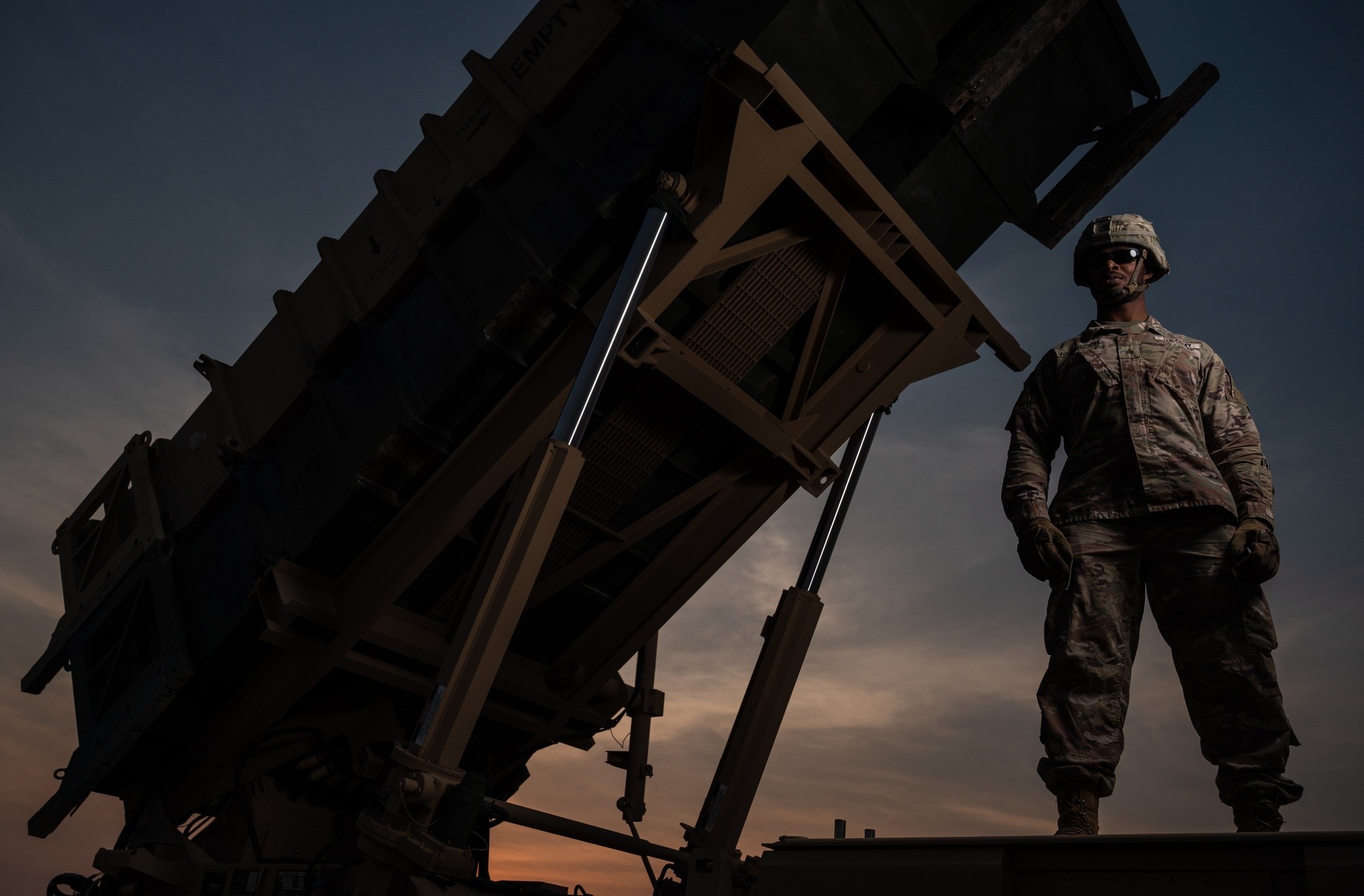
A Patriot battery operator with Charlie Battery, 1-43 Air Defense Artillery Battalion stands watch beside a launcher at an undisclosed location in the CENTCOM area of responsibility, Dec. 9, 2023. File photo, U.S. Air Force via DVIDS, public domain. Photo by Tech. Sgt. Alexander Cook.
The regular Iranian army, a separate institution from the IRGC, claimed its own operation: dozens of loitering drones against Al Minhad Air Base south of Dubai. The UAE Ministry of Defence called that false, said the base was in a high state of readiness, and reported intercepting a single drone over its territorial waters with no damage. Anwar Gargash, diplomatic adviser to the UAE president, was blunter: "The state of neither war nor peace cannot be a sustainable solution, just as the policy of targeting the Arab Gulf states and Jordan has proven to be a failure."
What it costs at the pump
Brent closed Friday at $89.30 and rose more than 3% Monday to above $91, roughly 3.5% higher on the month after a 20.5% jump in July.
The retail numbers are worse than the crude numbers suggest. EIA's weekly series has regular gasoline at $4.085 a gallon for the week of Aug. 24. Diesel, the fuel that moves groceries and equipment, sits at $5.652, up $1.07 from $4.578 on July 6. That is a seven-week move of 23%.
Traffic tells it from another angle. JMIC puts the 2025 baseline near 138 vessels a day. Its annex logs cargo transits for Aug. 23 through Aug. 29 at 1, 1, 0, 1, 0, 6 and 2. Tankers hit zero on three of those seven days.
Trump promised a response, then posted a video that wasn't real
At 10:18 p.m. Eastern Sunday the president posted "Kharg Island being blown to smithereens!!!" on Truth Social with a video attached. Reuters reported the clip was most likely synthetically generated, and a U.S. official confirmed the military did not target Kharg that night. Hamid Bovard, who runs the National Iranian Oil Company, called the post laughable and said conditions on the island were calm.
Trump's on-camera words were firmer. "We're going to hit them hard," he told Fox News Monday morning. "There will be a response." He also said one Iranian missile got through because it wasn't going to hit anything, which sits awkwardly beside Jordan's claim that all eight were destroyed.
Two things are true at once. American forces are striking Iranian territory again after a month of sanctions-only pressure, and the advisory CENTCOM's own coalition partners published hours earlier says the minesweepers never stopped working. A waterway this important does not get declared clear by press conference. The people paying $5.65 a gallon for diesel are already paying for the difference.