A Maryland judge has blocked the Democrats' redistricting constitutional amendment from the November ballot, ruling that the General Assembly violated an election law it had written and passed itself three months earlier, then described the amendment to voters in wording the court called intentionally misleading. Anne Arundel County Circuit Court Judge Robert J. Thompson signed the order on Aug. 26 and stayed it the same day, sending the fight to the Supreme Court of Maryland.
What Judge Thompson actually ruled
The case is Howell v. Maryland State Board of Elections, No. C-02-CV-26-001986. Michael L. Howell, president of the conservative Oversight Project, filed suit on Aug. 6 alongside Senate Minority Leader Stephen Hershey, Senate Minority Whip Justin Ready and the Maryland Freedom Caucus. Gov. Wes Moore is a named defendant. Thompson's 10-page opinion bars the State Board of Elections from placing statewide ballot Question 3 on the Nov. 3 ballot, then stays that injunction "to preserve the state's ability to present a ballot" during the appeal.
The amendment came out of House Bill 2100, which passed both chambers on Aug. 4 in a two-day special session Moore convened by proclamation. It confines the compactness and contiguity rules in Article III to legislative districts, and adds a new section declaring that no provision of the Maryland Constitution, the Declaration of Rights included, supplies any criteria for congressional district boundaries. The target is Maryland's 1st Congressional District, held by Rep. Andy Harris, the only Republican in the state's eight-member House delegation.
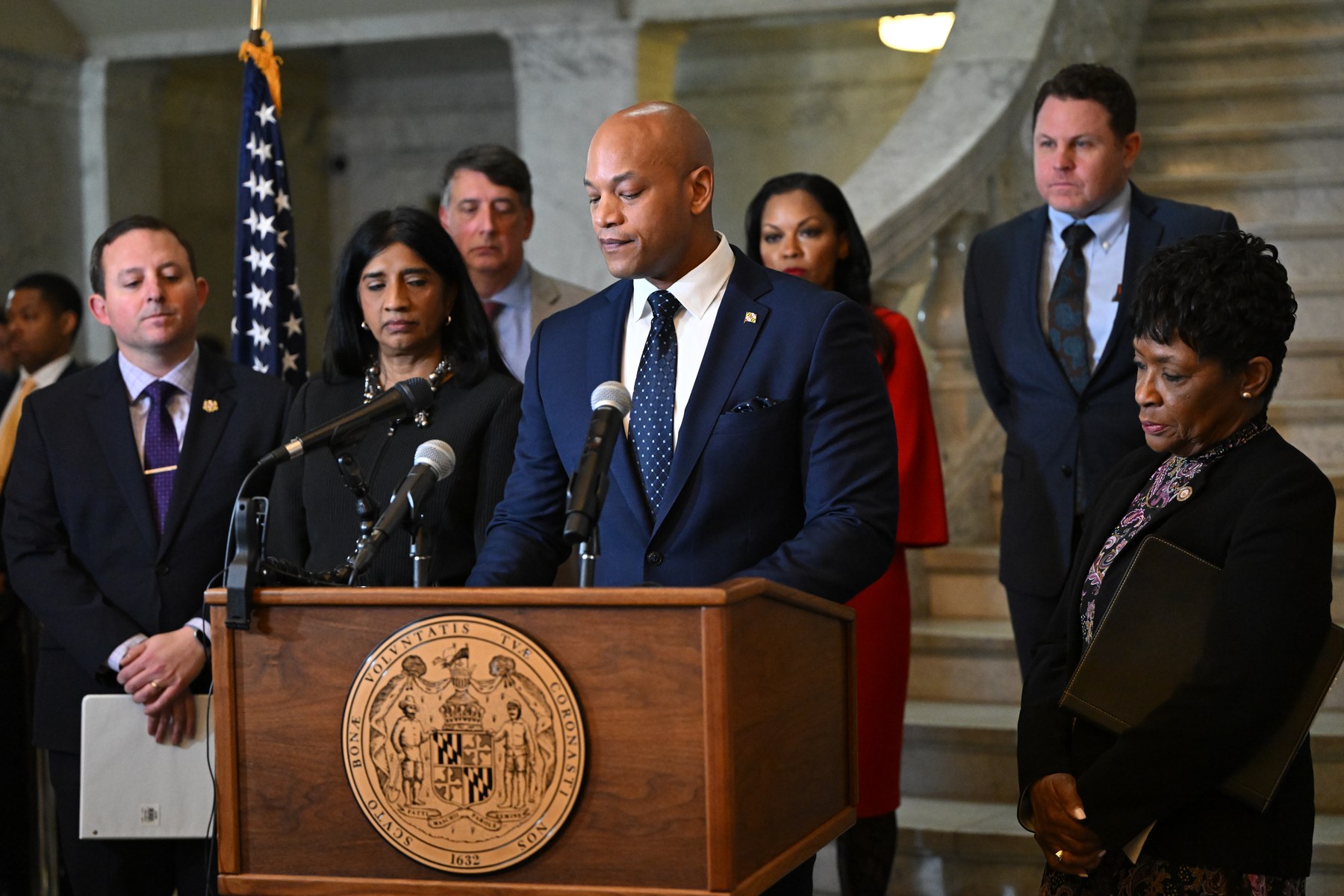
Gov. Wes Moore at a March 20, 2025 budget press conference with the General Assembly's presiding officers at the Maryland State House in Annapolis. Moore is a named defendant, and his office filed the state's appeal the same day the ruling came down. (Pat Siebert / Maryland GovPics, via Wikimedia Commons, CC BY 2.0)
Democrats wrote a July 1 deadline in May, then missed it in August
The law that undid them is Senate Bill 29, signed by Moore on May 12 and effective June 1. It requires the secretary of state to certify ballot question content to the State Board of Elections by the July 1 before a general election, gives the public a 15-day comment period, and requires the text of any proposed amendment to be widely accessible for at least 90 days before the vote.
House Bill 2100 was introduced on Aug. 3, which the opinion notes was "more than a month after the July 1, 2026 certification deadline established by SB 29 had already passed." Democrats attached language exempting their amendment from their own deadline. Assistant Attorney General Daniel Kobrin argued the deadlines never bound the legislature, since the General Assembly wrote the question itself and takes its amendment power directly from the constitution. "Statute cannot defeat the Constitution," he told the court. Thompson did not buy it.
Official record
Michael L. Howell, et al. v. Maryland State Board of Elections, et al., Case No. C-02-CV-26-001986, Circuit Court for Anne Arundel County. Memorandum Opinion of the Hon. Robert J. Thompson, dated Aug. 26, 2026, posted publicly by Maryland Matters.
"Because the legislature did not follow the very laws it enacted, the court finds the enactment of HB2100 to be legally deficient." — Judge Robert J. Thompson, Memorandum Opinion, p. 8
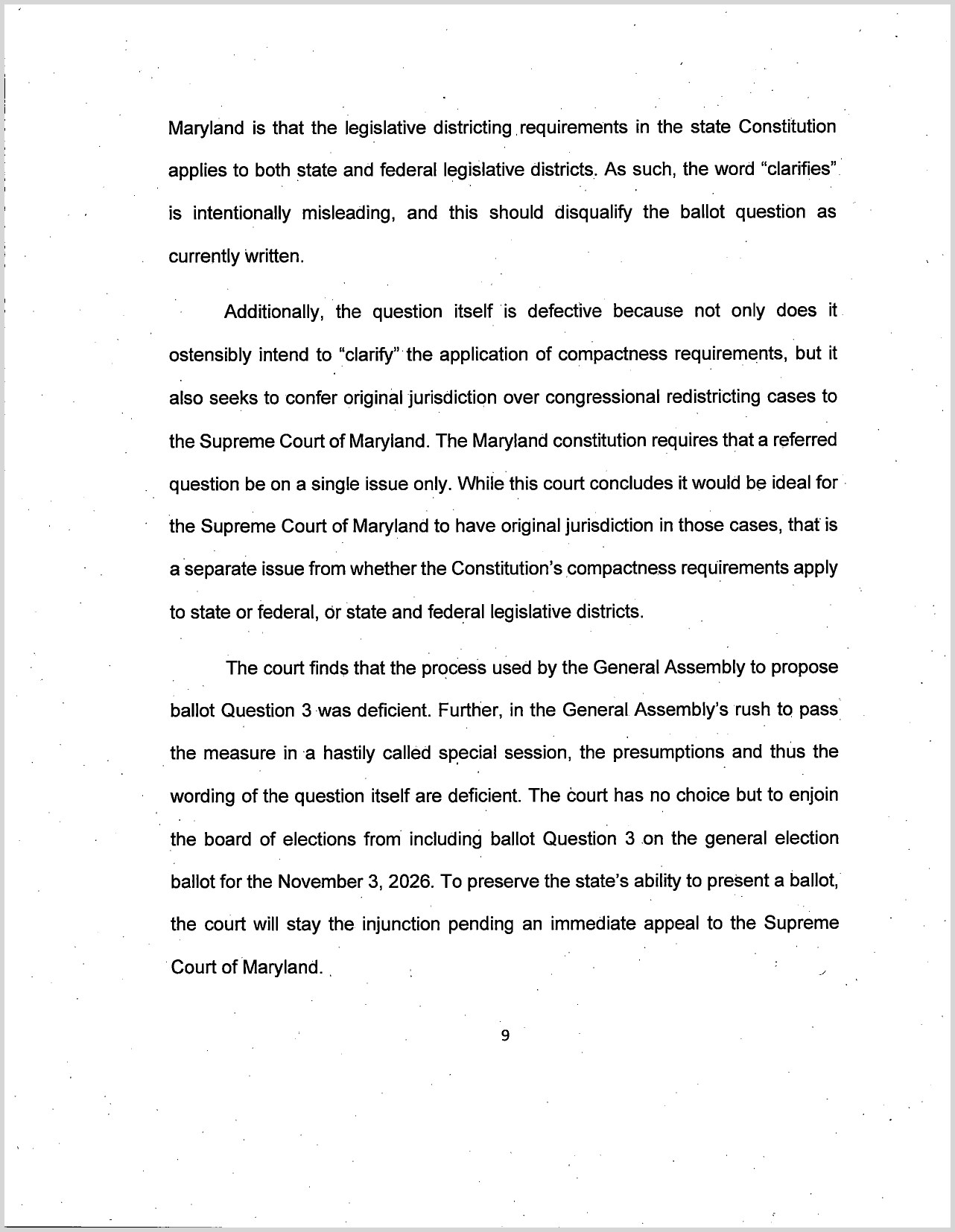
Page 9, where the court reaches the single-issue defect and orders the injunction. Read or download the full 10-page opinion (PDF).
The word that sank the ballot question
Question 3 told voters the amendment "clarifies" that certain standards in the Maryland Constitution apply only to General Assembly districts. The state defended that word by arguing everyone had read the compactness rules as covering state legislative districts alone until a 2022 ruling said otherwise. Thompson rejected the premise flatly. "There is nothing in the record to suggest that was ever a common understanding," he wrote, citing Judge Lynne Battaglia's decision in Szeliga v. Lamone, No. C-02-CV-21-001816, which held the same rules govern both.
So the word "clarifies" is "intentionally misleading, and this should disqualify the ballot question as currently written." He found a second defect too: packing the compactness change together with a grant of original jurisdiction to the state's high court violates Maryland's requirement that a referred question cover a single issue only.
A second judge, across the bay, said the same thing
In Wheatley v. Maryland State Board of Elections, No. C-09-CV-285, Dorchester County Circuit Court Judge S. James Sarbanes issued a 12-page decision on Aug. 28 enjoining the question, and stayed his order as well. "The practical effect of HB 2100 is to remove all Maryland Constitutional standards and protections from congressional districting plans," he wrote. "That is not clear from the ballot question." On the state's position that voters could work it out by reading the constitution themselves, he answered: "It should not be this confusing for a voter."

Rep. Andy Harris of Maryland's 1st Congressional District, the only Republican in the state's eight-member House delegation and the seat Democrats have been trying to redraw. File photo, 2013 Conservative Political Action Conference, National Harbor, Maryland. (Gage Skidmore, via Wikimedia Commons, CC BY-SA 2.0)
What the national scoreboard actually says
The Maryland push was sold as defense against a Republican map-drawing wave. The numbers are public. Ballotpedia's tracker, whose state-by-state tally matches the 2025-2026 redistricting tracker, counts ten states with new congressional maps in force for 2026.
| State | New map | Expected seat shift |
|---|---|---|
| Texas | Signed Aug. 29, 2025; Supreme Court allowed its use in 2026 | +5 R |
| Missouri | Signed by Gov. Mike Kehoe, Sept. 28, 2025 | +1 R |
| North Carolina | Enacted by the legislature, Oct. 22, 2025 | +1 R |
| Ohio | Redistricting Commission, Oct. 31, 2025 | +2 R |
| California | Proposition 50, approved by voters Nov. 4, 2025 | +5 D |
| Utah | Court-approved plaintiff map, Nov. 10, 2025 | +1 D |
| Florida | Signed by Gov. Ron DeSantis, May 4, 2026 | +4 R |
| Tennessee | Signed by Gov. Bill Lee, May 7, 2026 | +1 R |
| Louisiana | Signed by Gov. Jeff Landry, May 29, 2026 | +1 R |
| Alabama | Supreme Court order, June 2, 2026 | +1 R |
| Net | +10 R |
Virginia is the entry missing from that list, and it is the one Maryland Democrats should have studied. Virginia voters approved a Democratic amendment worth an expected four seats on April 21, 2026, by 51.61 percent to 48.39 percent. The Virginia Supreme Court struck the referendum down on May 8 over procedural failures in how it was proposed, and the U.S. Supreme Court refused to stay that ruling a week later. Two blue-state counter-moves have now been stopped, both over process rather than politics.
Everything turns on Sept. 3
The Supreme Court of Maryland has set oral argument for Sept. 3, the same day Maryland's roughly 1,200 ballot versions are due at the printer at close of business. That is why election officials expect a decision that day. Ballot proofs went up for review starting Aug. 31, and because both injunctions are stayed, those proofs still carry Question 3.
Moore's office says it disagrees with the circuit court and has already appealed. Senate President Bill Ferguson expects the high court to affirm the General Assembly's authority. Neither has answered the finding at the center of both opinions: the legislature passed a law in May setting the rules for ballot questions, then decided in August that the law did not apply to itself. Two judges read that record independently and reached the same verdict.