White House economic adviser Kevin Hassett said Sunday he "just" doesn't "buy" the polls showing Americans are sour on the economy, because shoppers are still spending. The spending is real. But the Commerce Department's own August report shows real after-tax income went nowhere that month, and families covered the difference by cutting their savings rate to the lowest level since November 2022.
Hassett Says the Cash Registers Beat the Polls
Hassett, director of the National Economic Council, made the case on CNN's "State of the Union" on October 4. "Ahead of an election cycle, the fact that there's, you know, possibly partisan pollsters telling us that the people are really really depressed, it's a classic Democrat move, and I just don't buy it," he told Jake Tapper, as quoted by The Hill and RedState.
His evidence was the checkout line. "If the polls were any value for thinking about what's going on with consumers, then we should look at the consumption data and say, 'Geez, yeah, that's right. People aren't spending.' But, in fact, the retailers are doing well," he said. Benzinga reported he also said banks tell him consumers are paying back their loans, and that "actions speak way louder than words."
The polls he waved off are not subtle. The AP-NORC survey taken September 24-28 put approval of President Trump's handling of the economy at 26%, and his handling of the cost of living at 17%. About 65% said his policies are contributing to high prices.
A Republican Senator Answered Him on the Other Network
The sharpest reply came from inside the GOP. On NBC's "Meet the Press" the same morning, Sen. John Kennedy of Louisiana said, "I think the biggest issue is cost of living. I think we have to tell the American people the truth." Then came the line that is now everywhere: telling voters "not to believe their own lying checkbooks" is "not going to work," according to transcripts published by Breitbart and Newsweek.

Sen. John Kennedy (R-La.), who warned on "Meet the Press" that Republicans have to level with voters about the cost of living. (U.S. Senate official portrait, public domain, via Wikimedia Commons)
Kennedy didn't blame the president. He said inflation "started under President Biden" and "reared its ugly head under President Trump because of the war in Iran," and predicted prices will come down once that war is settled. His point was about message, and it is a fair one. So we went to the same consumption data Hassett pointed to and read it line by line.
Hassett Is Right That People Are Spending
Start with what holds up. The Census Bureau's advance retail report for August put retail and food services sales at $773.9 billion, up 1.2% from July and 6.0% from August 2025. Nonstore retailers, mostly online sellers, rose 2.6% in the month and 9.9% over the year.
The Bureau of Economic Analysis says the same thing in its broader measure. Personal consumption expenditures jumped $190.8 billion in August, a 0.9% monthly gain, and real spending after inflation rose 0.6%. That is a strong month by any standard, and it backs Hassett's claim that Americans have not stopped opening their wallets.
So Where Did the Money Come From?
Here is the part neither network segment got into. In the same BEA release, disposable personal income, meaning income after taxes, rose just $68.6 billion. Spending rose $190.8 billion. Americans added almost three dollars of spending for every new dollar of after-tax income.
Adjust for prices and it gets starker. BEA's own table lists real disposable income growth for August at 0.0%. The underlying FRED series shows it actually slipped, from $18,415.4 billion in July to $18,410.5 billion in August, in inflation-adjusted dollars at an annual rate. Real income was flat to down. Real spending rose 0.6%. The gap had to come from somewhere.
Official record
U.S. Bureau of Economic Analysis, "Personal Income and Outlays, August 2026," release BEA 26-43, September 30, 2026 (BEA release page).
"Personal saving was $990.2 billion, and the personal saving rate, personal saving as a percentage of DPI, was 4.1 percent."
BEA release, page 1
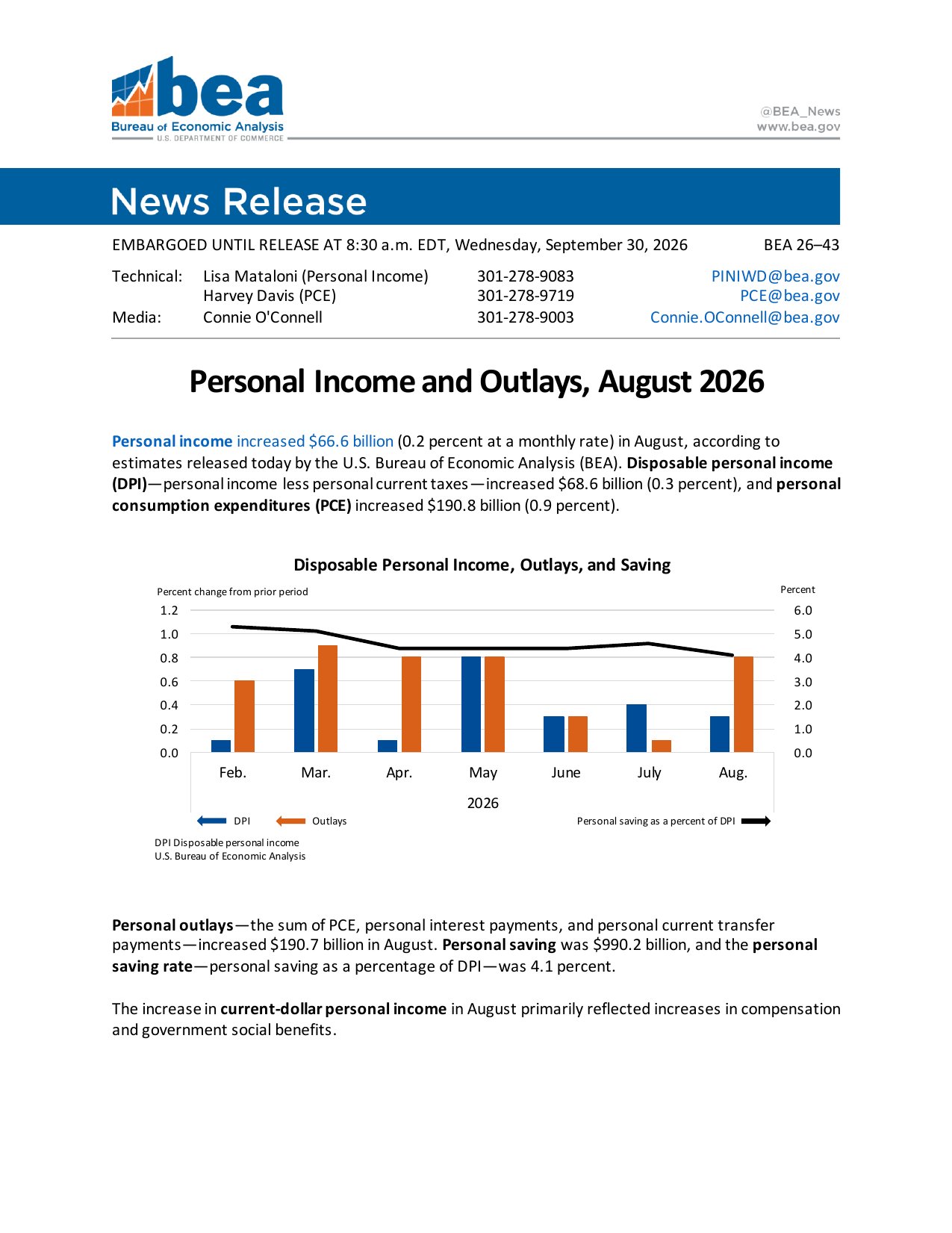
Read or download the full 5-page BEA release (PDF)
The Savings Rate Just Hit Its Lowest Level Since 2022
That somewhere is the family savings account. BEA's personal saving rate fell from 4.6% in July to 4.1% in August. In the full monthly history, you have to go back to November 2022, when it was 4.0%, to find a lower reading. That was during the Biden-era inflation spike.
The trend under this administration runs the same direction. The rate was 5.7% in January 2025 and 5.2% in August 2025. It has now been at or below 4.6% every month since April. A family that saves less to keep buying the same things is not a family that feels rich. It is a family that is stretched.
That is the honest answer to Hassett's question. The polls and the spending data aren't "radically inconsistent," in his words. People can spend more and feel worse at the same time, when the spending is coming out of savings rather than out of a raise.
What the Retail Numbers Look Like Without Gas
The Census report has a second catch. Gas station sales rose 3.1% in August and were up 21.0% from a year earlier, the biggest year-over-year gain of any store category in the report. Pull gasoline out and total retail sales grew 4.9% over the year instead of 6.0%. BEA's spending breakdown shows the same thing, with gasoline and other energy goods adding $20.9 billion to August's spending jump.
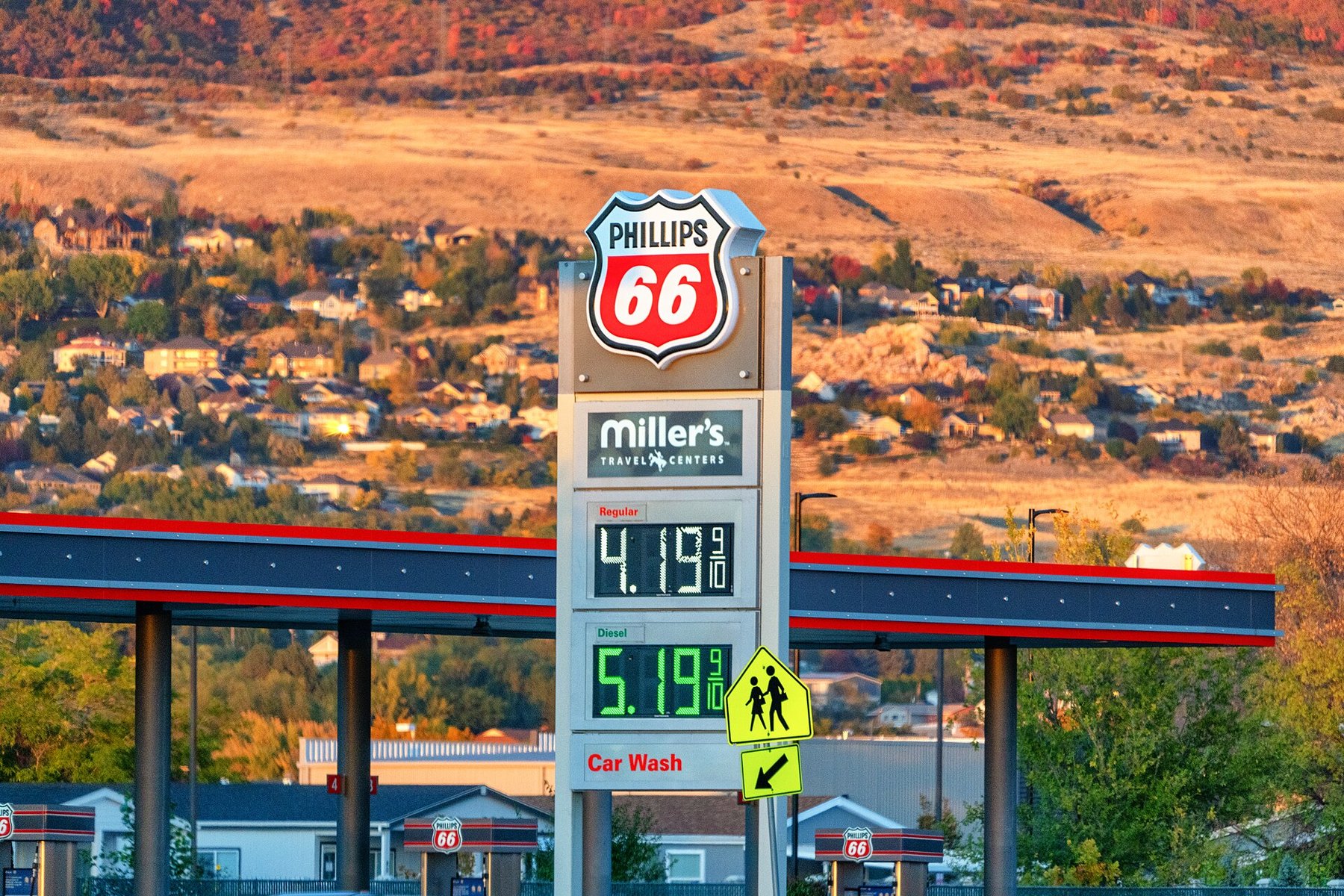
A Phillips 66 price sign near Salt Lake City in October 2022, file photo. AAA's national average was about $4.37 on October 4, 2026. (Photo by Tony Webster, CC BY 2.0, via Wikimedia Commons)
Some of what Hassett called retailers "doing well" is drivers paying more at the pump. AAA's national average was roughly $4.37 a gallon as of October 4. Higher prices make a bigger sales number without anyone buying an extra gallon.
Then there is the grocery line. Census shows grocery store sales up just 0.5% from August 2025 in plain dollars. Consumer prices overall were up 3.4% over the same stretch, per the Labor Department figure cited by Benzinga. Grocery dollars barely moving while overall prices climb suggests shoppers are trading down or buying less.
One caution on the Census numbers. The August figures are advance estimates. Census notes it released revised estimates on September 28 after its annual benchmark, and July was already revised to a 0.5% decline. The broad picture holds, but individual line items can move.
Why This Matters 29 Days Before the Midterms
Hassett has a real argument. Spending growth this strong does not happen in a recession. Treasury Secretary Scott Bessent told Axios this weekend that once the Iran conflict ends, oil will be "more well supplied" and prices "much lower," according to RedState. If gas falls back toward $3.50, a lot of the squeeze eases on its own.
But the data doesn't support telling voters their gloom is a Democrat trick. September's jobs report added just 29,000 jobs, as we covered Saturday, and consumer confidence hit a 12-year low the week before. Households are spending, and they are doing it by saving less. Those are the "lying checkbooks" Kennedy was talking about.
The next BEA report lands October 29, five days before Election Day. If the savings rate keeps sliding, the White House will have a hard time calling the polls partisan, because the government's own spreadsheet will be saying the same thing.
Top photo: Kevin Hassett, then chairman of the Council of Economic Advisers, at an Atlantik-Brücke event in Berlin, May 2018. (U.S. Embassy Berlin, public domain, via Wikimedia Commons)