Pete Hegseth has created a Pentagon Office of Religious Affairs that answers only to him, and he says it ends an era when military chaplains were "buried echelons deep, waiting for permission." Critics called that line rhetoric. A 2024 Pentagon instruction that governs the military's top chaplains shows it was a fairly literal description of the org chart.
What Did Hegseth Actually Create?
Hegseth announced the office on September 30 during his "State of the Force" address to junior officers and enlisted leaders at Marine Corps Base Quantico, Virginia. "Our department is, you might say, putting on the full armor of God, because while we wage physical war, we all know the real battle is spiritual," he said, according to Religion News Service. "God is good; evil is not, and America's military must understand the difference."
The same day, he signed a two-page memorandum establishing the office "effective immediately." It makes the new Director a Principal Staff Assistant with "direct access to the Secretary of War," reporting to the Secretary and Deputy Secretary "without intervening authority." No director has been named yet, Military Times reported.
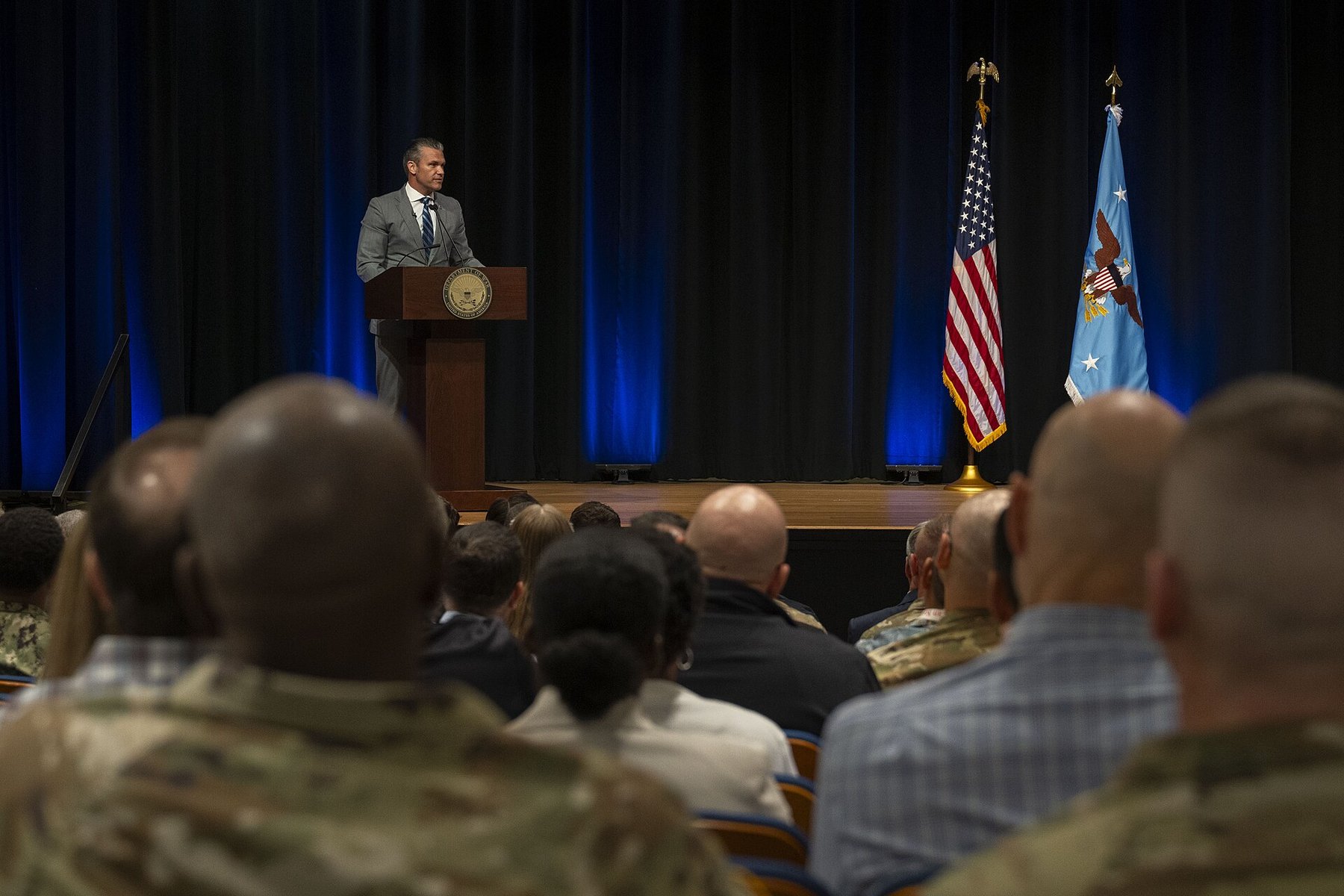
The Secretary of War's prayer service at the Pentagon on Aug. 19, 2026, one of the monthly services Hegseth has hosted. (Department of War photo, public domain, via Wikimedia Commons)
Where Were the Chaplains Before This?
The military's senior chaplains sit on the Armed Forces Chaplains Board, made up of the Chief and Deputy Chief of Chaplains from each military department. Its rules are set by DoD Instruction 5120.08, dated April 24, 2024, and approved by Ashish Vazirani, then performing the duties of the Under Secretary of Defense for Personnel and Readiness under President Biden.
Read the responsibilities page and the chain of command is spelled out. The Personnel and Readiness under secretary "exercises authority, direction, and control over the Board." The board's recommendations to the Secretary go "through the DASD(MPP)," the Deputy Assistant Secretary of Defense for Military Personnel Policy. That deputy assistant secretary in turn works under the under secretary "through the Assistant Secretary of Defense for Manpower and Reserve Affairs."
So the Army, Navy and Air Force chiefs of chaplains, as a board, sat inside a personnel-policy office, which sat under an assistant secretary, who sat under an under secretary. Even the fitness reports for the board's executive director, a colonel-grade chaplain, were handled by the military personnel policy deputy. The board sat three rungs down a personnel ladder, and its advice to the Secretary had to pass through the lowest of those rungs first.
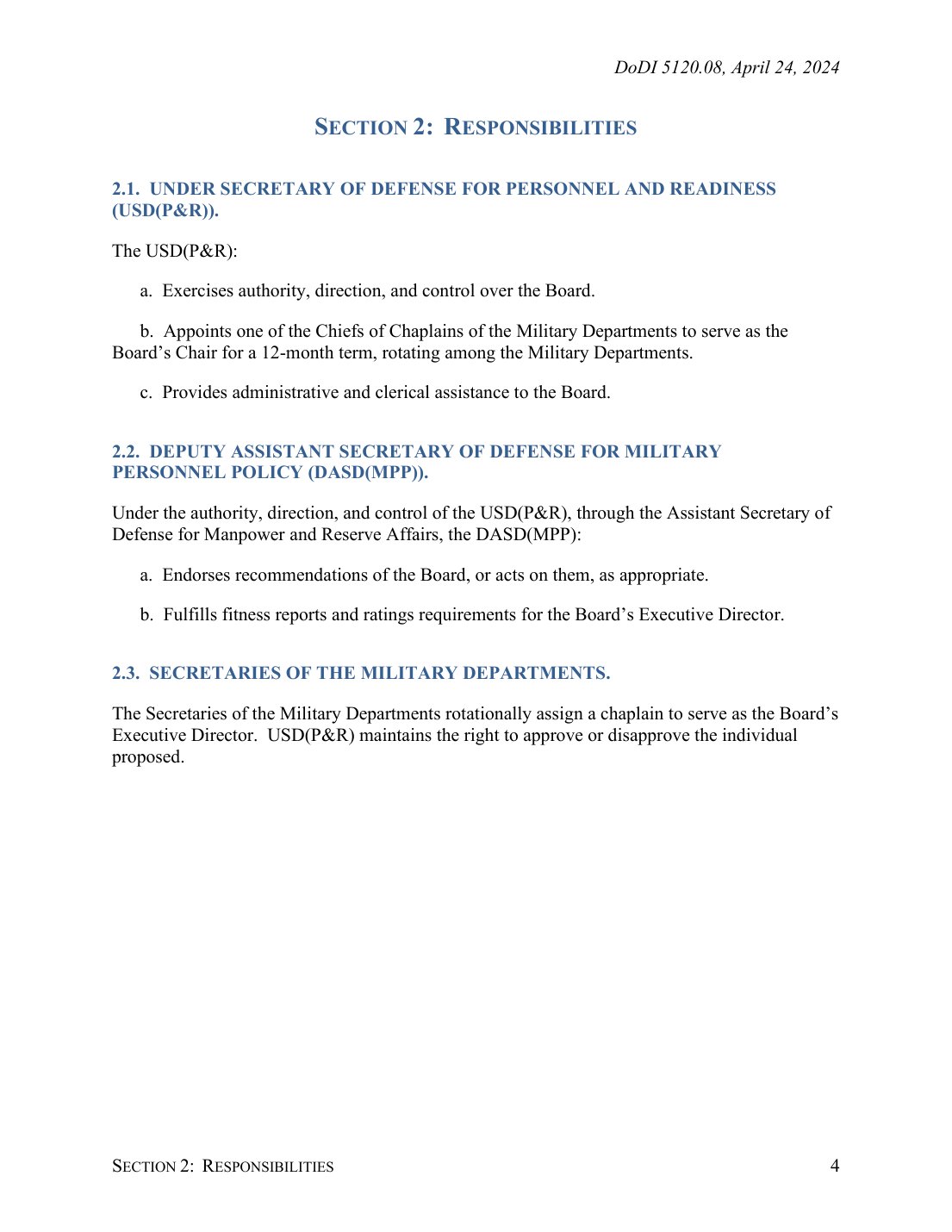
Page 4 of DoD Instruction 5120.08 (April 24, 2024), which places the Armed Forces Chaplains Board under the Under Secretary for Personnel and Readiness and routes its business through the Military Personnel Policy office. (U.S. Department of Defense, public domain)
What the Memo Changes for the Chaplains Board
Hegseth's memo pulls the board out of that stack. Its last listed duty orders the Pentagon to "Realign the Armed Forces Chaplains Board (AFCB) and its Executive Director under the authority, direction, and control of the Director to provide chaplain advisement to the Secretary of War." That is the same "authority, direction, and control" phrase the 2024 instruction gave to the Personnel and Readiness under secretary.
In plain terms, the chaplains' board now reports to a director who reports to Hegseth, with nobody in between. That is what Hegseth meant on stage. "The people who actually practice faith and religion, our chaplains, were buried echelons deep, waiting for permission," he said at Quantico, per Military Times. "We asked chaplains to serve and sacrifice, and then sidelined them with paperwork and process. And that ends now."
The national coverage reported that the board would be "realigned." What the reporting we reviewed did not lay out is where it is being realigned from, and the 2024 instruction answers that question in its own words.
Official record
Secretary of War memorandum, "Establishment of the Office of Religious Affairs," September 30, 2026 (2 pages), published by the Department of War.
"Nothing in this memorandum shall be construed to compel religious participation or to diminish the free exercise rights of any Service member, civilian employee, or family member of any faith or no faith."
Memorandum, page 1
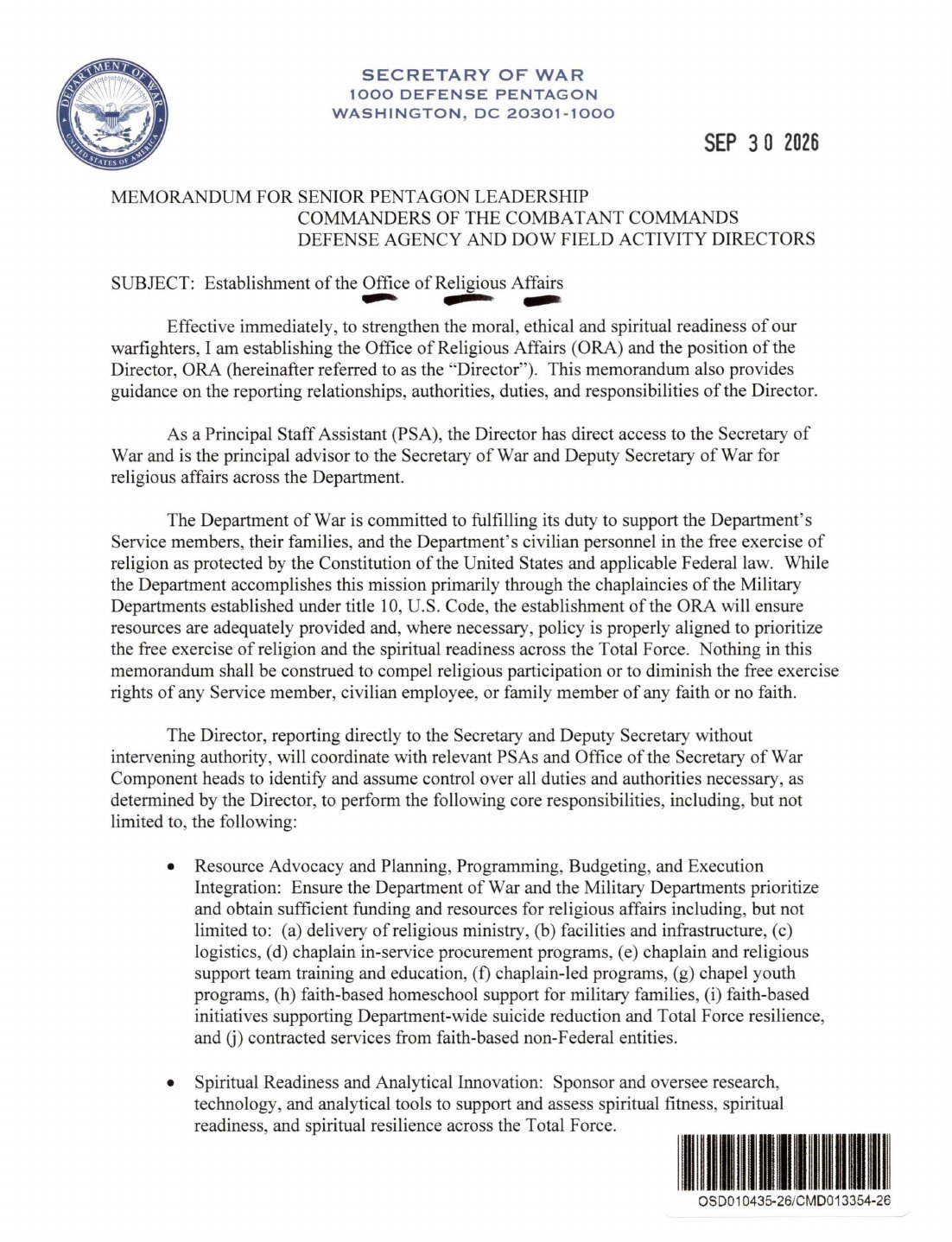
Read or download the full 2-page memorandum (PDF). The 2024 chaplains board instruction, DoDI 5120.08, is here (PDF, 8 pages).
Where Will the Money Go?
The memo's first job for the office is money. The Director is told to make sure the department and the services "prioritize and obtain sufficient funding and resources for religious affairs." The list runs from chaplain training and chapel facilities to chapel youth programs, "faith-based homeschool support for military families," faith-based suicide-reduction efforts and "contracted services from faith-based non-Federal entities."
There is a real gap to fill. The Episcopal Church's bishop for the armed forces, the Rt. Rev. Ann Ritonia, told RNS she found "really good things" in the memo and that the chaplains board has been "understaffed" and "not adequately funded." Field chaplains have long covered more ground than they have people for, riding out to outposts that have no chaplain of their own.
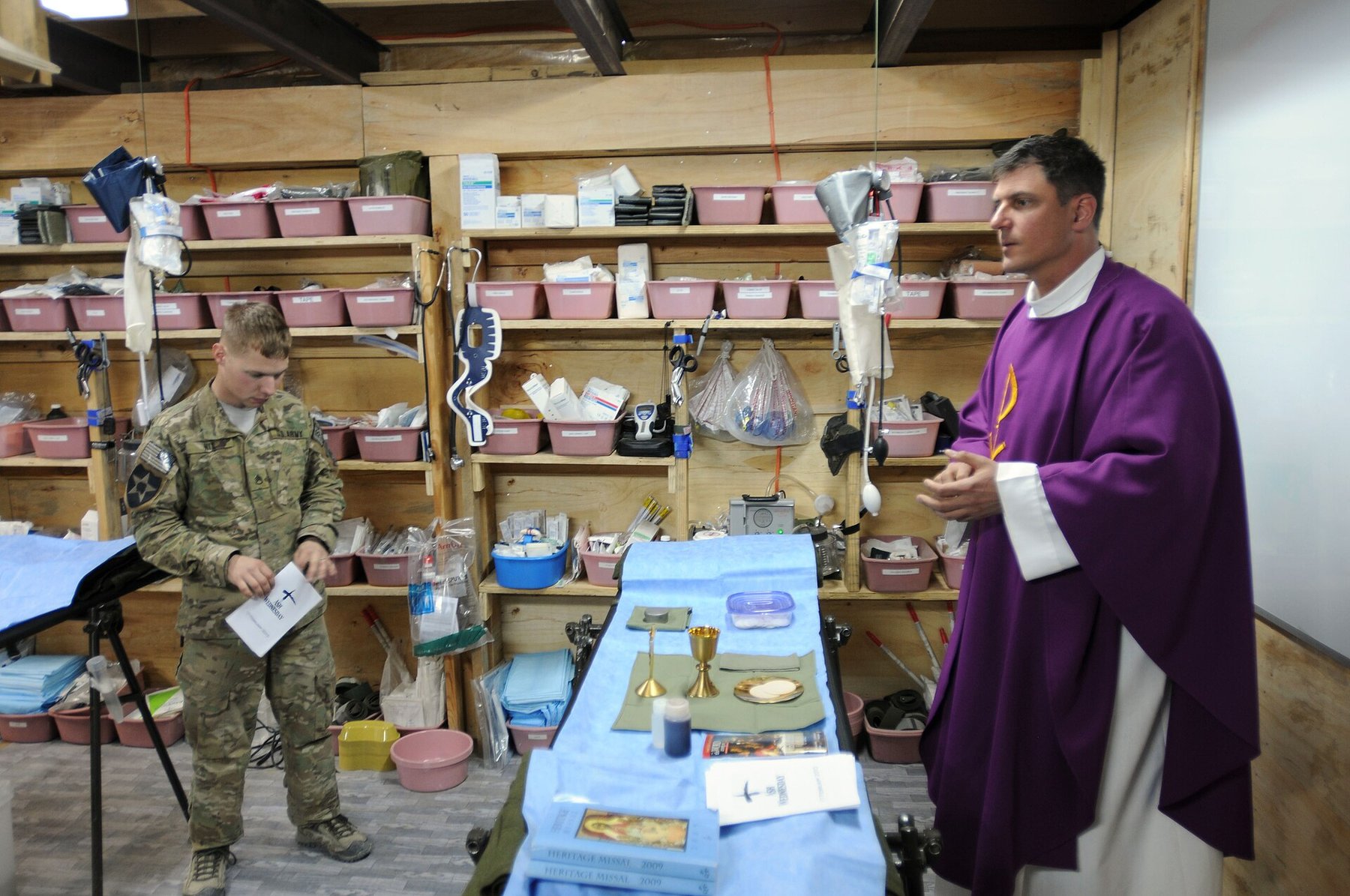
Army chaplain Maj. Paul D. Madej conducts an Ash Wednesday service in 2010 for Staff Sgt. David P. Nix. Task Force Mountain Warrior's chaplains regularly visited bases and combat outposts that had no dedicated chaplain. (U.S. Army, public domain, via Wikimedia Commons)
The Clock Is Already Running
The memo sets hard deadlines. Within 60 days, which falls on November 29, the Pentagon's cost-assessment office and the comptroller must hand Hegseth a plan to fund the office in fiscal 2027. Within 90 days, by December 29, the administration and management director must draft a formal directive chartering the office and identify its senior executive, civilian and military billets.
On that same 90-day clock, each service secretary, working with that service's Chief of Chaplains, owes the new Director "a comprehensive baseline report of all unfunded and underfunded religious affairs requirements." That report will be the first full public-facing count of what the chaplaincy says it has been missing, if the department chooses to release it.
What Are the Critics Saying?
Americans United for Separation of Church and State called the office "yet another example of Hegseth abusing the power of his government position to impose his beliefs on others," according to RNS. Mikey Weinstein of the Military Religious Freedom Foundation accused the Pentagon of elevating "unconstitutional Christian nationalism."
Ritonia raised a narrower, structural objection. "My initial assessment is that it violates the chain of command," she told RNS, warning that direct chaplain access to the office "can undermine good order and discipline, particularly if a particular religious group has the ear of the director." That concern is worth watching, because the memo lets the office "identify and assume control over all duties and authorities necessary, as determined by the Director." The Director, in other words, gets a large say in drawing the office's own lines.
Franklin Graham, who sits on the Justice Department's Religious Liberty Commission, called the office "a great idea" and told RNS that "not all administrations have treated military chaplains as necessary."
Does the 95 Percent Figure Hold Up?
Hegseth told the Quantico crowd that less than 5% of the force identifies as non-religious. The Pentagon has not published a religious breakdown of the force since 2019, Military Times noted. That year's data showed about 70% Christian and 2% atheist or agnostic, with another 24% listed as unclassified or unknown. The atheist and agnostic share fits his claim. Whether the unknown quarter "recognizes an Almighty God," as Hegseth put it, the data cannot say.
The bigger point stands on the documents. For years the chaplains' own board advised the Secretary from inside a personnel office, through a deputy assistant secretary. As of last Wednesday, it advises him through a director who reports to no one else. Supporters will call that putting faith back where it belongs, and critics will call it too much power in one office. Either way, the next test comes by November 29, when the money plan is due.