Georgia's State Election Board director has asked the Trump Justice Department to ban the QR codes Georgia uses to count in-person ballots, with early voting starting October 13. The letter's lead demand leans on a Georgia law it says took effect July 1, 2026. Georgia Republicans already pushed that date back to January 1, 2028, and Gov. Brian Kemp signed the delay three months before the letter went out.
What the Election Board Asked Washington to Do
The letter is dated September 30 and signed by James Mills, the board's executive director. It is addressed to Harmeet Dhillon, who runs the Justice Department's Civil Rights Division, with copies to Attorney General Todd Blanche and Homeland Security Secretary Markwayne Mullin. The five-page PDF runs three pages of letter plus a two-page board resolution.
Mills lists nine complaints about the Dominion Democracy Suite 5.5-A system Georgia uses statewide. Then he asks for six things. The headline items are a federal ban on QR-code tabulation and "a binding six-month deadline" for Georgia to switch systems. He also wants DOJ to force an update to newer Dominion software "all prior to the November 2026 General Election," and he wants federal investigators to look at Secretary of State Brad Raffensperger's handling of election records and the state's data sharing with ERIC.

Harmeet Dhillon, now Assistant Attorney General for Civil Rights and the letter's addressee, at AmericaFest in Phoenix, December 2022. (Photo: Gage Skidmore, CC BY-SA 2.0, via Wikimedia Commons)
Neither agency has said what it will do. A Homeland Security spokesperson told Votebeat the department "responds to official correspondence through official channels." The Justice Department did not answer Votebeat at all.
The July 1 Deadline in the Letter No Longer Exists
Request number one asks DOJ to ban QR-code counting "in conformity with" the Help America Vote Act and "consistent with O.C.G.A. § 21-2-379.23(d) (effective July 1, 2026)." That state code section comes from SB 189, the 2024 law that barred QR codes and other machine coding from the official count starting July 1 of this year.
It never kicked in. Georgia blew past the deadline without buying a replacement system, so Kemp called a special session. Lawmakers passed Senate Bill 3EX, and Kemp signed it June 25. According to Capitol Beat, it "postpones the prohibition until Jan. 1, 2028."
That delay was Republican work. Ballotpedia's tally shows 93 House Republicans and one Democrat voting for the final version, which passed 94-79, and the Senate passed it 36-16 with 32 Republican votes. So the board's letter is asking Washington to enforce a date that Georgia's own Republican majority moved back by 18 months, and it presents that date as current law.
Official record
Georgia State Election Board, "Formal Request for Department of Justice Intervention," letter from Executive Director James Mills to Assistant Attorney General Harmeet K. Dhillon, September 30, 2026, with the board's September 28 "Dominion Update Coordination" resolution (5 pages), as published by Democracy Docket.
"Prohibit the use of unreadable, unverifiable QR-code-based vote tabulation and any other electronic tabulation method that does not permit the voter to verify the vote that is actually counted, in conformity with 52 U.S.C. § 21081(a)(1)(A)(i) and (C), consistent with O.C.G.A. § 21-2-379.23(d) (effective July 1, 2026)."
Mills letter, page 2, Specific Relief Requested, item 1
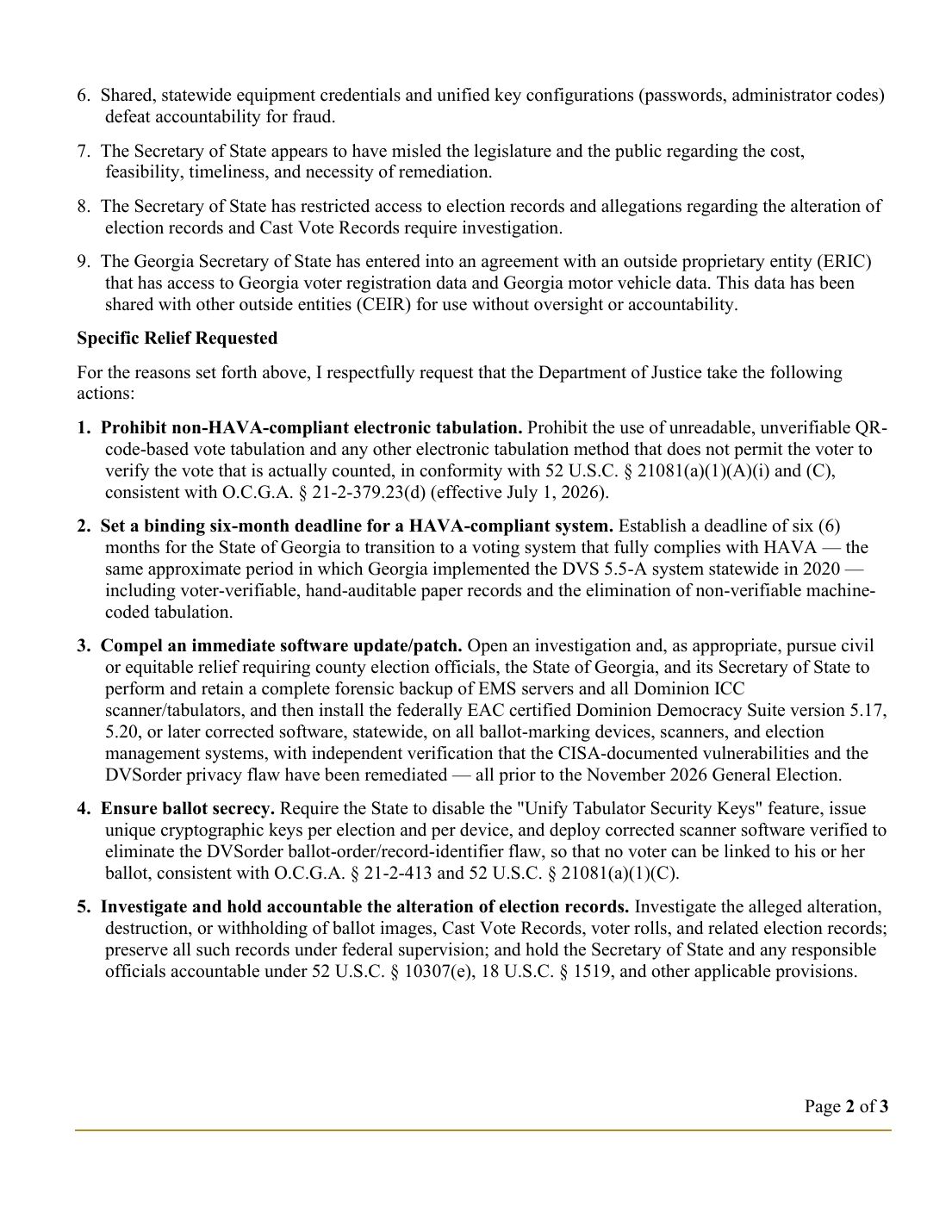
Read or download the full 5-page letter and resolution (PDF) · SB 3EX moved the QR-code ban to Jan. 1, 2028
Six Months Would Beat the Legislature by Nine
The second request asks for a six-month deadline to move to a system with "voter-verifiable, hand-auditable paper records." Mills says that matches how fast Georgia rolled out the Dominion system in 2020. If DOJ started that clock this week, it would run out around the start of April 2027.
That is roughly nine months ahead of the January 2028 date lawmakers just wrote into law. SB 3EX also put legislators, not Raffensperger, in charge of recommending Georgia's next voting system, Capitol Beat reported. A federal six-month order would leap past the committee the General Assembly created for that job.

The Georgia State Capitol in Atlanta, where lawmakers passed SB 3EX in a June special session. (Photo: Andre m, CC BY-SA 3.0, via Wikimedia Commons)
The Board's Own Resolution Never Asked for a Ban
The letter says the board adopted the enclosed "Dominion Update Coordination" resolution on September 28. Read the resolution itself, which is pages four and five of the PDF. It "urged" Raffensperger to install the Dominion updates. It called for forensic copies of server and scanner hard drives first, and it let Mills "seek assistance from any quarter," DOJ and DHS included.
Its closing paragraph tells Mills to help DHS and DOJ "in their examination of the use of QR Codes in Georgia elections as a potential violation" of HAVA. It does not ask for a QR-code ban or a six-month deadline. It makes no charge that Raffensperger misled anyone or altered records, either. Those all show up first in Mills' letter.
Two board members say that gap is the problem. Chairman John Fervier, Kemp's appointee and one of two no votes in the 3-2 decision, told Votebeat that members never saw the letters before they went out. "We have no control over our executive director, and he does whatever the hell he wants to," Fervier said. Salleigh Grubbs, Lt. Gov. Burt Jones' appointee and a yes vote, said she emailed Mills within hours asking to see the draft, never heard back, and learned the letters had been sent Thursday morning "with everybody else."
The Security Complaints Are Not Made Up
None of this means the underlying worries are fantasy. In June 2022, the federal Cybersecurity and Infrastructure Security Agency published advisory ICSA-22-154-01 on the Dominion ImageCast X, the touchscreen Georgia voters use. CISA said exploiting the flaws would require physical access to machines or the election management system, and that it had "no evidence" they had ever been exploited.
The letter's ballot secrecy item refers to a separate flaw called DVSorder, tracked as CVE-2022-48506. University of Michigan researcher J. Alex Halderman's team found that certain Dominion scanners assign ballot IDs in a predictable way, which can reveal the order ballots were cast in. The researchers say that can let outsiders link individual voters to their ballots.
The core HAVA complaint is simple. A Georgia voter reads the printed names on the ballot, but the scanner counts the QR code, which no human can read. 52 U.S.C. § 21081 requires that voters be able to "verify (in a private and independent manner) the votes selected by the voter on the ballot." Raffensperger's office answers that its ballot image audit showed the QR codes matched the printed text, and the legislature agreed the codes had to go, eventually.
Why Raffensperger's Office Says It Is Too Late
The fight now is about timing. A spokesperson for Raffensperger told Georgia Public Broadcasting, "People who are serious about election security don't inject chaos in the 11th hour." GPB reported that Dominion's software update is free but still needs staff to load it onto every machine, and that the secretary's earlier funding requests for updates were never approved.
Grubbs, who backed the resolution, sees the calendar the same way. "I know we don't have time to do those kinds of updates before November," she told Votebeat. In-person early voting opens October 13, eight days from now.
What Happens Next
It is not clear what authority the Justice Department would use to ban equipment the U.S. Election Assistance Commission certified, weeks before an election, with a state law already on the books phasing it out. But the request lands on a department already fighting Raffensperger over Georgia's unredacted voter roll, Votebeat reported. The board's resolution also refers to a September 2 DHS and DOJ letter examining Georgia's QR codes as a possible HAVA violation. Washington has room to keep the QR-code question alive after November even if it does nothing before.
For Georgia voters who want ballots they can read and check, the honest scorecard is mixed. Their legislature already voted to kill the QR code, on a 2028 timeline. The board's director tried to speed that up by citing a deadline that no longer exists, in a letter his own board members say they never approved. If the goal is a count every Georgian trusts, that sloppiness hands Raffensperger's defenders an easy reason to wave the whole complaint away.
Top photo: Georgia Secretary of State Brad Raffensperger at a Knight Foundation reception in Coral Gables, Florida, November 28, 2022. (Photo: Knight Foundation, CC BY-SA 2.0, via Wikimedia Commons)