President Trump is sending a one-time $90 payment to more than 20 million seniors on Medicare Part B, paid out of a fund Washington has refused to spend for 18 years. Read the law behind the fund and you find the real story: by our count, 39 laws have set or rewritten the fund's balance since 2008, and it shaved off another $21 million just one month before Trump moved to spend it.
What Trump Announced Friday Night
Just before 11 p.m. Eastern on Friday, Trump posted on Truth Social that his administration would "immediately, begin sending 'Checks' of nearly $100 to over 20 MILLION wonderful Seniors to help pay for their Medicare Part B premiums." He said the money "will come from the Medicare Improvement Fund, a pointless 'Slush Fund' that has only been used by Dumocrats in Congress to pay for the Waste, Fraud, and Abuse for their Special Interest friends."
The White House fact sheet put the exact figure at $90 per person. Most people will get it by direct deposit in early October. Anyone without direct deposit gets a paper check mailed to the address Medicare has on file.
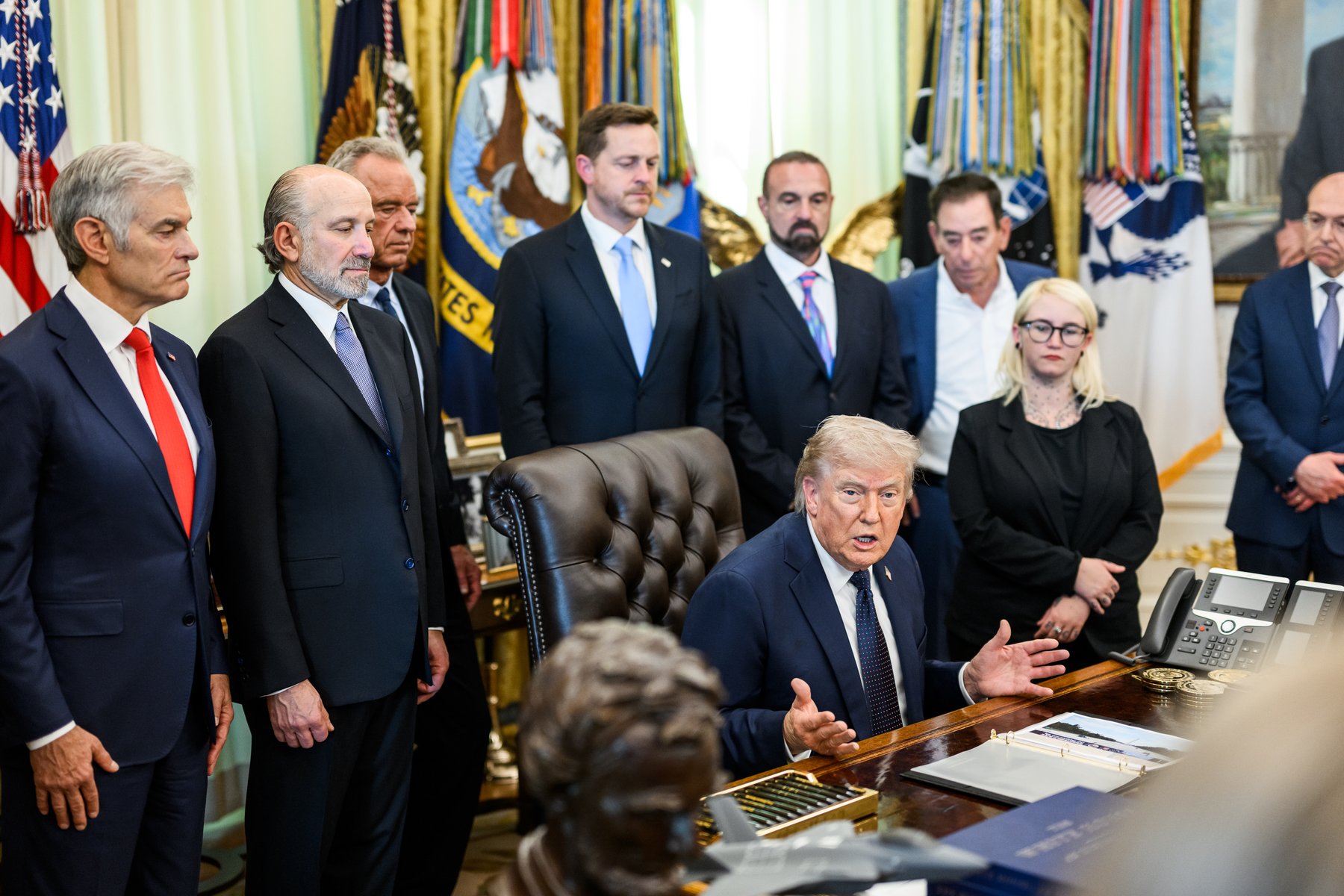
President Trump at an Oval Office health care affordability event announcing a drug pricing deal with Regeneron, April 23, 2026. (Official White House Photo by Molly Riley, public domain, via Wikimedia Commons)
Who Gets the $90, and Who Doesn't
The fact sheet says "most" Part B enrollees qualify. Two groups are left out: people whose premiums Medicaid already pays, and higher earners who pay the Income-Related Monthly Adjustment Amount, the surcharge Medicare adds on top of the standard premium. Seniors can check eligibility at 1-800-MEDICARE (1-800-633-4227), and the White House says payment status questions go to Social Security at 1-800-772-1213.
One warning worth repeating to every parent and grandparent. The real money arrives as a direct deposit or a mailed check. No one needs your bank details to "release" this payment, so hang up on anyone who calls asking for them.
As Axios pointed out, the standard Part B premium is $202.90 a month this year, according to Medicare's own cost guide. So $90 covers a little less than half of one month's bill.
A Fund That Has Never Paid Out a Dime
Congress created the Medicare Improvement Fund in a 2008 supplemental spending bill. The statute, 42 U.S.C. 1395iii, makes the money available "to make improvements under the original Medicare fee-for-service program under parts A and B" for people enrolled in those programs.
In April 2023 the Congressional Budget Office looked at the fund's whole history and reported a blunt finding: "CMS has not spent money from either fund since their establishment." The White House fact sheet makes the same claim, that "no Administration has ever utilized or made payments from the Medicare Improvement Fund." We found nothing that contradicts it.
Official record
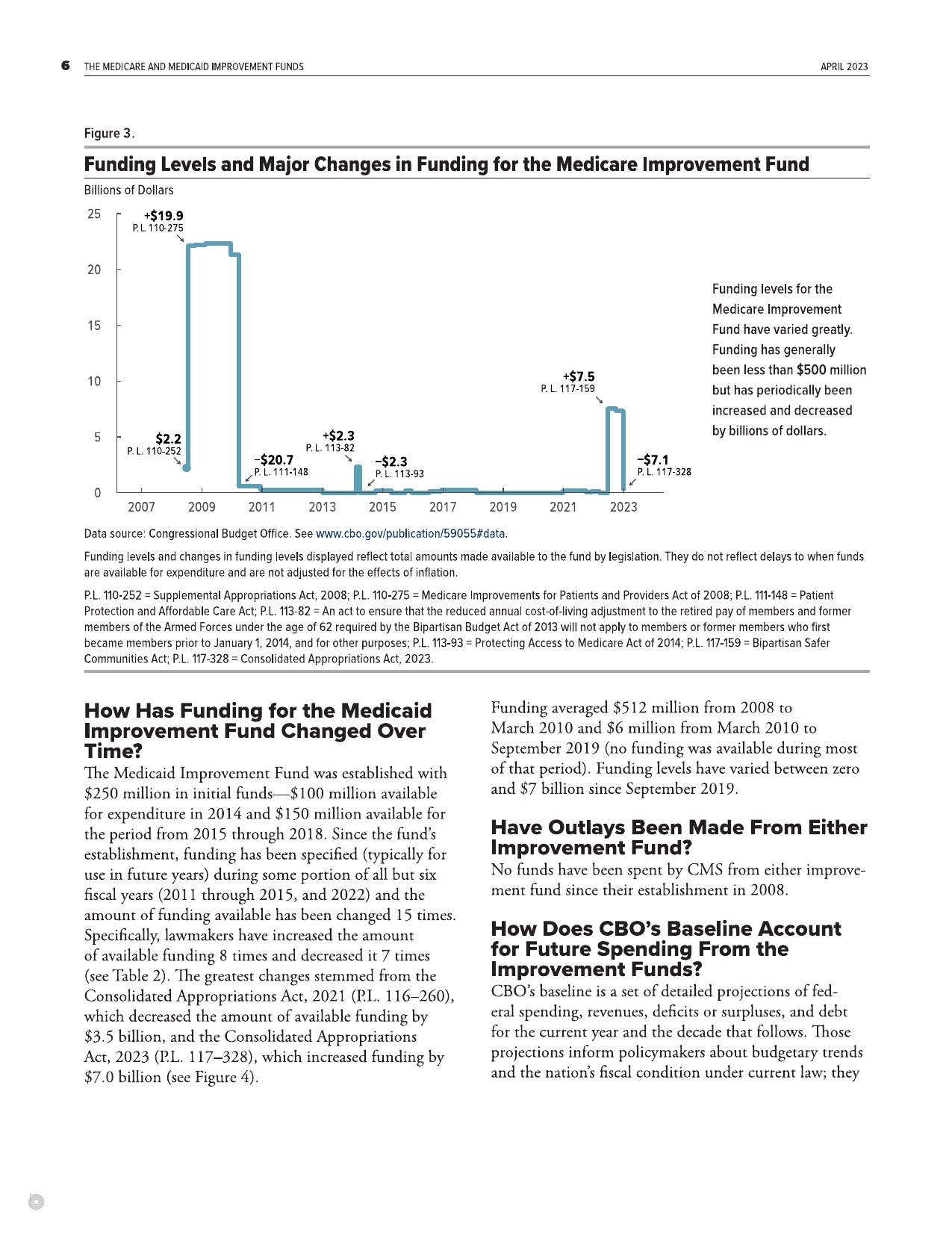
Congressional Budget Office, "The Medicare and Medicaid Improvement Funds: Budgetary History and Projections," Budget Spotlight, April 2023 (9 pages), CBO publication 59055. Page 6 charts the fund's balance swinging by billions of dollars from one law to the next.
"Funding has generally been less than $500 million but has periodically been increased and decreased by billions of dollars."
CBO, Figure 3, page 6
Read or download the full 9-page CBO report (PDF) · the statute and its amendment history
39 Laws Have Moved the Money Around
Here is what the headlines skipped. The amendment notes under the statute list every law that changed the fund's balance. Add the September stopgap spending bill, and we count 39 laws since 2008 that set or rewrote the amount. CBO's own tally through 2022 found lawmakers "increased the amount of funding available to the Medicare Improvement Fund 11 times and decreased it 17 times."
The biggest swing came from Obamacare. CBO's Table 1 shows the 2010 health law cut the fund by $20,740 million, which matches the "$20.7 billion" the White House says Democrats "raided." Under the 2008 law, that money had been slated for Medicare services in 2014 through 2017.
The 2022 numbers are even stranger. The Bipartisan Safer Communities Act, the gun-control package Joe Biden signed that June, parked $7.495 billion in the fund. Six months later the December 2022 omnibus pulled $7.098 billion back out. Seniors never saw a penny of it either time.
Why Congress Treats It Like a Piggy Bank
The CBO report explains the trick in plain language. Because CBO assumes the agency "would eventually spend all the funding available," cutting the balance gets scored as reducing the deficit. Adding to it gets scored as increasing the deficit.
That turns the fund into an accounting lever. Lawmakers can drop a big number into a future year, then pull it back out later and book the cut as "savings" that helps a different bill look paid for. The money only had to look like it might be spent someday. Trump's "slush fund" label is harsh, but the paper trail shows a fund that existed mostly to be raided.
To be fair, both parties have done it. The Bipartisan Budget Act of 2018, signed during Trump's first term, also zeroed out the balance. The difference this time is that someone is actually spending what's in it.
A sample of the Medicare card issued since 2018. The $90 payments go to Part B enrollees. (Centers for Medicare and Medicaid Services, public domain, via Wikimedia Commons)
The Money Became Spendable the Day Before the Announcement
Timing tells you a lot here. Under the current statute, the money is available "for services furnished during and after fiscal year 2027." The federal fiscal year 2027 began on Thursday, October 1. Trump announced the checks Friday night.
The balance itself was set this year. The Consolidated Appropriations Act, 2026, which Trump signed February 3, raised it from $1.403 billion to $2.062 billion, according to the amendment notes. Then Congress went back in one more time. Section 2007 of the stopgap, H.R. 6500, strikes "$2,062,000,000" and inserts "$2,041,000,000." That $21 million trim landed about a month before the checks were announced.
Do the math on what's left. At $90 apiece, $2.041 billion covers about 22.7 million people at most. Twenty million payments would use $1.8 billion, or roughly 88 percent of the fund.
The Fine Print Requires a Signed Certification
The statute has a guardrail. HHS can obligate money from the fund "only if the Secretary determines (and the Chief Actuary of the Centers for Medicare and Medicaid Services and the appropriate budget officer certify)" that the fund holds enough to cover it. The White House has not published that certification, and PJ Media's David Manney argued Saturday that it should, along with the legal reasoning that a premium payment counts as an "improvement" to Medicare.
It is a fair ask, and an easy one to meet. The law's wording is broad, covering improvements "for individuals entitled to, or enrolled for" Medicare benefits, which reads naturally to include helping enrollees with their premium. Publishing the actuary's sign-off would settle the question before Democrats try to turn it into one.
Keep one more detail in mind. The statute says the money is drawn "from the Federal Hospital Insurance Trust Fund and the Federal Supplementary Medical Insurance Trust Fund." In other words, this is Medicare's own money going back to the people enrolled in Medicare.
Seniors Get the Cash That Congress Kept Shuffling
The timing, a month before Election Day, invites the charge that this is a midterm stunt. The record cuts against anyone making that complaint. For 18 years, both parties in Congress kept this money on the books mainly so they could take it away again and claim the savings.
Trump took a balance that has existed mostly as a budget trick and sent it to the seniors the fund was named for. When those deposits land this month, it will be the first time this fund has paid out anything at all, which Congress never managed to do once in 18 years.