House Judiciary Republicans released a 61-page report Wednesday accusing a climate group of coaching judges who hear lawsuits against American energy producers. Buried in the committee's own exhibits is an email the report never quotes: in 2023, the federal judiciary's reviewers asked the authors of a climate chapter for judges to explain "what opposing experts might say." The authors offered to "debunk common myths" instead.
Jordan's Committee Says a Climate Group Targeted "Key Judges"
On September 30, Chairman Jim Jordan's committee published an interim staff report titled "How Radical Environmental Special Interests Manipulate the Federal Judiciary." Its target is the Environmental Law Institute and its Climate Judiciary Project, which runs climate science seminars for state and federal judges. The committee says it has reviewed more than 15,000 pages of documents since opening the probe in August 2025.
The report says at least 140 federal judges have attended the project's training sessions, based on letters from the group's lawyers at Cooley LLP. The project's own website claims it has reached more than 2,000 state and federal judges. Its first four seminars, all in 2019, ran in New York, Washington, Berkeley and Chicago, in partnership with the Federal Judicial Center, which Hanle testified was the body "charged with inviting the judges."
The sharpest line comes from the project's founder, Paul Hanle. In a May 12, 2022 email to a federal lab scientist, he wrote that "without legislative or executive action to address the climate problem, real government action might still be derived from court decisions." He then pitched "a specific idea for attribution" that "could make a great difference in the final outcome of cases."
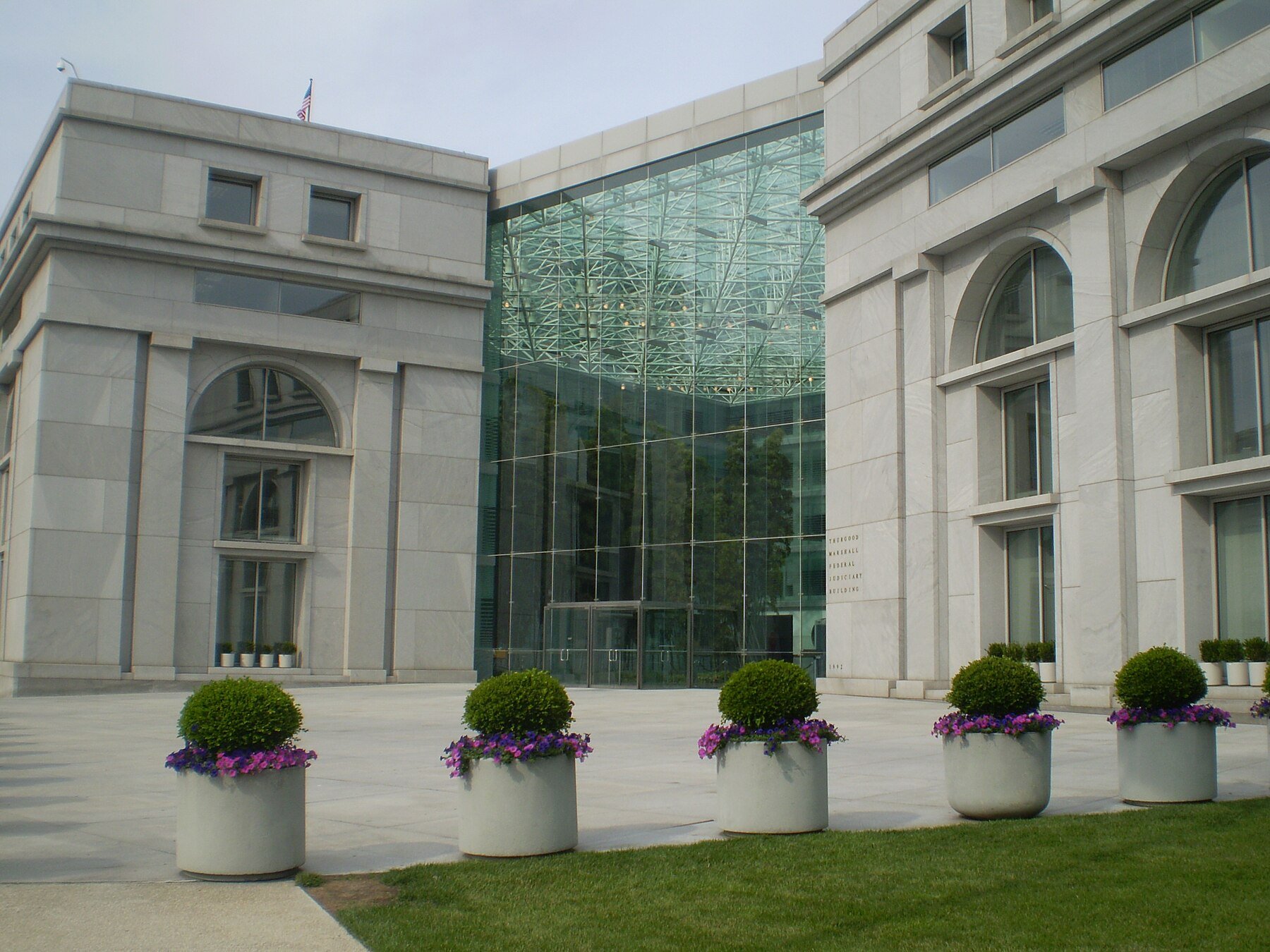
The Thurgood Marshall Federal Judiciary Building in Washington, home of the Federal Judicial Center, the courts' research and education agency. (Photo: Neutrality, public domain, via Wikimedia Commons)
A "Back-Channel" Push to Reach the Supreme Court
A June 11, 2019 email quoted in the report has Hanle telling Columbia's Michael Gerrard that a July seminar would "reach a different and important group of judges at a likely higher level." He added that there was "a back-channel effort to have one or more Supreme Court Justices attend." Asked about it in his July 21, 2026 transcribed interview, Hanle answered, "No. Honestly, I don't recall." That exchange appears in the transcript the committee posted as Exhibit 34.
The report also says the project has no written conflict-of-interest policy for its authors and presenters. Hanle told investigators he relied on "my knowledge of the network of and community of climate scientists, which is extensive" to judge who was fair. A September 2022 email shows him celebrating that one judge "had begun as a skeptic about the effects on health but was turned around."
The institute denies steering cases. The report itself quotes ELI's earlier statement that the project does not "participate in litigation, support or coordinate with any parties related to any litigation, or advise judges on how they should rule on any issue or in any case."
The Judiciary Picked a Plaintiffs' Lawyer First
The second half of the report covers the Federal Judicial Center's Reference Manual on Scientific Evidence, the go-to science guide for federal judges. Its fourth edition, published December 31, 2025, added a climate science chapter. The exhibits show how that chapter started.
On December 29, 2022, Joe Cecil, whom the report identifies as a senior adviser at the National Academies, wrote to Michael Burger, executive director of Columbia's Sabin Center for Climate Change Law, asking him to write it. The invitation said "much of the information for the proposed chapter is included in your 2020 co-authored law review article." It added that the new edition had support from the National Science Foundation and the Gordon and Betty Moore Foundation. Burger accepted the next day and asked to bring in his co-authors, Jessica Wentz and Radley Horton.
That timeline matters for one of the report's claims. Citing a March 13 Wall Street Journal analysis, the committee says the chapter's "substantial similarities" to that 2020 article suggest Burger "may have been an undisclosed third author." The overlap is real, but the judiciary's own invitation asked for it.
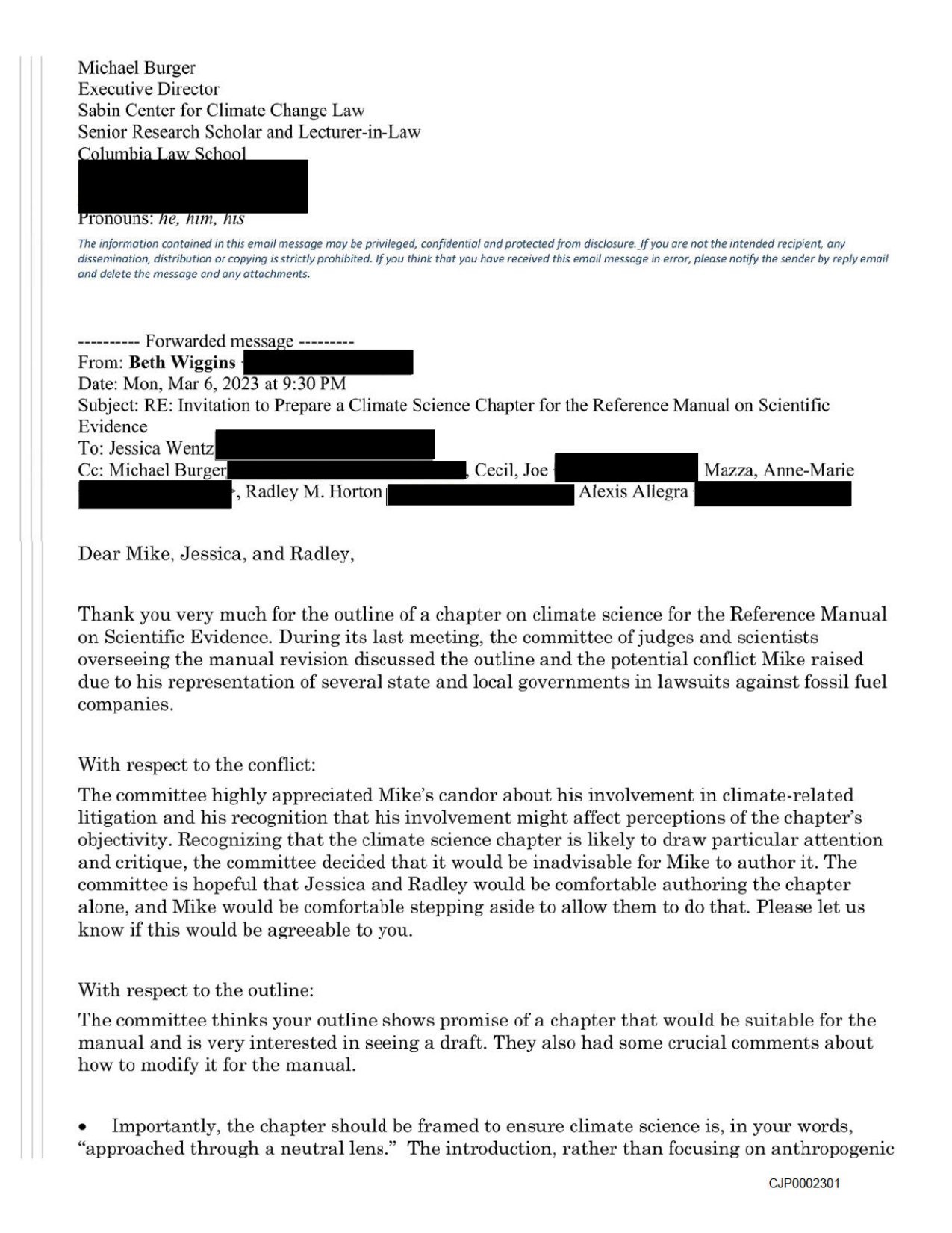
Beth Wiggins of the Federal Judicial Center tells Michael Burger on March 6, 2023 that it would be "inadvisable" for him to author the climate chapter. (House Judiciary Committee, Exhibit 23, public record)
Told to Step Aside, Burger Offered to Help "Behind the Scenes"
Burger disclosed his own conflict, and the judiciary acted on it. On March 6, 2023, Beth Wiggins, the center's research director, wrote that the committee of judges and scientists overseeing the manual decided "it would be inadvisable for Mike to author it" because of "his representation of several state and local governments in lawsuits against fossil fuel companies." Burger is Of Counsel at Sher Edling, a firm that has sued oil companies on behalf of governments, according to the report. Wiggins added that the committee "highly appreciated Mike's candor."
Burger replied at 7:05 the next morning. "I have no problem stepping aside for this," he wrote. "I will be happy to contribute behind the scenes." By April 26, 2023, Wentz was sending Horton a draft that "includes Mike's edits (and my responses)." That is Exhibit 25, and it is hard to square with stepping aside.
Burger's name stayed in the chapter's acknowledgments. In April 2024, Wentz floated "simply deleting the 'acknowledgements' section" to "alleviate the committee's concerns," adding, "I don't think Mike Burger will be offended." The report says the published chapter still thanked him.
Official record
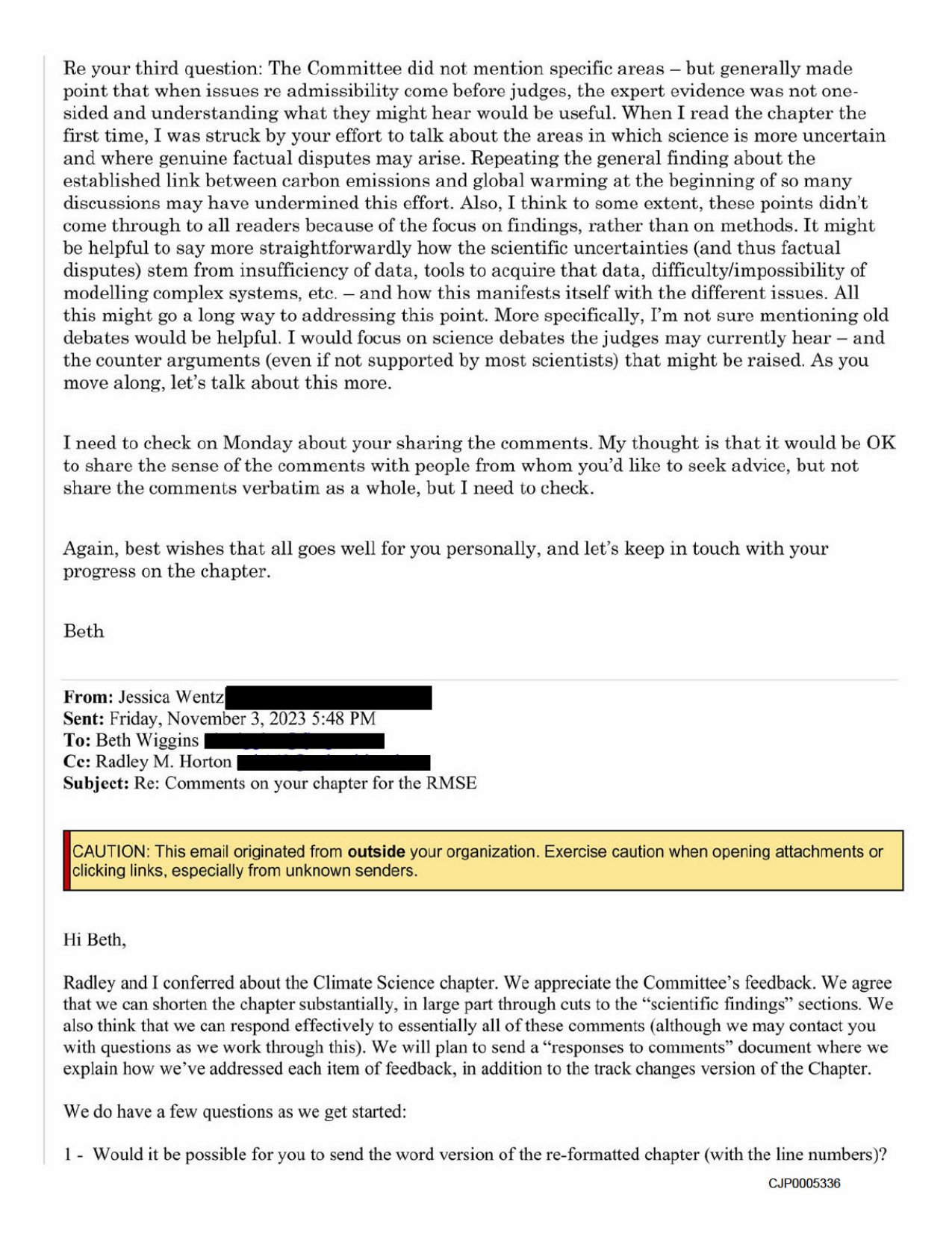
Exhibit 36 to the House Judiciary Committee interim staff report: October and November 2023 emails between Jessica Wentz, Radley Horton and Beth Wiggins of the Federal Judicial Center (5 pages), from the committee's exhibits, part two.
"I would focus on science debates the judges may currently hear ... and the counter arguments (even if not supported by most scientists) that might be raised."
Beth Wiggins, Federal Judicial Center, to the chapter authors
Read or download the 5-page Exhibit 36 excerpt (PDF) · full 61-page staff report
The Email the Report Left Out
Here is the part the report skipped. On October 20, 2023, the oversight committee sent the authors its comments on their draft. One comment, which Wentz quoted back, said "it would be helpful to understand what the rejoinder to some of the points made in the chapter would be, that is, what opposing experts might say."
Wentz's November 3 answer, written with Horton, said they were "not sure what 'contrary scientific findings' should be included." She offered three options. One was to discuss "old debates that have now been settled." Another was to "debunk common myths about climate change." The same email admits, "We did not have time to do an internal peer review process because the timeline for the initial drafting of this chapter was so short."
Wiggins answered on November 4. She wrote that the committee's general point was that when admissibility issues reach judges, "the expert evidence was not one-sided and understanding what they might hear would be useful." She warned that repeating the general finding on carbon and warming "may have undermined this effort," then told the authors to cover "the counter arguments (even if not supported by most scientists) that might be raised." The words "rejoinder" and "myths" appear nowhere in the 61-page report. By our reading, they are the clearest evidence in the whole file that the judiciary asked for balance and the authors resisted it.
Where the Report Stretches Its Own Evidence
Not every claim holds up as cleanly. The press release says Lawrence Berkeley scientist Michael Wehner shared an unpublished training module with attorney Roger Worthington "while the attorney represented Multnomah County" in its $50 billion heat-dome suit, calling it "an active dispute before the federal courts." The report's own body dates that email to March 16, 2023. The county did not file until June 22, 2023, and Worthington testified, "we had not filed a lawsuit."
The case has also been in Oregon state court since a federal judge sent it back in June 2024. Worthington himself referred to "our State court judge." The report also reprints Wehner's June 2, 2023 email turning down a paid consulting role after talking with Berkeley Lab attorneys. None of that clears the module, which Worthington's firm posted on its website. But the committee's case is strong enough without loose dates.
What Congress Does Next
The judiciary has already retreated. Federal Judicial Center Director Judge Robin Rosenberg pulled the chapter on February 6, 2026, eight days after 27 state attorneys general led by West Virginia's John McCuskey objected. The National Academies followed on August 7 and opened a process review that has not reported back.
The report does not name a bill. It says the oversight will "inform legislative reforms to better protect the integrity of the judiciary." The clock is short. Congress is out for the campaign season, and Jordan told Politico he will not seek the top Republican spot on Judiciary when this Congress ends, the Washington Examiner reported. The simplest fix is already in the record. The judiciary's own staff told the authors to give judges the other side, and Congress could write that into law for any outside group that trains federal judges.
Top photo: Rep. Jim Jordan (R-Ohio) speaking at AmericaFest in Phoenix, Arizona, December 19, 2021. (Photo: Gage Skidmore, CC BY-SA 2.0, via Wikimedia Commons)