Employers added 162,000 jobs in August, nearly triple what economists expected and the biggest monthly gain since March. Two industries account for 101,000 of that total: restaurants and bars, and local school district payrolls. Average hourly earnings rose 3.1 percent over the year, and the most recent published inflation reading is 3.4 percent.
Two industries carried 62 percent of the number
The Bureau of Labor Statistics released the August Employment Situation at 8:30 a.m. Eastern on Friday. The unemployment rate held at 4.1 percent. Payrolls rose 162,000 against a consensus of 56,000 in the LSEG poll of economists, a beat of 106,000 that Fox Business called a rebound after July's reported contraction.
Food services and drinking places added 59,000, against an average monthly gain of 12,000 over the prior year. Local government education added 42,000. BLS says that second figure was "largely offsetting a decrease in the prior month," which is the polite way of describing what the underlying series shows: local school payrolls fell 58,000 in July and recovered 42,000 in August, leaving them 16,000 below where they started the summer.
Add the two together and you get 101,000 of the 162,000 headline, or 62 percent of the month. Manufacturing added 16,000 and construction 22,000. Health care added 13,000, well off its 32,000 monthly average. The information industry lost 23,000, concentrated in computing infrastructure and data processing, publishing, and broadcasting.

A booth at The Bad Waitress coffee shop and diner in Minneapolis. Food services and drinking places added 59,000 jobs in August, the single largest industry gain in the report. Photo by Tony Webster, via Wikimedia Commons, CC BY 2.0.
The industry that grew pays $23.74 an hour. The one that shrank pays $55.53.
Table B-3 of the same release carries the pay data, and it is the part almost nobody quoted. Leisure and hospitality, the sector that contains food services and drinking places, paid an average of $23.74 an hour in August and $603.00 a week. Information, the sector that shed 23,000 jobs, paid $55.53 an hour and $2,065.72 a week.
That is a difference of roughly $1,460 a week between the jobs the economy is adding and the jobs it is subtracting. The all-industry private average sits at $37.75 an hour. A month that swaps information jobs for restaurant shifts can produce a strong headline and a weaker paycheck at the same time, and August did exactly that.
Now do the arithmetic on the raise
Average hourly earnings for all private employees went from $36.62 in August 2025 to $37.75 in August 2026. That is a 3.09 percent increase, which BLS rounds to 3.1 percent.
Set that against prices. The most recent published Consumer Price Index is July. Pulling the official index values from the BLS Public Data API, series CUUR0000SA0 went from 323.048 in July 2025 to 333.918 in July 2026, a 3.36 percent increase. The Federal Reserve's preferred gauge ran hotter: the Bureau of Economic Analysis put the PCE price index up 3.7 percent over the twelve months through July, the figure we broke down when it landed.
Subtract, and the raise loses. Wages up 3.09 percent against prices up 3.36 percent leaves real hourly pay down about 0.3 percent, and against PCE it is down about 0.6. Those are our calculations from the published figures, and they pair an August wage number with July price numbers because August CPI does not land until September 11.
BLS itself already ran the clean version. Its Real Earnings release for July, issued August 12, states that from July 2025 to July 2026 real average hourly earnings decreased 0.2 percent. That is the government's own arithmetic, same months on both sides, and it comes out negative.
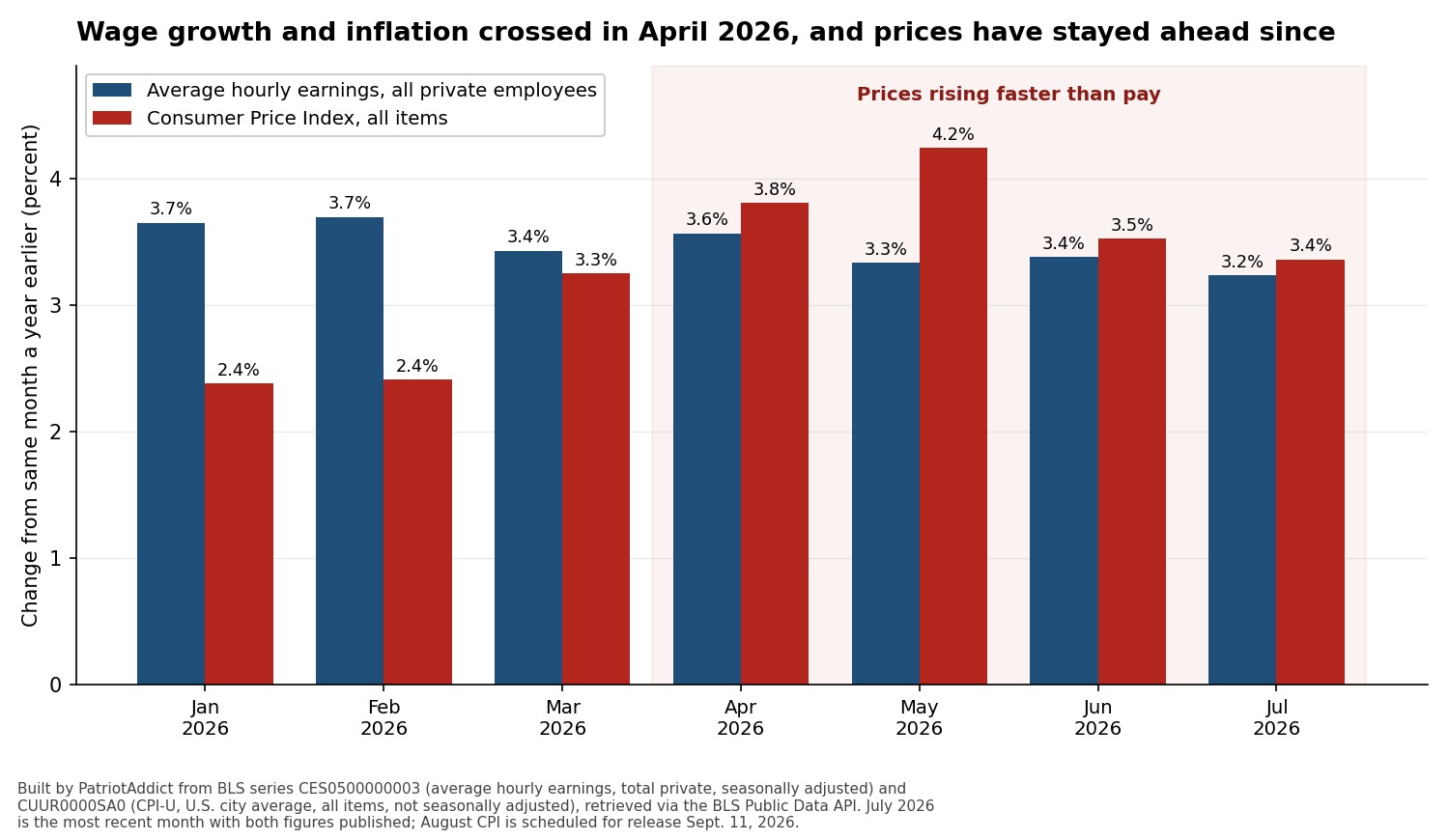
Chart built by PatriotAddict from BLS series CES0500000003 (average hourly earnings, total private, seasonally adjusted) and CUUR0000SA0 (CPI-U, all items, not seasonally adjusted), retrieved from the BLS Public Data API. Wage growth led inflation through March and has trailed it in every month since.
The chart is the part worth sitting with. In January, pay grew at 3.7 percent and prices at 2.4. The lines crossed in April, and inflation has stayed on top every month since. August's 3.09 percent is the slowest wage reading of the year. Families are not confused about why the grocery bill feels worse than the jobs coverage sounds, and PatriotAddict reported record August pump prices two weeks ago. That is the checkout counter this report has to answer to.
What the confidence band actually permits
BLS revised June up by 11,000, from a gain of 20,000 to 31,000, and July up by 44,000, from a loss of 23,000 to a gain of 21,000. Combined, the two months are 55,000 better than first reported. Even so, the release notes the average monthly gain over the prior twelve months was only 31,000. August is an outlier against its own recent history, not a return to form.
There is also a margin of error, and BLS publishes it in plain English.
Official record
U.S. Bureau of Labor Statistics, The Employment Situation — August 2026, release USDL-26-1435, issued 8:30 a.m. ET Friday, September 4, 2026. Thirty-nine pages. Summary on bls.gov and the Technical Note.
"For example, the confidence interval for the monthly change in total nonfarm employment from the establishment survey is on the order of plus or minus 122,000." — USDL-26-1435, Technical Note, Reliability of the estimates
Applied to August, the 90 percent band runs from roughly 40,000 to 284,000. The gain is real by BLS's own standard, since the whole band sits above zero. But a month that could honestly be 40,000 does not carry the weight the "much more than expected" framing gives it. Page one carries a second note easy to miss: October 2025 data were never collected because of the federal government shutdown, which is why that month is a hole in every series here.
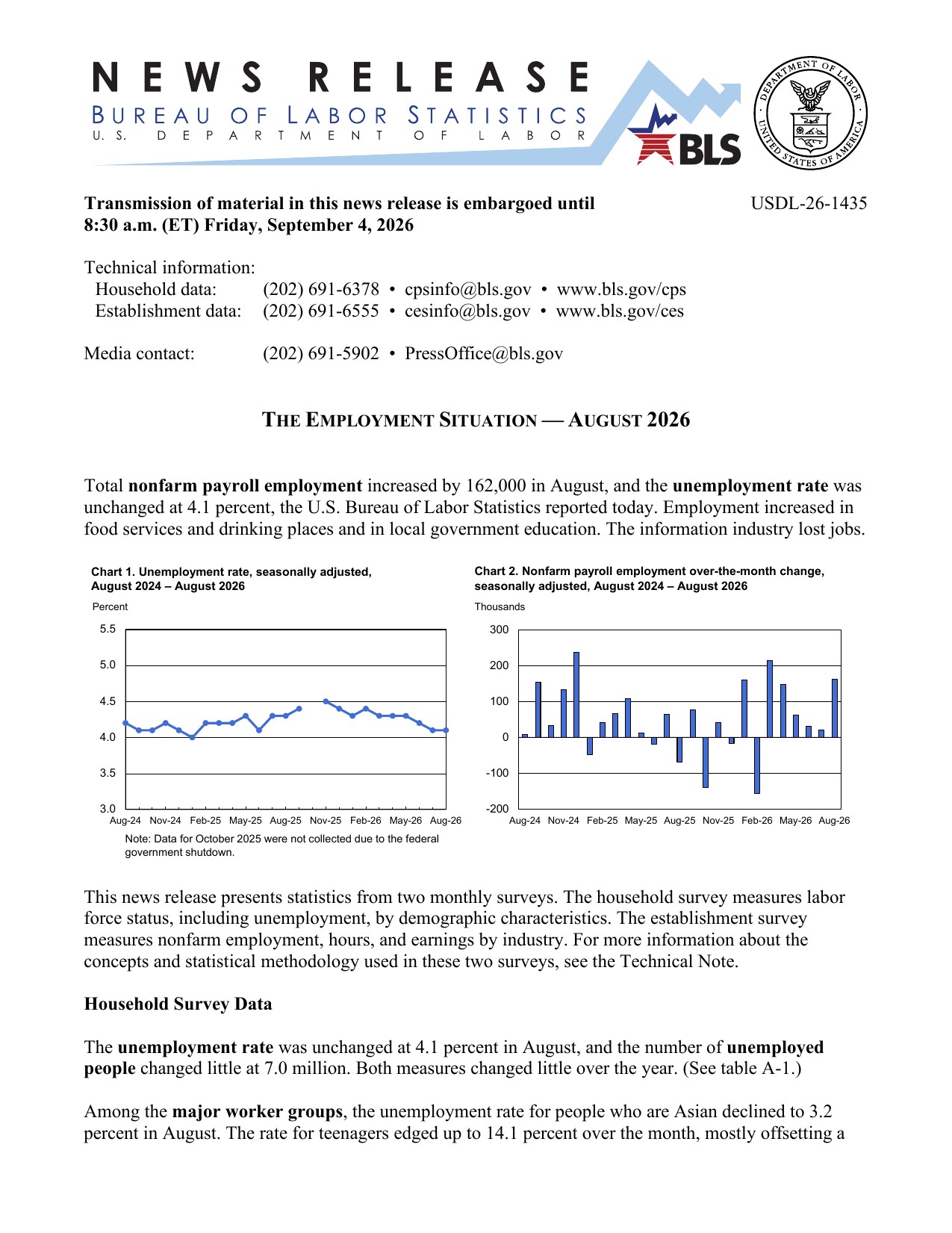
Read or download the full 39-page release (PDF) · BLS Current Employment Statistics program
The household survey has its own wrinkles. The labor force participation rate ticked up to 61.6 percent but is down half a percentage point since January, and a shrinking labor force flatters an unemployment rate without anyone getting hired. The broader U-6 underemployment measure fell to 7.7 percent from 7.9, driven almost entirely by 414,000 fewer people working part time for economic reasons. That is a genuinely good line, and it belongs in the record alongside the wage number.
Trump wants lower rates. The market read this report the other way.
President Trump posted on Truth Social that the Fed should "Lower the interest rates because the U.S.A. is a much stronger credit than it was just a short time ago," adding that the board "must get smart," in remarks Fox Business quoted. Traders moved the opposite way. Odds of a quarter-point hike at the September meeting rose to 60.4 percent from 49.4 percent the day before on the CME FedWatch tool, with the target range currently 3.5 to 3.75 percent.
Rep. Bobby Scott of Virginia, the ranking Democrat on the House education and workforce committee, said "Inflation has outpaced wage growth in recent months." On that specific point the data agrees with him, and it will keep agreeing with him until pay growth gets back above the price line.
Both parties will spend the week arguing about 162,000. The number that decides whether this month felt like a recovery is the one that lands September 11, when August CPI comes out. If prices came in above 3.1 percent again, American workers took another pay cut in a month the headlines called strong.