President Trump signed an executive order on Sept. 4 giving Interior Secretary Doug Burgum 90 days to determine whether the gray wolf and the Mexican wolf have met the recovery criteria to come off the Endangered Species Act. The clock runs out Dec. 3, and whatever Burgum decides is going straight to federal court.
That is not a guess. It is the pattern. Federal agencies have twice tried to hand wolf management back to the states, in 2012 and again in 2020, and both times a judge put the wolves back on the list.
What the order actually orders
The document is titled Supporting America's Ranchers, and most of it has nothing to do with wolves. Section 2 orders a broad regulatory review across five agencies. Section 4 revives the fight over mandatory country-of-origin labeling for beef. Section 3 is the part that lit up the phones at every conservation group in the country.
Official record
Executive Order, "Supporting America's Ranchers," signed Sept. 4, 2026 · Full text at whitehouse.gov · White House fact sheet
"Sec. 3. Helping Ranchers Combat Predation. Within 90 days of the date of this order: (a) The Secretary of the Interior shall make a determination as to whether the gray wolf and the Mexican wolf have met the recovery criteria for delisting or downlisting under the Endangered Species Act (ESA) and, if he determines that the recovery criteria has been met, shall begin the process of delisting or downlisting them." (Executive Order, Sept. 4, 2026)
Section 3(b) is the tell: it has Burgum draft a recommendation for Congress to delist both wolves by statute. Section 3(c) pushes states to drop wolves from their own protected lists. The reason that first line matters sits in a 2011 appropriations bill.
The line ranchers noticed was about subcutaneous hemorrhaging
Section 3(d) tells Interior and Agriculture to revisit their depredation-claim procedures and consider "additional factors beyond subcutaneous hemorrhaging when appropriate." That reads like paperwork until you know what it means on the ground.
Bruising under the hide is what a USDA Wildlife Services investigator looks for to call a dead calf a confirmed wolf kill rather than a scavenged carcass. Under current rules, only confirmed kills get paid, and the Fish and Wildlife Service says plainly that compensation covers none of the indirect damage. Loosen the evidentiary standard and more claims clear. Section 3(e) then tells Interior to relax its criteria for lethal removal and allow "greater emergency responsiveness, including precision targeting."
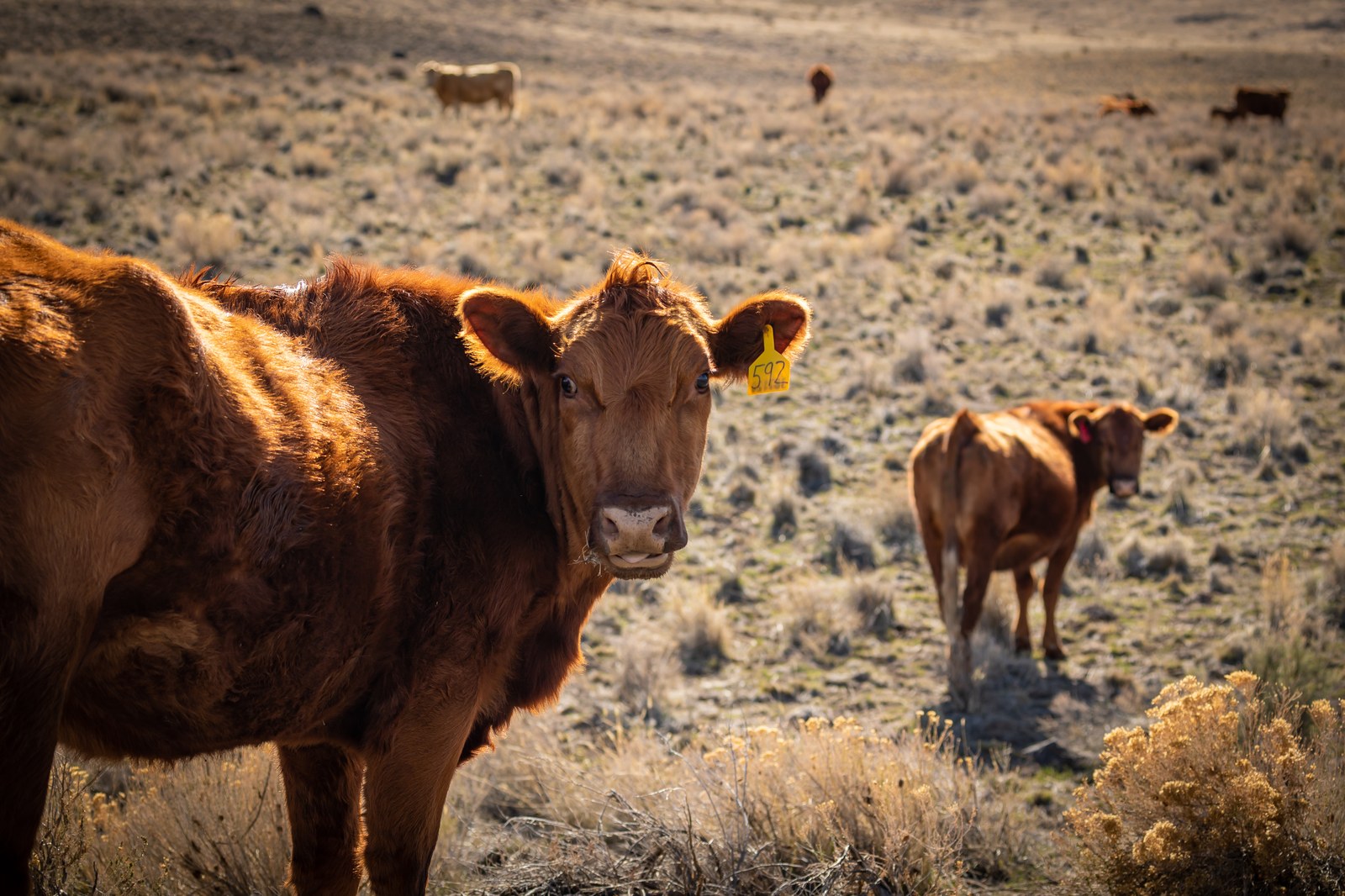
Cattle grazing on a federal allotment east of Steens Mountain, Oregon. Photo: Greg Shine / Bureau of Land Management (public domain, via Wikimedia Commons).
How many wolves are we actually talking about
Eradication campaigns cut the gray wolf's range in the lower 48 by an estimated 95 percent. Federal protection and reintroduction then took the population from roughly 1,000 animals at the early listings to more than 6,000 by 2020, per Fish and Wildlife Service figures cited in reporting on the order.
Today gray wolves are endangered in 44 states and threatened in Minnesota. The Northern Rockies population across Montana, Idaho, Wyoming and parts of Oregon, Washington and Utah is the exception, state-managed since 2011 with hunting and trapping seasons already running. This order does not touch it.
Montana is a reminder that these are estimates, not headcounts. State managers ran two versions of their population model this year. The older one put 2025 at 1,094 wolves. The revised model put it at 725. Same wolves, same state, a gap of nearly 400 animals depending on the math.
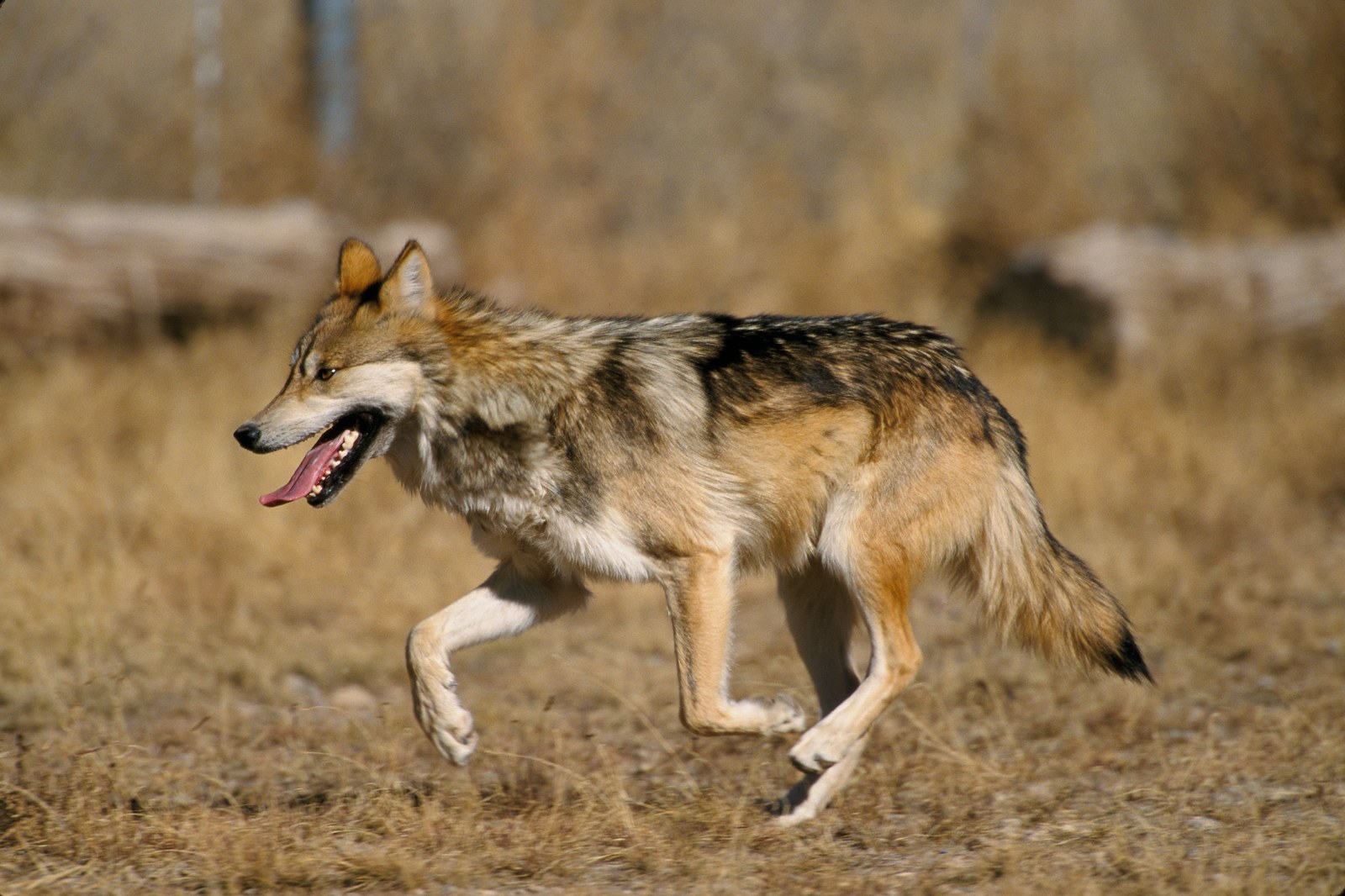
A Mexican gray wolf (Canis lupus baileyi), the subspecies named alongside the gray wolf in Section 3 of the order. Photo: Jim Clark / U.S. Fish and Wildlife Service (public domain).
The Mexican wolf is a narrower question with a clearer number attached. Arizona Game and Fish and New Mexico's wildlife department announced in February that the interagency count reached a minimum of 319 animals at the end of 2025, up from 286. The published downlisting criterion is a four-year average of 320 per year, and Arizona's own release conceded that average has not been reached.
The depredation numbers do not settle the argument
Confirmed wolf depredation incidents in the Mexican wolf recovery area hit 147 in 2025, up from 106 in 2024, a rate of 46 per 100 wolves, per the Mexican Wolf Interagency Field Team. Real animals on real operations, and the count is climbing with the wolf population.
The counterargument is scale. The Center for Biological Diversity points to federal data showing that even at the documented peak in Catron County, New Mexico, the 121 probable and confirmed livestock deaths in 2019 came to about 0.65 percent of the area's cattle, against roughly 6 percent average annual calf mortality from every other cause. Both numbers are true. A 0.65 percent loss rate is small across an industry and ruinous when it lands on your outfit.
Two delistings, two vacaturs, one survivor
In November 2020 the first Trump administration published a final rule taking gray wolves off the list across the lower 48 (85 FR 69778). On Feb. 10, 2022, Judge Jeffrey White of the Northern District of California vacated it, finding the Service had used two healthy core populations to justify a nationwide delisting without reasonably interpreting the "significant portion of its range" standard in 16 U.S.C. 1533. Any new rule has to satisfy that same language.
It was the second loss in a row. In December 2014, Judge Beryl Howell of the D.C. district court threw out the 2012 Western Great Lakes delisting as arbitrary and capricious, putting wolves in Michigan, Wisconsin and Minnesota back under federal control.
One delisting has held. In 2011 Congress attached Section 1713 to an appropriations act, ordered the Service to reissue its 2007 Northern Rockies rule, and walled it off from judicial review. The Ninth Circuit upheld it in Alliance for the Wild Rockies v. Salazar, and those wolves are still state-managed today. That is the precedent Section 3(b) is reaching for.
What both sides said out loud
Mark Miller of the Pacific Legal Foundation says the government is sitting on its own conclusions. "When the government's own data show that a species no longer meets the statutory definition of endangered or threatened, the law requires delisting, not indefinite regulation in search of a new justification," he said.
Michael Robinson of the Center for Biological Diversity named the destination: "We're prepared to prove in court that downlisting Mexican wolves and a steep increase in killings would not only be cruel but also deeply unwise and illegal." Sandy Bahr of the Sierra Club's Grand Canyon chapter called it "a political stunt at the expense of the wolves."
In the Oval Office, flanked by ranchers, Agriculture Secretary Brooke Rollins put the underlying complaint in one sentence: "The problem is, because they're on the Endangered Species List, they can't shoot them. They have to sit and watch them destroy their herd."
Why Dec. 3 is not the real deadline
The administrative road is rougher than the 90-day language suggests. In February 2024 the Service found that listing a western population segment was not warranted. On Aug. 5, 2025, Judge Donald Molloy in Missoula sent that finding back in a 105-page order citing "serious and pervasive" deficiencies, and he named the trap everyone is walking into.
"If the federal agency succeeds in restoring the gray wolf, leading to delisting, then the state agencies will depredate the wolf, leading to relisting, engendering a fruitless cycle of delisting and relisting," Molloy wrote. That is a sitting federal judge describing the loop this order is about to enter.
Burgum can issue a finding by Dec. 3. He cannot make it stick on his own, and the record says so twice over. The only wolf delisting that ever beat a court challenge came from Congress, and Rep. Lauren Boebert's Pet and Livestock Protection Act is sitting in the Senate right now after clearing the House in December. Section 3(b) all but concedes it. Ranchers who want this to last should watch that bill, not the clock.