The FCC asked a federal judge to throw out ABC's First Amendment lawsuit without ever deciding whether Chairman Brendan Carr retaliated against the network. The 56-page filing, stamped Sept. 3 on the docket in American Broadcasting Companies, Inc. v. FCC, No. 1:26-cv-02902 (D.D.C.), tells Judge Loren AliKhan she has no power to hear the case at all, because Congress sent challenges to Commission orders somewhere else. That argument has almost nothing to do with Jimmy Kimmel, and it will probably work.
What the FCC actually filed, in its own words
The document is a combined motion to dismiss and opposition to ABC's request for a preliminary injunction, filed under Rule 12(b)(1), which covers lack of subject-matter jurisdiction and nothing else. TheWrap reported it Sept. 4, and an FCC spokesperson said "Disney filed its meritless case in the wrong court at the wrong time."
Read the brief and one thing jumps out. In a footnote on page 22, the Commission admits it is not moving to dismiss for failure to state a claim, because such a motion "would accept all well-pleaded facts as true" and "the FCC disputes many factual allegations in the Complaint." The agency is not asking the court to rule that ABC's retaliation story is hollow. It is asking the court to say it never had authority to look.
Why the jurisdictional argument is the strong part of the FCC's case
The lead argument runs through the Hobbs Act. 28 U.S.C. 2342 says the courts of appeals have "exclusive jurisdiction to enjoin, set aside, suspend (in whole or in part), or to determine the validity of" all final FCC orders made reviewable by 47 U.S.C. 402(a). Section 402(b) routes a long list of licensing orders to the D.C. Circuit specifically. Under the D.C. Circuit's 1984 decision in Telecommunications Research and Action Center v. FCC, that channeling reaches further than final orders: a district court also loses jurisdiction over any suit whose relief "might affect the Circuit Court's future jurisdiction."
ABC's answer is Axon Enterprise v. FTC, the 2023 case that let a company sue an agency in district court over a constitutional claim without first sitting through the agency proceeding. The Commission's brief spends four pages arguing Axon cuts the other way, and the argument is decent. Axon protected claims attacking "the core of [an agency's] existence" or "structure." ABC is not saying the FCC is unconstitutionally built. ABC is saying the FCC used a power everyone agrees it has for a reason it should not have.
Official record
American Broadcasting Companies, Inc., et al. v. Federal Communications Commission, et al., No. 1:26-cv-02902-LLA (D.D.C.), Document 24, filed Sept. 3, 2026. Retrieved from the free RECAP archive.
"They are unlikely to prevail on the merits because this Court lacks jurisdiction over the subject matter of this case. Congress has limited judicial review of Commission orders to the federal courts of appeals ... Plaintiffs cannot bypass these jurisdictional limits by framing their claim as one for 'retaliation' in response to speech protected by the First Amendment." — Defendants' Combined Motion to Dismiss, at 3
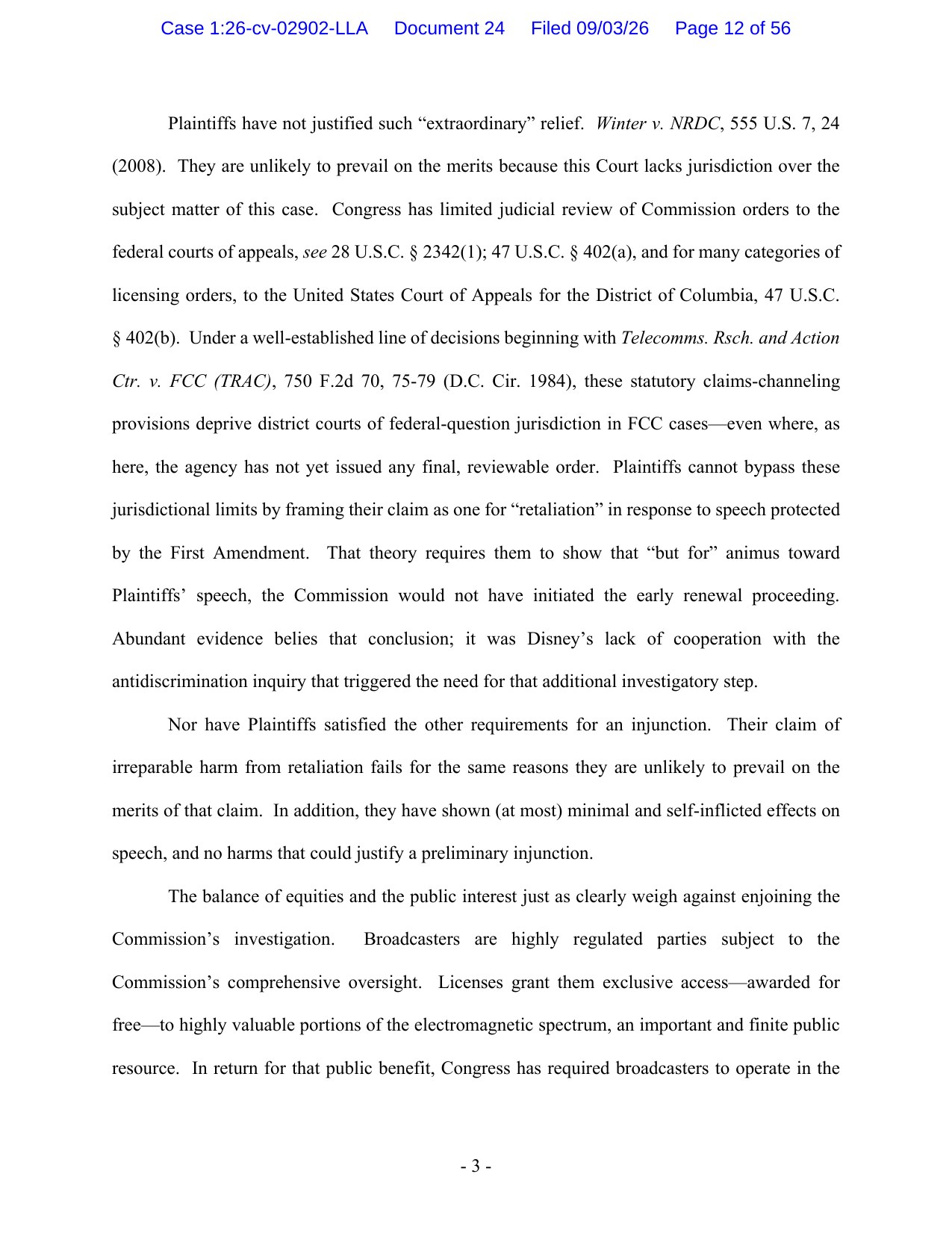
Page 12 of the 56-page filing, where the Commission lays out its jurisdictional theory. Read or download the full document (PDF) · the 46-page complaint ABC filed Aug. 18 is also public.
Does an early renewal order count as coercion under Vullo?
This is where the case gets genuinely hard, and where conservatives should slow down. ABC's complaint leans on National Rifle Association v. Vullo, the 2024 decision the NRA won 9-0 after a New York regulator leaned on insurers to drop the group. The slip opinion sets the test: a plaintiff "must plausibly allege conduct that, viewed in context, could be reasonably understood to convey a threat of adverse government action in order to punish or suppress the plaintiff's speech." Regulatory power is part of the context. As the Court put it, "the power that a government official wields, while certainly not dispositive, is relevant."
The FCC's 56-page brief does not cite Vullo once. Not in the table of authorities, not in the argument. It moves the fight onto retaliation doctrine, where Nieves v. Bartlett demands but-for causation and Hartman v. Moore supplies a "longstanding presumption of regularity" for investigations. On that turf the FCC has a real answer: Carr told Disney on March 27, 2025 that the Enforcement Bureau had opened a discrimination investigation, a year before he said anything about Kimmel or "The View."
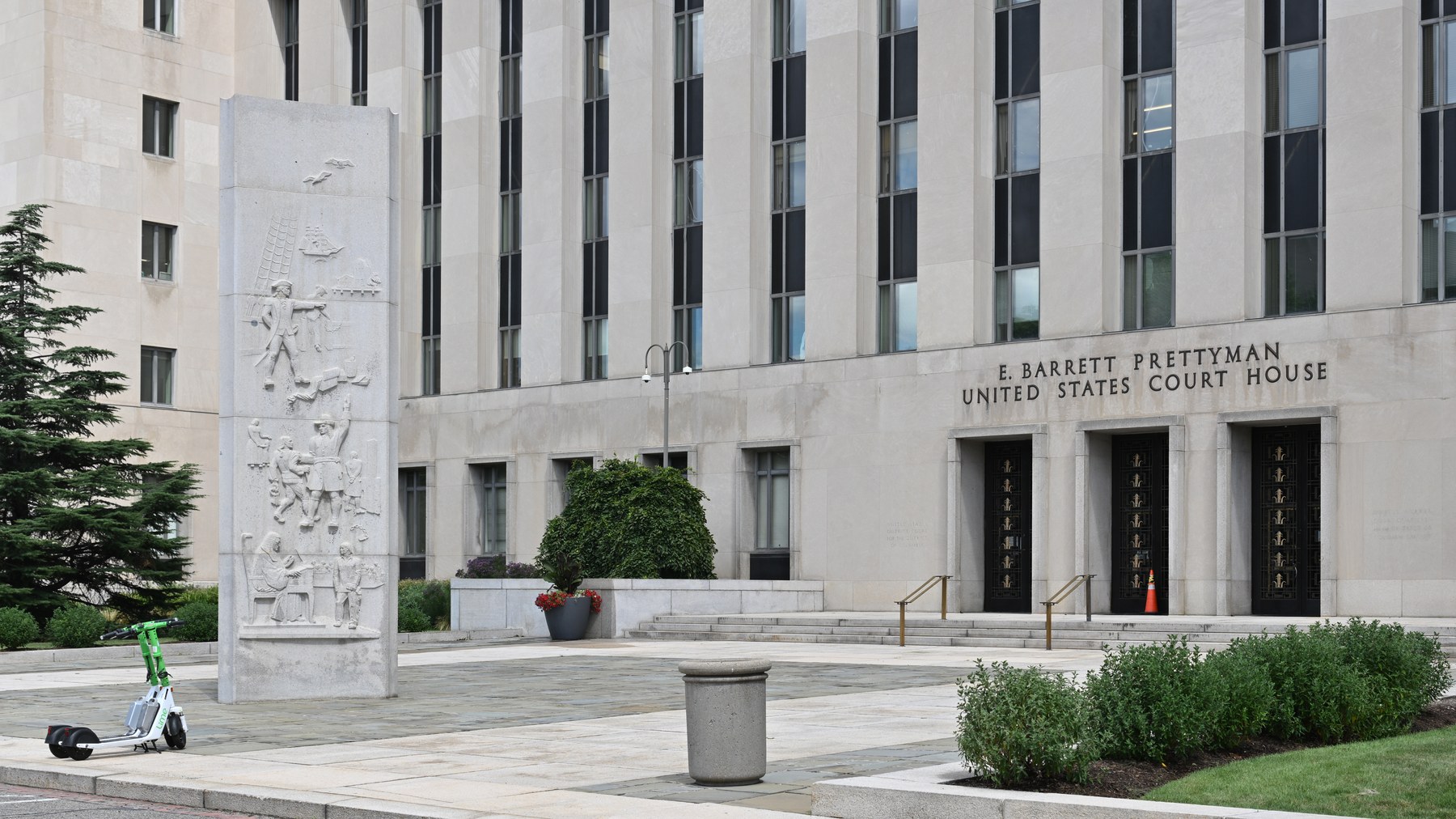
The E. Barrett Prettyman U.S. Courthouse in Washington, where Judge Loren AliKhan will hear argument the week of Oct. 5. Photo by G. Edward Johnson, Wikimedia Commons, CC BY 4.0.
There is a doctrinal reason the omission may be defensible rather than sneaky. Vullo is about a government official squeezing an intermediary to punish somebody else's speech. Here the FCC is regulating the speaker directly, which is retaliation territory. But Carr's reported ultimatum after the Kimmel monologue, quoted in ABC's complaint as "We can do this the easy way or the hard way," is Vullo-shaped almost word for word. A judge who wants to reach it can.
The rule the FCC is using is real, and it is three sentences long
The order that started this is DA 26-416, issued April 28, 2026 by the Chief of the Video Division. It runs three paragraphs and directs Disney's eight stations to file renewals within 30 days. Its entire legal footing is 47 C.F.R. 73.3539(c), which says that "whenever the FCC regards an application for a renewal of license as essential to the proper conduct of a hearing or investigation, and specifically directs that it be filed by a date certain, such application shall be filed within the time thus specified."
That is a broad grant with no stated limit and no required findings, and it dates to 1979. The Commission's follow-up notice, DA 26-541, concedes that none of the ABC licenses would ordinarily have come due until 2028 at the earliest. The brief concedes the rest: Carr himself has acknowledged that in recent decades the agency has not used the early-renewal tool, except once.
Why this one should not be a cheering section
ABC's complaint quotes Sen. Ted Cruz calling the Commission's posture toward the network "dangerous as hell," and Sen. John Kennedy saying "the FCC scares me right now" because it is "getting into the foothills of violating the First Amendment." It points to Justice Neil Gorsuch citing the Kimmel episode in a June 2026 concurrence as a cautionary tale about what an agency can do to a business out of favor with the White House. Those are not Disney's lawyers talking.
PatriotAddict has covered the same theory from the other direction, in the White House "Media Offenders" page story. The principle conservatives won in Vullo is that a regulator cannot use the leverage of a license or an examination to make a speaker behave. That principle does not check party registration. A rule that lets Carr call in ABC's licenses in the middle of an investigation lets a future chairman call in Sinclair's or Newsmax's on a similar three-paragraph order.
Here is the honest prediction. AliKhan is likely to dismiss on jurisdiction, ABC is likely to end up in the D.C. Circuit anyway, and nobody will have ruled on whether the government retaliated. A win on channeling is a win. It is also a decision that leaves 73.3539(c) sitting there, unlimited and now proven usable, for whoever holds the gavel next.