Energy Secretary Chris Wright says more than 17 million barrels of oil moved through the Strait of Hormuz on Monday, the biggest day since the war with Iran began in late February. His own department's statistical agency puts normal, pre-conflict flow at 21.6 million barrels a day.
The administration is selling the number as proof that the U.S.-escorted corridor works and that Iran's grip on the waterway is slipping. Part of that holds up. The arithmetic is less flattering than the press release.
What Wright actually said, and where he said it
Wright gave the figure to reporters Tuesday evening while traveling to Venezuela, then repeated it on CNBC from Venezuela on Wednesday, saying Iran is losing its ability to disrupt the strait. The Washington Examiner reported all 17 million barrels moved by ship, and that Wright called the total leaving the Gulf higher than prewar once you add 4 million to 5 million barrels moving through pipelines that bypass the strait.
The administration has not been consistent. Treasury Secretary Scott Bessent says at least 10 million barrels get through daily, 15 million to 17 million on Tuesday. Two U.S. officials told CNN that 40 ships carrying about 18 million barrels transited under escort Tuesday. Three senior officials, three different figures, one week.
Run the number against the Energy Department's own baseline
The Energy Information Administration sits inside Wright's own department, and it publishes the definitive count. Its World Oil Transit Chokepoints analysis has Hormuz carrying 20.7 million barrels a day in 2024 and 20.9 million in the first half of 2025. Its August Short-Term Energy Outlook pins the moment the war started: 21.6 million in the fourth quarter of 2025, collapsing to 4.9 million by the second quarter of 2026.
So 17 million barrels is 4.6 million short of the last normal quarter. It is 79 percent of the pre-conflict level, on the single best day of a six-month war. That is a genuine recovery from 4.9 million, and it is nowhere close to restored.
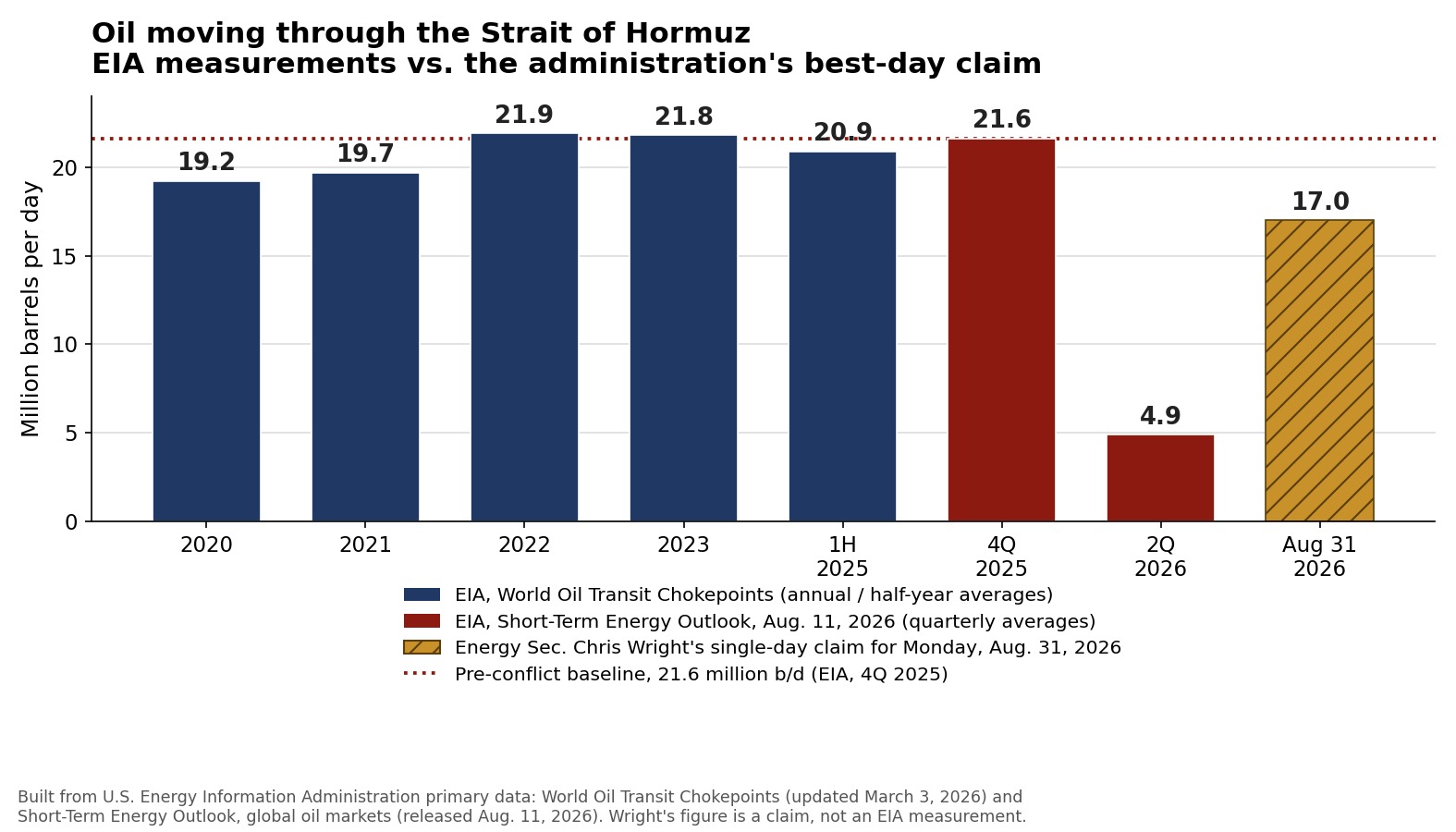
Chart built by PatriotAddict from U.S. Energy Information Administration primary data: World Oil Transit Chokepoints (updated March 3, 2026) and the Short-Term Energy Outlook, global oil markets section (released Aug. 11, 2026). The final bar is Wright's claim, not an EIA measurement.
Do the bypass pipelines really get you above prewar?
Here is where the framing breaks down. Saudi Arabia and the UAE were already pumping oil around the strait before the war, so counting today's pipeline barrels against a prewar figure that counted ships alone puts the same barrels on one side of the ledger and not the other.
EIA's numbers show what the bypass actually added. Traffic through Bab el-Mandeb, the route Saudi crude takes after crossing the country by pipeline to Yanbu on the Red Sea, averaged 8.1 million barrels a day in the second quarter of 2026, up from 5.4 million in the fourth quarter of 2025. That is a gain of 2.7 million, not 4 million to 5 million. Add it to 17 and you get 19.7, still under 21.6. EIA has also put spare bypass capacity at only about 3.5 million barrels a day, and the Yanbu route now runs into a Houthi blockade aimed at Saudi-linked shipping.
The ship count is the number that is hardest to spin
Barrels are an estimate. Hulls are countable, and the countable number is grim. The Joint Maritime Information Center, run by the Combined Maritime Forces, logged 39 U.S.-facilitated transits across the 48 hours of Aug. 30 and 31 against its own stated 2025 baseline of roughly 138 vessels per day. Call it 14 percent of normal.
Official record
Update 092 to JMIC Advisory Note, JMIC# 001 26, Sept. 1, 2026. This is what mariners were reading the day Wright made his claim. Read the full 11-page advisory (PDF) on UKMTO's site.
"Commercial traffic through the Strait of Hormuz remained at reduced levels, with a modest uptick from recent lows, still far below baseline. Independent tracking data indicated suppression with single-digit numbers transiting in both directions." — JMIC Update 092, Section 2B
"The threat level remains SEVERE, with deliberate hostile action considered highly likely under current conditions. ... There remained a continued risk of drifting or uncharted mines in and near the TSS, with mine danger areas still active." — JMIC Update 092, Sections 5B and 2B
That mine line matters. CENTCOM commander Adm. Brad Cooper announced the week before that U.S. forces had cleared the strait of mines. The Sept. 1 advisory still tells merchant captains to treat the danger areas as active.
Commercial trackers land in the same place. Kpler counted six crossings Wednesday, 11 Tuesday and five Monday, a 10-day average of 13 per day, according to Al Jazeera. Lloyd's List Intelligence logged about 12 a day from Aug. 26 to Sept. 1.
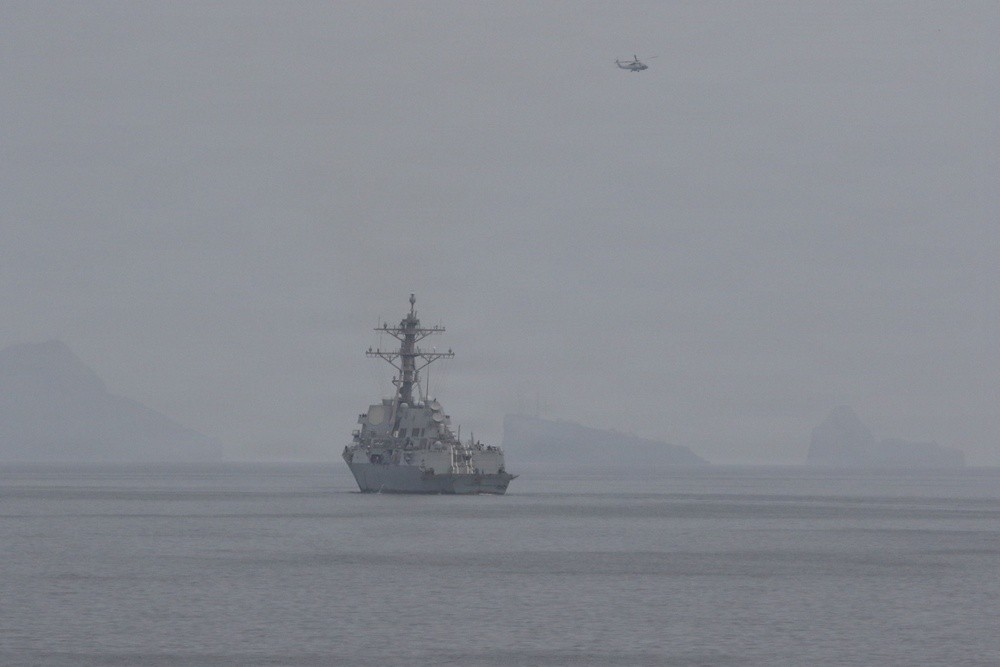
A U.S. Navy guided-missile destroyer operating in the Strait of Hormuz as CENTCOM forces began setting conditions to clear mines, April 11, 2026. (Photo by NAVCENT Public Affairs / U.S. Central Command, via DVIDS, public domain.)
The government has a real defense here, and it deserves saying plainly. Shippers run dark to avoid Iranian targeting, and commercial trackers miss those hulls. The Navy has satellites, aircraft and its own convoy manifests, so its count can legitimately be higher. Sal Mercogliano, the Campbell University maritime historian, told USNI News that crude is moving at roughly two-thirds to three-quarters of prewar levels, and that one day is the wrong unit: "You really have to do kind of a seven-day average because there's going to be peaks on this."
Then Iran shot at two American warships
Whatever the corridor was accomplishing, the shooting resumed. CENTCOM hit IRGC air defense sites, radars, maritime assets and mine-laying capability on Sept. 1. On Saturday the IRGC fired ballistic missiles at a U.S. aircraft carrier and a guided-missile destroyer. Both evaded, and no American was hurt.
The answer came fast. CENTCOM says it disabled the Iranian crude carriers M/T Downy off Kharg Island and M/T Stark 1 near Jask and destroyed the unladen M/T Kylo in the Gulf of Oman. "If you shoot at two of our ships, we will impose an even higher economic cost, taking out three of yours," Cooper said.
Iranian outlets went further on Kharg Island. The semi-official Tasnim agency, citing a correspondent near the island, said four U.S. missiles hit the tanker at the anchorage about six miles offshore, that the crew was evacuated and that nobody died. Those specifics come only from Iranian state-linked media and no U.S. source confirms them. CENTCOM confirms the strike and the ship's name, nothing more.
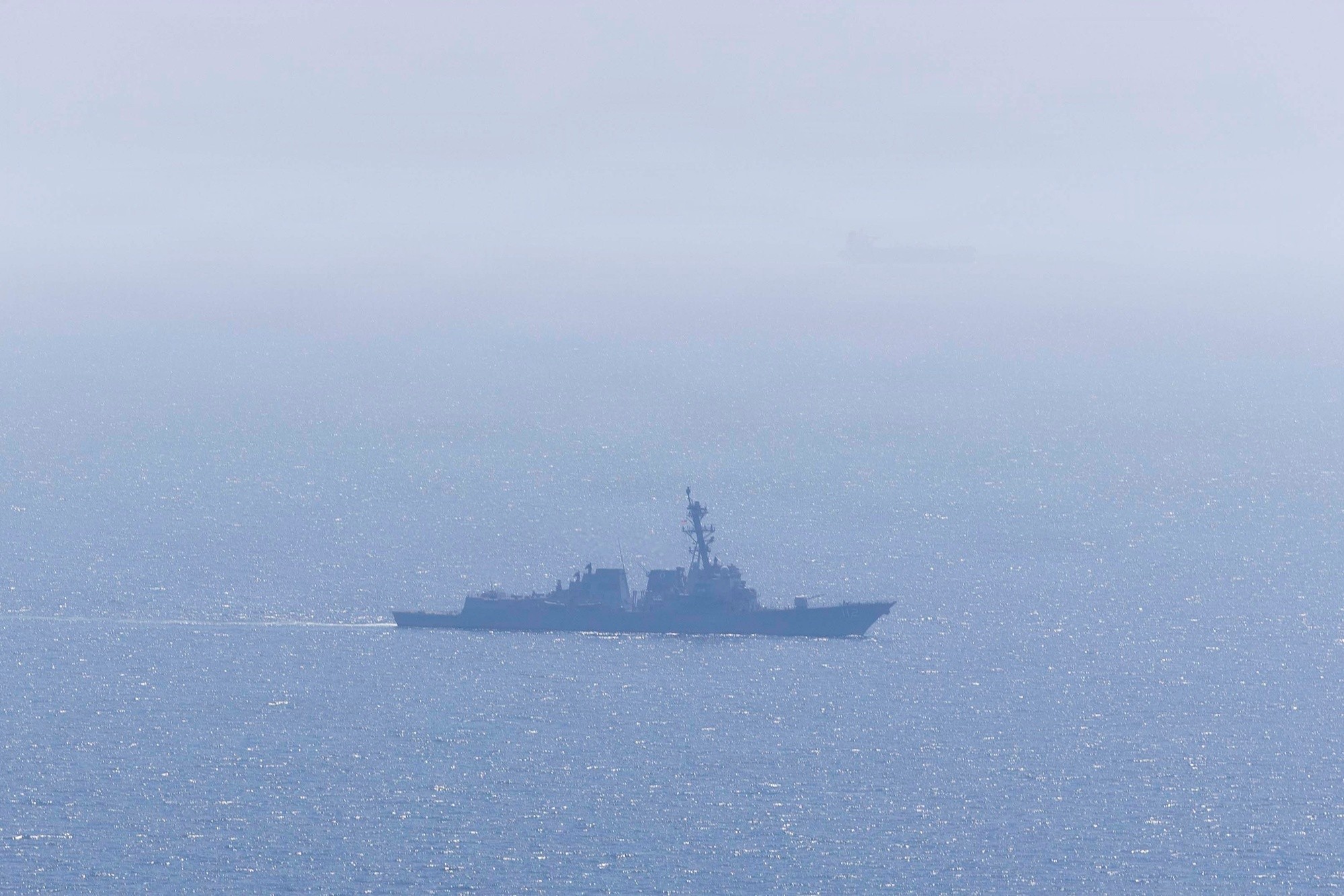
The Arleigh Burke-class guided-missile destroyer USS Michael Murphy (DDG 112) patrols the Arabian Sea in support of the blockade mission against ships entering or exiting Iranian ports, April 20, 2026. (U.S. Central Command photo, via DVIDS, public domain.)
What it costs at the pump
Here is the number that reaches American driveways. EIA's weekly retail gasoline series put the national average for regular at $4.071 a gallon for the week of Aug. 31. The last reading before the war, Feb. 23, was $2.937. That is $1.13 more a gallon, up 38 percent, and it has not budged since early August despite six weeks of better transit numbers. EIA's August outlook has Brent averaging $85 a barrel this quarter and does not expect trade patterns to look normal again until early 2027.
The honest scoreboard
Both governments are fighting a numbers war alongside the shooting one, and the incentives point the same way on each side. Tehran needs the strait to look closed to keep its leverage. Washington needs it to look open to keep insurers, charterers and crews willing to sail. What sits between them is a corridor that pulled Hormuz off the floor without pulling it back to normal.
Two seafarers were killed in the Aug. 31 attack on the tanker MT Sidr, one of at least 13 commercial vessels Iran struck in August. The advisory published the same day the administration took its victory lap still rates the threat severe and warns of live mines. Americans paying $4 a gallon can handle the real number.