A Department of Homeland Security rule that ends open-ended student visas takes effect on September 15, capping F and J admissions at four years and cutting foreign media representatives to 240 days. Whether it survives that date now rests with a federal judge in Boston who spent Thursday's hearing telling the government he cannot find the connection between the rule and the national security case DHS built for it.
U.S. District Judge F. Dennis Saylor IV did not rule from the bench. He told the lawyers his "fervent hope" was to decide before the rule kicks in, and he floated a short temporary restraining order to buy himself time if it comes to that, according to The Harvard Crimson. Nine days out, the biggest change to student visa administration since the Carter administration is sitting undecided on one judge's desk.
What the rule actually changes
Since 1978 for students and 1985 for exchange visitors and foreign journalists, all three categories have been admitted for "duration of status." No departure date on the I-94. You stay as long as you are enrolled and complying. The final rule, published July 17 at 91 FR 44976 under RIN 1653-AA95, ends that.
An F or J nonimmigrant now gets admitted to the program end date printed on the I-20 or DS-2019, capped at four years, plus 30 days to depart. Anyone who needs longer files an extension of stay with USCIS and submits biometrics, instead of handling it on campus through a designated school official. Foreign media representatives get 240 days, and 90 days if they hold a passport issued by the People's Republic of China. DHS classified it as a major rule subject to congressional review.
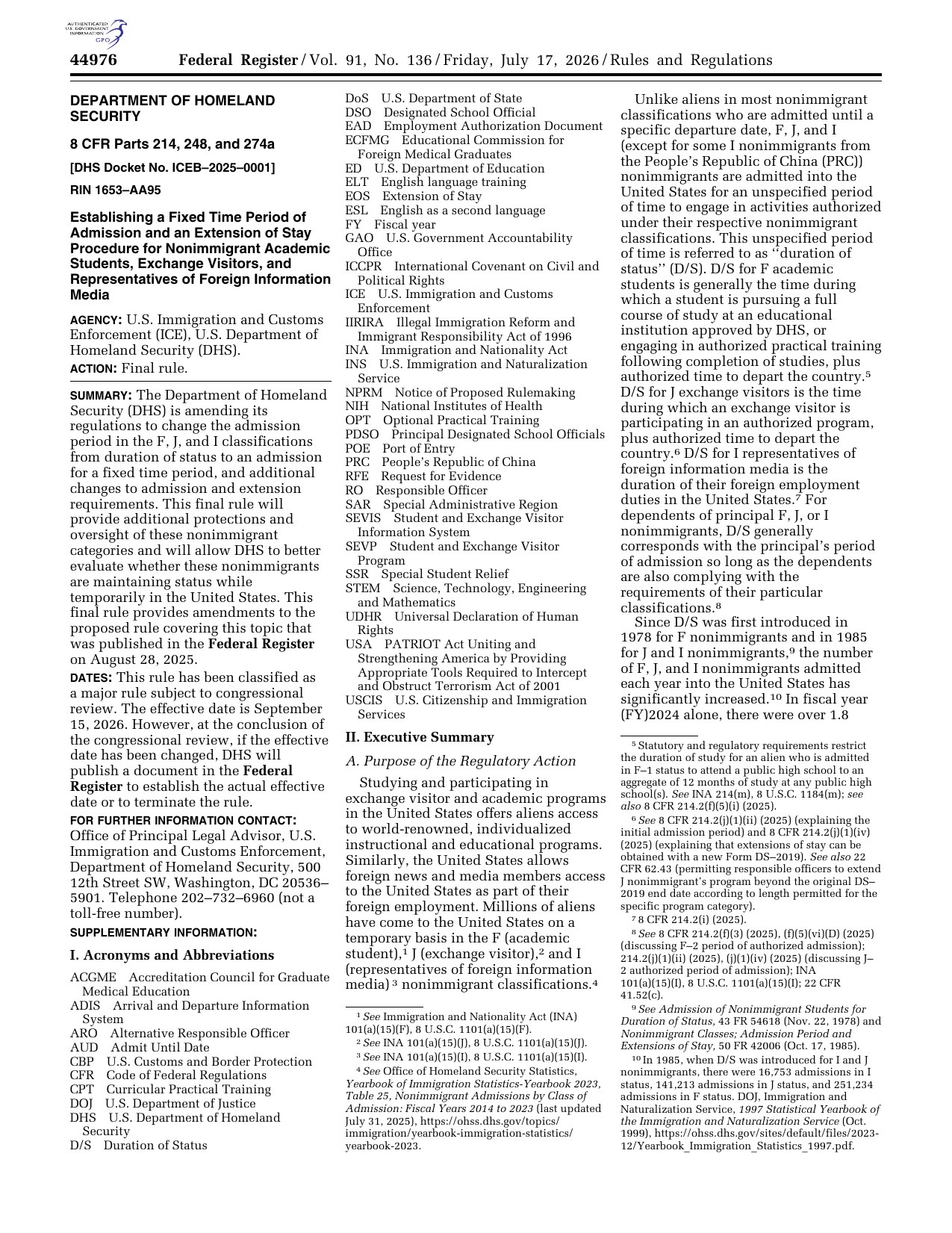
Page one of the DHS final rule as published at 91 FR 44976 on July 17, 2026, showing DHS Docket No. ICEB-2025-0001, RIN 1653-AA95, and the September 15 effective date. (U.S. Government Publishing Office, govinfo.gov, public domain.)
The scale argument is the administration's strongest card
DHS makes its case with numbers, and the numbers are real. In fiscal 2024 there were 1,816,480 admissions in F status, 514,170 in J status and 37,330 in I status. In 1985, when duration of status was extended to the J and I categories, those same figures were 251,234, 141,213 and 16,753.
An admission category with no scheduled checkpoint is a different proposition at 1.8 million entries a year than it was at a quarter million. That is a defensible reason to build in a review interval, and it is close to what the government's lawyer argued in court. Michael A. Celone told Saylor the four-year mark is "merely an administrative checkpoint," then compared it to checking library books out again before conceding that the comparison was not "entirely apt."
Why a Bush appointee is the one asking the hard questions
Saylor is not the profile the White House usually reaches for when it wants to attack a ruling. George W. Bush nominated him in July 2003 and the Senate confirmed him in June 2004, per the Federal Judicial Center. Before the bench he was chief of staff to the assistant attorney general running the Justice Department's Criminal Division. He was chief judge of the District of Massachusetts from 2020 to 2025.
What he pressed on was evidence. "Isn't all the evidence anecdotal?" he asked, per an account from NewsGuild president Jon Schleuss, who is a plaintiff in the case and sat through the hearing. Schleuss quoted the judge going further: "I'm struggling to see any real rational connection between the national security issues identified, which is not even half a dozen isolated incidents over a period of nearly 50 years." The Crimson, reporting independently from the same courtroom, has Saylor "struggling to see any rational connection." Both accounts also have him calling the potential harm from uncertainty enormous.
Official record
Presidents' Alliance on Higher Education and Immigration, et al. v. U.S. Department of Homeland Security, et al., No. 1:26-cv-13799-FDS (D. Mass.). Defendants' Response in Opposition to Plaintiffs' Motion for APA § 705 Relief, a Preliminary Injunction or, Alternatively, Summary Judgment, ECF No. 46-1, filed September 2, 2026, 57 pages. Posted publicly by NAFSA.
"By replacing the indefinite 'duration of status' (D/S) admission framework with a fixed period of admission, the Final Rule establishes predetermined intervals for immigration officers to evaluate whether nonimmigrants are complying with the terms and conditions of their nonimmigrant status. This change ... is a necessary measure to safeguard national security, combat documented instances of fraud and abuse, and ensure the overall integrity of the U.S. immigration system." (Defendants' opposition brief, p. 1)
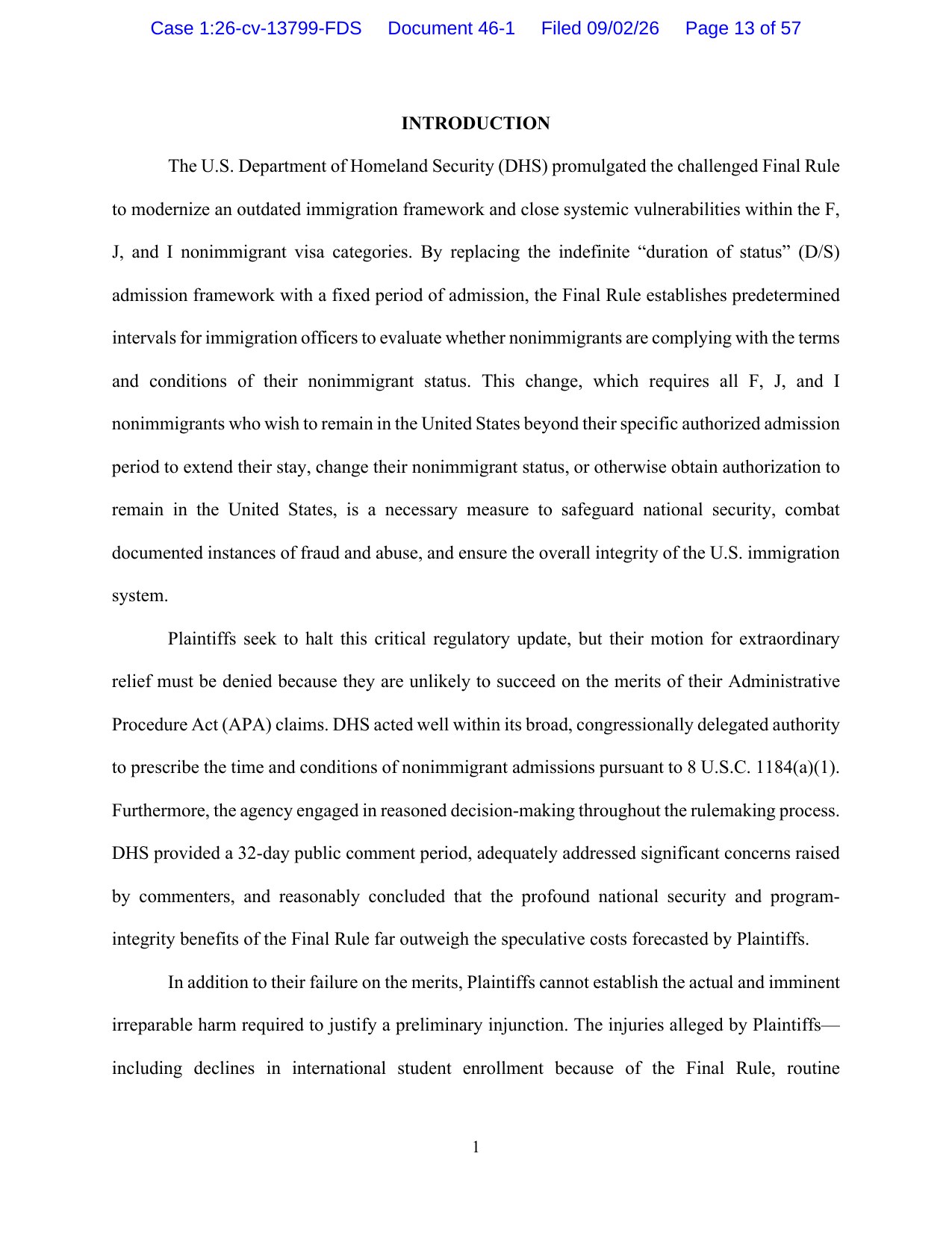
Read or download the full 57-page brief (PDF) · view the case page with the complaint and preliminary injunction motion
Thirty-two days is the number that could sink this
The government's own brief supplies the vulnerability. "DHS provided a 32-day public comment period," it says, arguing that was plenty. Roughly 22,000 comments came in on DHS Docket No. ICEB-2025-0001. Saylor described that window as "barely legal," the Crimson reported.
That is an Administrative Procedure Act problem, not a policy disagreement. Paul W. Hughes III of McDermott Will and Schulte, arguing for the coalition, put it plainly: "When it changes policy in an area that is so consequential, it is absolutely critical that the government abide by the Administrative Procedure Act." DHS's own economic analysis puts the rule's annualized cost between $443.1 million and $448.6 million, and between $119.9 million and $125.1 million counting U.S. parties alone. When an agency concedes numbers that size, a single month of comment and a handful of cited incidents is asking a court to take a lot on faith.
This keeps happening. Rules with a genuine argument behind them keep getting stopped on process, and process is the one part of a rulemaking the administration controls from start to finish.

MIT's Maclaurin Building and Great Dome in Cambridge. MIT is a member of the Association of Independent Colleges and Universities in Massachusetts, one of the eight plaintiffs suing to stop the rule. Photo by Wikimedia Commons contributor Beyond My Ken, licensed CC BY-SA 4.0.
The government raised the CASA problem itself
The last argument in the opposition brief is about remedy. Any equitable relief, the Justice Department writes, "must be narrowly tailored to the specific Plaintiffs before the Court, rather than issued as a sweeping, nationwide injunction or universal stay under APA § 705 which cannot be squared with CASA." That is Trump v. CASA, Inc., the June 2025 decision in which a 6-3 Court held that federal judges cannot enjoin the government as to people who are not parties.
The catch is who the parties are. All eight plaintiffs, from NAFSA and the Presidents' Alliance to the UAW and the NewsGuild-CWA, are membership organizations. Relief limited strictly to their members would still reach a large share of American higher education and a set of newsrooms. Section 705 of the APA is a second lever, because it lets a court postpone a rule's effective date, which acts on the rule rather than on a list of plaintiffs. CASA closed the universal injunction door. It did not close this one.
What to watch
If Saylor issues nothing, the rule takes effect September 15 as written. F and J holders already admitted under duration of status keep their existing program end dates and get four years from the effective date before they must file for an extension, so the first squeeze lands on new arrivals and on the foreign correspondents who drop to a 240-day clock immediately.
The administration has a serious argument that an admission rule written in 1978 stopped fitting a program that now runs at 1.8 million entries a year. It chose to make that argument in 32 days, on a record a Bush-appointed former Justice Department official described as fewer than six incidents across half a century. Saylor has nine days to decide whether that was enough, and the answer will say more about how this administration writes rules than about how one judge reads them.
Header photo: the John Joseph Moakley United States Courthouse, Boston, by Wikimedia Commons contributor 4300streetcar, licensed CC BY 4.0.