The Supreme Court on Friday cleared the way for Republican Party committees to buy midterm campaign ads at the deep discount federal law reserves for candidates. Justice Ketanji Brown Jackson was the only justice to publicly dissent, and the order landed on the same day the 60-day pre-election discount window opened.
The unsigned order in National Republican Congressional Committee v. Brown, No. 26A274, grants an emergency application from the NRCC and the National Republican Senatorial Committee. It recalls and freezes the mandate the Fourth Circuit issued nine days earlier, which had wiped out an FCC guidance document the two committees had been planning their fall ad buys around.
Timing was the whole ballgame. The Fourth Circuit ruled Aug. 25, leaving the committees about a week between a decision that killed the discount and the day it was supposed to start paying off.
Did the justices actually decide who gets the discount?
No, and that distinction matters more than most of the coverage suggested. The per curiam opinion never reaches the question of whether party committees belong in the statute. It rests on a jurisdictional problem with how the challenge got to court.
Four Democratic candidates filed an application for review with the full FCC on April 29. Two months later, with that application still unanswered, they went to the Fourth Circuit anyway. The Court held that the Communications Act does not work that way: 47 U.S.C. 155(c)(7) makes an application for review "a condition precedent to judicial review" of an action taken under delegated authority. The Fourth Circuit's contrary holding, the justices noted, "splits with every other Circuit to have considered the issue."
Official record
National Republican Congressional Committee, et al. v. Sherrod Brown, et al., No. 26A274, on application for stay, decided Sept. 4, 2026. Read it on the Supreme Court's public docket.
"Because the candidates' application for review was pending when they filed their petition for review, the Fourth Circuit likely lacked statutory jurisdiction to address their challenge." — Per curiam, No. 26A274
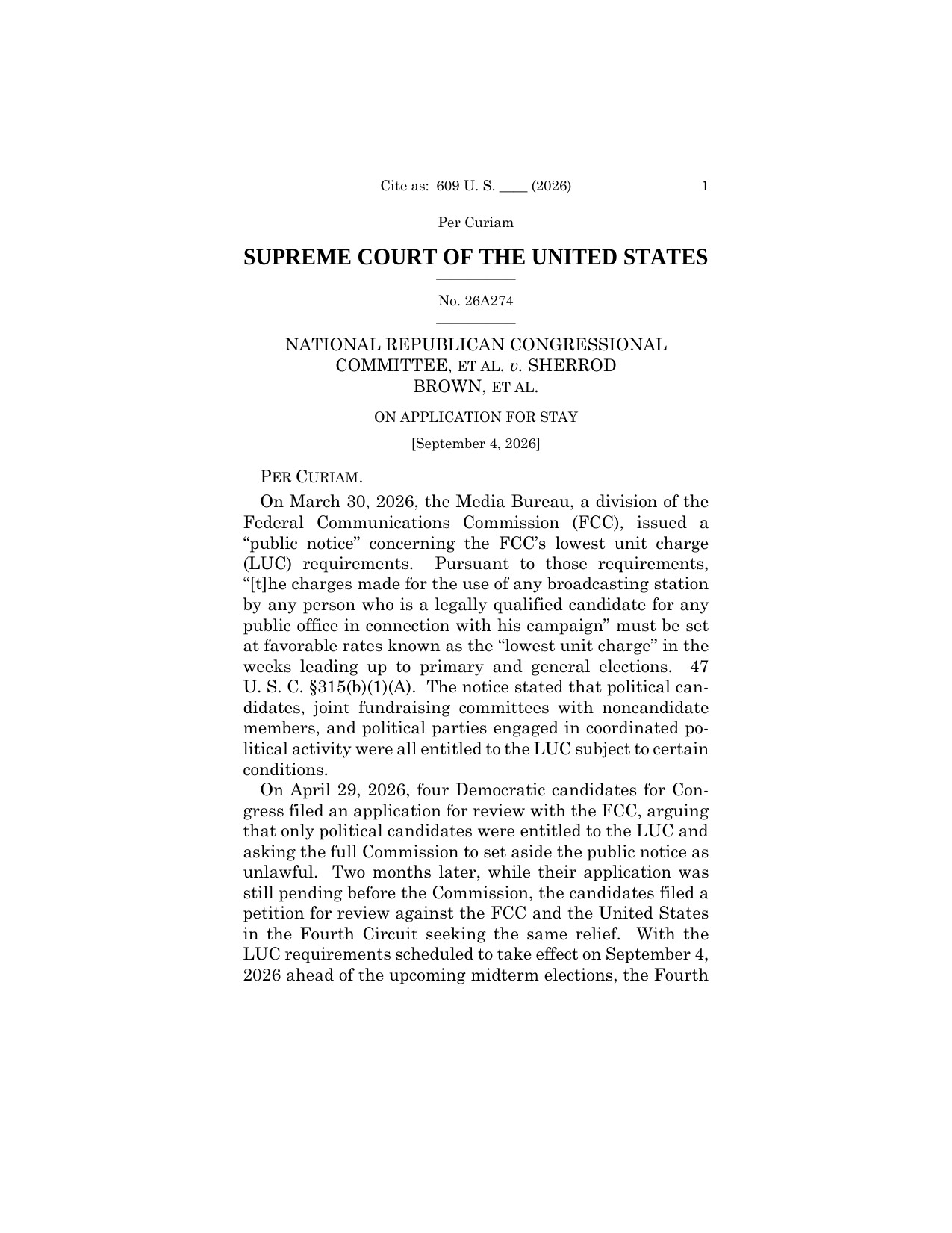
Read or download the full 5-page order (PDF) from supremecourt.gov.
What is the "lowest unit charge," and who was always covered?
The rule is old and narrow. Under 47 U.S.C. 315(b)(1)(A), during "the forty-five days preceding the date of a primary or primary runoff election and during the sixty days preceding the date of a general or special election," a station cannot charge a legally qualified candidate more than "the lowest unit charge of the station for the same class and amount of time for the same period." A candidate pays what the station's biggest annual advertiser pays, no matter how small the buy.
On March 30, the FCC's Media Bureau issued guidance, DA 26-300, saying the discount also reaches authorized joint fundraising committees and ads that qualify as coordinated expenditures between a party and its candidate. The document draws a line the critics tend to skip past: party spending done independently of the candidate still gets no discount. Coordination is what triggers it.
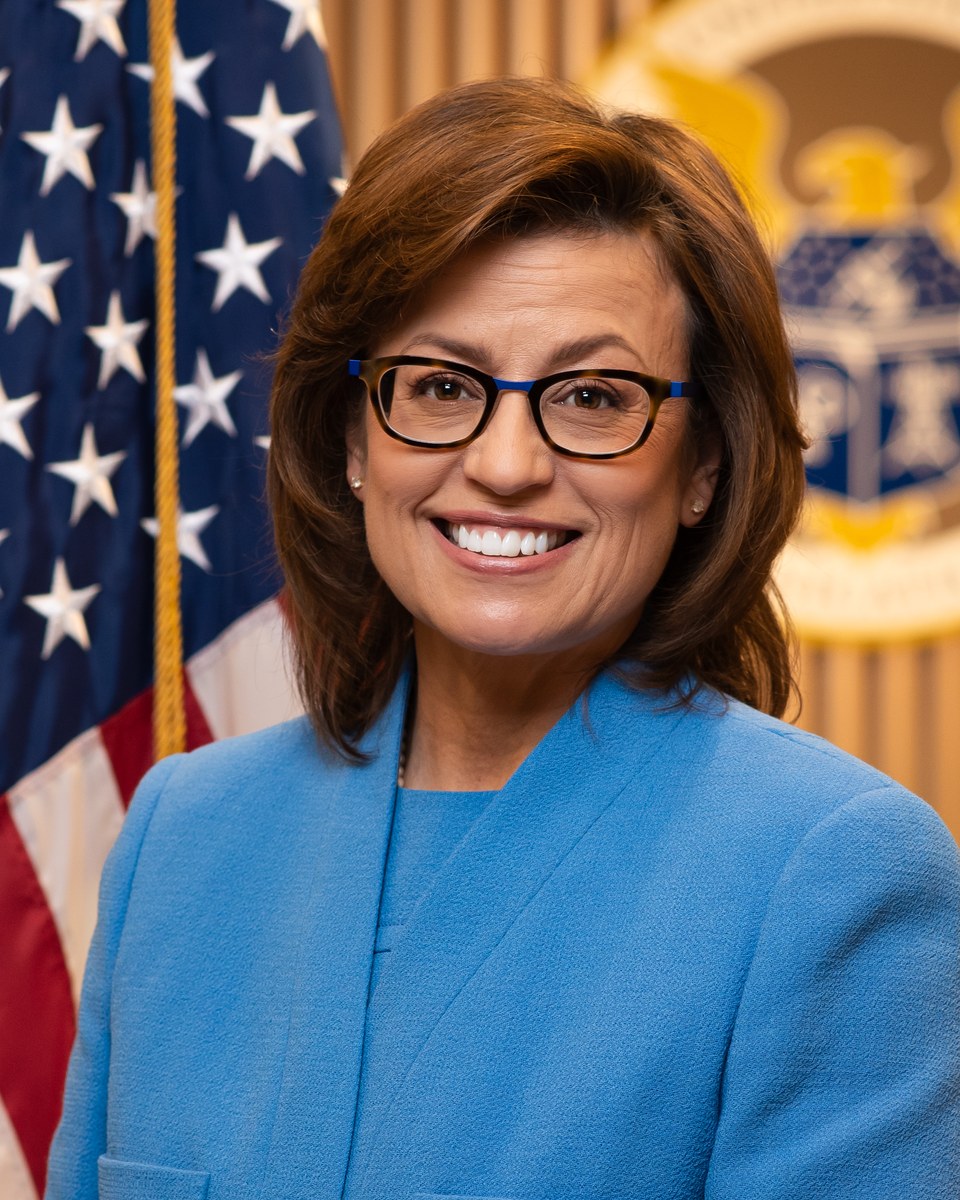
FCC Commissioner Anna M. Gomez, the agency's lone Democrat, called the Media Bureau guidance unlawful and said the Supreme Court's stay leaves broadcasters no time to adjust. (Official FCC portrait via Wikimedia Commons, public domain.)
Why the FCC's lone Democrat is the loudest voice against it
Commissioner Anna M. Gomez has been fighting this since spring, and her objection is procedural before it is political. In an Aug. 25 statement released through her office, she argued the guidance was written by staff rather than voted by the full Commission, with no notice and no comment period. She also went after the agency's own logic on broadcaster economics: "You cannot claim broadcasters are struggling to survive and then force them into a fire sale on the one thing that could actually help them compete and increase revenue."
After the stay came down, Gomez told Radio and Television Business Report that "this stay throws the final stretch of the midterms into chaos. It lands on the very day discounts for campaign ads on TV and radio take effect, leaving broadcasters and campaigns scrambling with almost no time to prepare." She has a real point about who absorbs the cost. Local affiliates sell their most valuable inventory in the last eight weeks before an election, and this order pushes more of it out the door at the year's floor price. FCC Chairman Brendan Carr, whose agency backed the committees throughout, praised the ruling.
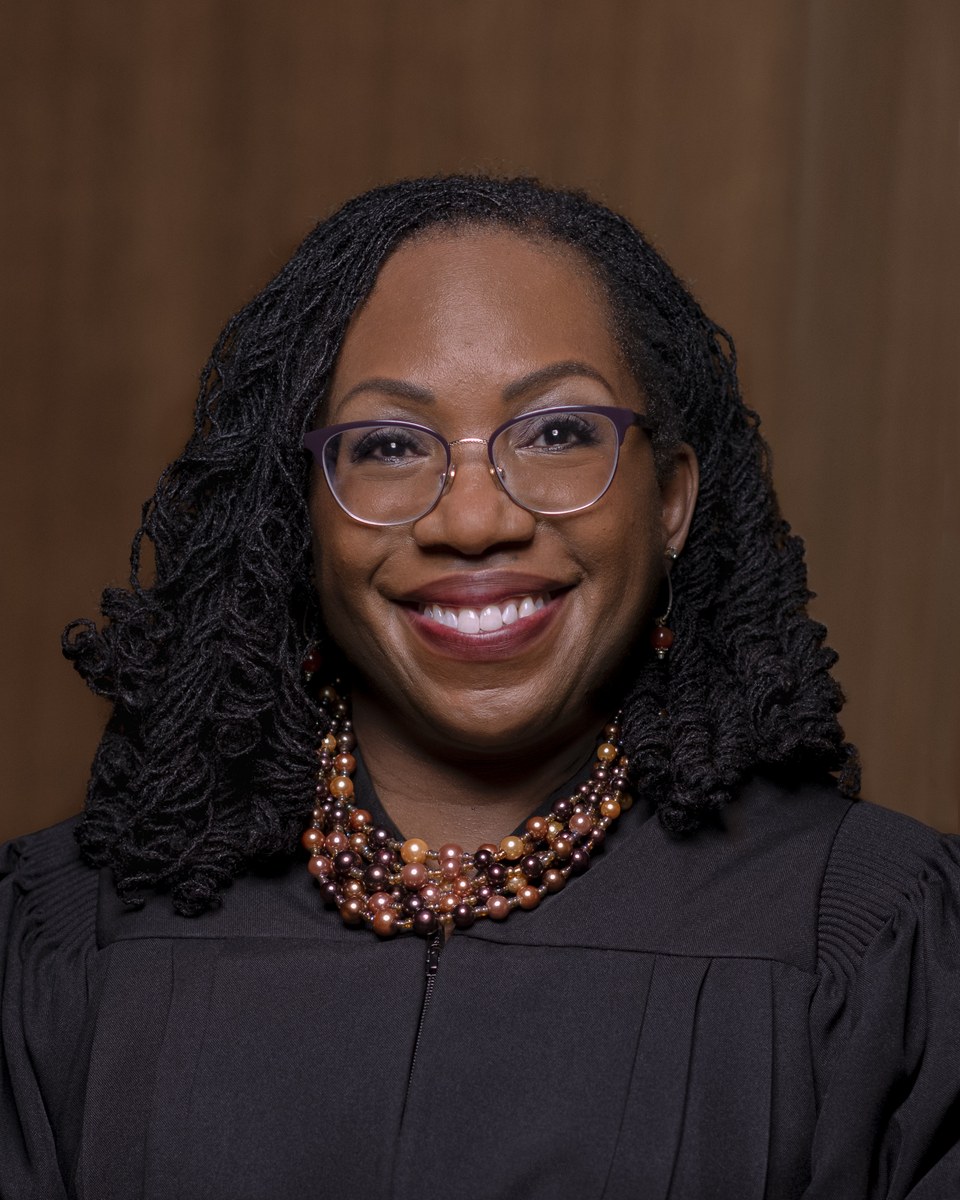
Justice Ketanji Brown Jackson, the only member of the Court to publicly note a dissent from the Sept. 4 stay. (Official Supreme Court portrait via Wikimedia Commons, public domain.)
Jackson's dissent is narrower than the headlines make it sound
Jackson did not write about dark money or broadcasters or the midterms. Her entire objection is that the committees lose on the jurisdictional question the majority built its order around. "I would deny the stay," she wrote. "In my view, the applicants are not likely to succeed on the merits of their argument that the Fourth Circuit lacked statutory jurisdiction."
She pointed to Judge Wynn's concurrence below, which found jurisdiction on constructive-denial grounds because "an agency may not reserve to itself the power to defeat judicial review through delay or inaction." That has some bite. The FCC sat on the April application for four months, and Carr's eventual response, circulated Aug. 14, proposed dismissing it as an improper vehicle rather than ruling on it.
What is this actually worth to Republicans?
A great deal, which is why the committees ran to the Supreme Court on a holiday weekend. The NRSC told members in a June memo that coordinated ads bought at the lowest unit charge have historically run three to 13 times cheaper than what outside groups pay for the same airtime. In their filing, the committees said they had already budgeted "tens of millions of dollars in ad buys under these rules," and that stations were rescinding those rates after the Fourth Circuit ruled.
Stack that on the cash. Reuters reported that the RNC, NRCC and NRSC closed July with about $279 million on hand, against roughly $136 million for their Democratic counterparts, who also carried nearly $18 million in debt. Add the Court's June 30 decision in NRSC v. FEC, which struck down the cap on coordinated party spending outright, and the two rulings fit together neatly: unlimited coordinated dollars, now spendable at the cheapest legal rate.
DSCC Executive Director Devan Barber and DCCC Deputy Executive Director Will Van Nuys said in a joint statement that the effort was designed "to flood the midterm elections with money from billionaire donors and drown out the power of the grassroots," then added a line worth remembering in November: "To the Republicans who have pushed for this, be careful what you wish for."
How long does this last?
The stay holds while the committees file a cert petition. Deny cert and it dissolves automatically, putting the Fourth Circuit's ruling back in force. Grant cert and it runs until judgment. Either outcome almost certainly arrives after Nov. 3, which means the discount is locked in for this cycle regardless of who is right on the law.
That is the part worth being honest about. Republicans did not win the argument over who Congress meant to cover. They won the calendar. Democrats built a strategy around a technicality and got beaten by a bigger one, and the practical result is that the party with $279 million in the bank gets to spend it at candidate prices for the next eight weeks.