Nicolás Maduro told a Manhattan federal judge on Wednesday that he is still Venezuela's head of state and that no American court has the power to try him. His lawyers asked Judge Alvin K. Hellerstein to throw out the entire narco-terrorism indictment on immunity grounds, eight months after U.S. forces took him out of Caracas and flew him to New York. His wife, Cilia Flores, filed her own motion the same day, claiming the same protection as the spouse of a sitting head of state.
What Maduro's lawyers actually filed
Attorney Barry Pollack filed two motions before a Wednesday deadline Hellerstein had set. The first asks the court to dismiss the Fourth Superseding Indictment outright. The second goes after Count One only, the narco-terrorism conspiracy charge under 21 U.S.C. § 960a, arguing the government cannot establish the statute's jurisdictional hook or a real connection to the United States. Flores filed separately, aiming at Counts Two, Three and Four, which happen to be the only counts she faces.
The supporting memorandum argues from American legal history rather than from the cocaine allegations. "No American court has ever presided over the criminal trial of a foreign leader who was recognized by their own country as the sitting head of state at the time the charges were brought," Maduro's lawyers wrote, in a passage quoted by Fox News. "It reflects a rule older than the common law: heads of state are exempt from the criminal process of any national court but their own."
He also wrote, in a passage reported by Reuters: "This unprecedented prosecution violates the absolute immunity from criminal jurisdiction to which heads of state and foreign officials acting in their official capacities have been entitled for hundreds of years." Prosecutors have until October 2 to answer. Argument is November 17. Trial is set for June 1, 2027.
Official record
United States v. Nicolás Maduro Moros, et al., S4 11 Cr. 205 (AKH), Southern District of New York. The Justice Department posted the full Fourth Superseding Indictment on justice.gov; the docket is public on CourtListener.
"For over 25 years, leaders of Venezuela have abused their positions of public trust and corrupted once-legitimate institutions to import tons of cocaine into the United States."
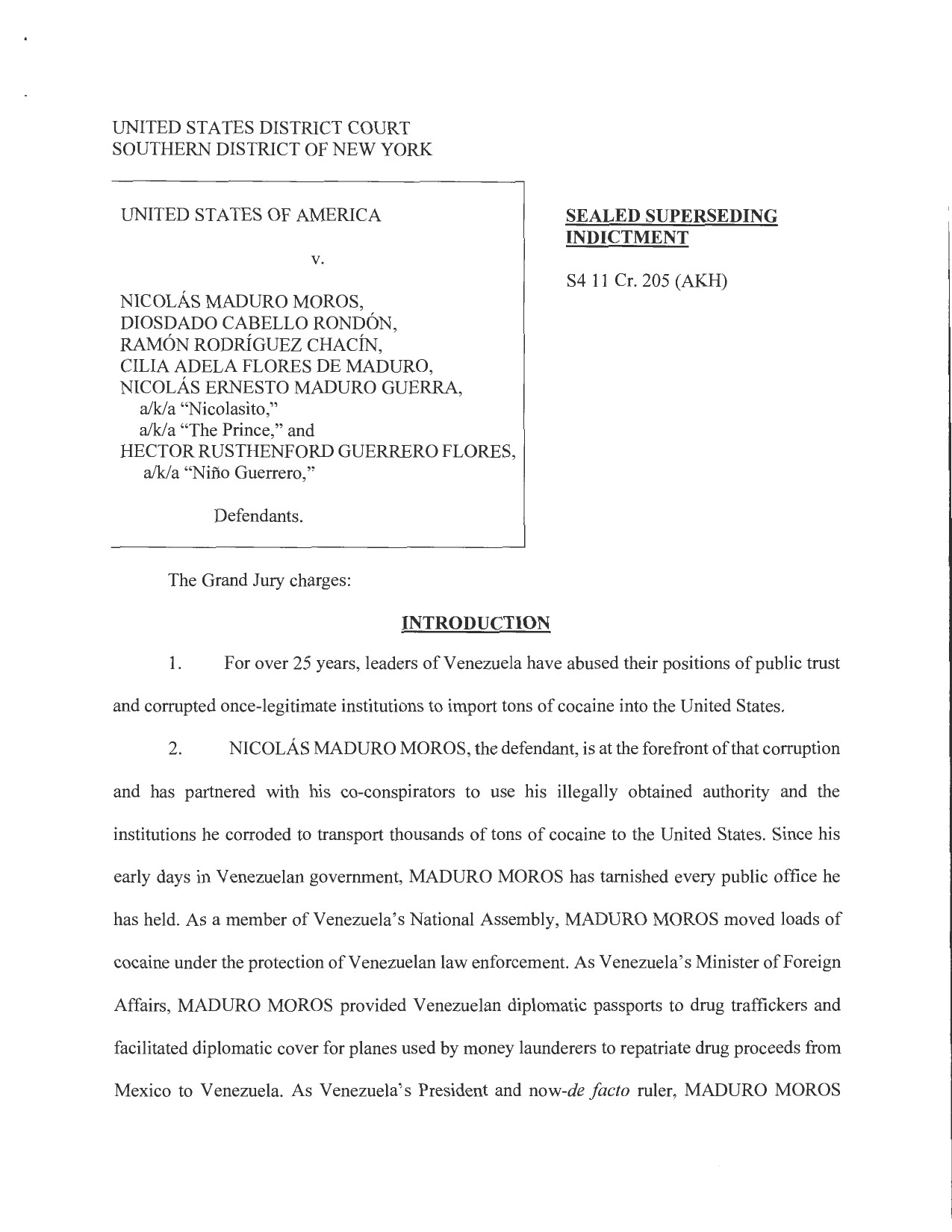
Read or download the full 25-page indictment (PDF), or view the public docket.
Count One is the charge that carries the weight
Count One charges Maduro, Interior Minister Diosdado Cabello Rondón and former Interior Minister Ramón Rodríguez Chacín with conspiring to violate § 960a by moving cocaine while knowingly enriching designated foreign terrorist organizations. The grand jury named seven: FARC, FARC-EP, Segunda Marquetalia, the ELN, Tren de Aragua, the Sinaloa Cartel and Cartel del Noreste, formerly the Zetas. Count Two is a cocaine importation conspiracy under 21 U.S.C. § 963 covering all six defendants, Flores included, and Counts Three and Four charge possession of machineguns and destructive devices under 18 U.S.C. § 924(c) plus conspiracy to do the same.
The organizing allegation is the Cartel de Los Soles, the Cartel of the Suns, which the indictment says takes its name from "the sun insignia affixed to the uniforms of high-ranking Venezuelan military officials." The document has Maduro moving cocaine as a National Assembly member, handing Venezuelan diplomatic passports to traffickers as foreign minister, and running the arrangement from the presidency. Those are the same acts his lawyers now want reclassified as protected sovereign conduct.
In an American courtroom, immunity is a recognition question
Here is the structural problem no amount of international law citation fixes. Head-of-state immunity in U.S. practice attaches to whoever the executive branch says holds the office, and the State Department signals that by filing a suggestion of immunity with the court. Nothing in the public record shows State has filed one for Maduro. State's own Narcotics Rewards Program page for him is now headed "Nicolás Maduro Moros (Captured)," following the reward increase to $50 million announced on August 7, 2025.
The Supreme Court settled who owns that call in Zivotofsky v. Kerry, 576 U.S. 1 (2015), which held the recognition power belongs to the President alone. Chimène Keitner, a law professor who served as the State Department's Counselor on International Law, laid out the consequence in Just Security: the United States has not recognized Maduro since 2019, and that "will likely be decisive for a U.S. judge under domestic law because of the executive branch's exclusive recognition power, even though head-of-state status under international law does not depend on any single country's recognition decision."
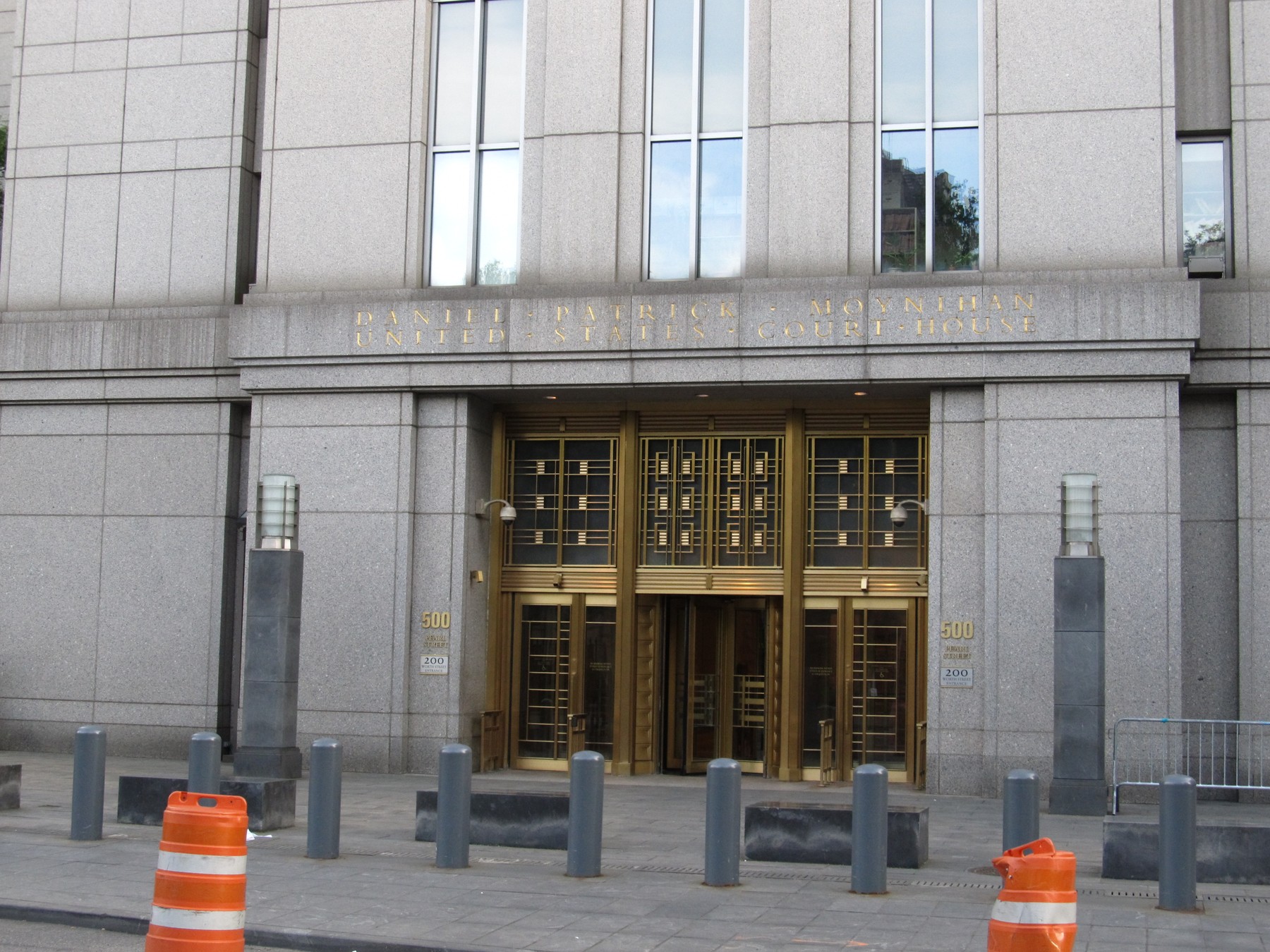
The Daniel Patrick Moynihan United States Courthouse at 500 Pearl Street, where the Southern District of New York will hear argument on the dismissal motions November 17. (Photo by Ken Lund, Wikimedia Commons, CC BY-SA 2.0)
Noriega is the case the government leads with, and Pollack has an answer
In 1997 the Eleventh Circuit rejected Manuel Noriega's identical claim in United States v. Noriega, 117 F.3d 1206. The court gave three reasons, quoted by Keitner: that "Noriega never served as the constitutional leader of Panama, that Panama has not sought immunity for Noriega and that the charged acts relate to Noriega's private pursuit of personal enrichment."
Pollack goes straight at the first one. "Unlike in Noriega, the Executive Branch does not dispute that Mr Maduro was Venezuela's head of state, but instead merely claims that, after 2019, he did not occupy that position legitimately," he wrote. That is the strongest sentence in the filing. Noriega was a general who never held the office. Maduro held it, and the indictment concedes as much when it calls him the "de facto but illegitimate ruler."
The second Noriega factor is the one that hurts. Panama never asked for immunity on Noriega's behalf, and Venezuela has gone quiet on Maduro's. Interim president Delcy Rodríguez, his own former vice president, said in January and February that she still regarded him as the legitimate leader, which is why Pollack calls it "incongruous" for Washington to recognize her and not him. Reuters reports her government has said nothing since, that murals of Maduro in Caracas have been painted over, and that the two countries reached a deal last month giving the United States about a fifth of Venezuela's oil reserves. A waiver argument that depends on Caracas speaking up is in trouble when Caracas has stopped speaking.
Does "former" gut the argument?
Largely, yes, and the doctrine is not close. Status-based immunity, the absolute kind Pollack is invoking, belongs to the office and ends when the officeholder does. Conduct-based immunity survives leaving office but covers only official acts, and Keitner's answer to that is one sentence: "drug trafficking and corruption do not fall within any head of state's official duties." Pollack's workaround is to recast the charged conduct as sovereign, characterizing things like issuing diplomatic passports and deploying the military as acts attributable to Venezuela rather than to Maduro personally. Flores makes the derivative version, arguing that sovereign immunity "is an attribute of Venezuela's sovereignty, and only Venezuela may surrender it."
Justice wrote the memo eleven days before the raid
The government did not stumble into this fight. On December 23, 2025, Assistant Attorney General T. Elliot Gaiser sent the National Security Council's legal advisor an Office of Legal Counsel opinion titled "Proposed War Department Operation to Support Law Enforcement Efforts in Venezuela." The NSC had asked whether the President could order the military to go get Maduro. OLC's answer was that such an action, "typically known as 'irregular' or 'extraordinary rendition,'" would not endanger any subsequent U.S. prosecution.
Official record
Memorandum for the Legal Advisor, National Security Council, U.S. Department of Justice Office of Legal Counsel, December 23, 2025, released in redacted form at justice.gov. Eleven days later, on January 3, U.S. forces seized Maduro and Flores in Caracas in what the administration called Operation Absolute Resolve. Both pleaded not guilty on January 5 and have been held at the federal jail in Brooklyn since.
"You have asked whether, consistent with domestic law, the President may lawfully order military personnel to assist law enforcement in forcibly removing Maduro from Venezuela to the United States for prosecution."
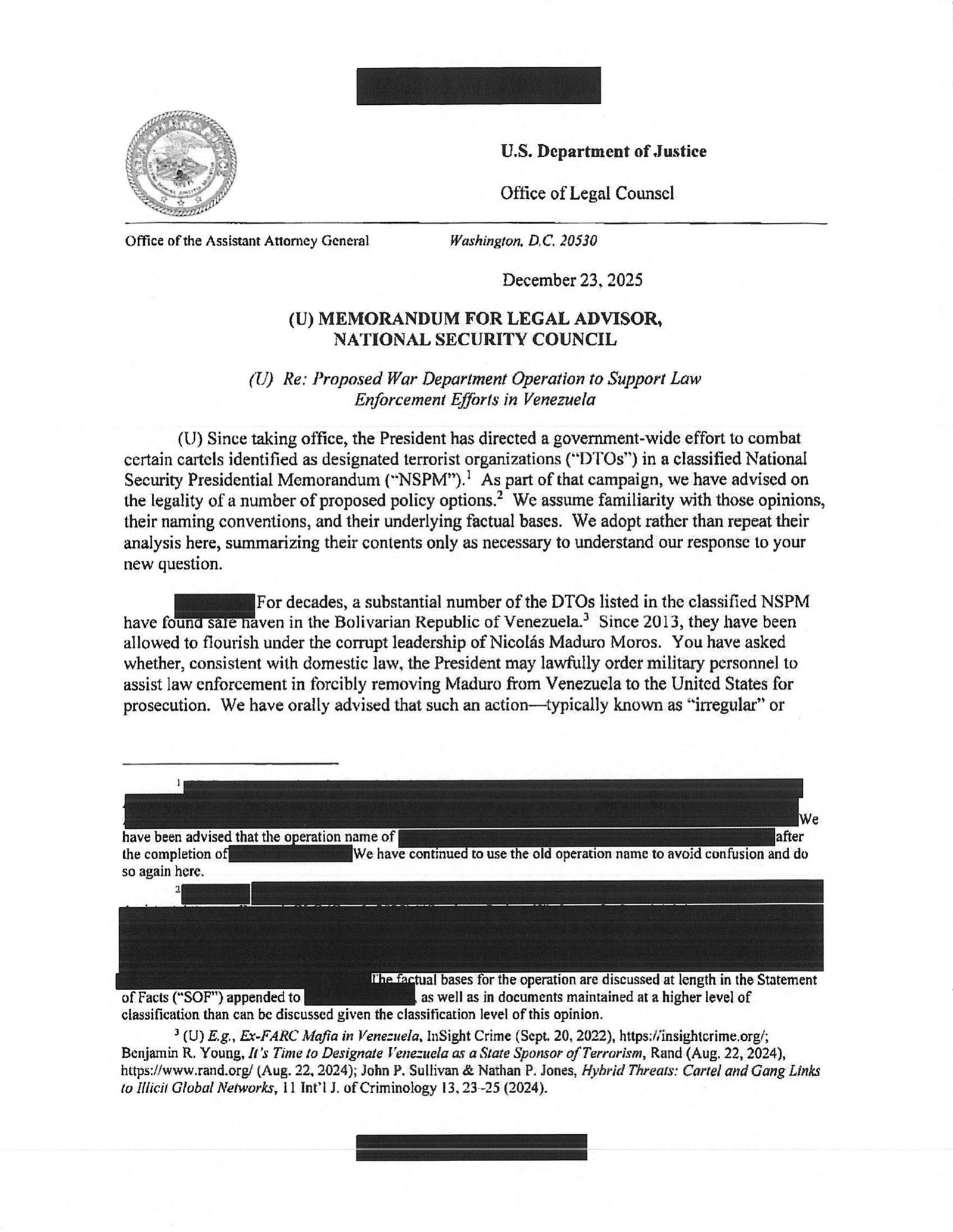
Read or download the full 22-page memorandum (PDF). Substantial portions, including the operation's code name, are redacted.
The ground OLC stood on is Ker v. Illinois (1886) and Frisbie v. Collins, 342 U.S. 519 (1952), the Ker-Frisbie doctrine, which the memo puts in plain English: "a person improperly seized may nevertheless be properly detained (and brought to trial)." The Supreme Court reaffirmed it in United States v. Alvarez-Machain, 504 U.S. 655 (1992). Maduro's lawyers have not argued that the raid itself voids the case, and this memo is a fair guess as to why.
What Hellerstein has to decide
Pollack is right that this is unprecedented, and the immunity motion is the only filing on his list that could end the case before a jury hears a word of evidence. But "unprecedented" is not a holding, and the question underneath it is not one a district judge answers for himself. Whether Nicolás Maduro is Venezuela's head of state is a call the executive branch made in 2019 and has not revisited across three administrations, a $50 million bounty and a military operation. The branch whose answer controls has been on the record the whole time.
Header photo: Nicolás Maduro at a December 2016 event commemorating Hugo Chávez. Photo by Eneas De Troya, Wikimedia Commons, CC BY 2.0.