

Temporary Protected Status for Venezuelans will not come back on Friday, Nov. 20. Hours after the Justice Department asked the Supreme Court to step in, the Ninth Circuit extended its own freeze on the order that would have restored it, and on Thursday Solicitor General D. John Sauer withdrew the Supreme Court request. His letter shows the appeals court finally granted something DOJ had asked for 12 days earlier.
What changed since Wednesday?
PatriotAddict reported Thursday that Venezuelan TPS was set to return Friday unless the Supreme Court acted on DOJ's emergency application, No. 26A714, Mullin v. National TPS Alliance. That application was filed Nov. 18 and sent to Justice Elena Kagan. The Court never had to rule on it.
The same evening, the Ninth Circuit issued a new order in the appeal, docketed as No. 25-5724. Per Sauer's letter, the court's administrative stay "will expire seven days after it publishes its judgment." The old expiration date of Nov. 20 is gone. The Associated Press reported that the order came late Wednesday and that the administration "remains free to detain and deport" Venezuelans who previously held TPS.
On Thursday, Nov. 19, Sauer wrote to Supreme Court Clerk Scott S. Harris that "the United States withdraws its November 18 stay application." The Supreme Court's docket lists two Nov. 19 entries: "Letter withdrawing the application filed" and "Application (26A714) withdrawn."
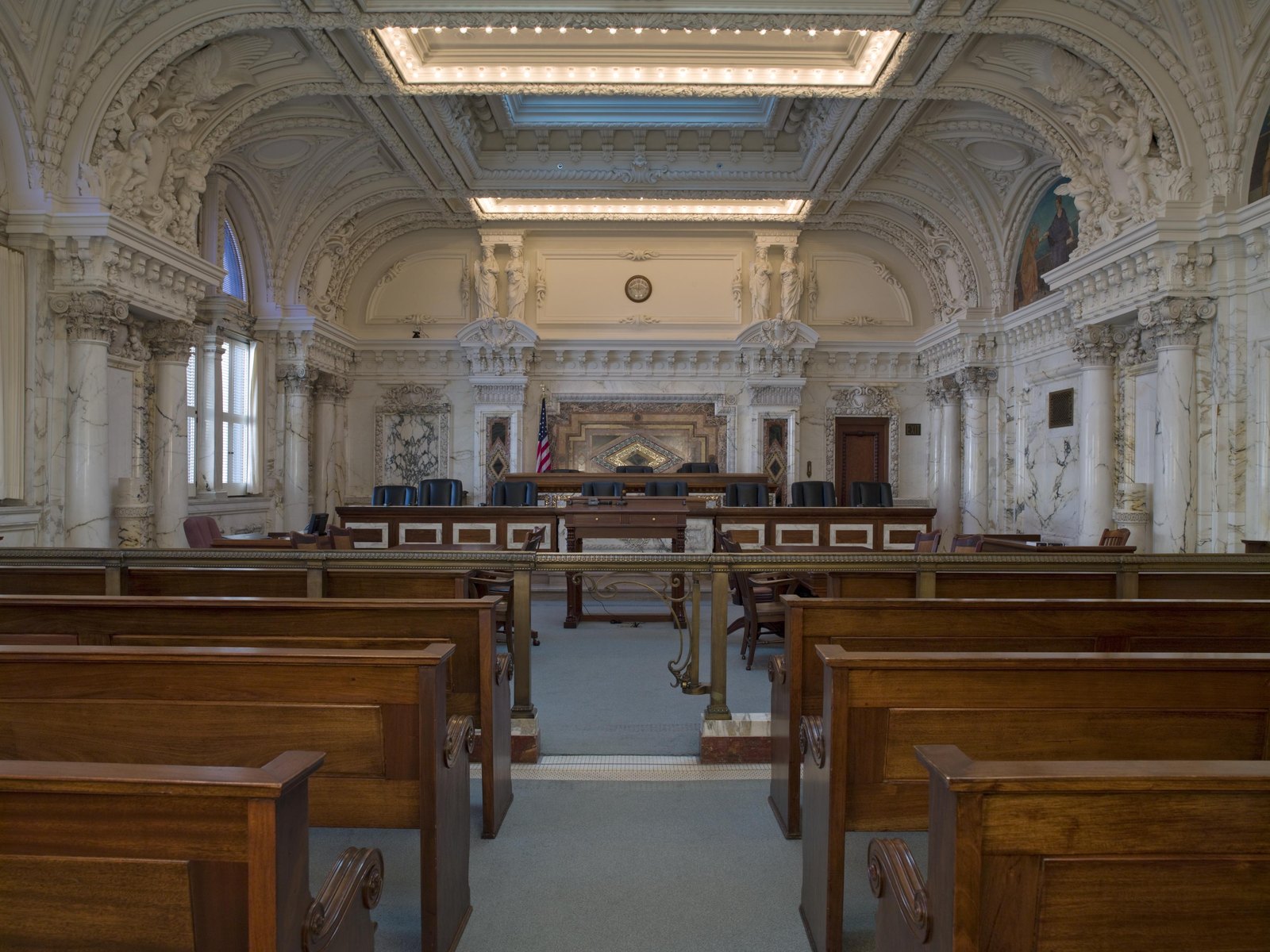
Courtroom One in the James R. Browning U.S. Court of Appeals Building, the Ninth Circuit's headquarters in San Francisco. Photo by Carol M. Highsmith, 2009, via the Library of Congress (no known restrictions on publication).
Did the Ninth Circuit move only after DOJ went over its head?
The timeline in Sauer's letter points that way. The government first asked the Ninth Circuit for a stay on Oct. 5, the day the Supreme Court sent the case back. On Oct. 30, the court "denied both stay requests." Four days later, on Nov. 3, it "partially reversed course," withdrawing that order, asking for more briefing on the Supreme Court's June TPS ruling, and granting a stay that ran only until Nov. 20.
On Nov. 6, DOJ asked the panel for one of two things by Nov. 13: a decision on the merits, or an order extending the stay until seven days after a merits decision. "By November 18, the court of appeals had not acted on any of these requests," Sauer wrote. So the government went to the Supreme Court. "Yesterday, a few hours after we filed our stay application, the court of appeals issued an order" doing what DOJ had asked for on Nov. 6.
Neither the AP nor the plaintiffs' own Nov. 18 release reported a reason from the court for the timing. The Ninth Circuit order itself does not appear in either account, and PatriotAddict has not seen its text.
Official record
Letter from Solicitor General D. John Sauer to Supreme Court Clerk Scott S. Harris withdrawing the stay application in Mullin v. National TPS Alliance, No. 26A714, dated Nov. 19, 2026. Page 1 is shown below.
"Should the Ninth Circuit enter an adverse judgment, however, we intend to immediately return to this Court for additional relief." Sauer letter, Nov. 19, 2026
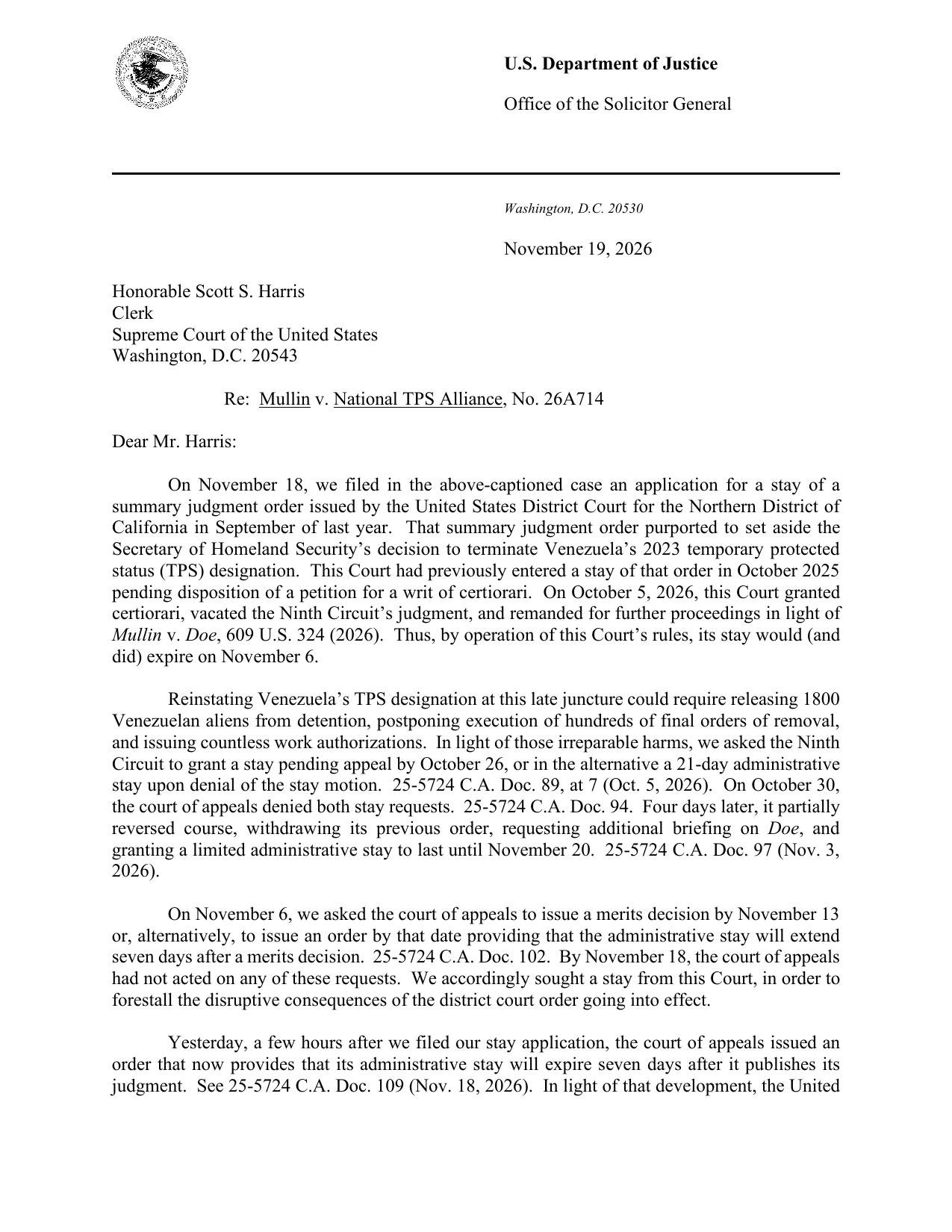
Read or download the full 4-page letter with service list (PDF) or view it on the Supreme Court's website.
Is DOJ backing down?
No. The letter is a procedural retreat, not a concession on the merits. The government still says the termination of Venezuela's 2023 designation is in force, and it still relies on the Supreme Court's June decision in Mullin v. Doe, which the letter cites as 609 U.S. 324. That ruling held courts cannot hear non-constitutional challenges to a secretary's decision to end a TPS designation, reading the statute's line that "there is no judicial review of any determination" in 8 U.S.C. 1254a(b)(5)(A).
The seven-day window matters here. If the panel rules against the administration, the stay keeps U.S. District Judge Edward Chen's 2025 order on hold for a week, enough time for Sauer to file a fresh application before anyone is released. His letter says the government would "immediately return" to the justices. It also restates the stakes the government put on the table: reinstatement "could require releasing 1800 Venezuelan aliens from detention, postponing execution of hundreds of final orders of removal, and issuing countless work authorizations."
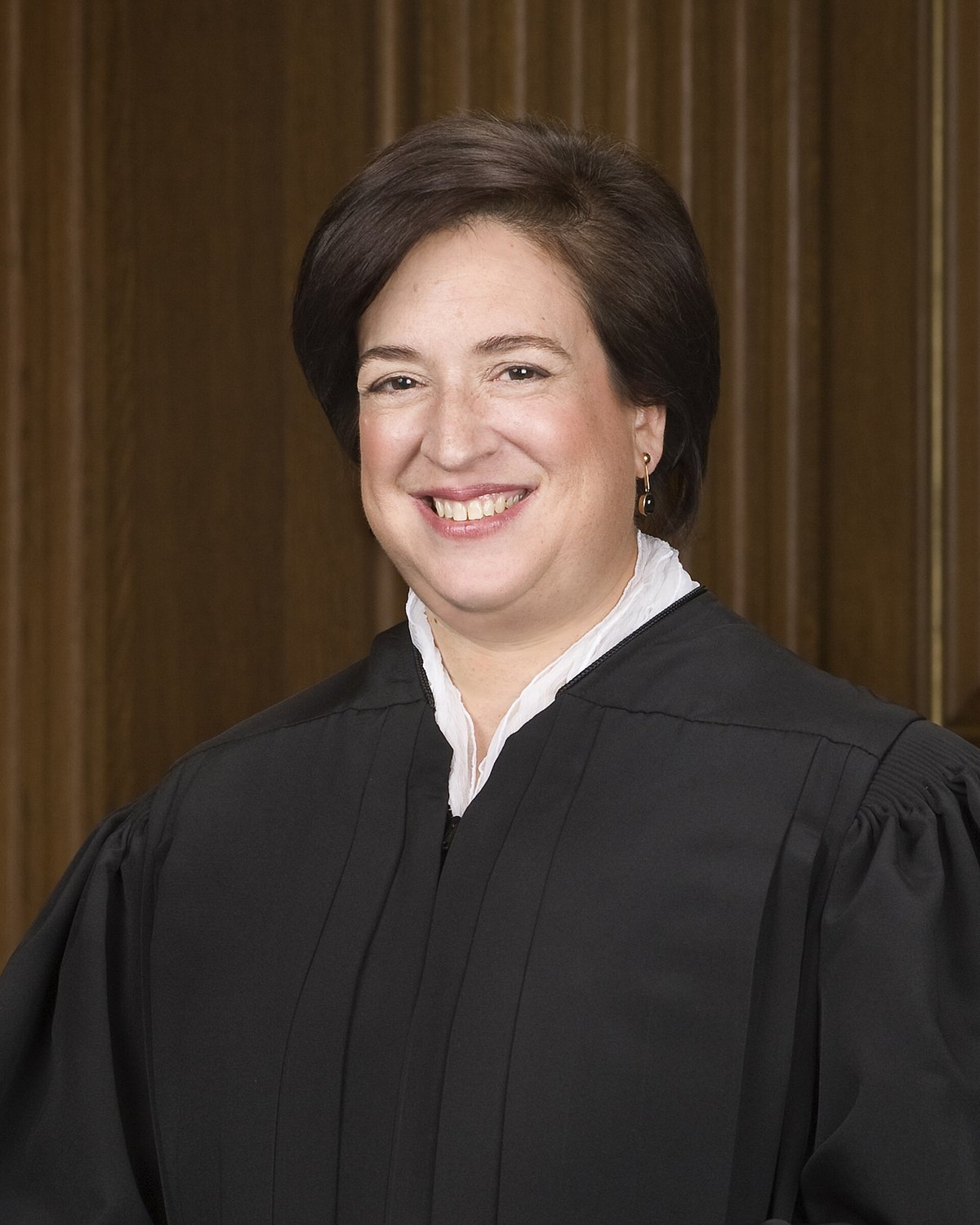
Justice Elena Kagan, who handles emergency applications from the Ninth Circuit and received DOJ's Nov. 18 request. Official Supreme Court portrait by Steve Petteway via Wikimedia Commons (public domain).
What do the plaintiffs say?
Lawyers for the National TPS Alliance, which won Chen's ruling, said the Supreme Court filing was never needed. "The government is yet again trying to jump the line to get the Supreme Court to endorse their illegal actions," Emi MacLean of the ACLU of Northern California said in the UCLA School of Law release. "The Ninth Circuit is reviewing this case on an expedited timeline and there is no basis for yet another shadow docket stay."
The same release says the case covers 600,000 Venezuelan TPS holders. DHS's own count is lower: the February 2025 termination notice says 348,202 people were registered under the 2023 designation. The AP said it is unclear how many former TPS holders remain in the country.
What happens now?
For Venezuelans who held TPS, nothing changes this week. The termination stays in effect, no status or work permit comes back, and ICE can keep detaining and deporting former holders. The AP put the number in detention at about 1,800, with about 330 facing deportation proceedings.
The next move belongs to the Ninth Circuit, which took 12 days to answer a request the government says needed an answer in seven. No date has been set for its merits ruling. When it comes, the plaintiffs will have to explain how their remaining claim survives a Supreme Court decision that took most of these challenges off the table, and DOJ has already told the justices it will be back the moment it loses.
Top photo: The Mission Street facade of the James R. Browning U.S. Court of Appeals Building in San Francisco, home of the Ninth Circuit. Photo by Carol M. Highsmith, 2009, via the Library of Congress (no known restrictions on publication).















