

Gun Owners of America told a House Oversight panel Wednesday that ATF holds more than 1.4 billion gun records that amount to an illegal national registry. The fix now on the table is a Trump ATF proposal to cap how long those records are kept at 20 or 30 years. ATF's own numbers say that would clear out about 500 million images, but GOA says the stacked clocks still let one gun sale sit on file for 60 years.
What did GOA tell the subcommittee?
The Nov. 18 hearing before the Subcommittee on Federal Law Enforcement, chaired by Rep. Clay Higgins (R-La.), dealt with the paperwork gun dealers must ship to ATF when they close for good. "I am here to tell you that ATF has ignored Congress," GOA federal affairs director Aidan Johnston said, according to the Daily Caller News Foundation. "Those records are searchable and they can be weaponized against law abiding gun owners for mass gun confiscation."
GOA's 111-page written submission pins the number to a June 10, 2026 ATF letter to Rep. Michael Cloud (R-Texas) reporting 1,414,088,513 records. The same report concedes that ATF counts every page, and that a page "may record one gun, several guns, or no guns at all." Nobody outside ATF knows how many owners are in the pile.
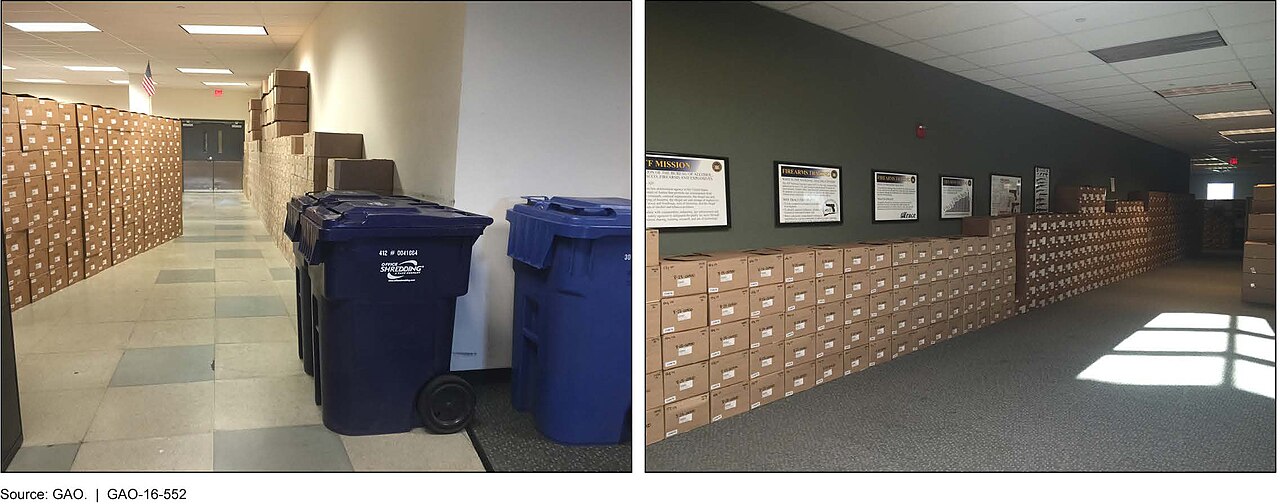
Boxes of records from closed gun dealers lining the halls of ATF's National Tracing Center in Martinsburg, W.Va. Figure 4 of GAO report GAO-16-552, via Wikimedia Commons (U.S. government work, public domain).
Can ATF search the files by name?
That was the fight of the afternoon. Higgins asked whether minor IT changes would make the records searchable by name, and Johnston said yes, according to the committee's hearing summary. Wally Nelson, the retired ATF official who ran the National Tracing Center from 1998 to 2005, answered: "It could be, I don't know. I'm not a computer expert." Cloud was blunter: "It's definitely a searchable database."
Nelson's written statement says the scanned images "are not searchable by an individual's name," and that tracers pull them by dealer license number one trace at a time. A 2016 GAO audit reached the same conclusion about the imaging system, though it also found ATF had not always complied with the restriction in other data systems. GOA's report answers that the name search is "simply disabled," and claims AI tools could switch it on "in less than a day." No ATF official testified. A spokesperson told the Daily Caller the records are used "for one purpose: tracing guns recovered in crimes, by serial number."
What would the Trump ATF rule change?
Before 2022, dealers could toss most records after 20 years. A Biden-era rule made retention permanent. ATF's May 6 proposal would set the dealer clock at 20 or 30 years and, for the first time, limit how long the tracing center keeps out-of-business records to 20 or 30 years "from the date it receives the records." The notice says the center held about 1.3 billion images as of June 2025, was taking in 6.8 million records a month, and that 500 million images were already more than 20 years old. Comments closed Aug. 4. No final rule has been published.
Official record
Firearm Records Retention Periods, proposed rule, 91 Fed. Reg. 24413 (May 6, 2026), Docket ATF-2026-0003, RIN 1140-AA95. Page 24419 is shown below.
"Changing the current retention period would significantly reduce the volume of records retained by ATF and alleviate concerns that ATF might have established or will establish a registry of firearms, firearms owners, or firearms transactions." ATF proposed rule, page 24419
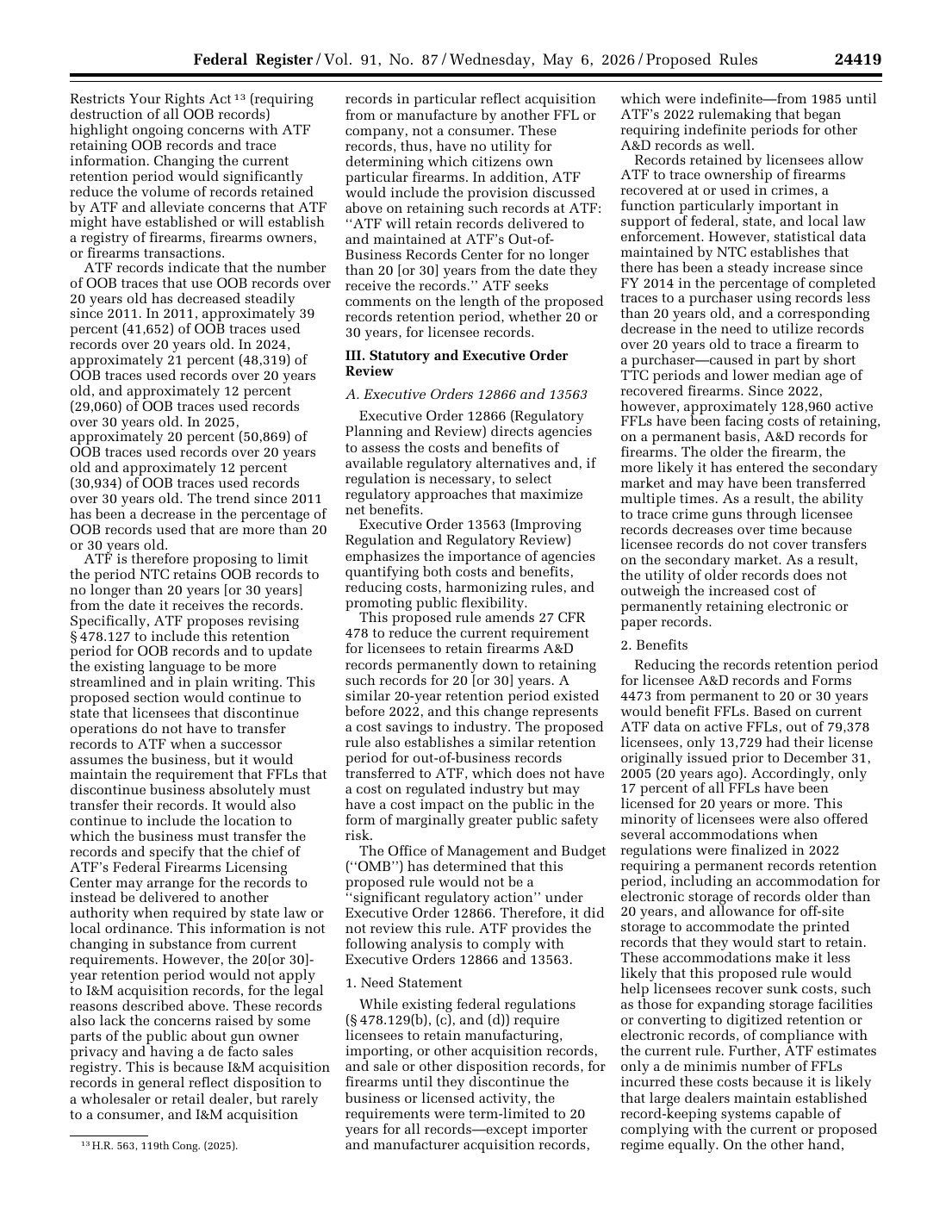
Read or download the full 12-page proposed rule (PDF) or view it at GovInfo.
Where does the 60-year figure come from?
It is GOA's math, and Higgins made the same point in his opening. A dealer could hold a Form 4473 for 30 years, close, and ship it to Martinsburg, where the second 30-year clock starts. "An American citizen purchasing his or her first handgun at age 21 could have his or her gun registered in an ATF database until he or she turns 81," GOA's report says. The group wants "zero years," echoing what senior vice president Erich Pratt told a Senate panel in April, and backs H.R. 563, which would order the existing records destroyed.
Rep. Andrew Clyde (R-Ga.) raised a different gap. He cited the 1986 Firearm Owners Protection Act ban on "any system of registration" and a permanent appropriations rider barring ATF from "consolidating or centralizing" dealer records, and said the proposed rule addresses neither, the committee summary reports. Johnston and FFLGuard founder Christopher Chiafullo agreed with his reading.
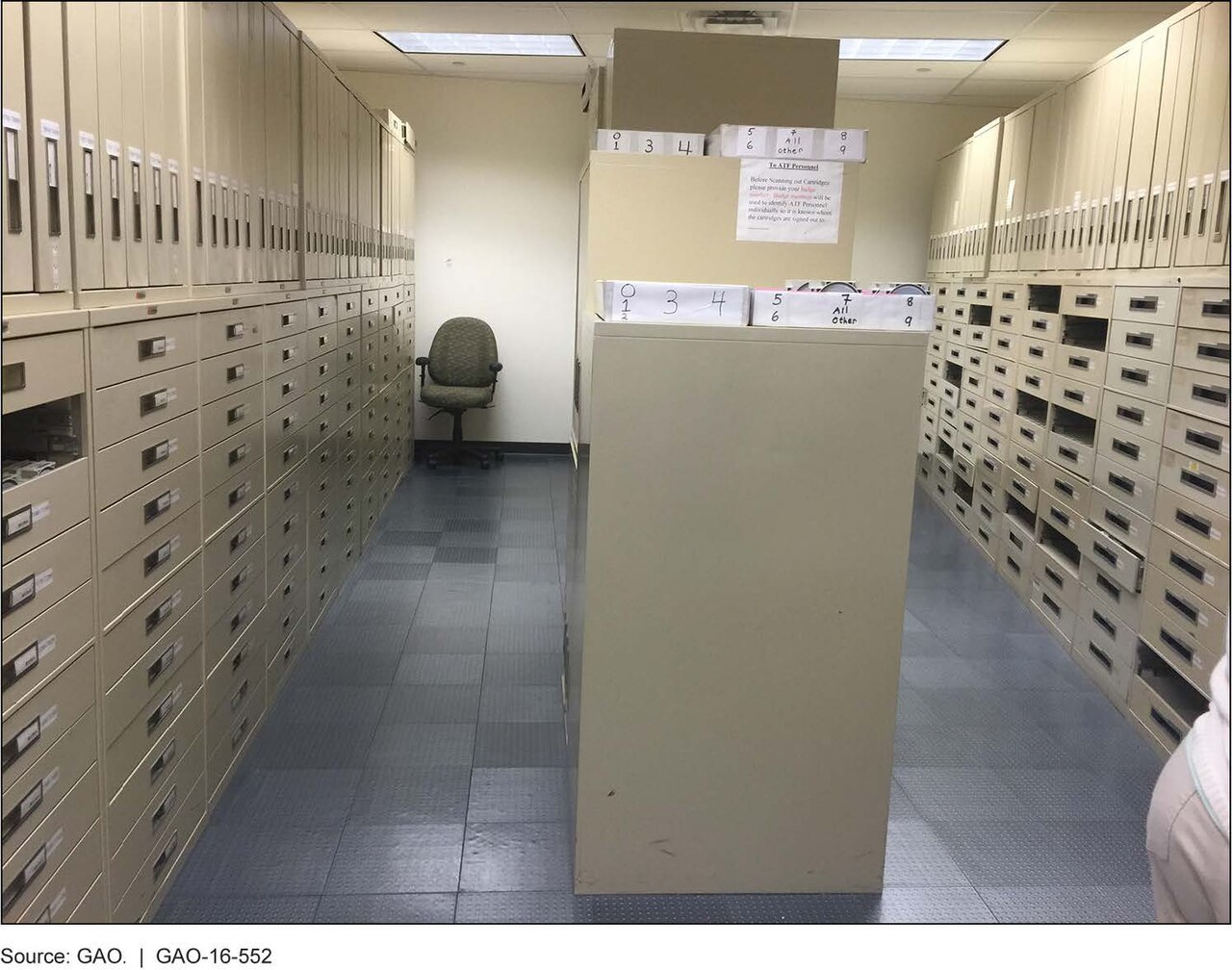
ATF's microfilm archive of out-of-business dealer records, which Nelson says still held more than 50,000 reels when he retired. Figure 5 of GAO report GAO-16-552, via Wikimedia Commons (U.S. government work, public domain).
How often do old records actually solve a trace?
The witnesses could not agree on that either. Gregory Jackson, the Democrats' witness and a former deputy director of Biden's White House Office of Gun Violence Prevention, wrote in his testimony that 52% of trace requests from 2000 to 2023 were completed with out-of-business records. Nelson wrote that the share fell from 25% in 2015 to 11% in 2024.
ATF's own notice fits neither figure neatly. It says 48,319 out-of-business traces in 2024 used records older than 20 years, about 21% of the total. That works out to roughly 230,000 such traces, a bit over a third of the 614,995 traces ATF ran in fiscal 2024, though the two counts use different calendars. ATF estimates a 20-year cap would cause 49,920 more traces a year to fail, and a 30-year cap 29,377, and concedes those failures "could delay or hinder" police work. Nelson, who supports the rule, wants the 30-year cap for the tracing center. He points to the 1998 Capitol shooting that killed Officers Jacob Chestnut and John Gibson, where the gun traced to a 1972 sale.
What happens next?
ATF has to choose 20 or 30 years and publish a final rule, and no date has been announced. GOA's 2022 lawsuit against the permanent-retention rule, Morehouse Enterprises v. ATF, has been stayed since February 2024 while the administration reviews it. Wednesday's hearing put a sharper question in front of Congress than the rule does. ATF itself says shorter retention would ease "concerns" about a registry. Whether those 1.4 billion pages should exist at all is a call the agency's proposal leaves to lawmakers, and only H.R. 563 answers it.
Top photo: Rep. Clay Higgins (R-La.), chairman of the House Oversight Subcommittee on Federal Law Enforcement. Official portrait by Brian Thorpe, House Creative Services, via Wikimedia Commons (U.S. government work, public domain).















