

The Senate passed the Trump-backed permitting overhaul 62-33 on Thursday, sending a bill that cuts the window to sue over federal environmental reviews from six years to 150 days to the House. President Trump says it will "codify our America First Energy Agenda." The part getting the least attention is a "project certainty" title that lets developers collect up to half their costs from the Treasury's Judgment Fund when an agency pulls a permit in bad faith, and it would bind the next president as much as this one.
What passed, and who voted for it?
The measure is the Bipartisan American Affordability and Jobs Act, introduced as S. 5653 on Sept. 30 by Environment and Public Works Chair Shelley Moore Capito of West Virginia and Energy Chair Mike Lee of Utah, with Democrats Sheldon Whitehouse and Martin Heinrich. To move it, the Senate stripped an unrelated House-passed tax bill, H.R. 2347, and swapped in the permitting text. The substitute was adopted 69-27 on Wednesday.
The final roll call shows 15 Democrats and independents voting yes, Chuck Schumer among them. Two Republicans voted no: Josh Hawley of Missouri and Mike Rounds of South Dakota. The other 31 no votes came from 30 Democrats and Bernie Sanders, including Chris Van Hollen, who is challenging Schumer for the leader's job.

Sen. Shelley Moore Capito (R-W.Va.), chair of the Environment and Public Works Committee and lead sponsor of the permitting bill. Official Senate portrait via Wikimedia Commons (U.S. government work, public domain).
"This bill has threaded a needle the likes of which this chamber has not seen in a while," Capito said before the vote, according to Roll Call. Trump, in a Truth Social post quoted by the Daily Caller ahead of the first procedural vote, called it "Landmark Permitting Reform Legislation" and said it also writes his "RATEPAYER PROTECTION PLEDGE" into law, so that data centers pay for their own electricity.
How much shorter does the lawsuit clock get?
A lot. Under current law, groups suing over a National Environmental Policy Act review generally get up to six years to file, the Congressional Research Service notes in its 37-page analysis of the NEPA title. Section 1110 drops that to 150 days, limits suits to people who raised the issue in public comments, and sends the cases straight to federal appeals courts.
The bigger change is the remedy. CRS says a court that finds a NEPA violation could no longer vacate the approval or issue a permanent injunction. The judge would send the review back to the agency with a deadline of no more than 180 days, "while the underlying project or action proceeds." For pipeline and power plant builders who have watched projects die in court years after approval, that is the heart of the bill. The Senate Western Caucus also lists 150-day limits on Endangered Species Act challenges.
What does "project certainty" actually do?
Title IV is where the money is. CRS legislative attorney Andrew Coghlan's Nov. 6 report says Section 1401 would bar agencies from revoking or altering existing permits, or interfering with a fully permitted project, unless a court orders it, the permit holder broke the law or lied, an urgent new threat appears, or the holder asks. An agency that wants to act would have to prove its case "by clear and convincing evidence," a reversal of the usual deference courts give the government.
Official record
Congressional Research Service Report R49511, "Bipartisan American Affordability and Jobs Act (BAAJA) of 2026: Analysis of Project Certainty Provisions," Nov. 6, 2026. The summary page is shown below. It analyzes the bill as introduced; the changes adopted Wednesday are described in the text.
"Section 1401 would authorize suit to enforce its terms and would entitle prevailing plaintiffs to injunctive relief and damages, including 25% to 50% of total project costs, to be paid from the Judgment Fund, a permanent, indefinite appropriation codified at 31 U.S.C. § 1304." CRS Report R49511, summary page
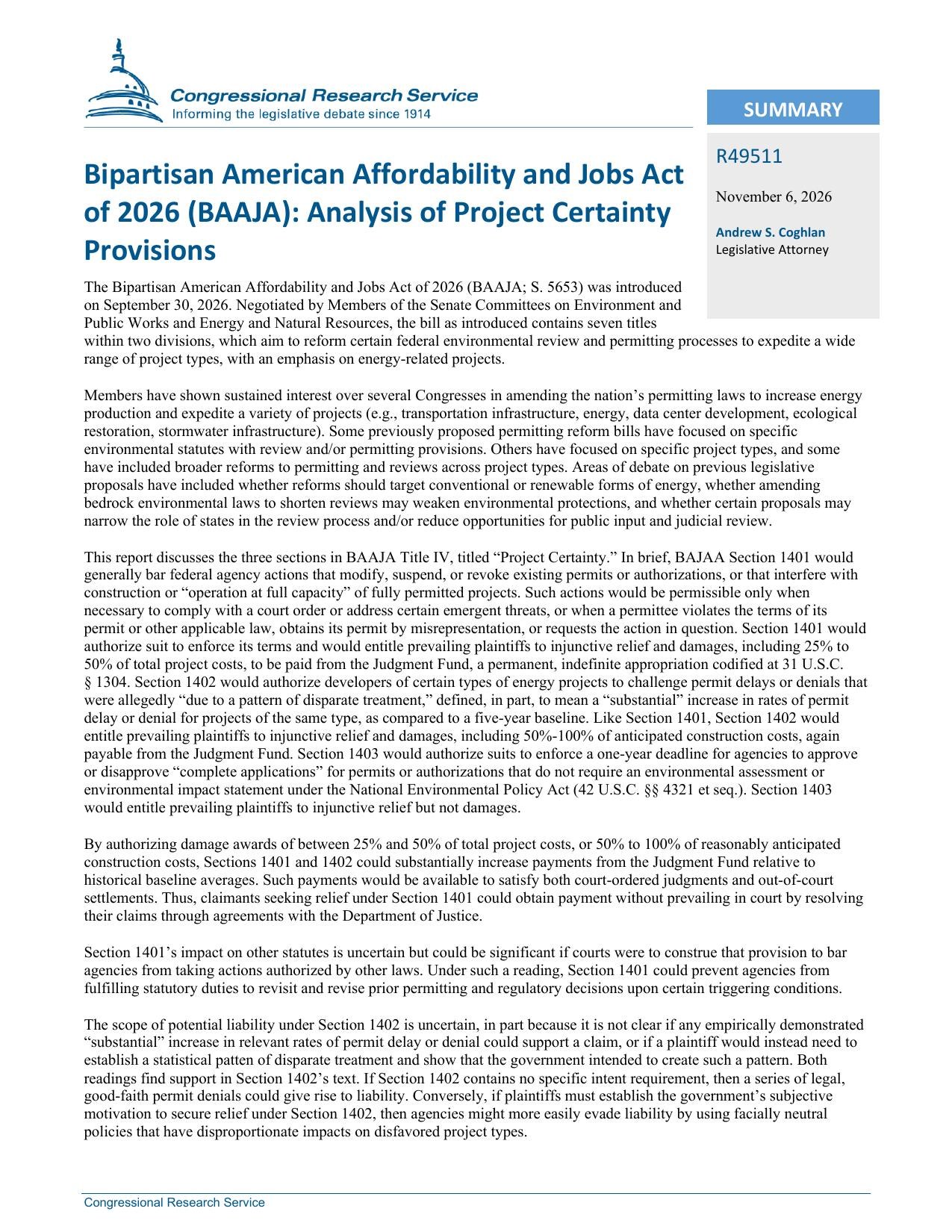
Read or download the full 13-page CRS report (PDF) or view the bill text on Congress.gov.
The Judgment Fund is a standing Treasury account with no dollar cap, so those payouts would never go through the annual appropriations fight. Section 1402 goes further for energy developers who can show a pattern of permit denials, with damages of 50% to 100% of a project's expected construction cost. CRS warned that both sections "could substantially increase payments from the Judgment Fund" compared with historical averages.
The version that passed is narrower. According to the Bipartisan Policy Center's breakdown of the manager's amendment, the cost payout now requires a finding that the agency "interfered in bad faith," covers development and construction costs, and cannot be paid out without a final judgment. The Clean Air Task Force notes the amendment also added exceptions for threats to human health and the environment, plus a broad one for actions "taken pursuant to any applicable law or regulation."
Who is this shield really for?
Both parties wrote it with someone else's president in mind. Roll Call reports the legal-recourse language is aimed partly at this administration's moves against wind and solar, which is how Heinrich and Whitehouse got Democrats back to the table. The bill even carries a special rule for projects whose stop-work orders a court already blocked, steering new suits to the same judge. That describes Revolution Wind, the Rhode Island offshore project whose stop-work order U.S. District Judge Royce Lamberth set aside in September 2025.
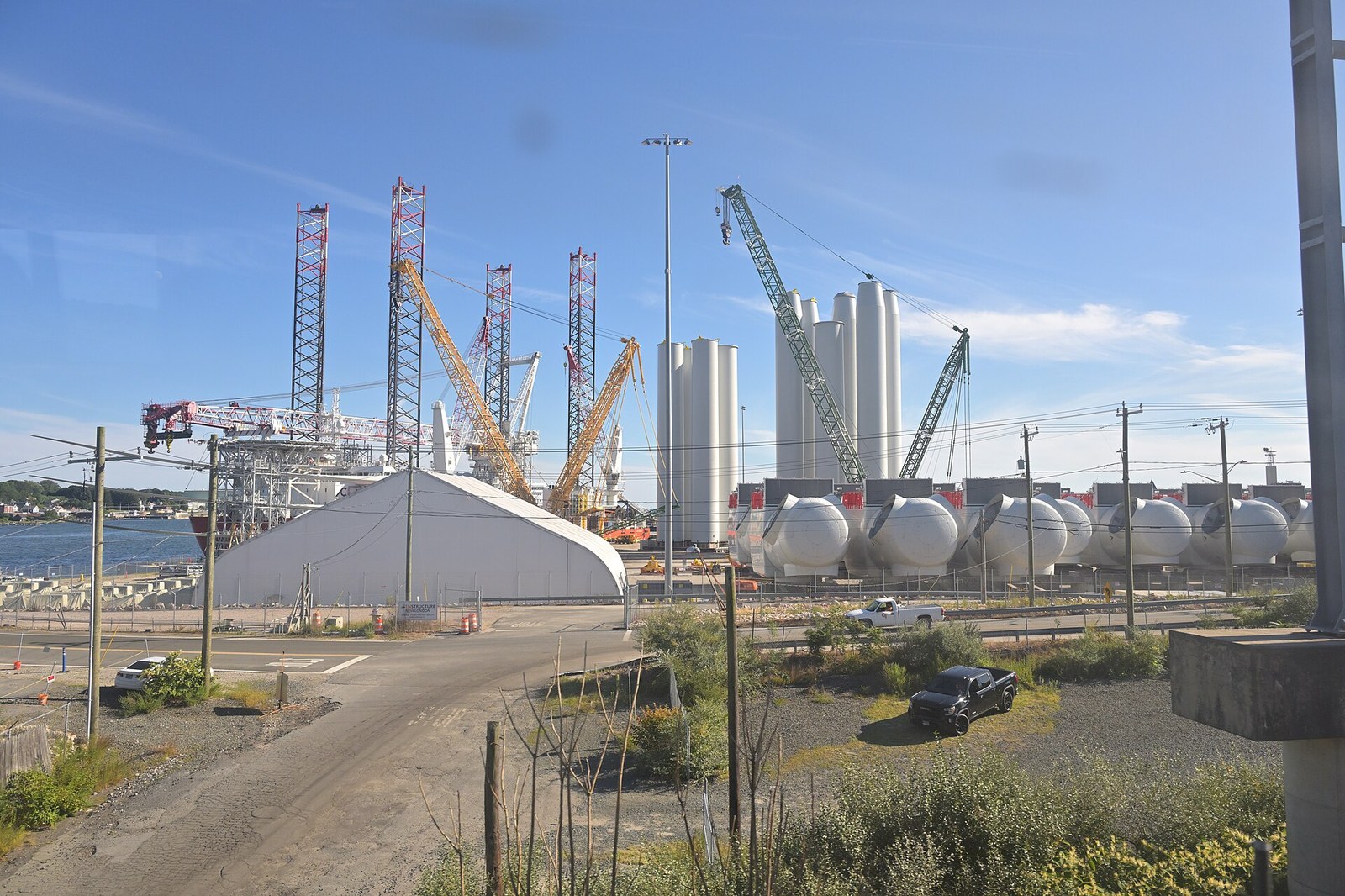
Turbine towers and nacelles for the Revolution Wind offshore project staged in New London, Connecticut, in August 2025, the same month federal regulators ordered work on it halted. Photo by 4300streetcar via Wikimedia Commons, CC BY 4.0.
The flip side matters more for conservatives. Every pipeline and gas plant permitted under Trump would carry the same shield in 2029, when a Democratic administration could take over. Section 1401 covers permits in effect on or after Nov. 6, 2026, so a future Interior or Energy secretary who tries to claw one back would face a clear-and-convincing burden and, on a bad-faith finding, a Judgment Fund bill.
Can the House finish it before Democrats take over?
Speaker Mike Johnson says the bill can pass, and Roll Call expects a House vote after Thanksgiving. Minority Leader Hakeem Jeffries opposes the current version, and Rep. Jared Huffman of California, in line to chair House Natural Resources, says it carries too many provisions Democrats oppose. Many Democrats want to wait until January, when their new majorities can rewrite it. If the House doesn't clear it before this Congress ends, the bill dies.
That is the real deadline. Trump has 62 Senate votes and a Speaker on board. What he doesn't have is time. A bill that limits what any future administration can undo has a few legislative weeks to reach his desk before the people most eager to undo his energy agenda control both chambers.
Top photo: President Donald Trump with Sen. Shelley Moore Capito, Sen. John Barrasso and Vice President-elect JD Vance at the Capitol, Jan. 8, 2025. Photo from the Office of Sen. Shelley Moore Capito via Wikimedia Commons (U.S. government work, public domain).















