Two Christian fathers sued Minnesota on Nov. 16 over its K-12 education tax credit and subtraction, which give parents money back for tutoring and textbooks but shut out anything used to teach "religious tenets, doctrines, or worship." Their 33-page complaint goes further than the press release suggests: one family admits a math book it uses is "not explicitly religious," and says it still cannot sign a form calling any lesson secular.
Who sued, and over what?
The case is Colestock v. Marquart, filed in the Minnesota Tax Court by Alliance Defending Freedom and the Upper Midwest Law Center. The defendant is Revenue Commissioner Paul Marquart, sued in his official capacity. ADF announced the suit on Nov. 18, and the Department of Revenue declined to comment, Alpha News reported.
Nathan Colestock is executive pastor of a church in Stillwater and part-time head of Valor Classical Academy, a Christian school that meets three days a week. Joseph Osburn, a father of six, is technology director at a Christian ministry. Both live in Washington County. Colestock says he has never claimed either benefit, and Osburn has skipped the one he qualifies for, because claiming means certifying that their children's lessons are not religious.
"Parents, not the government, have the right to direct how their children are raised and educated," ADF Senior Counsel Kate Anderson said in the group's statement.
What does Minnesota's law actually say?
The credit is refundable and covers 75 percent of qualifying costs, up to $1,500 per child for families earning $70,000 or less, under Minn. Stat. 290.0674. The subtraction has no income limit and lets parents knock up to $1,625 per child in grades K-6, and $2,500 in grades 7-12, off their taxable income under Minn. Stat. 290.0132.
The same statute that defines "textbooks" then carves out "instructional books and materials used in the teaching of religious tenets, doctrines, or worship, the purpose of which is to instill such tenets, doctrines, or worship." A matching rule strips tutoring and after-school fees from eligibility if the instruction teaches the faith. The Department of Revenue's own guidance lists "nonreligious textbooks" as a qualifying expense and "instructor fees paid for the teaching of religious beliefs" as one that is not.
Official record
Complaint, Colestock v. Marquart, State of Minnesota Tax Court, Regular Division, filed Nov. 16, 2026. Page 7, which defines the "Religious Exclusion," is shown below.
"Teaching a child to add fractions does not lose its academic value merely because the lesson begins in prayer." Complaint, paragraph 86
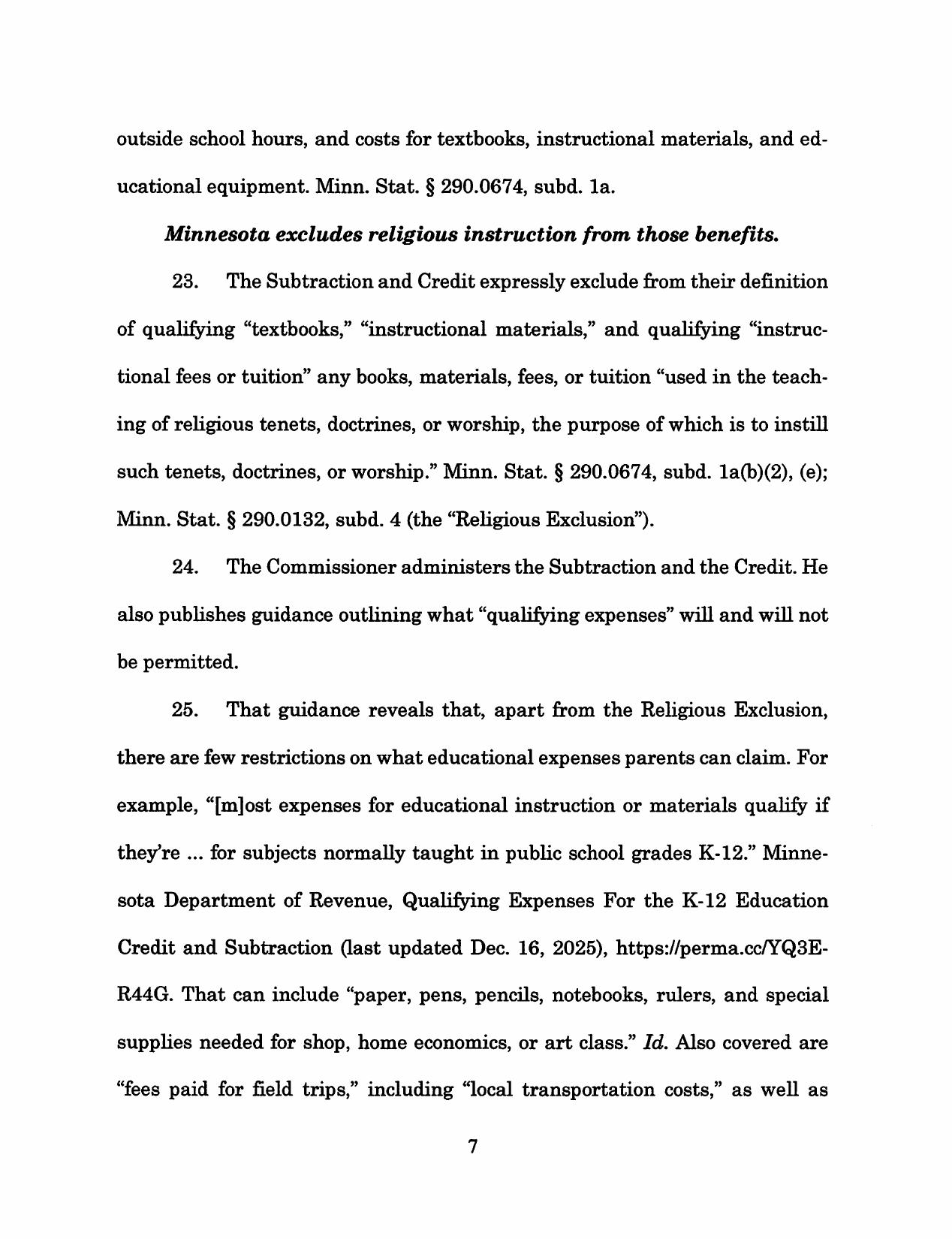
Read or download the full 33-page complaint (PDF), as posted by Alliance Defending Freedom.
What would the families get?
Not a windfall. The Colestocks expect to spend about $700 on curricula and materials this year, and their income falls under the $70,000 line, so they would qualify for the full credit but for the religion rule. The Osburns earn too much for the credit and say they skipped the subtraction for the past three tax years. They expect $500 to $700 in curriculum costs.
The complaint lists what that money would buy: theater classes, tumbling and soccer for the Colestock girls, plus a math tutor, pottery and gymnastics for the Osburn children, and violin lessons for their son. Statewide, the benefits are modest. A 2022 House Research brief counted about 189,000 returns claiming the subtraction in tax year 2019, and 32,220 claiming the credit, at an average of $249.
Is the math book religious?
This is where the complaint gets more interesting than the headlines. The Osburns use Master Books for history and math, and Apologia for science, both Christian publishers. When their kids raced ahead in math, they added Singapore Dimensions, which the complaint itself calls "not explicitly religious." The family teaches it anyway "through the lens of the Bible," telling the children that "even the pencils they use come from the ingenuity God gave to the minds of men."
A plain secular math workbook may well qualify under Minnesota's rule as written. The fathers say that misses the point. Paragraph 75 argues that "whatever line Minnesota might draw," they "do not view any of their children's education expenses as secular," so they cannot sign off on any of them. That makes this a fight over the certification as much as the books. It also exposes a real problem for the state: according to the complaint, the department's guidance excludes homeschool costs that are "primarily religious in nature," and the complaint argues that phrase gives the commissioner open-ended discretion to decide what counts.
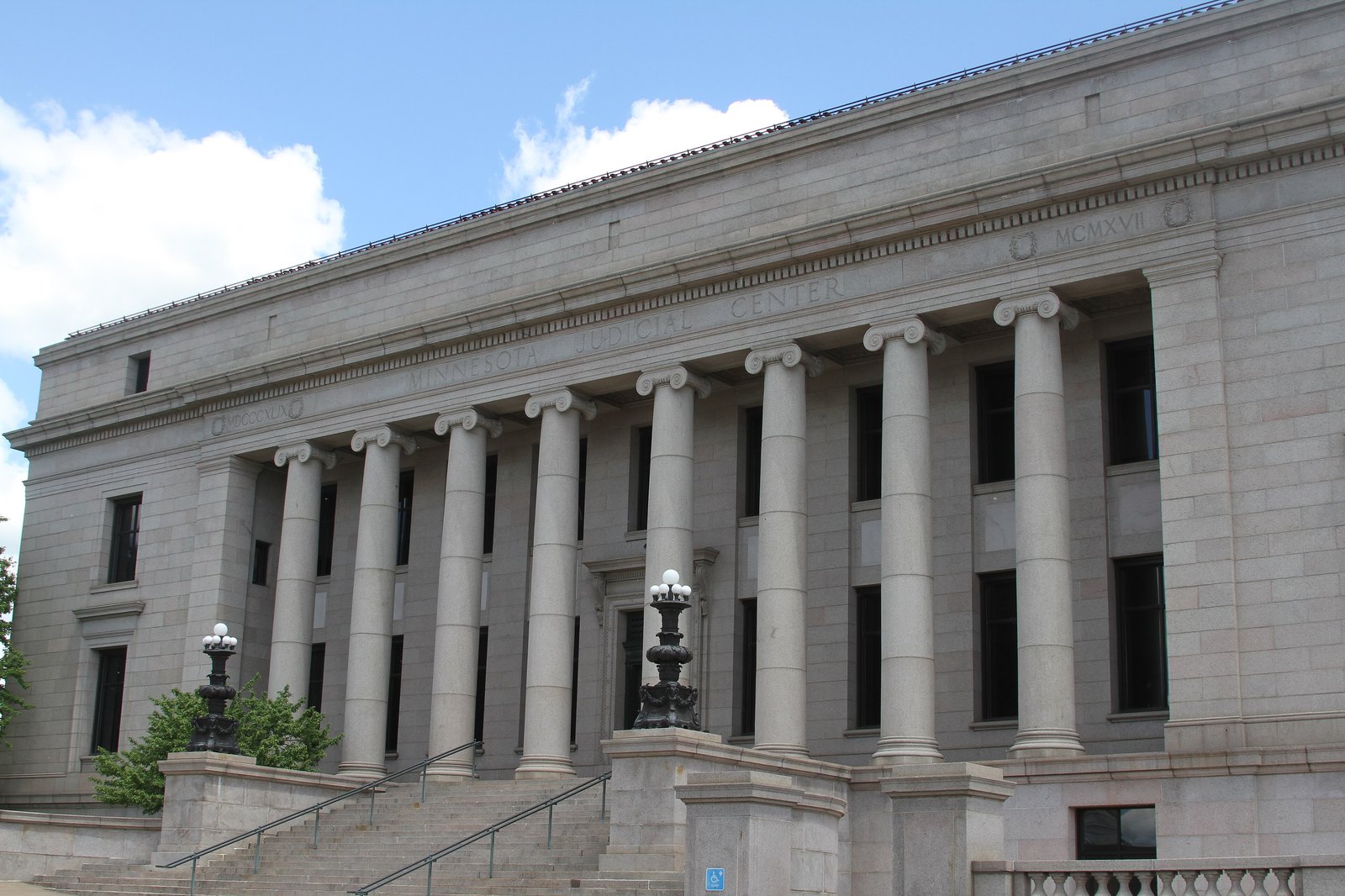
The Minnesota Judicial Center in St. Paul, which houses the Minnesota Tax Court where the complaint was filed. Photo by Myotus via Wikimedia Commons (CC0, public domain dedication).
Didn't the Supreme Court already rule on this law?
On a much older version, yes, and in the opposite direction. In Mueller v. Allen (1983), the justices voted 5-4 to uphold Minnesota's tuition, textbook and transportation deduction against people who said it funded parochial schools. Justice William Rehnquist's majority opinion pointed to the religious-textbook carve-out as part of why the law passed muster, noting state officials "must disallow deductions" for religious teaching materials, much like decisions the Court had approved before.
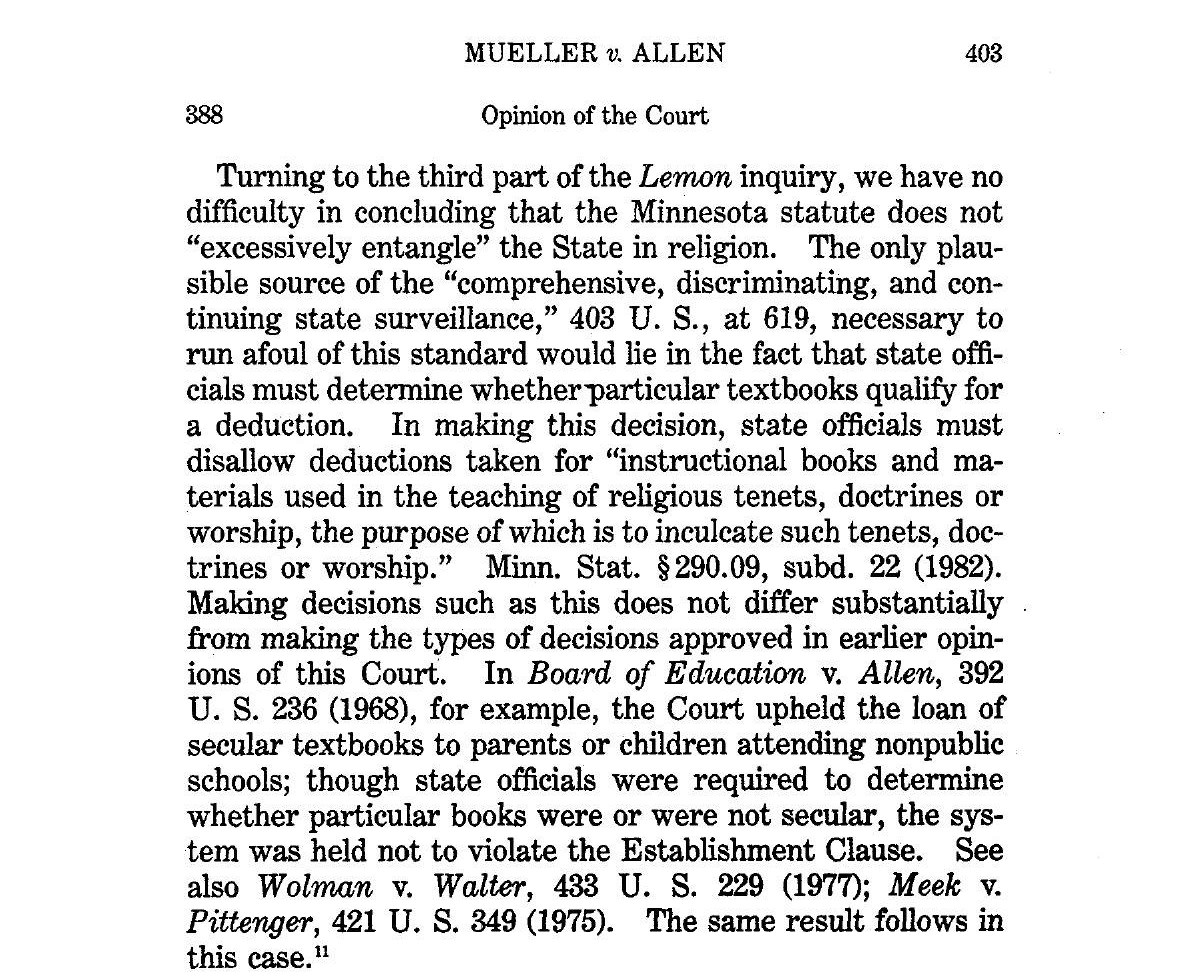
Page 403 of Mueller v. Allen, 463 U.S. 388 (1983), discussing the same religious-materials exclusion now under challenge. U.S. Reports via the Library of Congress (U.S. government work, public domain).
In 1983 the carve-out protected the law from an Establishment Clause attack. In 2026 the fathers say it violates the Free Exercise Clause. The law around it has moved. In Carson v. Makin (2022), the Court held that once a state subsidizes private education, it "cannot disqualify some" schools "solely because they are religious," and the complaint quotes that line in its fourth paragraph. It also leans on the 2025 Mahmoud v. Taylor ruling on parents' right to direct their children's religious upbringing.
One wrinkle cuts against the "Minnesota excludes Christian education" framing. Private school tuition, religious schools included, already qualifies for the subtraction, the Revenue Department says. That is the piece Mueller upheld. The exclusion bites on books, materials and outside-the-school-day instruction, which is exactly where hybrid and homeschool families spend their money.
What happens next?
Not a ruling soon. The Tax Court cannot decide constitutional questions on its own, the complaint concedes, citing Minnesota Supreme Court precedent, so the fathers filed a motion asking the court to refer those questions to a state district court. They seek a declaration that the exclusion is unconstitutional, an injunction barring the commissioner from enforcing it, nominal damages and attorney fees.
The stakes reach past two families. Minnesota's own guidance says the credit and subtraction apply whether a child attends "a public, private, parochial, or home school." If a court rules that the state cannot make parents certify their lessons are free of faith, a family teaching fractions from a Christian workbook would get the same tax treatment as the family down the street buying a secular one.