Vice President JD Vance refused Thursday to say when gasoline gets back to $3 a gallon, and the government's own price data explains why he refused. At the gap that has actually held between crude oil and the pump since June, a $3.00 national average requires Brent crude at roughly $44 to $53 a barrel. Brent closed the week ending August 28 at $89.73, and the last time it settled inside that range was the first week of 2021.
AAA put the national average at $4.14 on Thursday, the first time it has ever been above $4 on Labor Day, beating the $3.82 record set in 2012, according to the club's holiday release. Over the Fourth of July it was $3.83. Vance was at the podium because the number went the wrong way.
Bessent gave a date on July 2. He also gave the reason he thought it would happen.
The promise Vance was asked about is real and it is on video. Treasury Secretary Scott Bessent sat down with CBS News anchor Kelly O'Grady on Thursday, July 2, when AAA's average was $3.83, and said he was hopeful the number would reach $3 by Labor Day. What matters more than the date is the mechanism he named for getting there.
On the record
Treasury Secretary Scott Bessent, exclusive interview with CBS News MoneyWatch correspondent Kelly O'Grady, published July 2, 2026.
"Gasoline prices are a little stickier on the way down. We're trying to give the gasoline retailers a little bit of a nudge. We're telling them we're watching them. We've had some good uptake from some of the bigger retailers in terms of what they want to do for consumers."
Read the full CBS News write-up or watch the 10-minute extended interview.
That is a claim about gas stations, not about oil. Two days earlier, President Trump had posted on Truth Social that "Gasoline Retailers must get their Prices down, IMMEDIATELY!" and that "They're too high considering that Oil is now at $68 a Barrel, and heading south." Bessent went on Fox and Friends the next morning and said retailers "probably had record profits on gasoline retailing," adding, "we're watching."
Run the promise backward and it needs $44 oil
Here is the arithmetic nobody put on the board in July. Take the Energy Information Administration's weekly retail price of regular and subtract the cost of the crude inside it, which is the weekly Brent spot price divided by 42 gallons. Everything left over is refining, pipelines, trucking, the station and taxes. Across the last twelve weekly readings that leftover has averaged $1.948 a gallon.
Hold that constant and a $3.00 pump price leaves $1.052 for the crude, which works out to $44.18 a barrel. Use the wider average since the war began, $1.737, and the answer is $53.06. Brent has not printed a weekly settle at or below $44.18 since November 20, 2020, and has not been at or below $53.06 since the week of January 1, 2021.
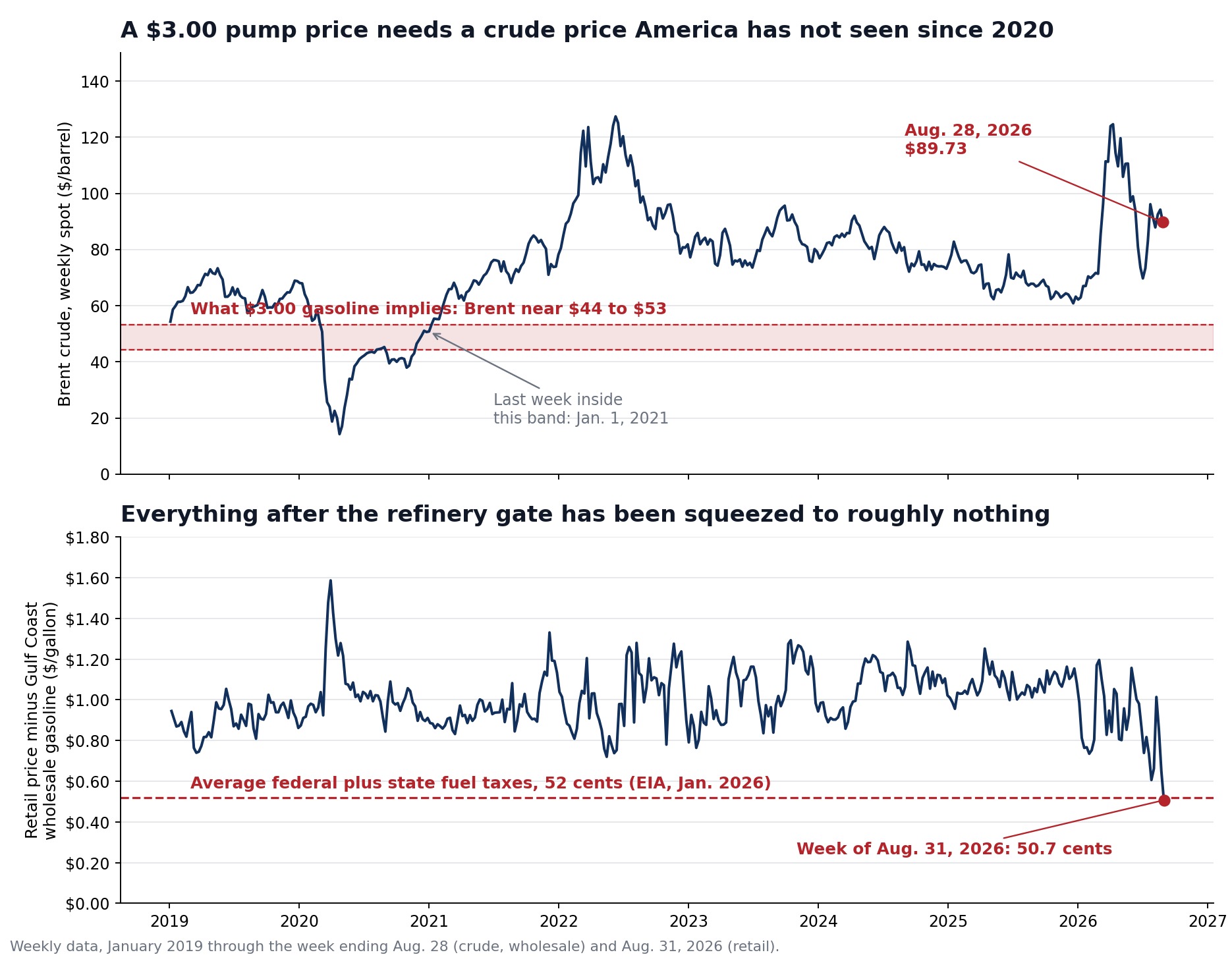
Charts built by PatriotAddict from EIA weekly series RBRTE (Europe Brent spot), EMM_EPMR_PTE_NUS_DPG (U.S. regular retail) and EER_EPMRU_PF4_RGC_DPG (U.S. Gulf Coast conventional regular gasoline spot), downloaded September 4, 2026. The tax line is EIA's January 1, 2026 average of 33.3 cents in state taxes and fees plus the 18.4-cent federal tax.
Bessent said "maybe," and Vance made that point at the podium. But the size of the bet is worth stating plainly. Getting to $3 by Labor Day meant Brent falling from about $70 to the low forties in eight weeks. It rose $20 instead.
Washington told the gas stations to eat it, and the gas stations did
The retailer theory got tested, and it failed on its own terms. Subtract the Gulf Coast wholesale gasoline price from the retail average and you isolate the piece Trump and Bessent were shouting about: distribution, marketing, the station's cut and taxes. In the week of July 6 that slice was 73.9 cents. By the week of August 31 it was 50.7 cents.
Now compare that to the tax bill. EIA reported that state taxes and fees on gasoline averaged 33.3 cents a gallon as of January 1, 2026, on top of the federal 18.4 cents that has not moved since 1993. That is 51.7 cents before a single tanker truck rolls. The 50.7-cent reading is the lowest weekly figure in this series going back at least to 2011, and it sits below the taxes alone.
The squeeze was real and it produced 23 cents. The gap to $3 was 83 cents.
Vance says it is Iran. Over eight weeks, he is right.
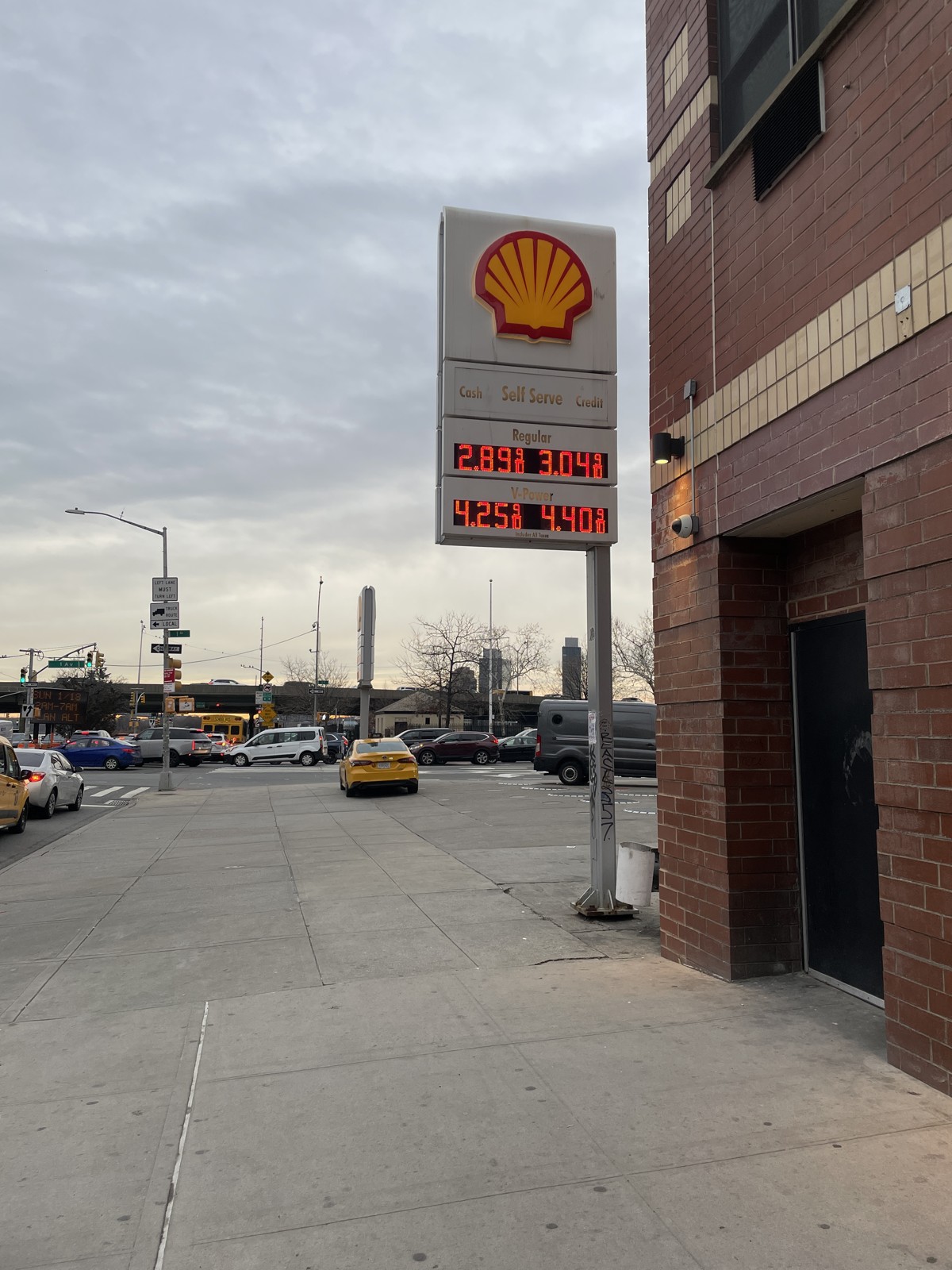
The price board at the Shell station at 1855 First Avenue on Manhattan's Upper East Side, photographed January 14, 2026, six weeks before the war began. Regular reads $2.89 cash. Photo by Deans Charbal via Wikimedia Commons, CC BY-SA 4.0.
Asked about the broken forecast, Vance told reporters that "the fundamental reality is that the reason gas prices are so high right now is because the Iranians are shooting at commercial shipping," and that even after signing an agreement to stop, "they almost immediately went back to shooting at commercial shipping," per CBN News. He would not name a date, and said prices "could have been much, much higher were it not for our efforts," USA TODAY reported.
On the window he was asked about, the data backs him. Brent went from $69.70 the week of Bessent's interview to $89.73 the week of Labor Day, $20.03 a barrel, or 47.7 cents on a gallon. The pump rose 29.4 cents. Crude more than accounts for the whole increase, and the Strait of Hormuz carries roughly a fifth of the world's seaborne oil, by EIA's own chokepoint analysis.
Stretch the window to the whole war and the answer changes. Regular averaged $3.015 in the week of March 2, days after the fighting started, against $4.071 on Labor Day, a move of $1.056. Brent over the same span went from $71.36 to $89.73, worth 43.7 cents. Crude explains about 41 percent of what happened to the pump this year. The rest happened between the wellhead and the station, which we worked through on Tuesday.
The same numbers say the next move is up
Retail lags wholesale by a couple of weeks, which is what that 50.7-cent reading is really telling you. Gulf Coast wholesale gasoline closed August 28 at $3.564 a gallon. In 2025 the retail average ran $1.078 above wholesale. In the five Augusts before this one it ran $1.012 above.
If wholesale simply holds where it ended August and that gap returns to its 2025 norm, the pump lands near $4.64. One caveat belongs on that: the Gulf Coast is the cheapest wholesale market in the country and the national retail average includes California, so this measure is best read against its own history rather than as a clean margin. Its own history says the catch-up has not happened yet.
Four officials, four answers, one pump
Energy Secretary Chris Wright was asked on CNN's State of the Union in April when Americans get gas under $3. He said, "That could happen later this year. That might not happen until next year." The next day Trump told The Hill that his own energy secretary was "totally wrong" about that timeline. In late June the White House said the problem was gas stations. In July the Treasury Secretary said Labor Day. On Thursday the Vice President would not name a date at all.
Vance is the only one of the four the data has not contradicted, and the reason is that he declined to give a number. That is the right answer to a question about oil prices sixty days out from a midterm. It is also an admission that the July answer should never have been given. The pump reads $4.14, and nobody in the building will say when it reads $3.