The Justice Department told a Manhattan federal judge on Tuesday that training an artificial intelligence model on The New York Times archive is fair use. It asked him to say so in writing. The 20-page filing hit the public docket on September 1, and it is the most direct statement the federal government has made in court about who owns the raw material of the AI boom.
What the United States filed, and under what authority
The document is a statement of interest, entered as ECF No. 1682 in In re: OpenAI, Inc. Copyright Infringement Litigation, No. 1:25-md-03143 (SHS) (OTW), the multidistrict case before U.S. District Judge Sidney H. Stein. The government filed it under 28 U.S.C. § 517, which the brief notes "contains no time limitation and does not require the Court's leave." Nobody invited them. Associate Attorney General Stanley E. Woodward, Jr. and Assistant Attorney General Brett Shumate are on the signature block.
The stated interest rests on President Trump's January 23, 2025 executive order, "Removing Barriers to American Leadership in Artificial Intelligence," and on a June 2, 2026 follow-on order. Footnote 11 then widens the target: the brief names the Times and OpenAI only "to simplify," and its arguments "apply similarly to all parties in this litigation and the related cases, including book authors and publishers."
Official record
Statement of Interest of the United States, In re: OpenAI, Inc. Copyright Infringement Litigation, No. 1:25-md-03143 (SHS) (OTW) (S.D.N.Y.), ECF No. 1682, filed September 1, 2026. Pulled from the public docket through CourtListener's RECAP archive.
"For all these reasons, the United States has a strong interest in this Court rejecting any argument that training LLMs on copyrighted texts violates copyright law."
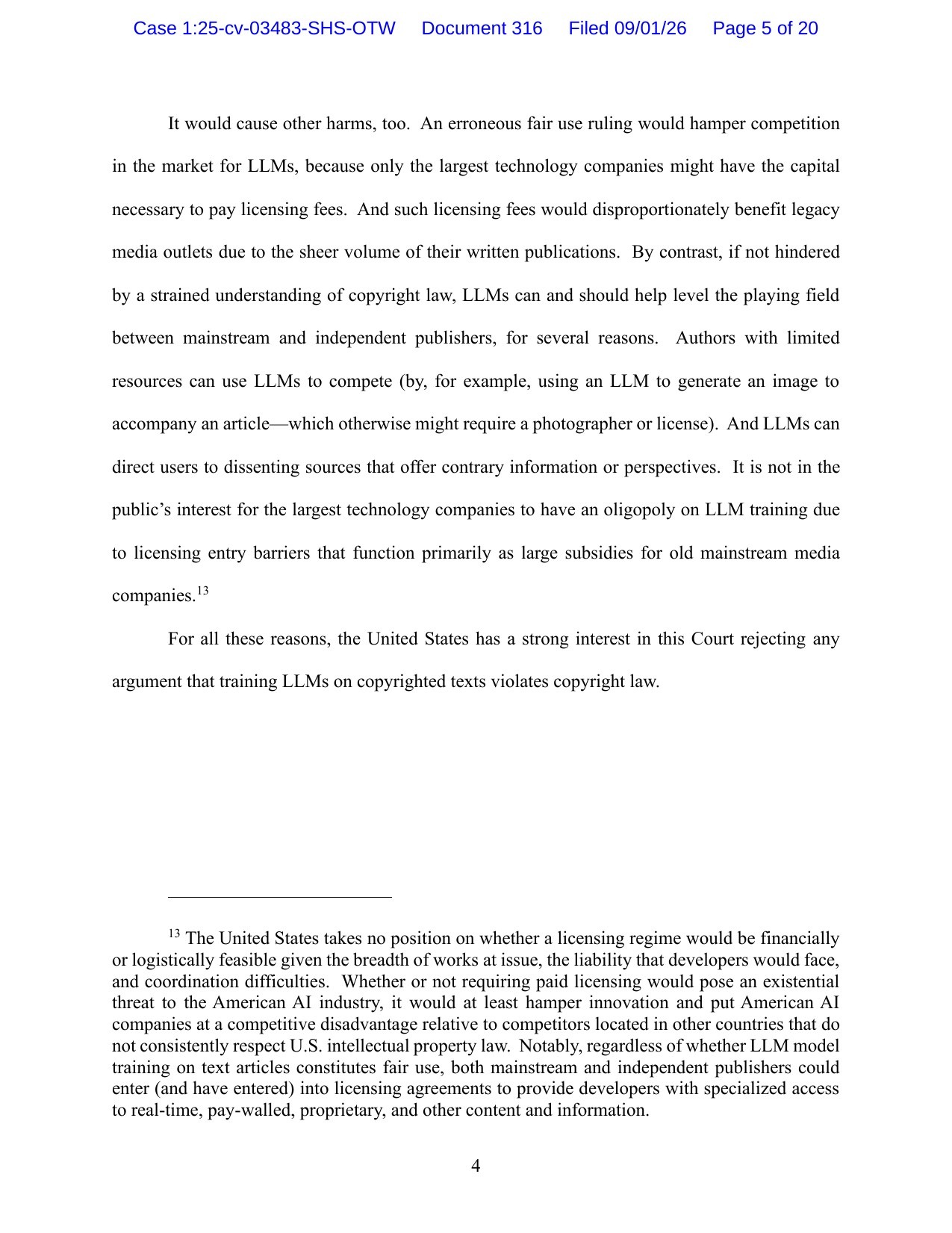
Page 5 of 20. Read or download the full filing (PDF), or view the official docket.
The sentence the Times is unlikely to print in its own coverage
Most of the brief runs standard doctrine, working through Campbell, Authors Guild v. Google and Google v. Oracle to argue that copying text to teach a model statistical patterns is "extraordinarily transformative." On page 4 the argument turns political in a way government briefs usually do not.
Requiring AI firms to license training data would leave only the biggest companies able to pay, the government says, and "such licensing fees would disproportionately benefit legacy media outlets due to the sheer volume of their written publications." Then: "It is not in the public's interest for the largest technology companies to have an oligopoly on LLM training due to licensing entry barriers that function primarily as large subsidies for old mainstream media companies."
The brief adds that models "can direct users to dissenting sources that offer contrary information or perspectives," and it proves the point with a live example. Footnote 20 cites the independent writer Andy Masley and the outlet Pirate Wires taking apart a July 2025 Times story about data centers draining a couple's water supply, noting the nearby data center was not yet operational. Main Justice used a small publication's takedown of a Times article as evidence in a federal filing.
What the Times actually pleaded
The operative pleading is the Third Amended Complaint of August 21, 2026. It alleges the models were built by "copying and using millions of The Times's copyrighted news articles," and that OpenAI and Microsoft "seek to free-ride on The Times's massive investment in its journalism."
Its numbers are specific. The Times says nytimes.com is the fifth-ranked domain in OpenAI's WebText corpus with 333,160 entries, and the most heavily represented proprietary source in a filtered slice of Common Crawl, behind only Wikipedia and a database of U.S. patents. It seeks "billions of dollars." Its third prayer for relief asks the court to order "destruction under 17 U.S.C. § 503(b) of all GPT or other LLM models and training sets that incorporate Times Works."
Times spokesman Graham James said the administration "is siding with a handful of trillion-dollar AI companies at the expense of the countless American creators whose work they stole."
The administration is overruling its own copyright office in writing
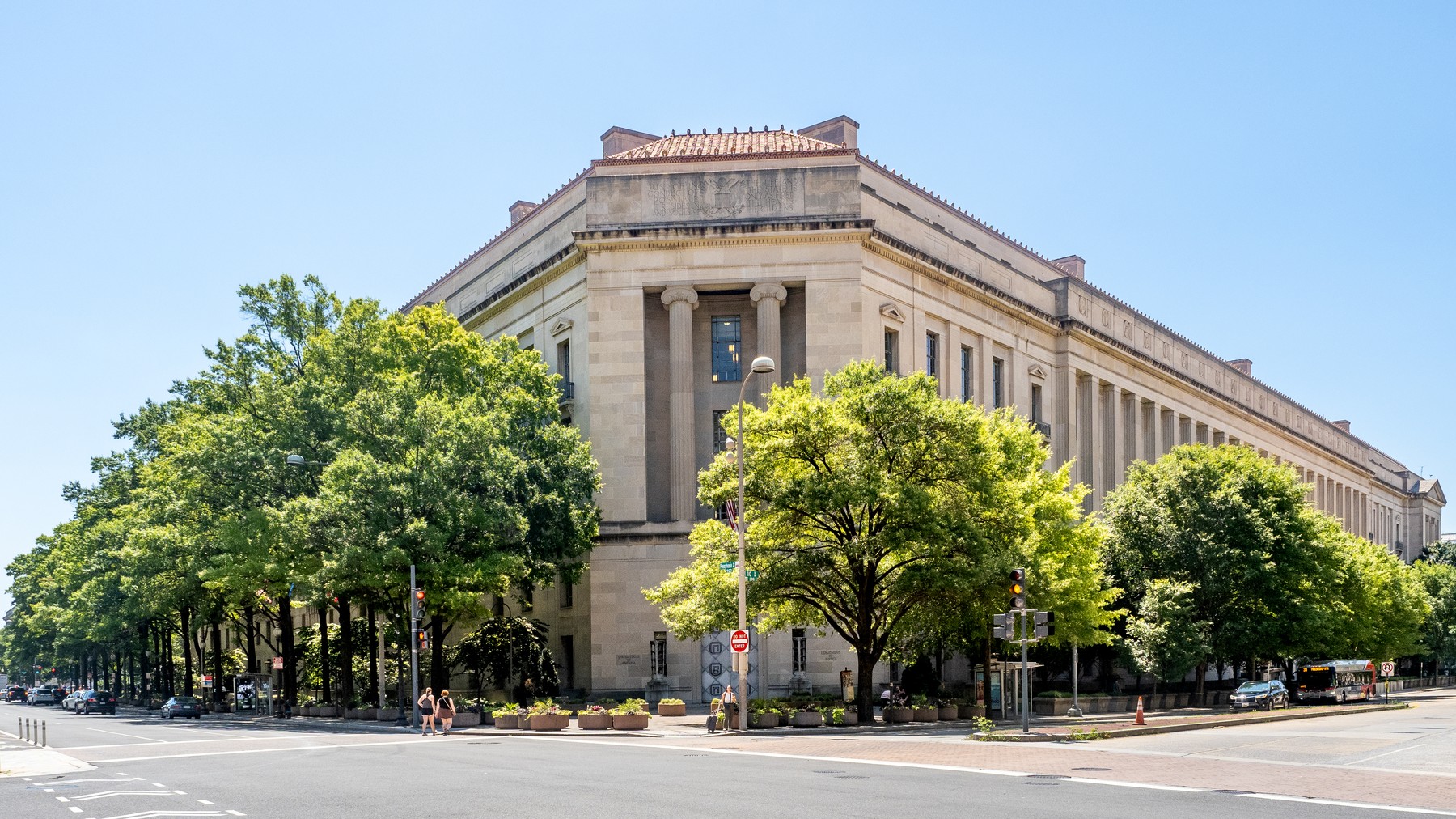
Main Justice on Pennsylvania Avenue. The filing came from the Associate Attorney General's office in Washington, not from the U.S. Attorney in Manhattan. (Photo by Ajay Suresh, Wikimedia Commons, CC BY 2.0)
On May 9, 2025, the Copyright Office released the pre-publication version of Part 3 of its AI report, concluding that "making commercial use of vast troves of copyrighted works to produce expressive content that competes with them in existing markets, especially where this is accomplished through illegal access, goes beyond established fair use boundaries." Register of Copyrights Shira Perlmutter was removed by email the next day.
Footnote 17 of Tuesday's brief disposes of her in a line: the Register "who is currently challenging her removal" endorsed a similar theory, and "her understanding does not warrant deference." Perlmutter is still in the job. The Supreme Court declined to disturb the injunction protecting her position on June 30, 2026.
The part conservatives should sit with rather than skip
A rule that strips the Times of a claim strips everyone of the same claim, and the practical result is easy to trace. In May 2024, News Corp signed an OpenAI licensing agreement reported at more than $250 million over five years, covering The Wall Street Journal, the New York Post and the rest of its titles. That is precisely the "large subsidy for old mainstream media" the Justice Department warned Judge Stein about, and it went to the newspaper group most identified with the political right in this country. The brief does not mention it.
The same company is on the other side of the argument elsewhere. NYP Holdings, which publishes the New York Post, is a plaintiff alongside Dow Jones in Dow Jones and Company, Inc. v. Perplexity AI, Inc., No. 1:24-cv-07984 (S.D.N.Y.), before Judge Katherine Polk Failla. Its first count is that Perplexity infringed by copying Post and Journal articles as inputs. The government's brief confines itself to the training stage and leaves output claims open, so it does not decide that case. It does reject the premise underneath the input count, which is that copying an article to build a machine is a taking at all.
Pirate Wires, the outlet the Justice Department held up as the beneficiary of all this, has no $250 million contract. Neither does any independent conservative site whose archive sits in the same scraped corpus as the Times.
Stein is not bound by any of it
A statement of interest carries no binding authority. Judge Stein decides fair use himself, and the case is deep into summary judgment briefing: a stipulated sealing order entered September 3 requires the parties to publicly refile their summary judgment briefs by September 17 and their reply briefs by November 19.
Adam Eisgrau of Chamber of Progress told NOTUS he could not recall the government ever telling a court this plainly how it felt about fair use, and that "if it's not unprecedented, it's darn unusual." Georgetown law professor Anupam Chander flagged the other complication in the same piece: Sam Altman floated a federal stake in OpenAI of around 5 percent in July, which would make Washington a shareholder in the company it just filed for.
There is real satisfaction in watching the Times lose an argument at a counter it helped build. Read the bill before the celebration. The Justice Department never said the Times is untrustworthy or that its work is worthless. It said written work, all of it, can be copied wholesale into a machine without permission or payment, and that the national interest requires exactly that. Whoever wins that argument wins it against every archive in the country, not only the one on Eighth Avenue.