Treasury Secretary Scott Bessent says the U.S.-China trade truce, set to expire November 10, now runs through January 10. He announced it minutes after Xi Jinping landed in Washington for his first state visit in more than a decade. Most coverage stopped at the new date. The executive order that actually holds the truce together shows a smaller problem for American farmers: China's pause on its own tariffs against U.S. farm goods ends December 31, ten days before the extended truce does.
Bessent Bought Two Months, Not a New Deal
Bessent broke the news in an interview on Fox News Channel on Wednesday evening, after an unscheduled meeting with Chinese Vice Premier He Lifeng. "We will extend what we call the 'Busan Agreement,' the economic détente between the two countries that was scheduled to end on Nov. 10, that is going to be extended until Jan. 10," he said, according to NBC News.
He was also candid about why the extension is short. "There are some deliverables that have not been perfect on the Chinese side," Bessent said, "so we also want to see, now that we've sat down and told them our expectations, if over the coming months they can be more fulsome in enacting the agreement." That is a Treasury Secretary saying on camera that Beijing has not fully paid what it owes.
Two months is a leash, and it is a shorter one than what was reportedly on the table. Farm Futures' September 23 market analysis noted media reports that the U.S. had proposed a six-month extension while China pushed for something longer. What came out was January 10. Earlier that day, Bessent told reporters that the Chinese had floated "the idea of a bigger deal" on Sunday, and that Washington was "fine with both" rolling the current arrangement or examining a larger one, Reuters reported.
President Trump and Xi Jinping lead their delegations at the October 30, 2025 bilateral meeting at Gimhae International Airport in Busan, South Korea, where the truce now being extended was struck. (Official White House Photo by Daniel Torok, public domain)
The Truce Date Is Written Into a Presidential Order
The "Busan Agreement" is not a treaty. On the American side it lives in Executive Order 14358, which Trump signed on November 4, 2025. The order doesn't even use Bessent's name for it. It calls the deal the "Kuala Lumpur Joint Arrangement," after the city where negotiators worked out the terms before the leaders met in Busan.
Section 2 of the order hard-codes the deadline. It says the heightened reciprocal tariff lines in the Harmonized Tariff Schedule "shall continue to be suspended until 12:01 a.m. eastern standard time on November 10, 2026." In other words, the truce date is in the text of the order, and moving it to January 10 takes a new or amended order. When we checked the Federal Register on Thursday morning, no amending order had been published. That doesn't make Bessent's announcement any less real. It means the new date so far exists only as an announcement.
Section 3(b) is the part worth remembering over the next two months: "Should the PRC fail to implement its commitments under the Arrangement, I may modify this order as necessary." The same order that grants the truce also gives Trump the power to pull it back. Bessent's "not perfect" remark is how you talk when you want the other side to know that clause exists.
Official record
Executive Order 14358 of November 4, 2025, "Modifying Reciprocal Tariff Rates Consistent With the Economic and Trade Arrangement Between the United States and the People's Republic of China," 90 Fed. Reg. 50729 (Nov. 7, 2025), Federal Register document 2025-19826. Page 2 shown below.
"And the PRC has committed to suspend or remove many retaliatory actions against the United States, including suspending tariffs on a vast swath of United States agricultural products until December 31, 2026, and extending the PRC's market-based tariff exclusion process for United States imports until November 10, 2026."
Executive Order 14358, Section 1
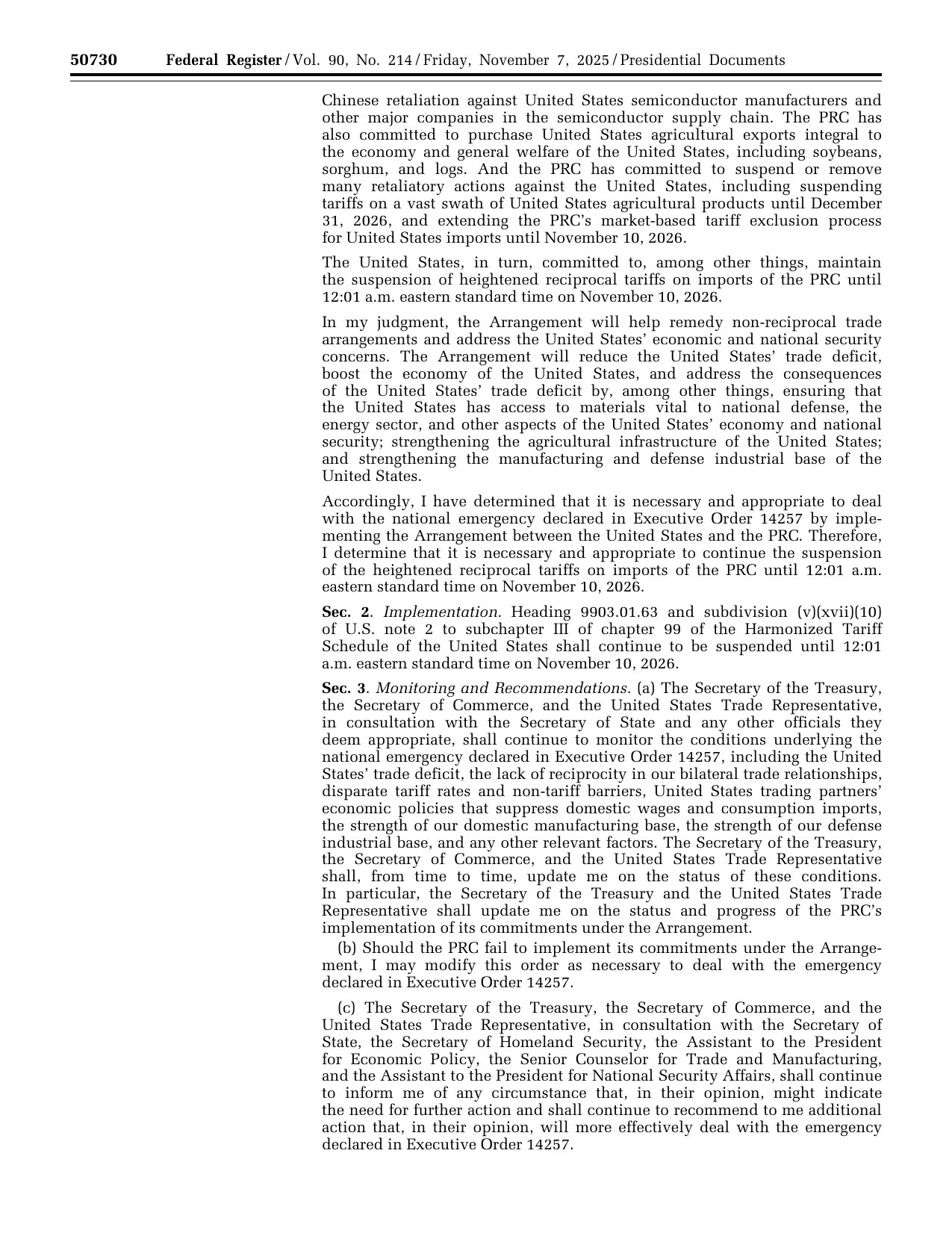
Read or download the full 3-page executive order (PDF) · official GovInfo copy
China's Farm-Tariff Pause Runs Out First
Read the rest of Section 1 and the calendar stops lining up. Under the arrangement, the order says, China committed to suspend its retaliatory tariffs on "a vast swath of United States agricultural products until December 31, 2026." Those are the tariffs Beijing slapped on American chicken, wheat, corn, cotton, sorghum, soybeans, pork, beef and dairy in 2025, as listed in the White House's own November 1, 2025 fact sheet.
So the American side now runs to January 10, but the Chinese side, as written, still ends December 31. Unless Beijing extends its own suspension too, American farm goods could face China's retaliatory duties again for the first ten days of 2027 while Washington is still honoring its half of the truce. Nothing reported so far says China has agreed to move its date. That is the question to ask when the leaders' statements come out.
There is a second date mismatch, this one between two official U.S. documents. The November 1 fact sheet said China's tariff exclusions for U.S. imports "will remain valid until December 31, 2026." The executive order signed three days later says China extended that exclusion process "until November 10, 2026." One of those is wrong. Either way, it is a Chinese commitment with an expiration date that no one has publicly said is being extended.
What Beijing Promised, and What It Has Delivered
The Busan terms were specific. China agreed to buy at least 12 million metric tons of U.S. soybeans in the last two months of 2025 and at least 25 million metric tons in each of 2026, 2027 and 2028, according to the November fact sheet. At the May summit in Beijing, the White House added more: its May 17 fact sheet says China will buy "at least $17 billion per year of U.S. agricultural products" on top of the soybeans, and that it "approved an initial purchase of 200 American-made Boeing aircraft."
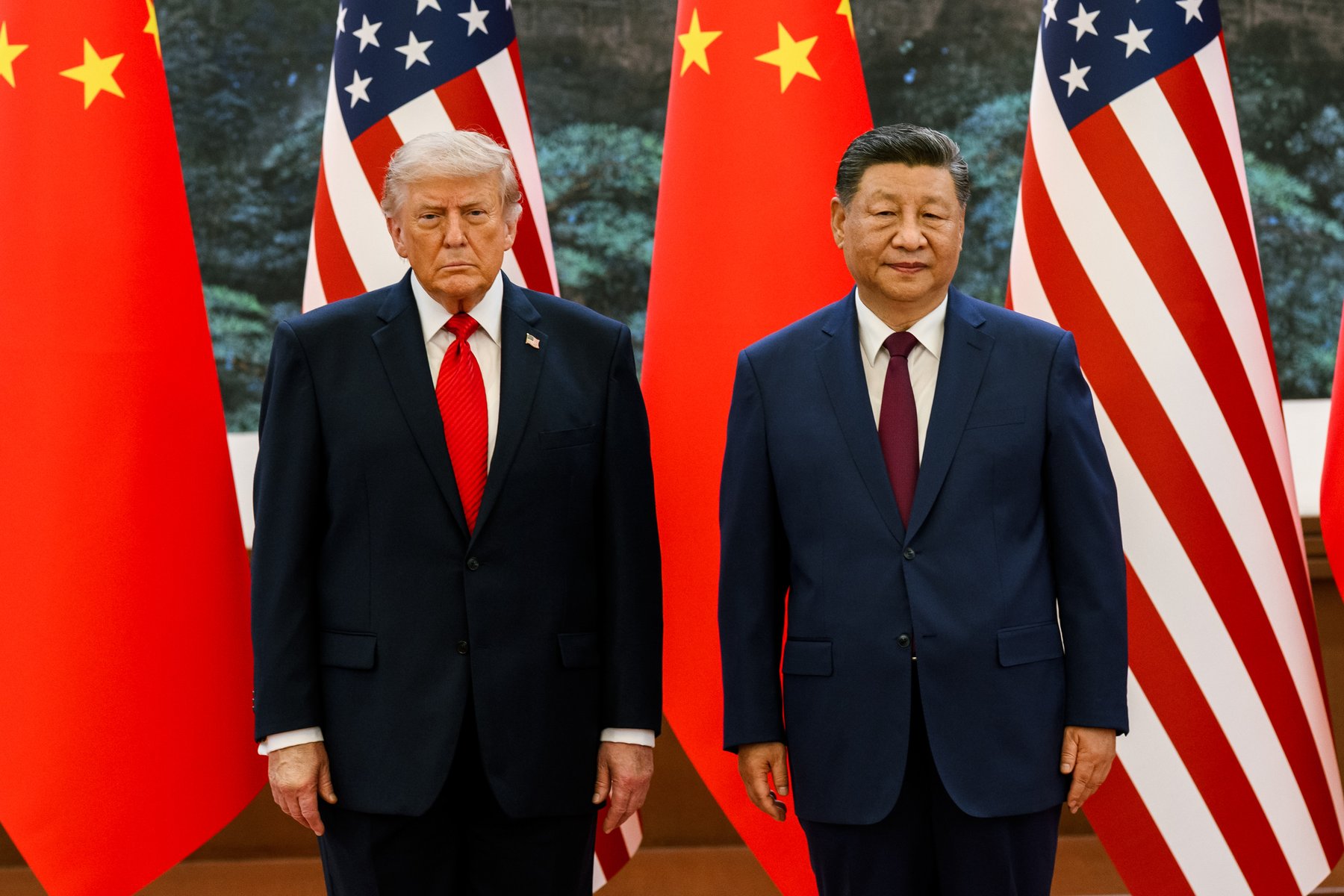
Trump and Xi at the welcome ceremony in the Great Hall of the People in Beijing on May 14, 2026, the summit that produced the $17 billion farm pledge and the 200-jet Boeing commitment. (Official White House Photo by Daniel Torok, public domain)
Soybeans are the one line that looks close to on track. Farm Futures reports China is "believed to be about halfway toward" the 25-million-ton target and bought extra cargoes in recent days as a goodwill gesture before the summit. The same analysis says there has been "little apparent follow-through" on the separate $17 billion farm pledge, and that Beijing "has yet to acknowledge either of those agreements" publicly.
Boeing is partly done. U.S. Trade Representative Jamieson Greer told Fox News on Monday, "There are about 140 that are in a good state. There are an additional 10 that are they're writing down the orders," Reuters reported. That leaves roughly 50 jets of the 200 with no status given. Boeing CEO Kelly Ortberg has said Chinese airlines will announce orders "at their pace." Rare earths, which the executive order itself ties to "materials vital to national defense," are behind. U.S. officials told reporters last week that China's delivery "has not been up to par," and Greer said Washington needs to keep up the pressure, per Reuters.
Why Farm Country Is Watching Thursday's Oval Office Meeting
The timing is rough for growers. Farm Futures says this fall's soybean crop is on track for a record above 4.5 billion bushels, and 12% of it was already harvested as of Sunday. November soybean futures were trading around $13.18 early Wednesday, propped up by hope that Xi will confirm the purchase pledge or even raise it.
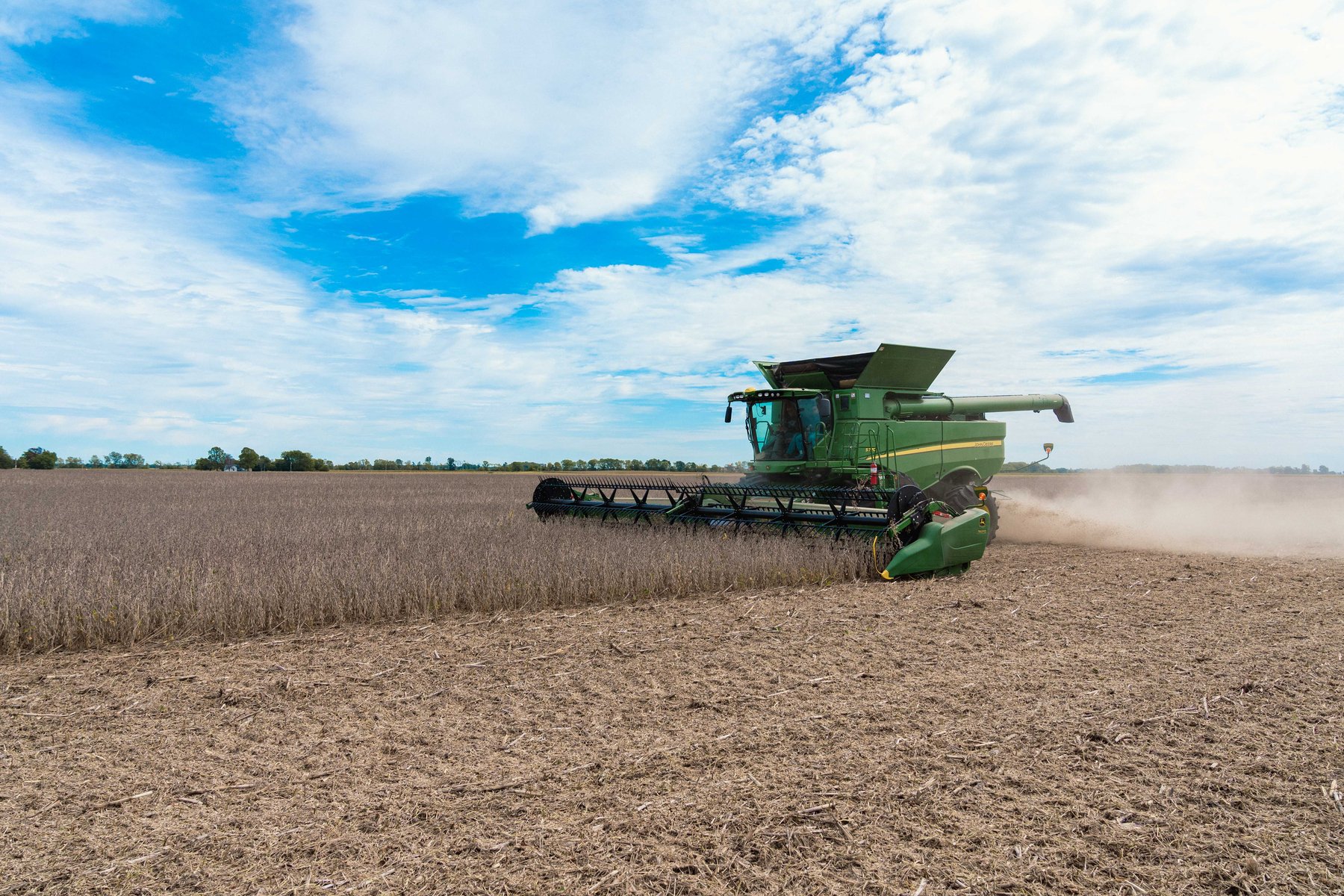
Indiana farmer Mike Starkey harvests soybeans in Brownsburg, Indiana, in a 2022 file photo. This year's U.S. crop is forecast at a record above 4.5 billion bushels, much of it bound for a Chinese market governed by the Busan truce. (USDA NRCS photo by Brandon O'Connor, public domain)
That hope is also the risk. The same Farm Futures analysis warned farmers to be wary of a "sell-the-news letdown" if the summit produces nothing new, and said a Chinese commitment on corn or wheat could spark a rally. Bessent has hinted that more is coming. NBC reported he said the Chinese delegation could make further announcements in the coming days, including more purchases of American farm products and possible financial-services deals.
The Pomp Is Real, and So Is the Leverage
Trump pulled out all the stops for this visit. He and First Lady Melania Trump met Xi and Madame Peng Liyuan at the foot of the aircraft stairs at Joint Base Andrews at 6:01 p.m. Wednesday. The Week, citing C-SPAN, reported it was the first time in 11 years a U.S. president had personally greeted a foreign leader there. The schedule includes an 11:30 a.m. Oval Office bilateral Thursday, an expanded Cabinet Room session at noon, a state dinner Trump said will draw "the entire tech world, the entire banking world," and a visit to the National Archives.
None of that changes the paper. The U.S. side of the truce is a single executive order with a date in Section 2 and an off-ramp in Section 3(b). By shortening the extension to two months, the administration kept its leverage close, which is the right call with a partner that has "not been perfect" on its promises. Taiwan remains the other shadow over the talks, as we reported last week, and Bessent has said Trump and Xi could meet as many as four times this year, with Shenzhen and Miami still ahead.
What to Watch Before January 10
First, the paperwork. An amended or new executive order moving the Section 2 date from November 10 to January 10 should appear in the Federal Register. Until it does, the extension is a spoken commitment. Second, Beijing's side of the calendar. If China doesn't push its farm-tariff suspension past December 31, American soybean, pork and beef exporters face a ten-day gap in which Washington is holding up its end and Beijing isn't.
Third, the scorecard. Roughly half of this year's soybean target, 140 of 200 Boeing jets in "a good state," no visible progress on $17 billion in other farm purchases, and rare earths that U.S. officials say are "not up to par." Trump gave Xi the red-carpet welcome. Now Beijing has until January 10 to show it will deliver what it promised.